12 Bible Verses About Hiding Money From Your Spouse
Explore 12 Bible verses about secret spending, hidden debt, financial honesty, confession, forgiveness, boundaries, and rebuilding trust in marriage.

A secret $40 purchase can become a bigger marriage problem than a $4,000 bill when the real damage is deception. The Bible never says married couples must use one bank account, but it says a great deal about truth, faithfulness, confession, wise stewardship, and repairing broken trust.
If you searched for Bible verses about hiding money from your spouse, you may already be dealing with something painful.
Maybe you found a credit card you did not know existed.
Maybe packages keep arriving that never appeared in the budget.
Maybe your spouse discovered the purchases you have been hiding.
Or perhaps the secret is much larger: unpaid taxes, gambling losses, loans, cash withdrawals, hidden savings, or thousands of dollars of debt.
This article is not going to tell you to simply “communicate better.”
First, you need to understand what happened. Then you need truth, numbers, boundaries, repentance where needed, forgiveness where possible, and a practical system that makes future secrecy harder.

Is Hiding Money From Your Spouse a Sin?
The Bible does not contain a command saying, “Husbands and wives must disclose every purchase.”
It also does not require every Christian couple to have joint checking accounts.
The biblical problem is deception.
Financial researchers use the term “financial infidelity” for money behavior someone expects a partner would disapprove of and then intentionally hides. Research published in the Journal of Consumer Research treats concealment as a central part of the problem.
That can include hiding debt, lying about what something cost, secretly opening credit cards, hiding income, moving money without agreement, or pretending a bill was paid when it was not.
But an important distinction is often missed.
Financial privacy is not automatically financial dishonesty.
A husband can have his own checking account. A wife can have personal spending money. Two spouses can maintain entirely separate finances.
If both know about the arrangement and agree to it, there is no deception.
The problem begins when information is deliberately hidden because telling the truth would reveal that an agreement has been broken.
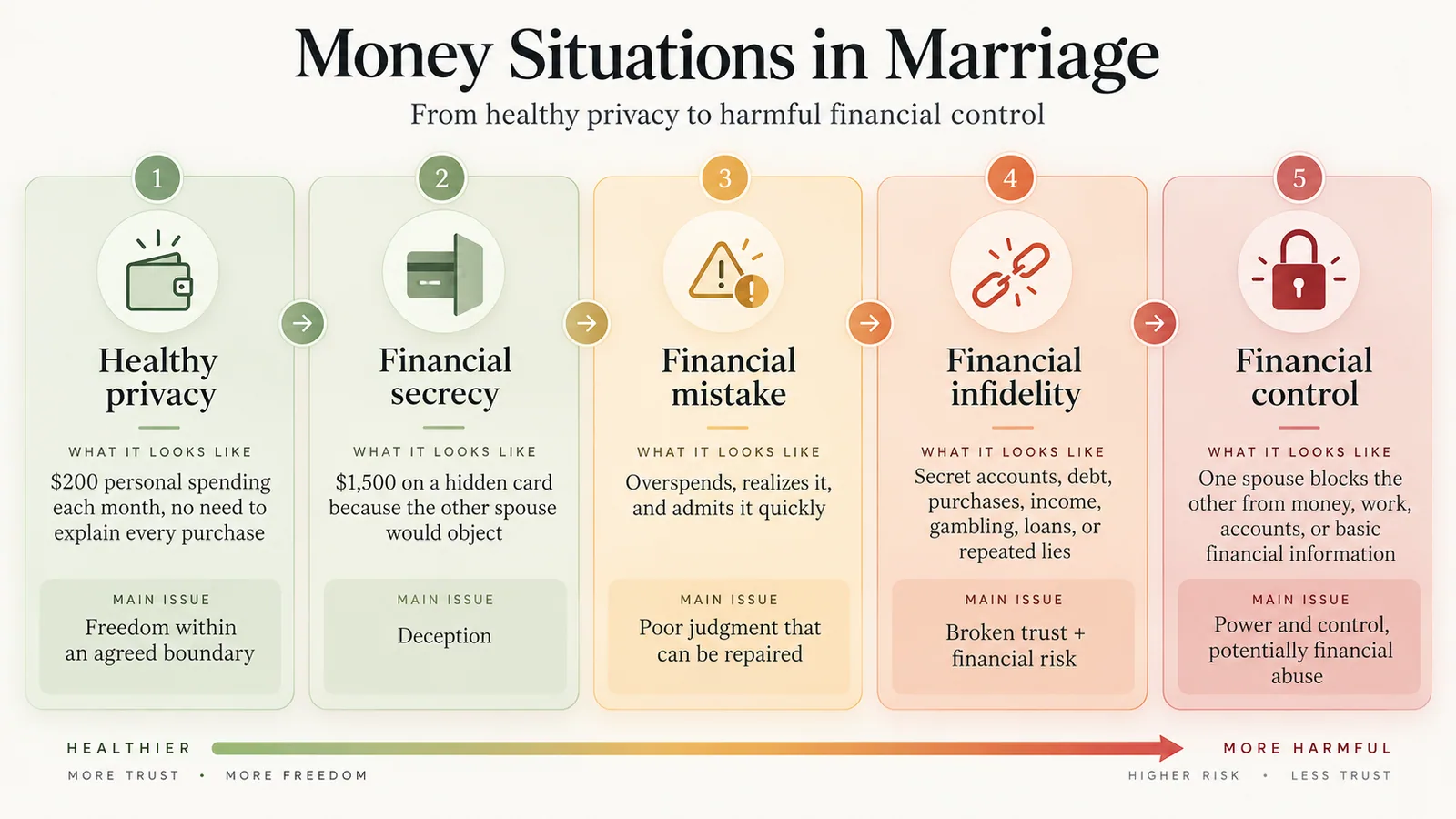
This distinction matters.
Someone should not use an article about honesty to demand access to every dollar their spouse spends or to justify controlling them.
Healthy marriage requires truth. It does not require surveillance.
If money arguments keep repeating even without secrecy, see these Bible verses for couples fighting about money.
Financial Secrecy Is More Common Than Many Couples Admit
Secret spending is not a rare marriage problem.
Bankrate reported in 2025 that 40% of U.S. adults who were married or living with a romantic partner said they had committed or were committing some form of financial infidelity with their current partner. Among the behaviors reported were spending more than a partner would approve of, secret debt, secret credit cards, and hidden checking or savings accounts.
Fidelity's 2026 Couples & Money Study found another warning sign: 49% of couples said they avoid financial conversations because they want to prevent arguments, while almost one in four admitted hiding a financial secret.
Avoiding the conversation may create temporary peace.
It does not create trust.
Older longitudinal research involving 4,574 couples also found that financial disagreements were stronger predictors of divorce than the other common disagreements studied. That does not mean one money fight causes divorce. It does show why repeated financial conflict deserves attention.
12 Bible Verses About Hiding Money From Your Spouse
These passages are not twelve ways to shame someone who made a financial mistake.
They address twelve different parts of the problem: truth, concealment, integrity, stewardship, partnership, confession, forgiveness, and rebuilding trust.
1. Ephesians 4:25 — Tell the Truth Before You Fix the Budget
Ephesians 4:25 tells believers to put away falsehood and speak truthfully.
That principle becomes very practical when money is hidden.
If there is a secret card with a $6,400 balance, making a clever repayment spreadsheet while claiming the balance is $2,000 does not fix the problem.
Truth comes first.
The first financial repair may therefore be simple and uncomfortable:
“The actual balance is $6,417. I have been hiding it. Here are the statements.”
You cannot build an accurate budget around inaccurate information.
2. Proverbs 28:13 — Concealing the Problem Keeps It Alive
Proverbs 28:13 contrasts hiding wrongdoing with confessing and turning away from it.
Notice both parts.
Confession matters. Change matters too.
“I am sorry” is important, but if the secret card stays active, statements remain hidden, passwords keep changing, and spending continues, nothing important has changed.
Real repentance should eventually become visible in behavior.
That might mean closing an unnecessary account, showing the real balances, stopping new borrowing, returning purchases, or agreeing on a spending limit.
3. Colossians 3:9 — A Half-Truth Can Still Be a Money Lie
Colossians 3:9 tells believers not to lie to one another.
Financial dishonesty is not limited to saying something completely false.
Imagine your spouse asks:
“How much did the trip cost?”
You answer, “The hotel was $600.”
That may be technically true.
But if you leave out another $900 for airfare, restaurants, shopping, and a rental car because you want your spouse to believe the whole trip cost $600, the problem remains deception.
Honesty answers the question the other person reasonably thinks is being answered.
4. Luke 16:10 — Small Hidden Purchases Can Create a Large Trust Problem
Luke 16:10 connects faithfulness in small things with faithfulness in larger things.
That is especially useful for couples who dismiss secret spending because the amount was small.
A hidden $18 purchase will not normally destroy a household budget.
But twenty hidden purchases can create a pattern.
The spouse who discovers them may start wondering, “If this was hidden, what else do I not know?”
That is why the dollar amount and the trust damage are not always equal.
Real-world pattern: “It was only $35”
Picture a couple who agreed to cut optional spending while paying medical bills.
One spouse keeps making $20 to $40 purchases and deleting the notifications.
When discovered, the defense is, “It was only $35.”
But the argument is no longer about $35.
The other spouse thought both people were sacrificing. Now they feel they were following rules that only applied to one person.
The practical solution is not checking every receipt forever. It is creating a reasonable personal-spending amount that both spouses can use without asking permission.
5. Proverbs 11:3 — Integrity Works When Nobody Is Checking
Proverbs 11:3 connects integrity with guidance.
Integrity is what happens when your spouse is not looking at the banking app.
A healthy financial system should not require one spouse to become the other's detective.
If trust depends on surprise phone inspections, constant receipt checks, or monitoring every location, the couple may have stopped the behavior without actually rebuilding the relationship.
Accountability can be useful for a season.
Permanent policing is different.
The goal is to become trustworthy, not merely harder to catch.

6. 2 Corinthians 8:21 — Financial Integrity Should Be Verifiable
In 2 Corinthians 8:21, Paul emphasizes doing what is honorable not only before God but also before people.
The immediate context involves careful handling of collected money. The broader principle is useful: good intentions should be matched by trustworthy practices.
After financial deception, reasonable transparency may be part of repair.
For example, both spouses might review every debt balance together once a month for six months.
That is not punishment.
It is verification while trust heals.
7. Philippians 2:4 — Your Purchase Affects More Than You
Philippians 2:4 calls Christians to consider the interests of others, not only their own.
Marriage makes this painfully practical.
A $900 purchase may be affordable if you look only at your checking balance.
It may not be affordable when that same money was supposed to cover rent, childcare, a car repair, taxes, or a joint debt payment.
Before a major purchase, ask:
“What does spending this money remove from our other goals?”
That question changes impulsive spending into household stewardship.
8. Ecclesiastes 4:9–10 — Marriage Is Financial Partnership, Not Financial Surveillance
Ecclesiastes 4 describes the strength of two people helping one another.
That picture works better for marriage finances than one spouse acting like the parent and the other like a child.
One person may naturally be better with spreadsheets.
That does not mean the other person should know nothing about the household finances.
Both spouses should normally be able to answer basic questions such as what accounts exist, how much major debt exists, what the essential monthly bills are, and where important financial records can be found.
Partnership requires access to reality.
For help having these conversations without turning them into accusations, use these relationship verses for hard conversations.
9. Luke 14:28 — Count the Real Cost Before Spending
Jesus uses the example of someone calculating the cost before starting a building project in Luke 14:28.
The passage is about discipleship, not household budgeting. But the picture gives us a useful wisdom principle: count the cost before making a commitment.
Credit makes this easy to ignore.
A $1,000 purchase charged at a high interest rate does not cost only $1,000 if the balance remains unpaid.
The same applies to buy-now-pay-later plans.
Four “small” payments can become twelve overlapping payments from several purchases.
Before borrowing, write down the total amount owed, payment amount, interest or fees, and payoff date.
If you would be uncomfortable showing those numbers to your spouse, stop before clicking “buy.”
10. James 5:16 — Confession Should Be Specific
James 5:16 connects confession with healing.
Specific confession is much more useful than vague confession.
“I haven't been great with money” tells your spouse almost nothing.
A meaningful financial confession sounds more like this:
“I opened a card eight months ago. The balance is $4,850. I also owe $700 through installment-payment apps. I missed one payment last month. There are no other debts that I know of.”
Facts give the other person something solid to work with.
Do not make your spouse discover the truth in installments.
Each new surprise resets trust.
Real-world problem: The disclosure that keeps getting bigger
This is sometimes called “trickle truth.”
A spouse first admits to $2,000.
Two days later it becomes $4,000.
The next week another card appears.
Even when each confession is technically truthful, repeated partial disclosure makes the other spouse wonder whether the final number has arrived.
A better approach is to pause, gather statements, review your credit information where available, list every account, and disclose the complete picture at once.
If hidden debt is part of the problem, this guide to Bible verses for paying off debt and building a practical payoff plan can help with the next stage.
11. Ephesians 4:32 — Forgiveness Does Not Mean Pretending Nothing Happened
Ephesians 4:32 calls Christians toward kindness, compassion, and forgiveness.
But forgiveness is often misunderstood in marriage.
Forgiving hidden debt does not require immediately restoring every old financial privilege.
You can forgive someone and still say:
“For the next six months, we need to discuss new credit before either of us opens an account.”
Forgiveness deals with the offense.
Trust deals with confidence about future behavior.
Forgiveness can be offered before trust is fully restored. Trust usually grows through repeated evidence.
For a deeper treatment of that difference, read about biblical forgiveness and relational repair after broken trust.
12. 1 Corinthians 13:6 — Love Does Not Need Deception to Survive
First Corinthians 13:6 says love rejoices with truth.
That creates a useful test for financial decisions.
Ask:
“Would this decision still work if my spouse knew the full truth?”
If the purchase, account, loan, or transfer depends on hiding the receipt, deleting the email, intercepting the mail, changing a password, or lying about the price, the secrecy itself is warning you that something needs attention.
Truth may create a difficult conversation today.
Deception usually creates a more difficult one later.
Three Different Money Problems That Should Not Be Treated the Same
One of the biggest weaknesses in advice about secret spending is that every situation gets the same prescription.
“Tell your spouse everything.”
Sometimes that is right.
Sometimes it is dangerously incomplete.
Problem 1: Impulsive Spending and Shame
Suppose Sarah overspends when stressed.
She begins hiding clothing purchases because she feels ashamed. Eventually she opens a store card so the purchases will not appear on the main account.
This needs honesty, but it also needs a system.
Sarah and her spouse might create equal personal spending amounts, remove stored cards from shopping apps, add a 24-hour waiting rule for nonessential purchases over a chosen amount, and schedule a weekly ten-minute account review.
Shame alone rarely creates better habits.
Structure does.
Problem 2: Serious Hidden Debt
Suppose Marcus reveals that he has several credit cards his wife did not know about.
The immediate temptation is to spend the first three hours arguing about why.
That question matters, but first protect the household.
Write down every lender, balance, interest rate, minimum payment, due date, overdue amount, and account owner.
Then check whether essentials such as housing, utilities, food, insurance, taxes, and transportation are at risk.
The couple can deal with motives after they know whether next month's rent is safe.
Problem 3: Financial Control or Abuse
Now imagine a spouse who controls every account, refuses to let their partner work, gives them a tiny “allowance,” monitors each purchase, threatens them when money is spent, hides family assets, or deliberately creates debt in the other person's name.
That is different.
The National Network to End Domestic Violence describes financial abuse as using money and economic resources as tools of power and control. Examples can include restricting access to money, interfering with employment, stealing resources, and damaging a partner's credit.
In that situation, “total financial transparency” can be dangerous advice.
A person saving emergency money in order to leave an abusive situation should not be shamed with Bible verses about secrecy or pressured to disclose information that could increase their danger.
Biblical marriage is not financial domination. This discussion of what biblical submission really means explains why Scripture should not be used to silence or control a spouse.

What to Do If You Have Been Hiding Money From Your Spouse
Do not start by promising, “I will never do it again.”
Start by making the truth complete.
Gather the numbers before the conversation: bank accounts, credit cards, installment plans, loans, overdue bills, subscriptions, tax obligations, hidden cash, and any purchases you are still paying for.
Then explain three things clearly: what you did, what it currently costs, and what you are willing to change.
Avoid blaming your spouse for the deception.
“My husband gets angry about spending” may explain why you feared the conversation. It does not automatically justify secretly borrowing thousands of dollars.
At the same time, if you hid money because you are afraid of violence, coercion, retaliation, or losing access to basic necessities, treat that as a safety issue rather than an ordinary budgeting disagreement.
What to Do If You Discover Secret Spending or Hidden Debt
Your first question will probably be “Why?”
Your first practical question should be “How large is the problem?”
Do not destroy cards, empty accounts, threaten divorce, or make major decisions during the first ten minutes unless immediate safety requires action.
Get the facts.
Find out whether there are overdue bills, joint liabilities, missed payments, tax problems, loans secured against shared property, or accounts you did not know existed.
A financial professional may be appropriate when the numbers are complicated. A qualified marriage therapist or financial therapist may help when secrecy has become a repeated pattern.
And remember that discovering deception does not obligate you to instantly trust the person again.
Rebuilding trust is a process, not a switch.
A Practical 30-Day Trust-Rebuilding Plan
The goal is not to spend the next thirty days discussing money every night.
The goal is to replace uncertainty with evidence.
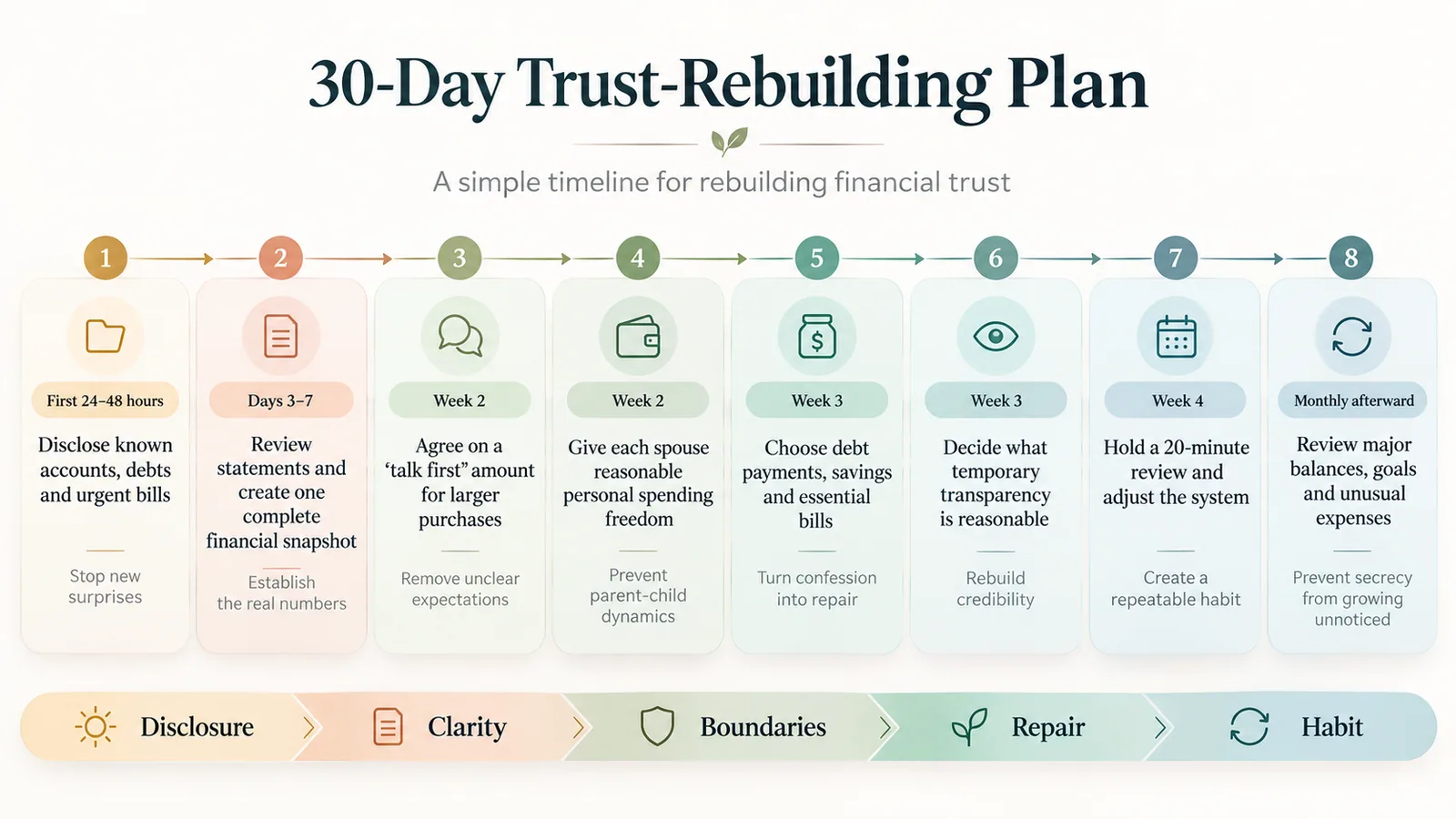
The “talk first” amount should fit your household.
For one couple it might be $50.
For another it could be $500.
The number matters less than having a rule that applies equally to both spouses.
The Trust Test: Ask These Three Questions Before a Purchase
A useful financial honesty test is simple.
Would I make this purchase if my spouse were standing beside me?
Does it violate an agreement we already made?
Am I planning to hide any part of it afterward?
A “yes” to the third question deserves attention.
The problem may be the purchase.
It may also be that your financial agreement is unrealistic and needs to change.
Couples need boundaries they can actually live with.
Real-World Expertise: Why “Just Combine Your Accounts” Is Not Enough
Joint accounts do not create honesty.
Separate accounts do not create dishonesty.
A person can hide money while using a joint-account system. Another couple can use three separate accounts and be completely transparent.
Fidelity's 2026 research even notes that fully joint accounts are no longer the norm for every generation. The stronger question is whether both partners understand the household's financial reality and have agreed on the system.
Financial professionals also see much larger forms of secrecy than hidden shopping.
A certified divorce financial analyst quoted by Bankrate described cases involving secret home-equity borrowing and other hidden financial activity.
That is why a marriage money system should be built around visibility of important risks, not visibility of every cup of coffee.

How Much Financial Privacy Should Married Couples Have?
Enough to remain adults.
Not enough to secretly endanger shared responsibilities.
A spouse should not normally need approval to buy lunch, replace basic toiletries, or use agreed personal spending money.
But taking out a $15,000 loan without telling the person who shares your mortgage is very different.
A healthy system often has three layers: shared obligations, shared goals, and personal freedom.
Shared obligations need high transparency.
Shared goals need regular discussion.
Personal money can have much more privacy once both spouses agree on the amount and rules.
That balance protects both trust and dignity.
When Should a Couple Get Outside Help?
Consider outside help when the same deception keeps happening, the debt is too complicated to understand, one spouse cannot safely discuss money, or conversations quickly become threatening or destructive.
Different problems need different expertise.
A financial planner, credit counselor, CPA, attorney, marriage therapist, financial therapist, pastor, or domestic-violence advocate does not serve the same role.
Choose the person who fits the problem.
A pastor can offer spiritual care.
A qualified financial professional can help untangle balances, taxes, cash flow, or debt.
A licensed therapist can help address compulsive behavior, shame, repeated lying, or broken relational trust.
And where coercion or abuse is present, safety-focused professional help should come before an ordinary couples budgeting session.
Frequently Asked Questions
What does the Bible say about hiding money from your spouse?
The Bible does not specifically prohibit private bank accounts between spouses. It repeatedly condemns lying and promotes truthfulness, faithfulness, integrity, confession, wise stewardship, and concern for others.
The central question is therefore not “Is the account separate?” It is “Is important financial information being intentionally concealed in violation of the trust or agreements of the marriage?”
Is secret spending financial infidelity?
It can be.
Researchers commonly describe financial infidelity as engaging in money behavior that you expect your partner would disapprove of and intentionally failing to disclose it.
A forgotten $12 purchase is not the same as deliberately hiding $12,000 of credit-card debt.
Intent, pattern, financial impact, and broken agreements all matter.
Is it wrong to have a bank account your spouse cannot access?
Not automatically.
Some healthy couples maintain separate accounts by agreement.
A separate account becomes a trust problem when its existence, purpose, balance, or activity is intentionally concealed in a way that violates the couple's agreements or places shared finances at risk.
Should married couples tell each other about every purchase?
Not necessarily.
Couples can agree on personal spending that does not require discussion.
A practical system might say that bills, debt payments, savings, and giving happen first. Each spouse then receives an agreed amount of personal spending money.
This provides transparency without micromanagement.
What if my spouse keeps hiding purchases?
Stop arguing about individual receipts and address the pattern.
Ask for a complete financial picture, agree on clear spending boundaries, and create scheduled reviews.
If deception continues after repeated agreements, consider professional marriage or financial counseling. The issue has moved beyond ordinary budgeting.
What if my spouse secretly opened a credit card?
Find the balance, account ownership, interest rate, minimum payment, payment history, and whether any other undisclosed debts exist.
Do not focus only on closing the card. You also need to understand why it was hidden and what system will prevent another hidden account.
If significant debt is involved, create a written repayment plan rather than relying on verbal promises.
Do I have to forgive financial infidelity immediately?
Christian forgiveness does not require pretending that trust was never broken.
You can pursue forgiveness while still requiring honesty, boundaries, financial disclosure, counseling, or demonstrated change.
Grace and accountability can exist at the same time.
How long does it take to rebuild financial trust?
There is no biblical thirty-day deadline.
Trust grows when truthful behavior continues long enough to become credible.
A spouse who hid debt for three years should not expect one emotional conversation to erase three years of secrecy.
Consistent statements, kept agreements, regular discussions, and no new surprises are much stronger than repeated promises.
What if I am hiding money because my spouse controls everything?
That deserves a different response.
If your spouse restricts your access to money, prevents you from working, creates debt in your name, threatens you over spending, or uses finances to trap you, the issue may involve financial or economic abuse rather than normal disagreement.
Do not put yourself in greater danger merely to satisfy a blanket rule about disclosure.
Seek confidential, safety-focused help appropriate to where you live.
Can a Christian marriage recover from hidden debt or secret spending?
Yes, many couples can repair financial trust, but recovery normally requires more than forgiveness language.
The person who hid the money must become truthful.
The other spouse needs room to process the betrayal.
Both need a workable financial system.
And the household needs evidence that the damaging behavior has actually changed.
The Bottom Line
The most useful Bible verses about hiding money from your spouse do more than say, “Do not lie.”
They show a path.
Tell the truth.
Stop concealing the problem.
Count the real cost.
Consider how your choices affect your spouse.
Confess specifically.
Change the behavior that created the secrecy.
Offer forgiveness without confusing forgiveness with instant trust.
Then build a financial system where neither spouse needs to hide ordinary purchases and neither spouse can quietly create a financial crisis.
Money honesty in marriage does not mean surrendering every inch of privacy.
It means your spouse should not have to discover the truth about your shared financial life by accident.
That is the difference between privacy and deception.
And it is where real trust begins.
Key Statistics
Financial infidelity among partnered adults
40%
Among U.S. adults who were married, in a civil partnership, or living with a romantic partner, 40% said they were currently committing or had committed financial infidelity against their current partner.
Source: Bankrate 2025 Financial Infidelity Survey
Secret or disapproved overspending
33%
Spending more than a spouse or partner would approve of was the most commonly reported form of financial infidelity in Bankrate’s survey.
Source: Bankrate 2025 Financial Infidelity Survey
Credible Sources
Bankrate · January 27, 2025
Current consumer survey supporting the article’s 40% financial-infidelity statistic and providing specific figures for overspending, secret debt, secret cards, and hidden accounts. The survey included 1,089 partnered adults and was conducted by YouGov.
Fidelity Investments · May 19, 2026
Primary source for the article’s 49% money-conversation avoidance figure, “almost 1 in 4” financial-secret figure, and current evidence about joint versus separate finances. The study surveyed 3,193 married or partnered U.S. adults.

About the Author
Editorial Team
Editorial Team
Daily Faith Path articles are prepared by the editorial team to help readers find scripture-centered guidance for healing, faith, prayer, and spiritual encouragement.
Expertise: Healing scriptures, Bible study resources, prayer guidance, devotional writing, Christian encouragement
Experience: The team researches scripture references, reviews surrounding biblical context, compares translation wording where useful, and updates articles to improve clarity, usefulness, and trust for readers.
Credentials: Editorial review, devotional writing, scripture study, content updating
This article is published by the Daily Faith Path editorial team to help readers use scripture carefully, prayerfully, and in ways that are practical for real-life seasons of illness, grief, waiting, and spiritual reflection.
Continue Reading
Related articles

October 6, 2026
15 Bible Verses for Couples Who Keep Fighting About Money
Money fights are rarely just about dollars. These 15 Bible verses help couples address spending, saving, debt, secrecy, unequal income, giving, and financial control with practical next steps and conversation questions.

October 5, 2026
Should You Tithe While in Debt? 11 Bible Passages to Study First
Should you tithe while in debt? Explore 11 Bible passages on tithing, debt, generosity, family responsibility, and giving according to your means—plus a practical plan for deciding what to do.

October 2, 2026
Broke but Not Hopeless: 15 Bible Verses for a Zero-Balance Season
When your bank balance is close to zero, Scripture can offer hope without pretending financial hardship is simple. These 15 Bible verses address food, rent, debt, anxiety, hard decisions, and accepting help, alongside practical steps for getting through the next 24 hours.