Broke but Not Hopeless: 15 Bible Verses for a Zero-Balance Season
When your bank balance is close to zero, Scripture can offer hope without pretending financial hardship is simple. These 15 Bible verses address food, rent, debt, anxiety, hard decisions, and accepting help, alongside practical steps for getting through the next 24 hours.

If your bank balance is $4.17 and rent is due, “God will provide” can sound comforting for five minutes and confusing for the next five days. These Bible verses about money when you are broke offer something more useful: truth for the fear, practical steps for the next 24 hours, and hope without pretending the Bible promises a surprise deposit.
Being broke is not a small problem when groceries are low, your card is declining, or you are deciding which bill will have to wait.
The Bible does speak about those moments. But biblical provision is not the same as guaranteed financial abundance.
Sometimes provision looks like a paycheck. Sometimes it looks like a food pantry, a friend buying groceries, a payment plan, a cheaper apartment, a temporary job, a church benevolence fund, or wisdom to make one hard decision without making the situation worse.

First, Being Broke Is More Common Than It Looks
Financial trouble can feel private because people usually do not post their overdue electric bill on Instagram.
But many households are living much closer to zero than their outside appearance suggests.
The Federal Reserve reported that in 2025, only 63% of U.S. adults said they could cover a $400 emergency completely with cash or its equivalent. That means 37% could not. Twelve percent said they could not cover the $400 expense by any method.
Eighteen percent said the largest emergency expense they could handle using savings alone was less than $100. Twenty-six percent reported skipping medical expenses because of cost during the previous year.
Food pressure is real too. The USDA reported that 13.7% of U.S. households experienced food insecurity at some point during 2024, including 5.4% experiencing very low food security.
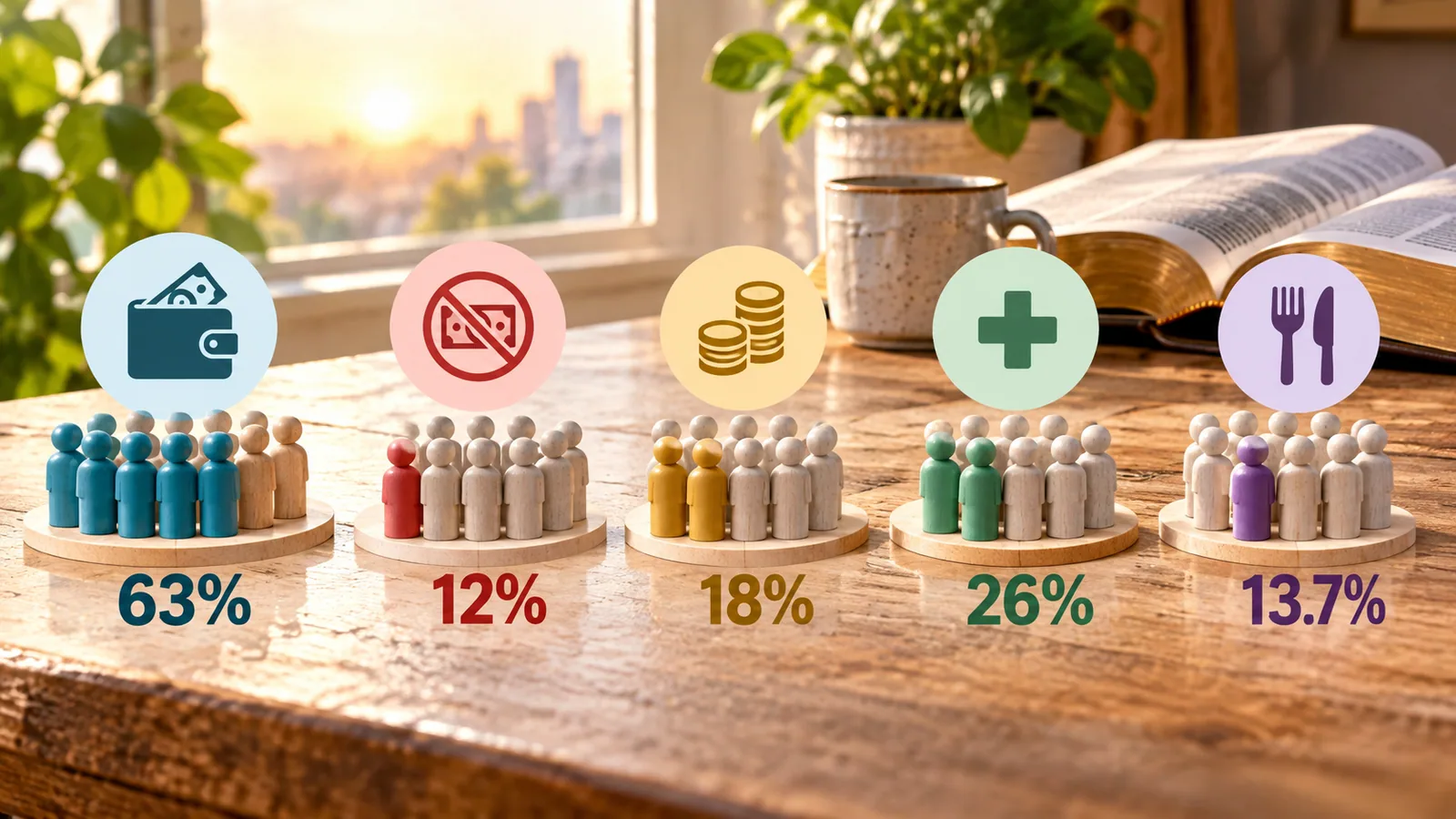
The point is not that statistics fix your situation.
The point is that an empty account does not make you uniquely defective, lazy, or spiritually inferior.
What the Bible Does — and Does Not — Promise About Money
Scripture repeatedly presents God as caring about food, clothing, debt, work, generosity, justice, anxiety, and people who have little.
It does not give every Christian a promise of a high income, a debt-free life, a house, or a financial breakthrough by a certain date.
That distinction matters.
Philippians 4:19 says God supplies needs. Paul also says in the same chapter that he knew what it was like to have plenty and to be in need.
Matthew 6 says your Father knows you need food and clothing. Jesus does not say believers will never face a frightening month.
Romans 8 even names famine and nakedness among forms of suffering Christians may encounter. The promise is that such suffering cannot separate them from Christ's love.
If you want a wider explanation of this distinction, read God’s promises about provision.
Biblical hope is stronger than “you will get rich.”
It says your bank balance is not your worth, your hardship is not invisible to God, you can ask for help, and you still have responsible steps available even when none of the choices feel good.
15 Bible Verses About Money When You Are Broke

Bible Verses for Food, Rent, and Basic-Needs Anxiety
1. Matthew 6:31–34 — When You Are Scared About Food and Tomorrow
Jesus names basic needs directly: what you will eat, drink, and wear.
That matters because sometimes Christians speak about money anxiety as though worrying about groceries is shallow. Jesus did not treat food anxiety as imaginary.
He tells his followers not to drag tomorrow's trouble into today.
That does not mean ignore next month's rent. It means do not try to financially survive the next six months at 2 a.m. tonight.
Real-life use: If you have $73 until Friday, work on the problem between now and Friday first. What food is already in the house? What transportation is essential? Which bill has an immediate consequence?
For a longer plan when several payments are already competing for the same money, see what to do when the bills keep piling up.
2. Philippians 4:19 — When You Need Provision, Not a Luxury
“My God shall supply all your need...” is one of the best-known verses about financial trouble.
Notice the word need.
The verse is not a blank check for every amount you want. Paul himself knew both abundance and shortage.
Provision may arrive through ordinary channels.
A payment extension can be provision. So can unemployment benefits, a bag of groceries, temporary work, a relative's spare room, reduced expenses, childcare help, or someone giving you a ride.
Do not reject help because it does not look supernatural enough.
3. Psalm 23:1 — When Scarcity Makes You Feel Alone
“The Lord is my shepherd...” describes relationship before resources.
A shepherd guides, protects, leads, and provides what the sheep actually need.
Psalm 23 is not a promise that Christians will always have extra cash.
It is a reminder that scarcity does not make you shepherdless.
Your prayer can become very specific: “Show me where to go next. Show me what I need today. Keep fear from leading me somewhere foolish.”
4. Proverbs 30:8–9 — When You Just Want Enough
This is one of the most useful money prayers in the Bible because it asks for neither poverty nor riches.
It asks for necessary food.
That is a very different message from “If you have enough faith, you will become wealthy.”
There are seasons when “enough” is a holy financial goal.
Enough groceries. Enough rent. Enough fuel to work. Enough stability to stop the next crisis from starting.
5. 1 Timothy 6:6–8 — When Comparison Makes Being Broke Worse
Paul connects contentment with basic needs such as food and clothing.
Contentment does not mean pretending an unsafe financial situation is fine.
It means refusing to make someone else's lifestyle the number you must reach before your life has value.
If you are already struggling, comparison adds a second bill you can never pay.
Bible Verses for Shame and Money Anxiety
6. Hebrews 13:5–6 — When Money Feels Like the Only Thing Keeping You Safe
Money can solve many real problems.
That is why losing it feels frightening.
But money cannot promise that nothing bad will ever happen. Hebrews directs security toward God's presence: “I will never leave thee, nor forsake thee.”
You can want more financial stability without asking money to become your god.
7. 1 Peter 5:7 — When the Numbers Will Not Leave Your Head
“Casting all your care upon him...” is not permission to ignore the bank account.
It is permission to stop carrying the emotional weight as though you must control every possible outcome.
Name the exact worry.
Not: “My whole life is falling apart.”
Try: “I am $310 short for rent, and it is due Monday.”
The second sentence still describes a serious problem. But it gives you something you can pray about, communicate clearly, and act on.
If financial fear is keeping you awake, these Bible verses for money anxiety focus specifically on those nighttime loops.
Bible Verses for Hard Money Decisions
8. James 1:5 — When Every Choice Looks Bad
Sometimes being broke means choosing between bad options.
Pay the electricity or the car? Buy medicine or make the full credit-card minimum? Take an extra shift or stay home because childcare costs almost as much as the shift pays?
James says to ask God for wisdom.
Wisdom is different from wishing.
Pray, then get the facts. Check the deadlines. Ask what happens if you pay late. Call the company. Find out whether assistance exists.
9. Proverbs 21:5 — When Panic Wants a Shortcut
Proverbs repeatedly connects careful planning with better outcomes and haste with trouble.
When money is almost gone, urgency can make expensive solutions look attractive.
That is when you especially need ten quiet minutes and real numbers.
Before borrowing, selling something important, breaking a lease, quitting a job, or making another hard-to-reverse decision, ask: “What problem does this solve, and what new problem could it create?”
For a wider framework, see how to trust God when you do not know what to do.
10. Luke 14:28 — Count the Cost Before You Commit
Jesus uses the picture of someone sitting down and calculating the cost of a building project.
The main context is discipleship, not household budgeting. But the image itself makes a simple point: count before committing.
When you are broke, vague numbers are dangerous.
Write down three numbers: money available today, money definitely coming before the next payday, and the minimum needed for essentials.
Then calculate the gap.
“I am doomed” gives you nowhere to go.
“I am $185 short” tells you what problem needs solving.
11. Proverbs 22:7 — When Debt Owns Too Much of Your Paycheck
“The borrower is servant to the lender” describes something many people already feel.
Debt can reduce your choices because future income is already promised elsewhere.
Do not read that as shame.
Read it as a warning against making a painful situation worse with debt you cannot realistically service.
If you are already in debt, the goal is not to hate yourself for yesterday's choices.
The goal is to understand today's numbers and avoid turning a temporary shortage into a much more expensive problem.
Bible Verses About Accepting Help When You Are Broke
12. Deuteronomy 15:7–8 — God Tells His People to Open Their Hands
Scripture does not place every burden on the person who is poor.
It also places responsibility on people who have enough.
Deuteronomy tells God's people not to harden their hearts against a poor brother or sister.
That means receiving help is not automatically evidence of failure.
There could be someone in your church who has been praying for a practical way to help somebody.
You may be the answer to that prayer.
13. Acts 4:34–35 — The Early Church Shared Material Resources
The early Christians did not treat every financial problem as a private spiritual test.
People shared resources so needs could be met.
A church food pantry, grocery card, rent fund, used car, donated furniture, meal train, or job connection may not look dramatic.
It can still be Christian community working exactly as community should.
United Way 211 shares the words of one client who received assistance: “I knew if I could just get a little help, I could stay caught up.”
Sometimes a little help is the difference between a short crisis and a much bigger one.
14. 2 Corinthians 8:12 — You Cannot Give What You Do Not Have
Paul writes that a gift is accepted according to what a person has, not according to what the person does not have.
That verse matters if someone is making you feel guilty because you cannot give the same amount you once gave.
Generosity matters.
But giving should not be treated like a fee you pay to unlock God's financial favor.
Do not let promises of guaranteed “financial breakthrough” turn fear into financial pressure.
A Bible Verse for When Being Broke Feels Like Spiritual Rejection
15. Romans 8:35–39 — Poverty Cannot Separate You From Christ
Romans 8 names distress, famine, nakedness, danger, and other severe hardships.
Then Paul says these things cannot separate believers from Christ's love.
That means material hardship is not proof that God stopped loving you.
You do not have to force a happy ending onto this month.
You can say, “This is painful. I do not know how it will turn out. And this problem still does not get to define my relationship with God.”
What to Do in the Next 24 Hours When Your Balance Is Almost Zero
Prayer matters.
So do phone calls.
The Consumer Financial Protection Bureau recommends that people who cannot pay every bill consider the consequences of each missed payment and prioritize accordingly. Its guidance specifically highlights housing, utilities, transportation needed for work, insurance, childcare, and other obligations that can create serious consequences if ignored.
Use this simple 24-hour plan:
-
Find the real number. Check every account. Add cash. Write down guaranteed income arriving soon. Do not count money that “might” come.
-
Protect immediate needs. Start with food, necessary medicine, safe housing, utilities, and the things required to keep earning income. Your exact priorities depend on your situation and local laws.
-
Rank consequences, not emotions. A bill with the loudest collection email is not always the bill with the worst consequence. CFPB guidance recommends considering risks such as utility shutoff, losing housing, losing transportation needed for work, or legal consequences.
-
Call before disappearing. Tell landlords, lenders, utilities, medical providers, or other creditors that you have an income shortfall. CFPB guidance notes that some creditors may offer payment arrangements, due-date changes, or fee relief.
-
Ask for a specific amount of help. “I need help” is hard for people to act on. “I am $140 short for groceries and electricity until Friday” gives someone a clear problem.
-
Avoid panic borrowing if you can. A fast loan can solve Thursday while making next month harder. Understand the fees, repayment date, and total cost before committing.
-
Recalculate tomorrow. A zero-balance season needs short planning cycles. Make today's best decision, then update the plan when new information arrives.

A Real-World Example: When $420 Cannot Pay $760 of Bills
Consider this composite example based on a common household cash-flow problem.
“Maria” has $420 available.
Before her next paycheck, she has a $530 rent balance, an $85 electric bill, a $70 credit-card minimum, and needs groceries.
The emotional response is: “I cannot pay everything, so there is no good decision.”
The practical response is different.
She checks how much food is already available. She calls the landlord before rent is late. She asks the utility about assistance or a payment arrangement. She contacts her church about groceries. She calls the card issuer about hardship options.
The CFPB specifically recommends contacting creditors rather than simply ignoring bills when money falls short.
Maria still has a money problem after those calls.
But she may no longer have four emergencies at the same time.
That is what good financial triage does.
Another Real-World Example: The Paycheck Disappeared
“Daniel” loses his job on Tuesday.
His first instinct is to spend the entire week applying for jobs while avoiding the bills because opening them makes him feel sick.
A better response is two-track action.
He starts the job search, but he also files for any benefits he may qualify for, reviews insurance deadlines, cuts nonessential spending, contacts creditors, and tells two trusted people what happened.
If job loss is the reason your account is near zero, read these Bible verses for money fear after losing your job.
Being proactive does not guarantee Daniel gets hired quickly.
It reduces the number of avoidable problems added to the original problem.
How to Ask Your Church, Family, or Friends for Help Without a Long Explanation
Shame often makes people either say nothing or tell their entire life story.
You can be simpler.
Try this:
“I have a temporary income shortage. I am $220 short for groceries and rent this week. I have already contacted the landlord and reviewed assistance options. Do you know of a church fund, food pantry, grocery card, temporary work, or other help I could apply for?”
Specific requests are easier to respond to.
They also make it clear that you are asking for practical help, not asking someone else to take responsibility for your whole financial future.
In the United States, 211 can also connect people with local resources for food, housing, utilities, and other financial needs. United Way says local 211 agencies maintain information about assistance available in their communities.

What Not to Tell Yourself When You Are Broke
Do not turn the bank balance into a verdict about your character.
Some people become broke through reckless choices. Others get there through job loss, illness, caregiving, divorce, rent increases, emergencies, low wages, business failure, or a pile of several problems at once.
Usually, real life contains a mixture of things you could control and things you could not.
Own the choices that are yours without inventing guilt for everything else.
Do not tell yourself, “If I had enough faith, this would not be happening.”
Paul knew need.
The early church had members who required material help.
The Bible contains laws protecting poor people precisely because poverty existed among God's people.
Faith is not proved by having a large checking-account balance.
Sometimes faith looks like praying.
Sometimes it looks like admitting the numbers do not work.
Sometimes it looks like making a phone call you wish you did not have to make.
A Short Prayer When You Have Almost No Money
God, you already know what is in my account and what is due.
Give me wisdom before fear makes my decisions. Show me what must be handled today and what can wait.
Provide what I truly need. Show me where help is available, and give me humility to accept it.
Protect me from shame, panic, dishonest shortcuts, and promises that sound spiritual but are not true.
Help me take the next responsible step and trust you with what I cannot control.
Amen.
Frequently Asked Questions About Bible Verses and Being Broke
What is the best Bible verse to read when you are broke?
Start with Matthew 6:31–34 if your main fear is food, clothing, or tomorrow.
If you are worried about provision, read Philippians 4:19 together with Philippians 4:11–13 so you also see Paul's discussion of having both plenty and little.
Does Philippians 4:19 mean God will pay all my bills?
The verse says God supplies needs according to his riches in Christ.
It should not be turned into a guarantee that every bill will be paid in full by your preferred deadline or that Christians will never experience material hardship.
God's provision can come through many channels, including work, people, community support, changed expenses, assistance programs, and opportunities you did not expect.
Is being broke a sign that God is punishing me?
Financial hardship by itself is not proof of God's punishment.
People can lose money because of unemployment, illness, economic changes, exploitation, emergencies, mistakes, family responsibilities, or many other causes.
Ask what you can learn without claiming to know a spiritual reason Scripture has not revealed.
Is it wrong for Christians to ask for financial help?
No.
Deuteronomy commands God's people to care for those in need, and Acts describes Christians sharing resources so needs could be met.
Asking for help can be uncomfortable. It is not automatically irresponsible.
Is it wrong to use a food bank?
No biblical rule says you must refuse legitimate help because receiving it feels embarrassing.
If using a food pantry protects your children, keeps money available for rent or medicine, or helps you survive a genuine shortage, accepting that assistance can be a wise decision.
What should I pay first if I cannot pay every bill?
There is no universal order that fits every household.
Focus on consequences. CFPB guidance recommends weighing needs connected to housing, utilities, keeping employment, insurance, childcare, secured debts, and legal obligations when deciding what must be handled first.
Then contact organizations you cannot pay instead of assuming there are no options.
Should I keep giving money to church when I cannot afford food or rent?
Christians disagree about some details of giving and tithing.
But 2 Corinthians 8:12 gives an important principle: giving is measured according to what a person has, not what the person does not have.
Do not treat an offering as a payment that forces God to send you more money.
How do I trust God when my account is at zero?
Trust does not require pretending the zero is not there.
Look at the number. Pray. Protect essentials. Ask for wisdom. Make the calls. Accept legitimate help. Take available work when appropriate. Then give God the future you cannot calculate.
That is faith operating in the real world.
Broke Is a Financial Condition, Not Your Identity
Your account may be nearly empty today.
That sentence can be true without becoming the definition of your life.
Scripture does not promise that faithful Christians always have enough cash to avoid frightening months.
It offers something deeper: God knows your needs, wisdom is available, community is supposed to help carry burdens, hardship cannot separate you from Christ, and you can still take one responsible step even when you cannot fix everything.
So pray.
Then count the money.
Protect what matters most.
Make the call.
Ask for help.
And refuse to confuse a zero balance with zero hope.

Key Statistics
Adults able to cover a $400 emergency with cash or equivalent
63%
In 2025, 63% of U.S. adults said they could cover a hypothetical $400 emergency entirely with cash, savings, or a credit card paid off at the next statement.
Source: Federal Reserve SHED 2025
Adults unable to cover a $400 emergency fully with cash or equivalent
37%
The remaining 37% would need to borrow, sell something, use another method, or could not cover the expense.
Source: Federal Reserve SHED 2025
Credible Sources
Board of Governors of the Federal Reserve System · May 13, 2026
Primary federal source for the article’s emergency-savings, $400-expense, and skipped-medical-care statistics. The report is based on the Federal Reserve’s Survey of Household Economics and Decisionmaking.
U.S. Department of Agriculture, Economic Research Service · December 30, 2025
Primary federal research source for the 13.7% food-insecurity and 5.4% very-low-food-security statistics used to establish the real-world scale of financial hardship.

About the Author
Editorial Team
Editorial Team
Daily Faith Path articles are prepared by the editorial team to help readers find scripture-centered guidance for healing, faith, prayer, and spiritual encouragement.
Expertise: Healing scriptures, Bible study resources, prayer guidance, devotional writing, Christian encouragement
Experience: The team researches scripture references, reviews surrounding biblical context, compares translation wording where useful, and updates articles to improve clarity, usefulness, and trust for readers.
Credentials: Editorial review, devotional writing, scripture study, content updating
This article is published by the Daily Faith Path editorial team to help readers use scripture carefully, prayerfully, and in ways that are practical for real-life seasons of illness, grief, waiting, and spiritual reflection.
Continue Reading
Related articles

October 7, 2026
12 Bible Verses About Hiding Money From Your Spouse
Explore 12 Bible verses about secret spending, hidden debt, financial honesty, confession, forgiveness, boundaries, and rebuilding trust in marriage.

October 6, 2026
15 Bible Verses for Couples Who Keep Fighting About Money
Money fights are rarely just about dollars. These 15 Bible verses help couples address spending, saving, debt, secrecy, unequal income, giving, and financial control with practical next steps and conversation questions.
October 5, 2026
Should You Tithe While in Debt? 11 Bible Passages to Study First
Should you tithe while in debt? Explore 11 Bible passages on tithing, debt, generosity, family responsibility, and giving according to your means—plus a practical plan for deciding what to do.