Trust God When Your Brain Won’t Stop: Proverbs 3:5–6
When your mind won’t stop replaying conversations, predicting worst-case scenarios, or searching for certainty, Proverbs 3:5–6 offers a practical way forward. Learn how to separate productive thinking from anxious looping, make wise decisions, and trust God with what you cannot control.

Your brain has replayed the conversation 14 times. You have prayed, checked every possible outcome, and asked God for direction—but your mind is still running.
Trust in the Lord with all your heart when overthinking does not mean turning off your brain. Proverbs 3:5–6 gives you a better goal: know when thinking is helping, know when it has become a loop, and know when it is time to trust God with what you cannot solve tonight.
This guide will show you how.
You will learn how to tell the difference between productive thinking, anxious looping, and spiritual discernment. You will also get a practical 10-minute reset for those nights when your body is in bed but your brain is holding a 2 a.m. emergency meeting.

What Does “Trust in the Lord With All Your Heart” Mean When You Overthink?
Proverbs 3:5–6 says:
“Trust in the Lord with all your heart and lean not on your own understanding; in all your ways submit to him, and he will make your paths straight.”
These verses are sometimes treated like an order to stop questioning things.
That is not what Proverbs teaches.
The same book praises wisdom, planning, learning, good judgment, and wise counsel. Proverbs 15:22 even teaches that plans benefit from advisers.
So “lean not on your own understanding” does not mean:
-
Stop thinking.
-
Ignore facts.
-
Make reckless choices.
-
Treat every feeling as a message from God.
-
Refuse professional advice.
-
Wait for a supernatural sign before doing normal things.
The warning is about what you are leaning on.
The Hebrew idea behind “trust” can carry the sense of relying on something for support. Your understanding matters, but it is limited. You cannot know every future outcome, every person's intentions, or everything God may do next.
That is exactly where an overthinking mind gets trapped.
It keeps trying to turn limited information into total certainty.
Trust says, “I will think carefully about what I can know. I will act wisely on what I know. And I will trust God with what I cannot know.”
That is very different from shutting your brain off.
If you want a broader collection of passages on this theme, see these scriptures about trusting God.
The Problem May Not Be That You Think Too Much
Overthinkers often get bad advice.
“Just stop thinking about it.”
“Give it to God.”
“Have more faith.”
Those statements may sound spiritual, but they do not tell you what to do when your brain immediately asks, “Okay, but what if I made the wrong choice?”
Here is a more useful question:
What kind of thinking am I doing right now?
There are at least three very different things that can feel like “overthinking.”
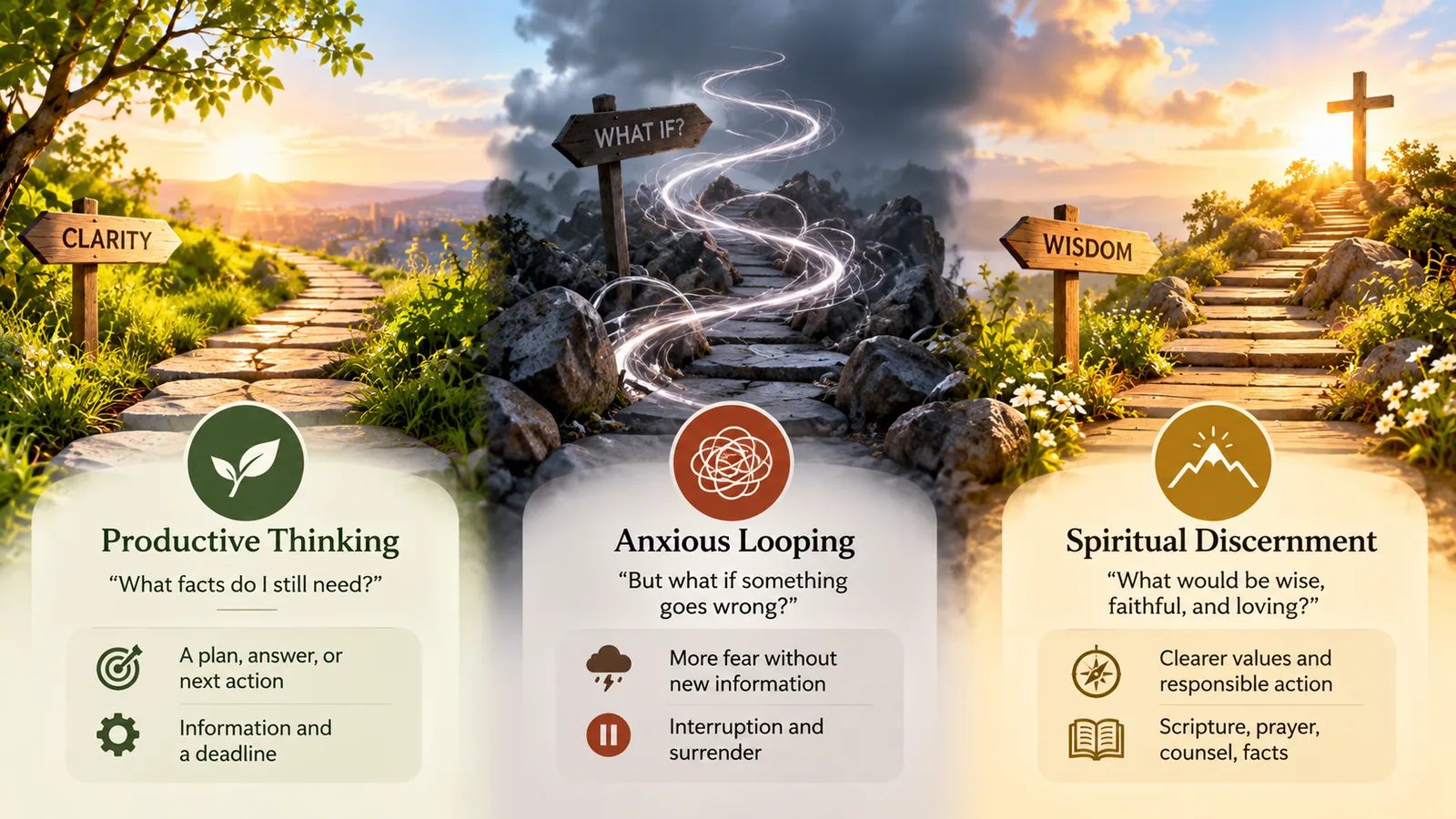
Confusing these three causes trouble.
If productive thinking is needed, “stop thinking” can make you careless.
If anxious looping is happening, more research can make the anxiety worse.
And if you are discerning something important, fear can disguise itself as spiritual urgency.
Here is how to tell them apart.
Type 1: Productive Thinking Solves Something
Productive thinking has somewhere to go.
You gather information. You compare options. You identify a risk. You make a plan.
Then something changes.
Real-world example: Should I take this job?
Imagine you receive a job offer.
The salary is better, but the commute is longer.
Productive thinking might include:
-
checking the actual commute;
-
calculating fuel or transportation costs;
-
comparing benefits;
-
talking with your spouse;
-
asking about work hours;
-
reviewing the employment contract;
-
praying about your priorities.
Every step gives you useful information.
Eventually, you have enough to make a reasonable decision.
That is thinking doing its job.
The productive-thinking test
Ask:
“If I spend another 20 minutes thinking about this, what new information could I realistically gain?”
If you have a clear answer, keep working.
If the answer is “nothing, but I might finally feel certain,” you may have crossed into anxious looping.
That distinction matters.
You usually do not need perfect certainty to make a wise decision.
You need enough information to take the next responsible step.
Type 2: Anxious Looping Keeps Asking Without Learning
An anxious loop feels busy.
That makes it easy to mistake for problem-solving.
But your brain is no longer gathering useful information. It is recycling the same fear.
You reread the text.
You replay your answer.
You check Google again.
You imagine the worst-case scenario.
Then you start from the beginning.
Psychologists often use terms such as worry, rumination, and repetitive negative thinking for related patterns of repeated thought. Research has connected repetitive negative thinking with anxiety and depression, and studies have also found links between worry or rumination and poorer sleep.
That does not mean normal overthinking is automatically a mental health disorder.
It does mean an endless loop is not always giving you the clarity it promises.
Real-world example: “Was she mad at me?”
You meet a friend for coffee.
Afterward, she sends a shorter-than-normal text:
“Thanks. Talk later.”
Your brain notices the period.
Now the investigation begins.
“Was she upset?”
“Did I talk too much?”
“Was my joke rude?”
“She normally uses an emoji.”
“What if she's pulling away?”
You reread the conversation.
Nothing new appears.
You ask another friend what the message means.
You feel better for six minutes.
Then the thought returns.
This is not really a communication problem anymore.
It is a certainty problem.
Your mind wants proof that your friend is not angry. But there may be no way to get 100% certainty tonight.
The practical response is different.
If there is a real reason to think you caused harm, address it.
If there is no evidence beyond an ambiguous text, stop putting the message on trial.
Tell yourself:
“I have noticed a possibility. I do not have proof. I will respond if real information appears.”
Then return to your life.
That is not denial.
It is refusing to treat every fear as evidence.
For more help with future-focused “what if” thoughts, read Bible verses for anxiety about the future.
Type 3: Spiritual Discernment Asks a Different Question
Spiritual discernment is not fortune-telling.
Its goal is not to discover a secret code that guarantees the future.
It asks:
“What is true?”
“What does Scripture clearly teach?”
“What is wise?”
“What are my motives?”
“What responsibilities has God already placed in front of me?”
“What do trusted, mature people see that I might be missing?”
“What action reflects love, wisdom, courage, and integrity?”
That is different from:
“God, please give me another sign so I can know nothing bad will happen.”
Real-world example: “Is God telling me to quit?”
Suppose you hate your job.
One morning, you read a Bible verse about stepping out in faith. You immediately wonder whether God is telling you to resign.
Do not assume the thought is wrong.
But do not assume the thought is divine either.
Discern it.
Does quitting violate any responsibilities you currently have?
How much money do you have saved?
Have you spoken with your spouse?
Is another job available?
Is the workplace unhealthy, or are you reacting to one terrible week?
Have mature Christians who know you well noticed the same pattern?
What does your employment contract say?
A spiritual impression does not become more trustworthy because it feels intense.
Good discernment can include Scripture, prayer, wise counsel, careful observation, patience, and ordinary facts.
If distinguishing spiritual guidance from your own thoughts is a recurring struggle, this guide on how to hear God's voice clearly goes deeper into that question.

The 3-Question Test for an Overthinking Brain
When you catch yourself circling, do not immediately try to force the thought away.
Classify it.
Ask these three questions.
1. Is there information I still need?
If yes, identify it.
Be specific.
Not: “I need to know whether this is the right decision.”
Instead:
“I need to know whether my insurance covers this doctor.”
“I need to ask whether the job includes weekends.”
“I need to check whether we can afford the monthly payment.”
That is a solvable question.
Solve it.
2. Am I learning anything new?
This is the question anxious thinking hates.
You may have spent an hour “thinking” without producing one new fact.
When the same arguments have gone around three times, your brain is probably no longer solving the problem.
You are circling it.
Say:
“I have already reviewed this. Nothing new has appeared.”
Then stop reopening the case unless new information actually arrives.
3. Am I looking for wisdom—or a guarantee?
This may be the most important question in the article.
Wisdom asks:
“What is the responsible next step?”
Anxiety asks:
“How do I guarantee I will never regret this?”
Those are not the same goal.
Most important decisions contain some uncertainty.
Marriage does.
Parenting does.
Moving does.
Changing careers does.
Medical treatment can.
Starting a business does.
Faith does not remove every unknown before you move.
Faith changes what you do with the unknown.
Why Overthinking Gets Worse at Night
At 2 a.m., a manageable problem can suddenly feel like the collapse of civilization.
There is a reason nighttime thinking can feel so convincing.
You are tired.
There are fewer distractions.
You cannot call the office, talk with your friend, or solve tomorrow's problem immediately.
Research has found associations between worry and rumination and poorer sleep. A meta-analysis covering 55 studies found higher levels of this repeated negative thinking were associated with poorer sleep quality.
So if your mind starts racing at night, your goal should usually not be to solve your entire life from bed.
Your goal is to decide whether anything truly needs action before morning.
Usually, it does not.
The 10-Minute Proverbs 3:5–6 Reset for 2 a.m.
This is not a magic routine.
You may finish it and still feel anxious.
That does not mean it failed.
The goal is to stop feeding the loop, place the unknown back where it belongs, and give your mind permission to rest.
Set a quiet 10-minute timer if that helps.
Minute 0–2: Name the actual fear
Do not write a five-page journal entry.
Finish one sentence:
“I am afraid that ______.”
Examples:
“I am afraid my boss wants to fire me.”
“I am afraid my daughter will make a terrible choice.”
“I am afraid I embarrassed myself tonight.”
“I am afraid the test result will be bad.”
“I am afraid I chose the wrong person.”
A named fear is easier to examine than a cloud of dread.
Minute 2–4: Separate fact from prediction
Make two columns.
Facts
What do you actually know?
Predictions
What is your brain adding?
Example:
Fact: “My boss asked to meet tomorrow.”
Prediction: “I am getting fired.”
Fact: “My friend has not replied for six hours.”
Prediction: “Our friendship is over.”
Fact: “I noticed a symptom.”
Prediction: “It must be the worst diagnosis I found online.”
Do not call a prediction a fact just because it feels vivid.
Minute 4–6: Read Proverbs 3:5–6 slowly
Now read the passage.
Pause after each part.
“Trust in the Lord with all your heart.”
Ask: “What am I trying to carry alone?”
“Lean not on your own understanding.”
Ask: “What am I pretending I can know tonight that I actually cannot know?”
“In all your ways submit to him.”
Ask: “What would faithfulness look like in the part I can control?”
“He will make your paths straight.”
Remind yourself: “I do not need to see the whole road to take tomorrow's next step.”
Minute 6–8: Pick one next action
Your action should be small and concrete.
“Call the doctor at 9 a.m.”
“Ask my manager what the meeting is about.”
“Apologize to my friend tomorrow.”
“Review the budget after breakfast.”
“Talk with my pastor this week.”
Or:
“No action is needed right now.”
That last answer is allowed.
Minute 8–10: Close the mental office
Write this sentence:
“I will reopen this problem when ______.”
Use a real condition.
“I will reconsider it when I have the test results.”
“I will think about it tomorrow at 10 a.m.”
“I will revisit the decision if the offer changes.”
“I will address it if my friend tells me there is a problem.”
This gives your mind a boundary.
Then pray simply:
“God, I have done what I can do tonight. Give me wisdom for what is mine to handle and help me trust You with what is not.”
Put the phone away.
Turn off the light.
You are not required to finish tomorrow tonight.
For more Scripture specifically for these hours, see Bible verses for anxiety at night.

Four Real-Life Problems—and What Trust Looks Like
Proverbs 3:5–6 becomes useful when it leaves the wall art and enters Monday morning.
Here are four common situations.
Problem 1: You cannot stop replaying something embarrassing
You made a joke at work.
Nobody laughed.
Now your brain has created a documentary about it.
You remember everyone's face. You rewrite what you should have said. You wonder whether your coworkers have lost all respect for you.
Ask:
Is there harm to repair?
If yes, repair it.
If no, replaying the event another 40 times will not change it.
Try this:
“That moment was uncomfortable. I do not need to turn discomfort into a catastrophe.”
Then place your attention on the next thing in front of you.
Problem 2: You are scared of choosing the wrong relationship
A relationship decision can trigger intense overthinking because it matters.
But more thinking is not always better thinking.
Instead of asking only, “Do I feel completely certain?” examine observable patterns.
Can you communicate honestly?
Can you disagree safely?
Are your core values compatible?
Is there respect?
Is there manipulation, intimidation, abuse, or coercive control?
Do trusted people who know both of you have serious concerns?
Faith does not require ignoring evidence.
And fear is not always proof that something is wrong. Important decisions can feel scary because they are important.
Gather the evidence.
Seek wise counsel.
Then make the best decision you can without demanding a guarantee about the next 50 years.
Problem 3: Your child is struggling
Parents can turn love into mental surveillance without realizing it.
Your teenager gets one poor grade.
Your mind jumps from algebra to unemployment in six seconds.
Instead, shrink the timeline.
What needs attention this week?
Talk with your child.
Speak with the teacher if appropriate.
Find out whether the problem is effort, understanding, stress, sleep, bullying, or something else.
Make one plan.
Then refuse to rehearse your child's entire adulthood in your head.
Concern can lead to action.
Worry tries to create control where control does not exist.
Problem 4: A health worry will not leave you alone
You notice something unusual.
You search online.
Ten minutes later, you are reading about rare diseases.
This is where “trust God” should never mean “ignore your health.”
If a symptom needs medical attention, seek appropriate medical care.
Write down your symptoms.
Make an appointment.
Follow qualified medical advice.
But once you have taken the responsible step, endless searching may not make you safer.
Trust can look like saying:
“I have taken the next responsible action. I will wait for real information instead of diagnosing myself from every possible outcome.”
If your life is dealing with a genuine crisis rather than a normal decision, this guide on how to trust God when life is falling apart may be more useful.
Use the “New Information Rule”
Here is one practical rule that can stop many overthinking loops:
Do not reopen a settled question without new information.
Suppose you have decided to accept a job.
You prayed.
You reviewed the salary.
You discussed the move.
You checked the schools.
You spoke with people you trust.
You accepted.
Two days later, anxiety says:
“But what if we hate it?”
That is not new information.
It is a new feeling.
Feelings matter, but a new feeling does not automatically require a new decision.
Reopen the issue when something meaningful changes.
For example:
The salary changes.
The role changes.
Your spouse learns something important.
A serious problem appears in the contract.
You receive relevant medical or financial information.
This protects you from confusing emotional intensity with evidence.
Use a Decision Deadline
Overthinkers often leave ordinary decisions open forever.
That creates mental clutter.
Instead, match the deadline to the size of the decision.
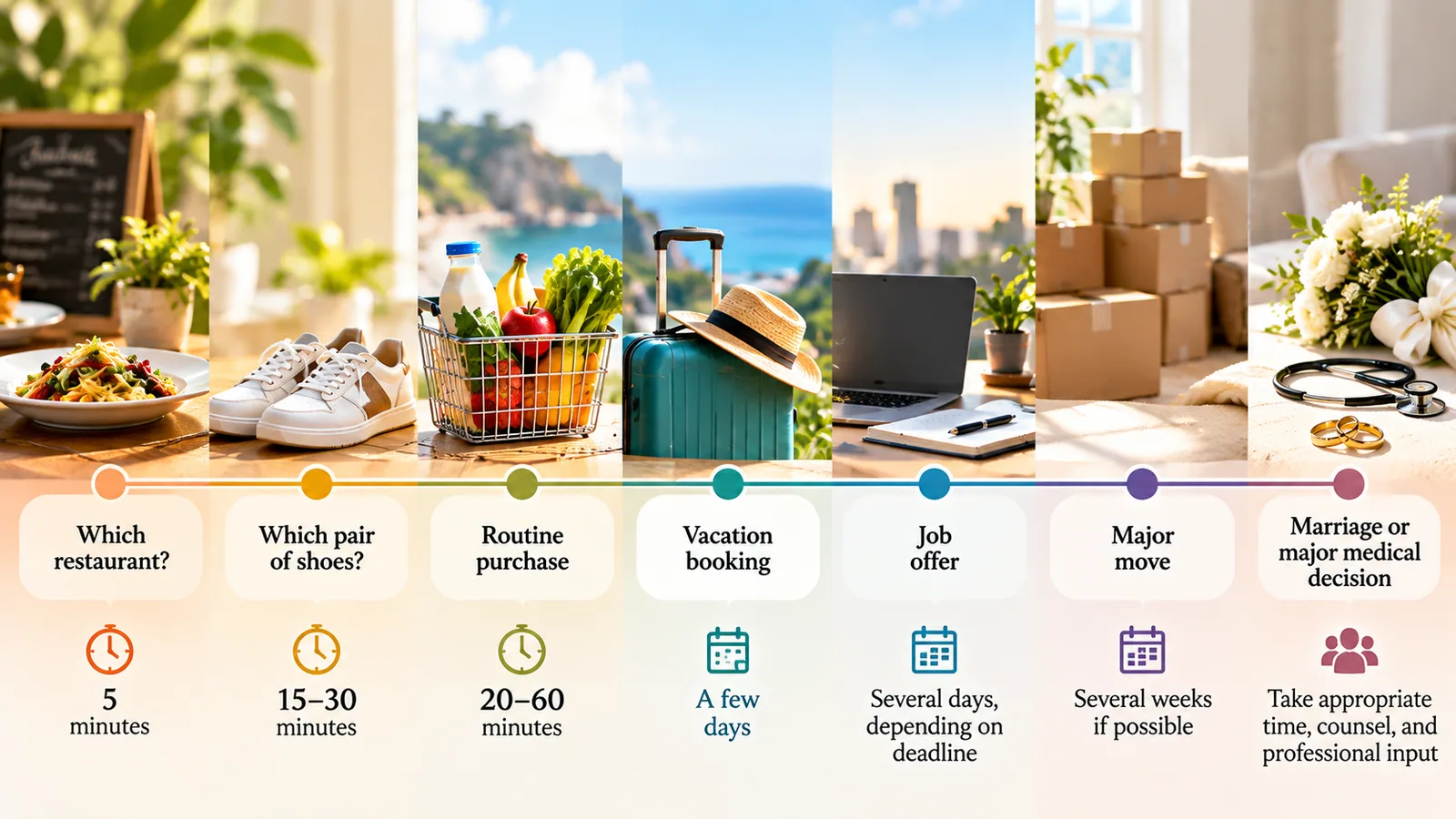
These are examples, not fixed rules.
The principle is simple:
Do not give a $20 decision the mental weight of a life-changing decision.
And do not rush a life-changing decision just because uncertainty feels uncomfortable.
When “Praying About It” Becomes Another Form of Checking
Prayer can bring your fear to God.
But an anxious mind can also turn prayer into another reassurance ritual.
You pray:
“God, should I do this?”
Then you wait for a feeling.
No feeling arrives.
So you pray again.
Then you open the Bible randomly.
Then you watch a sermon.
Then you ask for a sign.
Then something unusual happens, and you wonder whether that was the sign.
Now you need another sign to confirm the first sign.
At that point, you may not be seeking wisdom anymore.
You may be seeking certainty.
Prayer does not need to produce a special feeling before you can make an ordinary wise choice.
Sometimes the next step is simply to use the wisdom you already have.
Trusting God Does Not Mean You Will Immediately Feel Calm
This matters.
You may do everything in this article and still feel nervous.
Your heart may still beat faster.
You may still have the urge to check.
You may still wonder whether you made the wrong decision.
Trust is not measured only by how calm you feel.
Sometimes trust looks like not checking again even while you still want to.
Sometimes it looks like making the phone call while nervous.
Going to bed without solving tomorrow.
Waiting for the test result.
Having the hard conversation.
Leaving the unanswered text alone.
Feeling fear and taking the wise next step anyway.
That distinction is important because believers can create a second problem on top of anxiety:
“I am anxious, therefore I must not trust God enough.”
Now you are anxious about being anxious.
You do not need that extra burden.
When Overthinking May Need More Than a Bible Study
Not every racing thought is a spiritual problem.
Anxiety disorders are real health conditions.
The U.S. National Institute of Mental Health reports that an estimated 19.1% of U.S. adults experienced an anxiety disorder in a given year in the national survey data it cites. Its lifetime estimate is 31.1%.
Those figures do not mean 19.1% of people who overthink have an anxiety disorder.
Overthinking is not a diagnosis.
But if worry regularly affects your sleep, school, work, relationships, eating, health, or ability to function, consider talking with a qualified mental health professional.
Pay particular attention if you:
-
cannot control the worry most days;
-
repeatedly seek reassurance but never feel reassured;
-
avoid normal activities because of fear;
-
experience panic attacks;
-
lose significant sleep;
-
have intrusive thoughts that cause major distress;
-
feel driven to repeat checking or mental rituals;
-
feel hopeless or unsafe.
Seeking professional help does not require abandoning prayer.
You can pray, read Scripture, talk with your pastor, and see a licensed clinician.
These forms of support do not have to compete.

A Better Definition of Trust for Overthinkers
If you remember one thing, remember this:
Trusting God is not knowing what happens next. It is knowing what to do with the fact that you do not know.
You gather the facts available to you.
You seek wisdom.
You pray.
You notice your motives.
You get qualified help when needed.
You make the next responsible decision.
Then you stop demanding that your mind predict everything that follows.
That is where Proverbs 3:5–6 becomes practical.
“Lean not on your own understanding” means you stop asking your limited brain to perform a job it cannot perform.
You cannot calculate every future consequence.
You cannot read another person's mind.
You cannot prevent every loss.
You cannot guarantee that a wise decision will produce an easy result.
You cannot eliminate uncertainty from being human.
But you can be faithful with what is in front of you.
A One-Minute Version for Busy Days
When your mind starts looping during work, school, parenting, or errands, you may not have 10 minutes.
Use four sentences:
What do I know?
State the facts.
What am I predicting?
Separate fear from evidence.
What is mine to do?
Choose one responsible action.
What must I trust God with?
Release the part you cannot control.
That is Proverbs 3:5–6 turned into a daily practice.
Frequently Asked Questions
Is overthinking a sin?
Not automatically.
Thinking carefully can be wise. Worry, rumination, fear, intrusive thoughts, and indecision can have many causes.
The better question is what your thinking is producing.
If your thoughts are helping you understand a problem and act wisely, keep thinking. If they are repeatedly demanding certainty you cannot obtain, the next faithful step may be to stop feeding the loop.
How do I trust in the Lord with all my heart when overthinking?
Start by separating what you can know from what you cannot know.
Gather the facts you actually need, pray for wisdom, make the next responsible choice, and stop reopening the question unless new information appears. Trusting God does not require turning off your brain. It means refusing to treat your own understanding as unlimited.
How can I stop overthinking according to the Bible?
Do not make “stop thinking” your main goal.
Instead, redirect your thinking.
Philippians 4 points believers toward prayer and what is true. Proverbs encourages wisdom and counsel. Jesus repeatedly directs attention away from carrying tomorrow's troubles before tomorrow arrives.
A practical biblical response is to identify today's responsibility and leave tomorrow's unknowns with God.
How do I know if I am discerning or overthinking?
Ask whether your thinking is becoming clearer.
Discernment normally moves toward truth, wisdom, responsible action, and humility.
Overthinking usually keeps reopening the same question without meaningful new information.
If you keep asking the same people, rereading the same material, or looking for repeated signs after you already have enough information, anxiety may be driving the process.
What does “lean not on your own understanding” really mean?
It does not mean refusing to think.
The book of Proverbs strongly values wisdom, planning, learning, and counsel.
The point is that human understanding has limits. You can use your judgment without treating it as the final and complete view of reality.
Why does my brain keep overthinking after I pray?
Because prayer is not an on/off switch for your nervous system.
You can sincerely trust God and still feel anxious.
Your brain may have learned habits of checking, rumination, or worst-case thinking. Stress, sleep problems, past experiences, and anxiety conditions can also contribute.
Do not use the return of an anxious feeling as proof that prayer failed.
What should I do when I keep replaying a conversation?
First ask whether there is anything useful left to do.
If you hurt someone, apologize.
If you need clarification, ask when appropriate.
If no action remains, label the replay accurately: “I am reviewing something I cannot change.”
Then move your attention toward a present task rather than continuing the mental trial.
What should I do when my brain will not stop at night?
Do not try to solve your entire future from bed.
Write down the fear, separate facts from predictions, identify anything that truly needs action tomorrow, read Proverbs 3:5–6 slowly, and give yourself permission to revisit the problem in daylight.
If nighttime anxiety happens often or severely disrupts sleep, consider professional support as well.
Does trusting God mean I should not plan?
No.
Proverbs repeatedly supports wise planning.
The problem is not making a plan. The problem is believing a plan can remove all uncertainty.
Plan carefully.
Hold the outcome humbly.
Can Christians go to therapy for overthinking or anxiety?
Yes.
Mental health care and Christian faith do not have to oppose each other.
A qualified therapist can help identify patterns such as rumination, reassurance-seeking, avoidance, intrusive thoughts, or chronic worry. Pastoral care can provide spiritual support. Depending on the person, both may be useful.
When Your Brain Starts Again, Remember This
Your brain may ask one more “what if” before you finish this page.
You do not have to answer every question it produces.
Ask instead:
Is this productive thinking, anxious looping, or spiritual discernment?
If information is missing, find it.
If wisdom is needed, seek it.
If action is needed, take it.
But if your brain is simply demanding a guarantee about something no human can guarantee, you have reached the edge of your responsibility.
That is where Proverbs 3:5–6 becomes more than a verse you know.
Think wisely.
Do what is yours to do.
Then let God be God while you get some sleep.
Key Statistics
U.S. adults with an anxiety disorder in the past year
19.1%
NIMH estimates that 19.1% of U.S. adults had any anxiety disorder during the previous year, based on National Comorbidity Survey Replication diagnostic interview data. The underlying adult prevalence data were collected in 2001–2003, so this should not be presented as a 2026 prevalence survey.
Source: NIMH — Any Anxiety Disorder
Studies included in sleep meta-analysis
55 studies
A systematic review and meta-analysis synthesized 55 studies examining worry/rumination and sleep in non-clinical populations.
Source: Clancy et al. — Health Psychology Review
Credible Sources
National Institute of Mental Health (NIMH) · No publication date stated on page; underlying past-year prevalence data are from 2001–2003
Authoritative U.S. government source for the article’s 19.1% past-year and 31.1% lifetime anxiety-disorder prevalence figures. It also helps distinguish ordinary overthinking from diagnosable anxiety disorders.
Health Psychology Review / Taylor & Francis · January 20, 2020 online; December 2020 issue
The strongest direct support for the article’s nighttime-overthinking section. It combined 55 studies and found associations between worry/rumination and poorer sleep quality, shorter sleep, and sleep-onset difficulties.

About the Author
Editorial Team
Editorial Team
Daily Faith Path articles are prepared by the editorial team to help readers find scripture-centered guidance for healing, faith, prayer, and spiritual encouragement.
Expertise: Healing scriptures, Bible study resources, prayer guidance, devotional writing, Christian encouragement
Experience: The team researches scripture references, reviews surrounding biblical context, compares translation wording where useful, and updates articles to improve clarity, usefulness, and trust for readers.
Credentials: Editorial review, devotional writing, scripture study, content updating
This article is published by the Daily Faith Path editorial team to help readers use scripture carefully, prayerfully, and in ways that are practical for real-life seasons of illness, grief, waiting, and spiritual reflection.
Continue Reading
Related articles

October 7, 2026
12 Bible Verses About Hiding Money From Your Spouse
Explore 12 Bible verses about secret spending, hidden debt, financial honesty, confession, forgiveness, boundaries, and rebuilding trust in marriage.

October 6, 2026
15 Bible Verses for Couples Who Keep Fighting About Money
Money fights are rarely just about dollars. These 15 Bible verses help couples address spending, saving, debt, secrecy, unequal income, giving, and financial control with practical next steps and conversation questions.

October 5, 2026
Should You Tithe While in Debt? 11 Bible Passages to Study First
Should you tithe while in debt? Explore 11 Bible passages on tithing, debt, generosity, family responsibility, and giving according to your means—plus a practical plan for deciding what to do.