Is It Wrong to Feel Anxious About the World Right Now?
Feeling anxious about the future doesn't mean your faith is weak. Discover Bible verses for anxiety about the future, matched to real anxious thought patterns and supported by practical, psychology-backed techniques that help calm both your mind and nervous system.
No — feeling anxious about the future is not a sin, and the Bible never says it is. What Scripture actually offers is something better than shame: a set of specific, repeatable ways to calm an anxious brain, and modern psychology can explain exactly why they work.
That's what this guide covers. Not another decorative list of verses on pretty backgrounds — but Bible verses for anxiety about the future, matched to the actual thought patterns your brain runs when it's scared of tomorrow.

Why the Future Feels Heavier Than Usual
If you feel like everyone around you is more anxious lately, you're not imagining it.
The World Health Organization estimates that around 300 million people worldwide live with an anxiety disorder, making it the most common mental health condition on earth. In the United States, roughly 1 in 5 adults experiences an anxiety disorder in any given year.
And the future specifically is where much of that worry points. In the American Psychological Association's "Stress in America" surveys, over 70% of adults report significant stress about the economy, and a similar share say they're stressed about the future of the country.
Add AI reshaping jobs, nonstop election coverage, wars in the headlines, and grocery prices that make you wince — and your nervous system is doing exactly what it was built to do. It's scanning for threats. It's just scanning a world with way more visible threats than it was designed for.
Here's the key idea to hold onto: anxiety about the future is a signal, not a verdict. It says something about your environment and your brain — not about your faith.
Does the Bible Say Anxiety Is a Sin?
This question quietly torments a lot of believers. Someone reads "Do not be anxious about anything" (Philippians 4:6) and hears an accusation: I'm anxious, so I'm failing.
But look at the grammar and the context. Paul isn't scolding — he's giving instructions to a persecuted church facing real danger. "Do not be anxious" is followed immediately by a method: "but in every situation, by prayer and petition, with thanksgiving, present your requests to God."
That's not "stop feeling that." That's "here's what to do with what you're feeling." Big difference.
Jesus Felt It Too
In Gethsemane, Jesus was "sorrowful and troubled" and said His soul was "overwhelmed with sorrow to the point of death" (Matthew 26:37–38). Luke, a physician, records Him sweating drops like blood — a real physiological stress response.
If the sinless Son of God experienced crushing distress about what was coming, then the feeling of dread about the future cannot itself be sin. What Jesus modeled is what He did next: He took the dread directly to the Father, honestly, three times.
So no — you don't need to repent for feeling anxious. You need a plan for what to do when you feel it. That's the rest of this article.
What Anxiety Actually Is (In Plain Language)
Most "Bible verses for anxiety" posts skip this part entirely, and it's why they don't help much. You can't aim a verse at a problem you don't understand.
Here's anxiety in simple terms. Deep in your brain sits the amygdala — think of it as a smoke alarm. Its job is to yell "DANGER!" fast, before you've had time to think.
The problem: a smoke alarm can't tell the difference between burnt toast and a house fire. Your amygdala can't tell the difference between "a lion is chasing me" and "I read a scary headline about the economy."
Both trigger the same body response: racing heart, tight chest, shallow breathing, spinning thoughts. Psychologists call future-focused worry anticipatory anxiety — your brain rehearsing disasters that haven't happened, trying to feel prepared.
Two more terms worth knowing, because Scripture speaks to both directly:
Catastrophizing — your mind jumps to the worst possible outcome and treats it as certain. "Layoffs are coming" becomes "I'll lose the house."
Intolerance of uncertainty — research consistently shows this is the engine of chronic worry. It's not the bad outcome that torments you most. It's the not knowing. Anxious brains would rather imagine a certain disaster than sit with an uncertain future.
Read that last sentence again, because it explains why the Bible's answer to anxiety is almost never "here's what will happen." It's "here's who holds what will happen."
Bible Verses Matched to Actual Anxious Thought Patterns
This is the part most articles get wrong. They hand you 25 verses in a row, like handing someone a whole pharmacy and saying "good luck."
Instead, find your specific thought pattern below, then use the verse built for it. This is closer to how a good counselor works: identify the distortion, then answer it with truth.
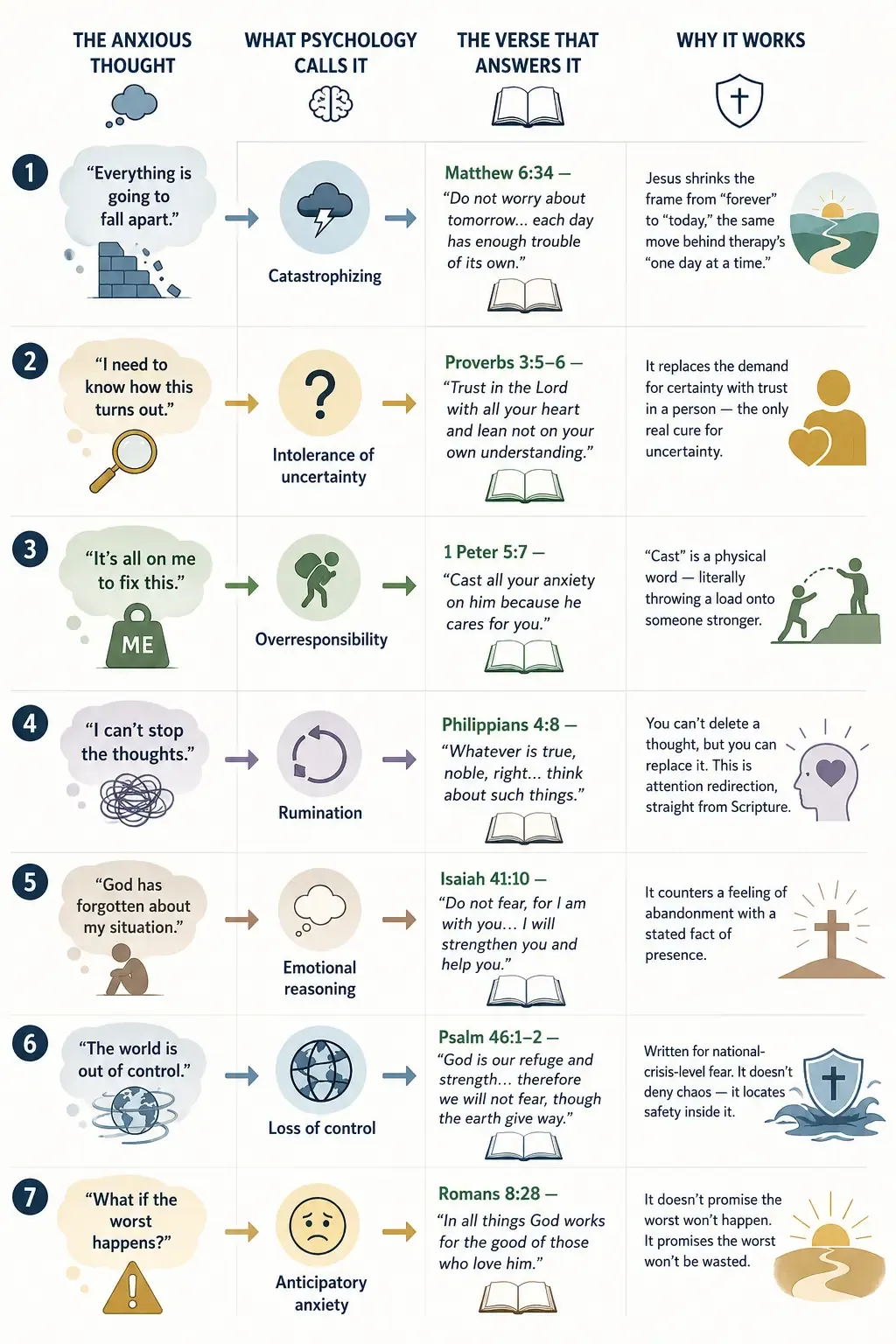
Bookmark that table. Screenshot it. The goal is that next time your brain runs one of these scripts, you know exactly which truth to reach for — and if you want a bigger library to draw from, browse these scriptures for when you feel anxious sorted by feeling.
How to Actually Use a Verse (Reading It Once Doesn't Work)
Here's an uncomfortable truth: skimming a verse while anxious is like reading a fire escape map while the building burns. Information alone doesn't calm an activated nervous system.
Anxiety lives in your body as much as your mind. So the verses need to reach your body too. Here are three methods that combine Scripture with what actually calms a stress response.
Method 1: Breathe the Verse (2 minutes)
Slow exhaling activates your parasympathetic nervous system — the body's built-in brake pedal. Pair it with a short verse split in two.
Breathe in slowly (4 counts): "Cast all your anxiety on Him..." Breathe out slower (6 counts): "...because He cares for me."
Repeat for 8–10 breaths. The long exhale calms your body while the words redirect your mind. You're praying and regulating at the same time.
Method 2: Write the Worry, Answer It in Ink (5 minutes)
Worry thrives in the fog of your head. Writing forces it into daylight.
Draw a line down a page. Left side: write the exact anxious thought ("What if AI takes my job in two years?"). Right side: write the matching verse from the table above, word for word, by hand.
Handwriting slows your thinking to the speed of the pen. Studies on expressive writing show that naming worries on paper measurably reduces their intensity. You're doing exposure and truth-telling in one move.
Method 3: The 5-Second Interrupt
When a spike hits mid-day — a headline, an email, a news alert — you won't have time for journaling. So keep one verse loaded like a reflex.
Pick ONE verse this month. Just one. Say it out loud (out loud matters — it engages more of your brain than silent reading) the instant you notice the spike.
Psychologists call this a "pattern interrupt." Believers have called it "taking every thought captive" (2 Corinthians 10:5) for two thousand years. Same mechanism.
Three Real Stories (Because Theory Isn't Enough)
Marcus: The Dad Who Got Laid Off
Marcus, 41, a logistics manager, was laid off when his company "restructured around automation." For three weeks he couldn't sleep past 3 a.m. His brain ran the same loop: mortgage, kids, insurance, mortgage, kids, insurance.
His breakthrough wasn't a job offer. It was Matthew 6:34 taped to his bathroom mirror and a rule he made: "I'm allowed to solve today's problem only." Today's problem was: send four applications. Not "secure my family's next decade" — four applications.
He found work five months later. But he'll tell you the verse saved him before the job did, because it shrank an unsolvable future into a solvable day.
Elena: The College Student Who Couldn't Stop Scrolling
Elena, 20, described her anxiety honestly: "I doomscroll about elections and climate until 1 a.m., then lie there feeling like the world is ending."
Her counselor (at a faith-based counseling center) gave her two assignments. First, a hard news cutoff at 8 p.m. Second, replace the scroll with Psalm 46 read slowly — the psalm written for people watching their world shake.
The genius of Psalm 46 for a doomscroller: it doesn't pretend things are fine. "Though the earth give way, though the mountains fall into the sea" — that IS the doomscroll feeling. But it anchors it: "God is our refuge." Elena says her sleep improved within two weeks, mostly because her last mental input of the day changed. If nighttime is when your future-worry peaks too, this guide to Bible verses for anxiety at night walks through a full Scripture-based wind-down routine.
Pastor Dave: The Leader Who Hid It
Dave pastored a church of 200 and secretly had panic attacks about declining attendance and the church's future. He felt double shame: anxious, and a "bad example."
What freed him was studying Elijah in 1 Kings 19 — a prophet who, right after his greatest victory, collapsed into fear and despair and wanted to die. God's response wasn't a rebuke. It was sleep, food, and a gentle whisper.
Dave now says from the pulpit: "God treated Elijah's crash with a nap and a meal before He said a single word of correction. Your anxiety doesn't disqualify you." He also sees a Christian therapist monthly and tells his congregation so.
When Worry Crosses a Line: Faith AND Help
Let's be direct, because this matters: sometimes anxiety about the future stops being ordinary worry and becomes something that needs treatment.
Watch for these signs lasting more than a few weeks: you can't control the worry even when you try, sleep is consistently broken, you're avoiding normal life (work, people, driving, news of any kind), physical symptoms like chest tightness or stomach problems keep showing up, or the anxiety travels with a heavy, hopeless mood.
If that's you, seeing a doctor or licensed counselor is not a failure of faith. Luke was a physician. Timothy was told to take something for his stomach. God heals through prayer and through people trained to help — and many find that Scripture and therapy work better together than either alone. If your anxiety has that heavier, darker edge to it, this collection of Bible verses for depression and anxiety also covers biblical figures who struggled deeply and why seeking support is biblical.
One practical note: therapy approaches like CBT (cognitive behavioral therapy) have strong research behind them for anxiety — and as you may have noticed, several CBT techniques look remarkably like things Scripture told us to do all along.

Fear vs. Anxiety: Why the Difference Changes How You Pray
Here's a distinction that clears up a lot of confusion, both psychologically and biblically.
Fear is a response to a present, specific threat. A growling dog. A diagnosis in your hand. It's sharp, and it fades when the threat passes.
Anxiety is a response to an imagined or uncertain future threat. It's foggy, it lingers, and it has no "off" moment because the threat never actually arrives — it just hovers.
Why does this matter for your faith life? Because they need different prayers. Fear needs courage for a real thing: "God, be with me in this room, today." Anxiety needs trust for an unknown thing: "God, I hand You a future I can't see."
When the Bible says "fear not" — which appears in various forms dozens and dozens of times across Scripture — it's almost always paired with a reason rooted in God's presence, not a promise that the scary thing won't happen. "Fear not, for I am with you." The antidote is company, not certainty. For a deeper walkthrough of the courage side of this, see how to overcome fear with God.
That's also the heart of choosing faith over fear: not pretending the world is safe, but refusing to face it alone.
A Simple 7-Day Plan for Future Anxiety
Knowledge without practice fades in about a week. So here's a one-week starter plan. Ten minutes a day, no theology degree required.
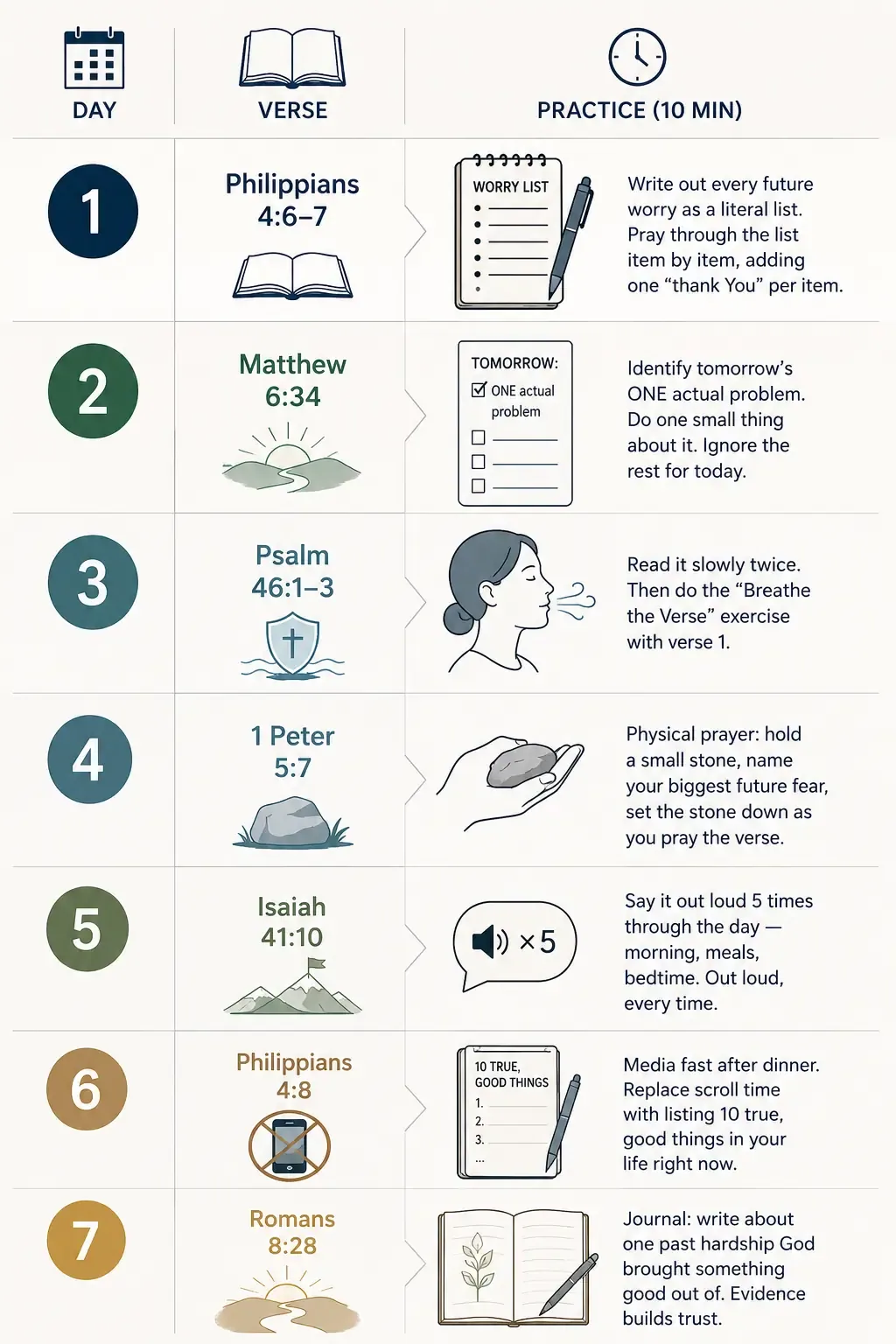
After the week, keep the two verses that helped most and drop the rest. A verse you actually use beats twenty you admire.
The Bottom Line
Anxiety about the future isn't a sin, a weakness, or proof your faith is broken. It's a smoke alarm doing its job in a smoky world.
What Scripture gives you is not a switch to turn the alarm off. It's something sturdier: a Person to hand the future to, specific truths matched to your specific anxious thoughts, and practices — breathing, writing, speaking, shrinking the day — that reach both your soul and your nervous system.
Start small. One verse. One thought pattern. One ten-minute practice tonight. The future is uncertain; that part won't change. Who walks into it with you — that part already has.
If you want more Scripture to lean on, the Bible verses about peace collection is a good next stop for slow, unhurried reading.
FAQ: Bible Verses for Anxiety About the Future
Is anxiety a sin according to the Bible?
No. Anxiety is an emotion and a body response, and emotions aren't sins. Jesus Himself experienced overwhelming distress in Gethsemane (Matthew 26:38). Verses like "do not be anxious" (Philippians 4:6) are instructions with a method attached — pray, petition, give thanks — not accusations. Sin would be things like refusing to trust God at all, not the feeling of worry itself.
What is the most powerful Bible verse for anxiety about the future?
There's no single "most powerful" verse — the best one depends on your thought pattern. For catastrophizing, Matthew 6:34. For needing certainty, Proverbs 3:5–6. For feeling the world is out of control, Psalm 46:1–2. Philippians 4:6–7 is the most complete because it includes both the instruction and the promised result: peace that guards your heart and mind.
Why do I feel anxious even after praying?
Because prayer engages your mind and spirit, but anxiety also lives in your body — stress hormones don't vanish instantly. That's normal, not a faith failure. Pair prayer with slow breathing, movement, or writing so your body catches up with your prayers. Also, one prayer rarely ends chronic worry; Paul prayed three times about his thorn, and Jesus prayed three times in Gethsemane.
How many times does the Bible say "fear not"?
Commands not to fear appear dozens of times throughout Scripture — some counts reach well over a hundred depending on translation and phrasing. The more important pattern: "fear not" is almost always followed by "for I am with you." The Bible's answer to fear is God's presence, not a guarantee that hard things won't happen.
Should Christians take medication or go to therapy for anxiety?
Yes, if it's needed — using medical help is not a lack of faith. The Bible honors physicians (Luke was one) and practical remedies (1 Timothy 5:23). If worry is uncontrollable, wrecking sleep, or shrinking your life for weeks on end, see a doctor or licensed counselor. Many people find Scripture and therapy strengthen each other.
How do I stop anxious thoughts about the future at night?
Nighttime is when future-anxiety peaks because there are no distractions and your tired brain defaults to threat-scanning. Three things help: a news/social cutoff 1–2 hours before bed, the "Breathe the Verse" exercise with a short scripture like 1 Peter 5:7, and keeping a notepad by the bed to "park" worries for tomorrow. Psalm 4:8 — "In peace I will lie down and sleep, for you alone, Lord, make me dwell in safety" — was practically written for 2 a.m.
What did Jesus actually say about worrying?
His longest teaching on it is Matthew 6:25–34. His argument is practical: worry adds nothing ("Can worry add a single hour to your life?"), God already knows your needs, and tomorrow's troubles belong to tomorrow. His command is to seek God's kingdom today — redirecting attention from the uncontrollable future to the actionable present, which is exactly what modern anxiety treatment teaches.
Key Statistics
People living with anxiety disorders worldwide
~300 million
Estimated global number of people living with an anxiety disorder.
Source: World Health Organization (WHO)
Most common mental health condition
Anxiety disorders
Anxiety disorders are the world's most common mental health condition.
Source: World Health Organization (WHO)
Credible Sources
World Health Organization · January 1, 2023
Provides authoritative global statistics on anxiety disorders and mental health prevalence.
National Institute of Mental Health · Updated periodically
Supplies reliable U.S. prevalence statistics used to support claims about anxiety affecting approximately 1 in 5 adults annually.

About the Author
Editorial Team
Editorial Team
Daily Faith Path articles are prepared by the editorial team to help readers find scripture-centered guidance for healing, faith, prayer, and spiritual encouragement.
Expertise: Healing scriptures, Bible study resources, prayer guidance, devotional writing, Christian encouragement
Experience: The team researches scripture references, reviews surrounding biblical context, compares translation wording where useful, and updates articles to improve clarity, usefulness, and trust for readers.
Credentials: Editorial review, devotional writing, scripture study, content updating
This article is published by the Daily Faith Path editorial team to help readers use scripture carefully, prayerfully, and in ways that are practical for real-life seasons of illness, grief, waiting, and spiritual reflection.
Continue Reading
Related articles

October 7, 2026
12 Bible Verses About Hiding Money From Your Spouse
Explore 12 Bible verses about secret spending, hidden debt, financial honesty, confession, forgiveness, boundaries, and rebuilding trust in marriage.

October 6, 2026
15 Bible Verses for Couples Who Keep Fighting About Money
Money fights are rarely just about dollars. These 15 Bible verses help couples address spending, saving, debt, secrecy, unequal income, giving, and financial control with practical next steps and conversation questions.
October 5, 2026
Should You Tithe While in Debt? 11 Bible Passages to Study First
Should you tithe while in debt? Explore 11 Bible passages on tithing, debt, generosity, family responsibility, and giving according to your means—plus a practical plan for deciding what to do.