15 Bible Verses for Couples Who Keep Fighting About Money
Money fights are rarely just about dollars. These 15 Bible verses help couples address spending, saving, debt, secrecy, unequal income, giving, and financial control with practical next steps and conversation questions.

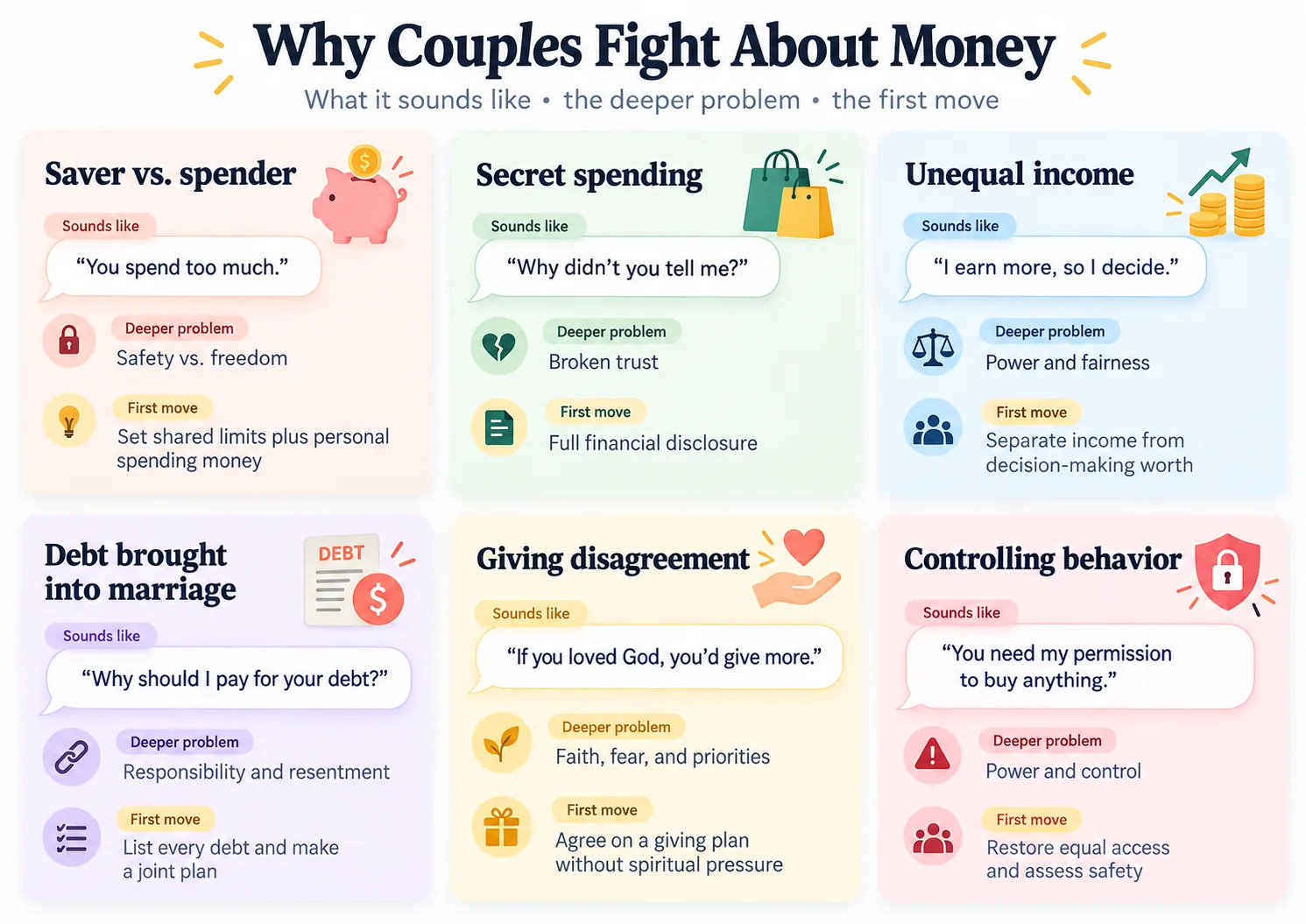
If you keep fighting with your spouse about money, you probably do not need another lecture about “being good stewards.” You need help with the exact fight you are having: spending, saving, debt, secrecy, unequal income, giving, or control.
These 15 Bible verses about money for couples who fight about finances are organized around those real problems. Each section also gives you a practical next step and one question to discuss without turning your kitchen table into another battlefield.
Money conflict is common. Fidelity's 2026 Couples & Money Study found that 49% of couples avoid money conversations to prevent arguments, and almost one in four admitted hiding a financial secret from their partner.
Research also suggests the problem is not simply “not having enough money.” A study of 4,574 couples found that financial disagreements were stronger predictors of divorce than other common disagreements studied.
That does not mean a money argument means your marriage is doomed. It means repeated money conflict deserves real attention.

Why Couples Really Fight About Money
A $70 restaurant bill may look like the problem.
Often it is not.
One spouse hears, “You wasted $70.”
The other hears, “I do not trust you to make decisions.”
That is why money arguments become personal so quickly. Money can represent safety, freedom, respect, hard work, generosity, status, fear, childhood memories, or control.
Researchers who analyzed more than 1,000 severe financial conflicts and hundreds of everyday marital money disagreements found recurring themes such as unfair contributions, income, different financial values, one-sided decisions, unusual expenses, and perceived irresponsibility.
That is a much better way to approach Scripture.
Do not ask only, “What does the Bible say about money?”
Ask, “What is actually happening between us when we fight about money?”
Before You Read the Verses: Stop Using Scripture as a Weapon
A Bible verse should not become ammunition.
Quoting “submission,” “provision,” “debt,” or “generosity” to win an argument can make a bad conversation worse.
Read the verse first to examine your own behavior.
Then discuss what the principle might require from both of you.
If your talks normally turn into shouting, accusations, or hours of arguing at bedtime, move them to a scheduled time. This guide to Bible verses for money anxiety explains why nighttime is usually a poor time for solving financial problems.
When One Spouse Saves and the Other Spends
Saver-versus-spender conflict is rarely as simple as “responsible person versus irresponsible person.”
The saver may associate money with safety.
The spender may associate money with enjoying life, caring for people, or freedom after years of restriction.
Research on couples has found that perceived spending differences can contribute to financial conflict.
The goal is not to make both spouses identical.
It is to create rules both can live with.
1. Proverbs 21:20 — Saving Is Wise, but Wisdom Is the Goal
Proverbs 21:20 contrasts storing resources wisely with consuming everything available.
The practical lesson is simple: spending every dollar leaves a household fragile.
But this verse does not prove that the spouse who wants the biggest savings account is automatically right.
Savings need a purpose.
Agree on what you are saving for: three months of expenses, a car replacement, Christmas, retirement, medical costs, or a home repair.
Practical fix: Automate the agreed savings amount on payday. Then stop debating that amount every week.
Conversation question: “What amount of savings would make you feel secure without making our life feel unnecessarily restricted?”
2. Proverbs 21:5 — Make a Plan Before You Police Each Other
Proverbs 21:5 connects careful planning with better outcomes.
Many couples do the opposite.
They spend first, become surprised later, and then blame each other.
Create the plan before the purchase happens.
One useful system is a “talk first” number. For example, purchases under $75 may not require discussion, while purchases over $75 do.
Choose a number that fits your actual income.
Real-world example: The $42 argument
Imagine Leah and Daniel.
Daniel gets upset because Leah spends $42 on lunch with friends. Leah gets angry because Daniel recently spent $60 on equipment for a hobby.
Their real problem is not lunch.
They have never agreed on what either spouse can spend without permission.
They solve it by giving each spouse $150 per month in personal spending money. Bills, savings, debt payments, and giving happen first.
Now Leah's lunch does not require a courtroom hearing.
Neither does Daniel's hobby purchase.
Conversation question: “What amount should each of us be free to spend without explaining every purchase?”
3. Matthew 6:21 — Your Budget Reveals Your Priorities
Jesus teaches that our treasure and heart are connected.
That makes this a useful verse when couples argue about priorities.
One spouse may want vacations.
The other wants to pay off the mortgage.
Neither goal is automatically sinful.
The better question is what your household says matters most.
Try this exercise.
Each spouse privately writes the five things they most want the household's money to accomplish during the next three years.
Then compare the lists.
You may discover that the real conflict is not spending.
It is that you have never agreed on a destination.
Conversation question: “If someone saw only our bank statements, what would they think matters most to our family?”

When There Is Secret Spending or Hidden Debt
Secret spending changes the problem.
Now you are not only discussing money.
You are discussing trust.
Fidelity's 2026 study found that almost one in four couples admitted hiding a financial secret.
Another survey found secret purchases and hidden debt among common forms of financial infidelity.
4. Ephesians 4:25 — Tell the Truth Before You Fix the Budget
Ephesians 4:25 tells believers to put away falsehood and speak truthfully.
That includes money.
You cannot repair financial trust while balances, purchases, loans, or accounts remain hidden.
The first meeting after financial secrecy should not begin with a perfect budget.
It should begin with complete information.
Write down:
-
Every checking and savings account.
-
Every credit card.
-
Every personal loan.
-
Every student loan.
-
Every buy-now-pay-later balance.
-
Every past-due bill.
-
Every significant financial obligation.
-
Every recurring subscription.
Then agree that no new debt will be hidden.
Conversation question: “Is there anything about our finances that you are afraid to tell me?”
5. Proverbs 28:13 — Concealing a Problem Keeps It Alive
Proverbs 28:13 contrasts hiding wrongdoing with confessing and turning away from it.
Financial repair needs both parts.
“I am sorry” matters.
Changed behavior matters too.
Suppose a spouse secretly used a credit card and built a $4,800 balance.
Real repentance may include showing the statements, stopping new charges, removing the card from shopping apps, creating a repayment plan, and agreeing to temporary accountability.
Forgiveness does not require pretending the damage never happened.
For a broader biblical framework on confession, mercy, boundaries, and rebuilding trust, see biblical forgiveness and relational repair.
Conversation question: “What action would help rebuild trust, not just end today's argument?”
6. Luke 16:10 — Small Money Habits Matter
Jesus' teaching in Luke 16 connects faithfulness in small matters with faithfulness in larger ones.
That principle matters because financial trust usually disappears through patterns.
A hidden $18 purchase may sound small.
Twenty hidden purchases are a different issue.
Do not create a marriage where every coffee needs an investigation.
Create clear rules.
The goal is transparency, not surveillance.
Conversation question: “What does financial honesty look like in ordinary purchases, not just large ones?”
When One Spouse Earns Much More
Income differences can quietly turn into power differences.
“I earn most of the money” can become “I get the final decision.”
That is not a healthy financial partnership.
Paid income is also not the only contribution to a household. Childcare, household work, elder care, career sacrifices, and unpaid support have real value.
7. Ecclesiastes 4:9–10 — Marriage Is a Partnership, Not a Payroll Ranking
Ecclesiastes teaches that two are better than one because they can help one another.
That becomes very practical when income changes.
One spouse may earn $100,000 while the other earns $30,000.
Later, a job loss, pregnancy, illness, relocation, or career change may reverse the situation.
Treat income as a household resource, not a scoreboard for human value.
Real-world example: “But I pay for everything”
Consider Aaron and Nicole.
Aaron earns most of the household income. Nicole works part time while managing school pickups, meals, medical appointments, and much of the home.
During arguments Aaron starts saying, “I pay for everything.”
Nicole hears, “Nothing you do counts.”
Their repair starts when they stop using salary as a measurement of authority.
They agree that major financial decisions require two yeses regardless of who earned the dollars.
Conversation question: “Have we accidentally connected income with power in our marriage?”
8. Philippians 2:4 — Consider Your Spouse's Interests Too
Paul tells believers not to focus only on their own interests but also on the interests of others.
That principle matters when one spouse controls the financial plan because that spouse is “better with money.”
Being skilled with spreadsheets does not give you ownership of the other person's voice.
A good system may divide jobs.
One spouse can pay bills.
The other can track savings.
Both should still understand the financial picture.
Fidelity has found that financial responsibility often falls more heavily on one partner, which can create frustration or disconnection.
Conversation question: “Do we both understand our money, or does one of us simply manage it while the other stays in the dark?”
9. 1 Timothy 5:8 — Providing for a Household Is Serious Work
First Timothy 5:8 stresses responsibility for one's household.
Do not use this verse to shame a spouse who earns less.
Its point is responsibility, not salary competition.
A spouse who refuses to work, contribute, communicate, or take reasonable responsibility may need a serious conversation.
A spouse who temporarily earns less because of childcare, illness, education, caregiving, or unemployment is a different situation.
Conversation question: “Are we both carrying a fair share of our family's responsibilities, even if those responsibilities look different?”

When Debt Came Into the Marriage
Few phrases create resentment faster than “your debt.”
Student loans may have existed before the wedding.
So may credit cards, medical debt, car loans, or tax problems.
The debt may legally belong to one spouse depending on the account and local law. But its monthly payment can still affect the household.
10. Proverbs 22:7 — Debt Reduces Your Options
Proverbs 22:7 warns about the power debt can create between borrower and lender.
Debt is not merely a number.
It takes part of next month's income before next month begins.
That is why couples need to know every balance, interest rate, minimum payment, and due date.
If you are actively working through debt, use these Bible verses for paying off debt alongside an actual repayment plan.
A simple debt meeting
Write down four numbers for every debt:
Balance. Interest rate. Minimum payment. Due date.
Then choose a method.
You may attack the highest interest rate first to reduce total interest.
Or you may attack the smallest balance first to build momentum.
The best system is the one you both understand and will actually follow.
Conversation question: “Can we stop arguing about who caused the debt long enough to decide what we will do next?”
11. Luke 14:28 — Count the Cost Before Starting
Jesus uses the example of calculating the cost before building.
The passage is not a marriage budgeting lesson in its original context.
But the principle of counting the cost is directly useful.
Before financing furniture, upgrading a car, booking a vacation, or taking another loan, calculate the full effect.
A $500 monthly payment is not “only $500.”
It is $6,000 each year.
Ask what that payment prevents you from doing.
Real-world example: Debt from before the wedding
Maria enters marriage with $28,000 in student loans.
Her husband, Chris, has no debt and starts resenting the monthly payment.
They keep using the phrase “Maria's debt.”
That language makes every payment feel like one spouse is taking from the other.
They eventually agree on a household goal: eliminate the loan in 36 months while keeping a small emergency fund.
The numbers did not change overnight.
The story they told about the numbers did.
Conversation question: “What would change if we viewed this as a problem our household must manage instead of a weapon from the past?”
When You Disagree About Giving and Tithing
Christian couples can love God and still disagree about giving.
One spouse may want to tithe 10%.
The other may worry about rent, debt, food, or an emergency fund.
This becomes especially painful when one spouse treats the disagreement as proof that the other lacks faith.
12. 2 Corinthians 9:7 — Giving Should Not Be Forced
Second Corinthians 9:7 emphasizes purposeful and willing giving rather than reluctant or pressured giving.
That matters in marriage.
Spiritual pressure is still pressure.
Do not say, “If you trusted God, you would agree with me.”
Talk about the household honestly.
What are your essential expenses?
What debts are due?
What amount do you each believe you should give?
Where do you disagree?
For a deeper treatment of this exact issue, read what the Bible says about tithing while in debt.
Conversation question: “What giving amount can we choose faithfully without one of us feeling spiritually bullied?”
13. 1 Corinthians 16:2 — Generosity Can Be Planned
In 1 Corinthians 16, Paul describes believers setting aside money regularly for a collection.
This passage is not a universal command that every married couple must use a certain percentage.
It does show something useful: giving can be intentional.
Instead of repeatedly arguing when a request appears, choose a giving amount during your monthly budget.
You can also create a small generosity category for unexpected needs.
Planning generosity often reduces conflict because the decision happens before the emotional moment.
Conversation question: “What amount can we set aside for giving so generosity becomes part of the plan instead of a surprise?”
When Money Becomes a Tool for Control
This section is different.
Some money disagreements are normal marriage conflict.
Financial control can become abuse.
Examples include preventing a spouse from accessing household money, taking their income, blocking them from working, forcing debt into their name, denying money for basic needs, or requiring permission for every purchase while the controlling spouse follows different rules.
The National Domestic Violence Hotline defines financial abuse around power and control over a partner's finances or ability to support themselves.
14. Ephesians 5:21 — Biblical Marriage Does Not Require Financial Domination
Before Ephesians discusses marriage roles, Ephesians 5:21 speaks about submitting to one another.
Whatever Christian tradition you come from, Scripture should not be used as a license for intimidation or financial domination.
A husband should not quote “submission” to prevent his wife from knowing the bank balance.
A wife should not use spiritual language to justify secretly controlling all household money.
For a fuller look at this passage, read what biblical submission really means.
Conversation question: “Do both of us have meaningful access to information, money, and financial decisions?”
15. James 1:19 — Listen Before You Defend Yourself
James tells believers to be quick to hear, slow to speak, and slow to anger.
That may be the most practical verse in this entire article.
You cannot solve a money problem while preparing your next defense.
Try this rule.
One spouse gets two uninterrupted minutes to explain the problem.
The other spouse then says, “What I hear you saying is…”
Do not argue with the summary.
First make sure it is accurate.
Then switch roles.
For more Scripture focused on listening, patience, speech, and conflict, see these relationship verses for hard conversations.
Conversation question: “What are you afraid will happen if we keep handling money the way we do now?”

The 20-Minute Money Meeting That Prevents Two-Hour Fights
Do not try to fix your entire financial life every time money comes up.
Use a short weekly meeting.
Twenty minutes is enough for many couples.
Minutes 1–3: Pray briefly and agree on one issue.
Minutes 4–8: Look at facts only. Bank balance. Bills. Debt. Upcoming expense. No accusations.
Minutes 9–14: Each spouse explains what they want and why.
Minutes 15–18: Choose one next action.
Minutes 19–20: Decide when you will review it.
Do not bring six months of resentment into a conversation about the grocery bill.
If another issue appears, write it down for the next meeting.
Use the “Problem, Fear, Request” Formula
Many couples argue with accusations.
“You never save.”
“You waste everything.”
“You care more about money than me.”
Replace the accusation with three parts.
Problem: “We spent $420 more than we planned this month.”
Fear: “I am scared we will need to use the credit card for our car repair.”
Request: “Can we reduce restaurant spending by $150 next month?”
That gives your spouse something concrete to answer.
It also exposes the emotion beneath the number.
What If There Simply Is Not Enough Money?
Sometimes the problem is not communication.
The math does not work.
You may be fighting because $4,000 of income cannot cover $4,600 of basic obligations.
No communication technique can turn a deficit into a surplus.
Treat that as a financial problem first.
Cut or renegotiate what you can.
Contact lenders before missed payments when possible.
Review insurance, subscriptions, transportation, housing, food, and debt costs.
Look for income options.
Ask for qualified financial help when needed.
Most importantly, stop blaming each other for a shortage neither spouse created through reckless behavior.
Economic pressure itself is associated with greater financial conflict.
What Healthy Financial Unity Actually Looks Like
Financial unity does not mean you agree about every purchase.
It means you have agreed on how disagreements will be handled.
Healthy couples can have different money personalities.
They may even keep some accounts separate.
What matters more is whether both people know the financial reality, understand the plan, have a voice, and can raise concerns without fear.
A useful household system usually includes five things:
-
Shared knowledge of income, debts, bills, and major accounts.
-
A written plan for regular expenses.
-
Agreed savings and debt goals.
-
A clear amount each spouse can spend without discussion.
-
A threshold that requires a joint decision.
That turns vague tension into rules.
Rules are easier to solve than resentment.

Frequently Asked Questions
What is the best Bible verse for couples fighting about money?
There is no single verse for every money fight.
Proverbs 21:5 is useful for planning. Ephesians 4:25 matters when money has been hidden. Proverbs 22:7 addresses debt. Second Corinthians 9:7 helps with giving disagreements. James 1:19 is especially useful when the biggest problem is how you talk to each other.
Choose the verse that speaks to the actual problem.
Does the Bible say married couples must combine all their bank accounts?
The Bible teaches marital unity, honesty, responsibility, and generosity, but it does not give modern instructions about checking accounts, credit cards, or whether every couple must use one joint bank account.
Some couples combine everything. Others use joint household accounts plus separate personal accounts.
The system should support transparency, fairness, and shared responsibility.
Who should control the money in a Christian marriage?
“Control” is usually the wrong goal.
One spouse may manage the bookkeeping because that person is better at it.
But managing the money is different from owning all financial authority.
Both spouses should normally understand the household finances and have a meaningful voice in major decisions.
What should I do if my spouse secretly spends money?
Do not begin with a stricter budget.
Begin with disclosure.
You need to understand what happened, how much money is involved, whether debt exists, and whether the behavior is continuing.
Then decide what repair looks like.
That might include account transparency, spending limits, counseling, financial planning, or other accountability.
Should I help pay debt my spouse brought into the marriage?
You should first separate two questions.
The legal question is who is responsible for the debt. That depends on the account, location, and other legal details.
The marriage question is how the payment affects your shared household goals.
You can treat debt as a shared planning problem without pretending its history does not matter.
What if my spouse and I disagree about tithing?
Do not use giving as a test of whether your spouse loves God.
Study Scripture together.
Look honestly at your income, essential household responsibilities, debts, and convictions.
Then seek an amount or plan you can practice without coercion.
Is controlling all the money financial abuse?
It can be.
A spouse being responsible for budgeting is not automatically abusive.
The warning signs are power and coercion: blocking access to money, preventing employment, forcing debt, denying money for necessities, taking income, hiding financial information, or creating rules that only one spouse must follow.
If you feel unsafe or controlled, this is bigger than a budgeting disagreement. Seek confidential support from a qualified local domestic-abuse service. In the United States, the National Domestic Violence Hotline offers confidential support and safety-planning resources.
Your Next Money Conversation Only Needs One Goal
You do not need to solve your mortgage, retirement, credit cards, Christmas budget, giving, vacation plans, and grocery spending tonight.
Pick one fight.
Name the real problem.
Read the verse that speaks to it.
Then agree on one action.
Maybe that action is opening every credit-card statement.
Maybe it is creating a $100 personal spending allowance.
Maybe it is putting $200 into savings automatically.
Maybe it is finally admitting that the argument is not really about money. It is about fear, secrecy, fairness, or control.
The strongest financial marriages are not couples who never disagree about money.
They are couples who learn how to disagree without turning money into a weapon.
Key Statistics
Couples who avoid money conversations
49%
Nearly half of couples surveyed said they avoid talking about money specifically to prevent arguments. This strongly supports the article’s opening premise that financial communication itself is a major pain point.
Source: Fidelity 2026 Couples & Money Study
Couples hiding a financial secret
Almost 1 in 4
Fidelity found that nearly one-quarter of couples admit hiding a financial secret from their partner, supporting the section on secret spending and hidden debt.
Source: Fidelity 2026 Couples & Money Study
Credible Sources
Fidelity Investments · May 19, 2026
Primary source for the article’s current statistics that 49% avoid money conversations and almost 1 in 4 hide a financial secret.
Family Relations / Wiley · September 4, 2012
Peer-reviewed longitudinal research using 4,574 couples. Supports the claim that financial disagreements can be more predictive of divorce than other common disagreement categories.

About the Author
Editorial Team
Editorial Team
Daily Faith Path articles are prepared by the editorial team to help readers find scripture-centered guidance for healing, faith, prayer, and spiritual encouragement.
Expertise: Healing scriptures, Bible study resources, prayer guidance, devotional writing, Christian encouragement
Experience: The team researches scripture references, reviews surrounding biblical context, compares translation wording where useful, and updates articles to improve clarity, usefulness, and trust for readers.
Credentials: Editorial review, devotional writing, scripture study, content updating
This article is published by the Daily Faith Path editorial team to help readers use scripture carefully, prayerfully, and in ways that are practical for real-life seasons of illness, grief, waiting, and spiritual reflection.
Continue Reading
Related articles

October 7, 2026
12 Bible Verses About Hiding Money From Your Spouse
Explore 12 Bible verses about secret spending, hidden debt, financial honesty, confession, forgiveness, boundaries, and rebuilding trust in marriage.

October 5, 2026
Should You Tithe While in Debt? 11 Bible Passages to Study First
Should you tithe while in debt? Explore 11 Bible passages on tithing, debt, generosity, family responsibility, and giving according to your means—plus a practical plan for deciding what to do.

October 2, 2026
Broke but Not Hopeless: 15 Bible Verses for a Zero-Balance Season
When your bank balance is close to zero, Scripture can offer hope without pretending financial hardship is simple. These 15 Bible verses address food, rent, debt, anxiety, hard decisions, and accepting help, alongside practical steps for getting through the next 24 hours.