Should You Tithe While in Debt? 11 Bible Passages to Study First
Should you tithe while in debt? Explore 11 Bible passages on tithing, debt, generosity, family responsibility, and giving according to your means—plus a practical plan for deciding what to do.

If you are choosing between a tithe, a credit card payment, groceries, and rent, the Bible does not give you a neat modern spreadsheet telling you which dollar goes where. It does give something more useful: principles about generosity, debt, family responsibility, promises, contentment, and giving according to what you actually have.
Christians agree that generosity matters and that debts should be handled responsibly. They do not all agree that every Christian must give exactly 10% while paying off debt.
That difference matters.
You should not have to pretend the debate does not exist. You also should not use the debate as an excuse to ignore either generosity or legitimate financial obligations.
This guide walks through 11 Bible passages about money and tithing while in debt, explains the major Christian interpretations, and gives you a practical way to make the decision.

First: Being in Debt Does Not Make This a Small Question
Debt is not an unusual problem.
The Federal Reserve Bank of New York reported that U.S. household debt stood at about $18.8 trillion in the second quarter of 2026. Credit card balances alone were about $1.26 trillion.
The Federal Reserve's 2026 household survey also found that 16% of adults had not paid all their bills in full during the previous month. Only 63% said they could cover a $400 emergency expense completely with cash or its equivalent.
So this is not just a theological puzzle.
A person asking, "Should I tithe while in debt?" may really be asking:
"Do I give $400 to church or keep the electricity on?"
"Do I tithe before paying my credit card minimum?"
"If I reduce my giving, am I disobeying God?"
"Should I give 10% even if I have to borrow money afterward?"
Those are different situations. They should not receive the same one-line answer.
If your immediate problem is that you simply cannot cover every bill, start with this guide on what to do when bills are piling up.
The Big Biblical Distinction: Tithing and Generosity Are Related, but They Are Not Exactly the Same Question
The word tithe means a tenth.
In the Old Testament, Israel's tithing system supported Levites, worship, religious celebrations, and people in need. Passages such as Leviticus 27, Numbers 18, and Deuteronomy 14 describe different parts of that system.
That is already more complex than saying, "The Bible says everyone must send 10% of every paycheck to a local church."
Then we reach the New Testament.
Christians are clearly commanded to be generous. Churches and gospel workers need support. Poor people should be helped. Believers are warned against greed.
But Christians disagree about whether the Old Testament's 10% figure remains a binding minimum.
You can see this disagreement even among conservative Christian teachers. Some argue that the tithe remains a Christian requirement or minimum. Others argue that the Mosaic tithe is not binding under the New Covenant and that New Testament giving should instead be voluntary, generous, planned, and proportional.
The United Methodist Church, for example, describes tithing as a longstanding standard while also emphasizing broader generosity. Catholic teaching requires believers to support the material needs of the Church according to their abilities, rather than imposing a universal 10% rule.
That is why a useful answer must go deeper than "yes" or "no."
11 Bible Passages About Money and Tithing While in Debt
1. Proverbs 22:7 — Debt Changes the Relationship
Proverbs 22:7 says the borrower becomes servant to the lender.
That does not mean every mortgage or business loan is automatically sinful. It does mean debt reduces freedom.
A portion of future income already belongs to someone else.
If you have $20,000 in credit card debt at a high interest rate, that debt can limit your ability to give, save, change jobs, help relatives, or deal with emergencies.
Practical lesson: Do not treat debt repayment as spiritually meaningless. Getting out of destructive debt can itself be responsible stewardship.
If you are broke and trying to work out what Scripture says about debt and giving, see these Bible verses for when you're broke.
2. Romans 13:7–8 — Pay What You Owe
Romans 13 first tells believers to give people what is due to them. Paul then says to "owe no man any thing" except the continuing debt of love.
This passage is sometimes treated as a ban on every form of borrowing. That goes further than the context clearly requires.
A more careful application is simple: take your obligations seriously.
If you promised to make a payment, do not casually ignore it while spending money elsewhere.
Debt creates a real responsibility toward the lender.
That matters in the tithing question because generosity should not become an excuse for financial dishonesty.
3. Psalm 37:21 — Borrowing Includes an Obligation to Repay
Psalm 37 contrasts a wicked person who borrows and does not repay with a righteous person who is generous.
Notice something important.
The same verse cares about repayment and generosity.
Those two values are not enemies.
That means the goal should not be:
"Choose debt repayment instead of ever being generous."
Nor should it be:
"Give money away and ignore everyone you owe."
A mature financial plan makes room for both as circumstances allow.
And if you genuinely cannot pay, inability is different from dishonesty. Call the lender. Ask about hardship options. Renegotiate where possible. Do not disappear.
4. 1 Timothy 5:8 — Providing for Your Household Matters
Paul strongly emphasizes responsibility toward your own household.
This passage is especially important when guilt about giving causes someone to neglect food, housing, medicine, or children.
Imagine a parent with $80 left until payday.
The refrigerator is almost empty. A prescription costs $35. The child needs lunch money.
Using the $80 for those needs is not evidence that the parent cares nothing about God.
Family provision is itself treated as a serious biblical responsibility.
This does not erase generosity.
It stops us from pretending that every dollar spent on necessary household care is spiritually inferior to a dollar placed in an offering.
5. Matthew 6:31–33 — Seek God's Kingdom Without Pretending Needs Do Not Exist
Jesus tells His followers not to live consumed by anxiety about food, drink, and clothing. He tells them to seek God's kingdom first.
This passage is sometimes turned into a financial formula:
"Give first, and God must make the bills work."
That is stronger than Jesus' promise.
Jesus is teaching trust in the Father's care. He is not telling people to ignore arithmetic, contracts, rent dates, or hungry children.
Trust can pray.
Trust can give.
Trust can also open the bank statement and make a plan.
If money fear is keeping you awake, these Bible verses for money anxiety may help you separate spiritual trust from financial avoidance.
6. Malachi 3:8–10 — The Famous Tithing Passage Needs Its Context
This is probably the first passage many Christians hear when tithing comes up.
Israel is accused of withholding tithes and offerings. God calls His people to bring the tithe into the storehouse and speaks of blessing.
The passage matters.
But context matters too.
Malachi is speaking to Israel within its covenant life. The surrounding blessing includes agricultural language appropriate to that setting.
Christians disagree about how directly this command transfers to Christians under the New Covenant.
One group sees Malachi as supporting a continuing 10% principle.
Another sees the passage as part of Israel's covenant law and believes Christians should apply its broader principles—honor God, support ministry, resist greed, and give generously—without treating the 10% figure as a binding law.
What should you not do?
Turn Malachi 3:10 into an investment promise.
"Give $500 and God will make $5,000 appear" is not a safe reading of the passage.
Biblical provision is bigger than financial multiplication. If you need help sorting those promises out, read what God's promises about provision actually mean.
7. Deuteronomy 14:22–29 — Old Testament Tithing Was Bigger Than a Modern Offering Plate
Deuteronomy 14 helps correct another common misunderstanding.
Ancient Israel's system involved agricultural produce, worship, Levites, community celebration, and care for vulnerable people such as foreigners, orphans, and widows.
The point is not that giving no longer matters.
The point is that copying one number—10%—without studying the system around it can oversimplify the Bible.
Before asking, "Do I have to give exactly 10%?", ask a larger question:
What kind of person is God's teaching about money trying to make me?
Generous.
Responsible.
Concerned about worship.
Concerned about people in need.
Free from greed.
Faithful with what has been entrusted to me.
That is much harder than checking a percentage box.

8. Matthew 23:23 — Jesus Mentions Tithing but Condemns Distorted Priorities
Jesus rebukes religious leaders who carefully tithe tiny herbs while neglecting justice, mercy, and faithfulness.
That creates an important warning for this discussion.
You can be mathematically precise and spiritually unhealthy.
Someone can give exactly 10% while cheating a lender.
Someone else can aggressively pay debt while becoming selfish and refusing to help anyone.
Jesus refuses both forms of convenient religion.
Your budget should reflect more than one biblical value.
9. 1 Corinthians 16:1–2 — Planned and Proportional Giving
Paul tells believers to set money aside regularly in keeping with their income.
That is extremely practical.
Giving should not have to depend on emotional pressure every Sunday.
Plan it.
Budget it.
Connect it to your actual financial capacity.
This also suggests something important for people with irregular income.
A freelancer earning $6,000 one month and $1,800 the next does not have to pretend both months are financially identical.
Proportional giving naturally adjusts to reality.
10. 2 Corinthians 8:12–14 — Give According to What You Have
This may be the most important New Testament passage for someone asking whether to tithe while deeply in debt.
Paul says a willing gift is accepted according to what a person has, not according to what that person does not have. He then explains that the goal is not to relieve others while leaving the giver crushed.
Read that carefully.
Paul values willingness.
He values generosity.
But he also recognizes capacity.
That directly challenges giving based on imaginary money.
If you have to use a credit card, overdraft, payday loan, or new personal loan because your donation emptied your account, you are effectively giving money you do not presently have.
That deserves serious reconsideration.
For a deeper look at this principle, read about giving according to what you actually have.
11. 2 Corinthians 9:6–8 — Giving Should Not Be Forced
Paul continues by teaching generous giving, but he also says giving should be decided in the heart and not done reluctantly or under compulsion.
Both parts matter.
Generosity matters.
Freedom from coercion matters too.
Fear is a poor stewardship system.
"If I do not transfer 10% by midnight, God will punish my family financially" is not the cheerful generosity Paul describes.
A church can teach strongly about giving without turning financial hardship into spiritual blackmail.
So, Should You Tithe While in Debt?
Here is the most balanced answer:
If your basic needs are covered, your required payments are current, and you can give without creating new debt, there is a strong biblical case for continuing regular generosity while paying debt.
Whether that amount must be exactly 10% depends on your interpretation of tithing.
If you believe the tithe remains a binding Christian practice, you may choose to keep giving 10% while cutting spending and slowing extra debt payments.
If you believe New Testament giving is proportional rather than fixed at 10%, you may choose a smaller amount during a severe debt season and increase it as your finances recover.
Both views should take generosity seriously.
Neither should require financial pretending.
Use This Four-Bucket Test Before Deciding
Here is a practical way to make the decision.
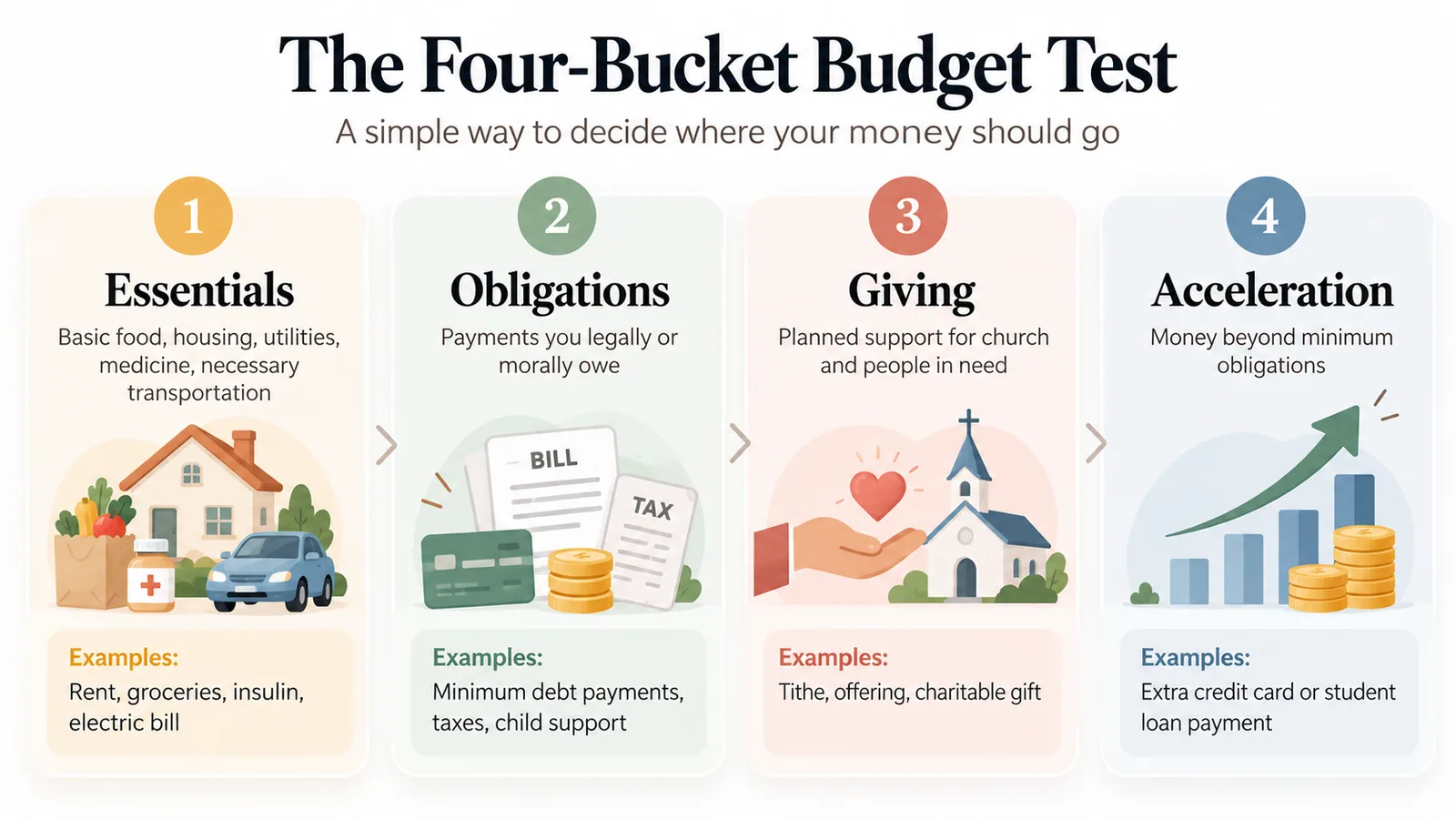
The biggest mistake is confusing minimum debt payments with extra debt acceleration.
Suppose you owe $15,000 on credit cards.
Paying the required minimum is an obligation.
Paying an extra $900 this month is a debt-payoff strategy.
Those are not the same thing.
A Christian might reasonably continue regular giving while reducing that extra $900 payment.
But if you cannot buy food or make your minimum payment without borrowing again, you have a different problem.
Real-World Example #1: Stable Income and $18,000 of Credit Card Debt
Daniel brings home $4,800 per month.
After housing, food, utilities, transportation, insurance, minimum debt payments, and other basic costs, he has $1,000 left.
He wants to become debt-free quickly.
If Daniel gives $480 and sends the remaining $520 toward extra debt repayment, he is still moving forward.
He does not necessarily need to stop all giving just because a balance exists.
If he prefers the debt avalanche method, he can send extra money toward the card with the highest interest rate. That usually reduces total interest cost.
If motivation is his bigger problem, he might prefer the debt snowball and attack the smallest balance first.
The Bible does not tell Daniel which debt payoff algorithm to choose.
That is a financial technique, not a doctrine.
Real-World Example #2: Giving 10% Would Require More Borrowing
Maria brings home $3,200 per month.
Her basic bills and minimum payments total $3,300.
She is already $100 short before giving anything.
A 10% gift would turn her monthly gap into $420.
Putting that missing $420 on a credit card each month would add $5,040 of new debt in one year before interest.
That is not a small detail.
Under a proportional-giving interpretation of the New Testament, Maria could temporarily reduce her financial giving while fixing the monthly deficit.
She might still give a small planned amount. She might volunteer. She might serve people in ways that do not require money.
If Maria belongs to a church tradition that teaches a continuing 10% tithe, this is exactly the kind of situation she should discuss openly with a trusted pastor or church leader rather than silently borrowing to maintain appearances.
She should also ask whether the church has a benevolence fund.
Sometimes the person trying desperately to put money into the church is exactly the person the church is supposed to be helping.
Real-World Example #3: The Family That Is Behind on Rent
Imagine a family that has $700 available.
Rent is $1,200 and already late.
The refrigerator is nearly empty.
A $90 utility bill is approaching disconnection.
This is not mainly a "debt snowball versus tithing" question anymore.
It is financial triage.
Protect housing, food, essential utilities, medicine, and safety. Contact the landlord and utility company immediately. Ask about hardship plans. Contact the church and local assistance programs.
Do not take a payday loan simply to make a donation.
Then build a longer-term giving plan when the crisis stops growing.
Real-World Example #4: Job Loss Changes the Numbers Overnight
A couple regularly gives 10%.
Then one spouse loses a job.
Their income falls from $7,000 to $3,800 per month.
Keeping every old budget percentage unchanged may no longer work.
They can cut entertainment and optional purchases first. They can pause aggressive extra debt payments. They can reduce other spending.
But if the numbers still do not work, they should not hide reality.
Generosity during hardship can be beautiful. It also does not have to mean pretending lost income still exists.
For more help with that exact situation, read about giving after losing income.

What to Do This Month: A Practical Tithing-and-Debt Plan
Step 1: Find Your Real Monthly Number
Do not guess.
Write down take-home income.
Then list essentials, minimum required debt payments, and other unavoidable obligations.
The number remaining is your actual margin.
Step 2: Stop Creating New High-Interest Debt
Paying $800 toward a credit card while adding $900 of new purchases is not progress.
Fix the monthly cash-flow leak first.
Cancel or reduce optional costs aggressively if necessary.
Step 3: Separate Giving From Guilt
Ask:
"Am I giving because I believe this is faithful?"
Or:
"Am I terrified God will punish me if I don't?"
Those are very different motivations.
Paul's picture of Christian giving includes willingness rather than compulsion.
Step 4: Decide What You Believe About the 10% Question
Do not leave the theology vague.
Study the passages.
Ask your pastor why your church teaches what it teaches.
Then compare that explanation with Scripture.
There are roughly three common approaches:
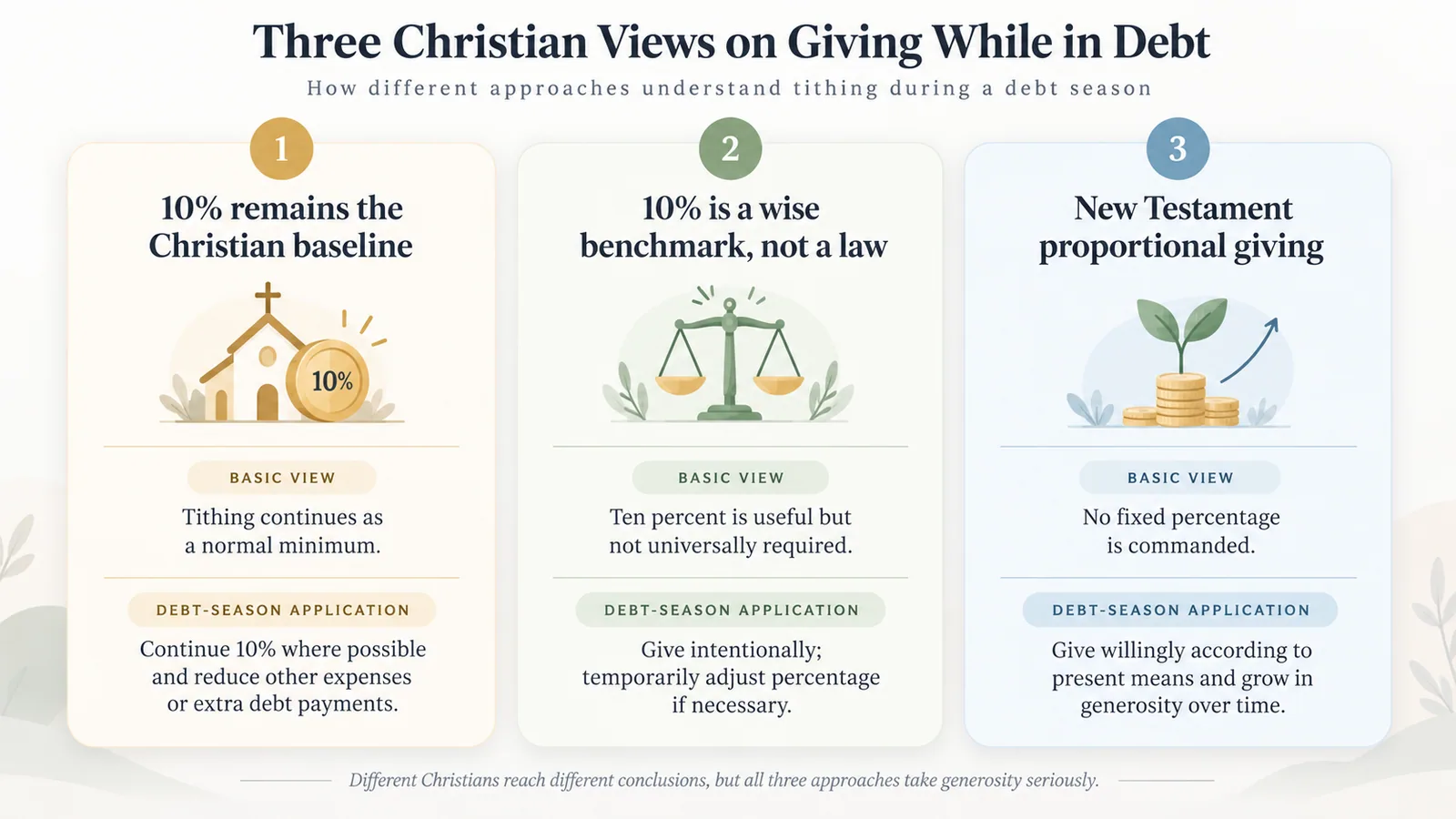
You may strongly prefer one view.
The point is to understand why.
Step 5: Never Borrow Merely to Look Generous
This is one of the most practical rules in this article.
If you donate $500 and then need a $500 cash advance to buy groceries, you have not escaped the financial reality.
You moved it.
The new debt may also carry interest and fees.
2 Corinthians 8:12 is worth reading again: Christian willingness operates according to what a person has, not imaginary resources.
Step 6: Keep Some Generosity in Your Life
Reducing a percentage does not have to turn into permanent selfishness.
You can help someone move.
Bring a meal.
Volunteer.
Give $10.
Offer professional skills.
Call a lonely person.
Generosity is larger than a banking transaction.
Step 7: Put a Date on the Review
Do not say, "I'll start giving again someday."
Choose a date.
For example:
"On the first Saturday of every month, I will review income, debt progress, emergency savings, and giving."
When income rises or a debt disappears, decide beforehand that some of the new margin will increase generosity.
This prevents lifestyle spending from quietly swallowing every improvement.

What If Your Church Says You Must Tithe Even If You Cannot Pay Your Bills?
Ask questions respectfully.
"What passage leads us to that conclusion?"
"How do we understand 2 Corinthians 8:12–13?"
"Does our church believe Christians are under the Old Testament tithe law?"
"What should a member do when giving 10% requires new borrowing?"
"Does the church provide financial help for members who cannot afford food or housing?"
Healthy pastoral guidance can handle serious questions.
You should not have to hide a shutoff notice to prove your faith.
At the same time, do not use one difficult month as permission to stop examining your spending.
Maybe the problem really is a $900 car payment, constant restaurant spending, subscriptions, gambling, shopping, or lifestyle inflation.
Financial hardship deserves compassion.
It also deserves truthful numbers.
Three Mistakes to Avoid
Mistake #1: Treating Tithing Like a Guaranteed Return
Do not turn giving into:
"I gave God $100, so He owes me $1,000."
God is not a slot machine.
Give because you worship God and love people, not because you found a spiritual investment hack.
Mistake #2: Using Debt as a Permanent Excuse Never to Give
A person can always find another financial goal.
After credit cards comes the car.
After the car comes the mortgage.
After the mortgage comes retirement.
If giving only begins when you have no financial goals left, giving may never begin.
That is why even a small planned gift can matter during a debt-payoff season.
Mistake #3: Giving While Refusing to Face the Numbers
Faith does not mean avoiding a budget.
Luke 14:28 praises counting the cost.
Proverbs repeatedly praises wisdom and planning.
You can pray and use a calculator in the same hour.
In fact, faith does not mean ignoring the numbers.
A Simple Decision Tree
Ask these questions in order.
Can I cover basic food, housing, medicine, utilities, and necessary transportation?
If no, deal with the immediate crisis and ask for help.
If yes, continue.
Can I make the payments I have already promised to make?
If no, contact creditors and create a hardship plan.
If yes, continue.
Would my planned giving force me to borrow again this month?
If yes, reconsider the amount and study 2 Corinthians 8:12–13 carefully.
If no, continue.
Do I believe Scripture requires 10%, treats 10% as a benchmark, or teaches proportional giving without a fixed number?
Apply your conviction consistently.
Then ask one final question:
Am I also attacking the spending or income problem that created the debt?
That question prevents theology from becoming a distraction from bad math.
Frequently Asked Questions
Should you tithe while in debt?
Many Christians believe yes. Others believe Christians should continue giving while in debt but are not required to give exactly 10%.
The strongest practical distinction is between debt you are responsibly paying and a financial crisis where giving would require you to miss essentials or borrow more money.
Is it a sin to stop tithing while paying debt?
Christians disagree because they disagree about whether the Old Testament 10% tithe remains binding on Christians.
What is clear is that the New Testament expects generosity, willing giving, care for family, support for ministry, concern for poor people, and responsible treatment of obligations.
Study the whole picture rather than building your decision on one verse.
Should I tithe if I cannot pay rent?
If you cannot pay for basic housing, you are in financial triage.
Do not hide the problem.
Contact your landlord early, protect essential needs, speak with your church, and look for available assistance. A church teaching generosity should also care deeply about members facing genuine hardship.
Can I give less than 10% while in debt?
Under the view that New Testament giving is proportional rather than governed by a mandatory tithe, yes.
Under traditions that see 10% as a continuing requirement, the answer may differ.
Either way, do not confuse a smaller gift during genuine hardship with abandoning generosity altogether.
Should I borrow money so I can tithe?
That is difficult to justify.
Borrowing specifically so you can donate means giving resources you do not currently possess while creating a new obligation to someone else.
Second Corinthians 8:12 directs attention toward giving according to what a person has.
Should I tithe on gross income or take-home pay?
Scripture does not directly answer the modern gross-versus-net-pay question.
That is another reason not to pretend the Bible provides a modern payroll formula.
If you practice a 10% tithe, choose your method prayerfully and consistently instead of turning it into a rule Scripture never explicitly defines.
Does Malachi 3:10 promise that tithing will make me richer?
It should not be used as a guaranteed cash-return formula.
Malachi addresses Israel within a specific covenant setting. Christians can learn from God's call to faithfulness and generosity without promising that every financial gift will create a larger financial payment in return.
Does Romans 13:8 mean Christians can never borrow money?
Not necessarily.
The surrounding context is about giving people what is owed to them, and Christian interpreters differ on how directly the verse prohibits borrowing itself.
At minimum, it teaches a serious attitude toward obligations. Do not borrow carelessly. Do not ignore legitimate debts. Pay what you have agreed to pay.
What if I feel guilty whenever I reduce my giving?
Ask where the guilt comes from.
Conviction should lead toward truth and faithful action.
Fear says, "Something terrible will happen if this transfer does not go through."
Those are not the same thing.
Talk with a trustworthy pastor who will actually examine the biblical passages with you rather than simply repeat a percentage.
The Bottom Line
So, should you tithe while in debt?
In many ordinary debt situations, there is no need to choose between all generosity and all debt repayment. You can give and repay debt at the same time.
The harder question comes when the numbers truly do not work.
When giving 10% means missing rent, skipping medicine, failing to feed your children, missing promised minimum payments, or borrowing more money, do not solve the problem with slogans.
Study Scripture carefully.
Recognize that Christians genuinely disagree about whether the Old Testament tithe remains a binding 10% rule.
Take debt seriously.
Take generosity seriously.
Protect necessary responsibilities.
Give willingly from what you actually have.
Then make a plan to grow in both financial freedom and generosity as your situation improves.
You do not need a fake promise that faithful Christians never struggle with money.
You need truth, wisdom, good numbers, and the courage to take the next faithful step.
Key Statistics
U.S. household debt
$18.8 trillion
Total U.S. household debt at the end of Q2 2026. The New York Fed reported a $13 billion quarterly decline, leaving total balances at approximately $18.8 trillion.
Source: S1 — New York Fed, Q2 2026
U.S. credit card balances
$1.26 trillion
Credit card balances rose by $21 billion during Q2 2026 and stood at roughly $1.26 trillion.
Source: S1 — New York Fed, Q2 2026
Credible Sources
Federal Reserve Bank of New York · August 11, 2026
Primary Federal Reserve Bank data supporting the article's $18.8T total household debt and $1.26T credit-card balance claims. It is the strongest source for establishing how widespread household debt is.

About the Author
Editorial Team
Editorial Team
Daily Faith Path articles are prepared by the editorial team to help readers find scripture-centered guidance for healing, faith, prayer, and spiritual encouragement.
Expertise: Healing scriptures, Bible study resources, prayer guidance, devotional writing, Christian encouragement
Experience: The team researches scripture references, reviews surrounding biblical context, compares translation wording where useful, and updates articles to improve clarity, usefulness, and trust for readers.
Credentials: Editorial review, devotional writing, scripture study, content updating
This article is published by the Daily Faith Path editorial team to help readers use scripture carefully, prayerfully, and in ways that are practical for real-life seasons of illness, grief, waiting, and spiritual reflection.
Continue Reading
Related articles

October 7, 2026
12 Bible Verses About Hiding Money From Your Spouse
Explore 12 Bible verses about secret spending, hidden debt, financial honesty, confession, forgiveness, boundaries, and rebuilding trust in marriage.

October 6, 2026
15 Bible Verses for Couples Who Keep Fighting About Money
Money fights are rarely just about dollars. These 15 Bible verses help couples address spending, saving, debt, secrecy, unequal income, giving, and financial control with practical next steps and conversation questions.

October 2, 2026
Broke but Not Hopeless: 15 Bible Verses for a Zero-Balance Season
When your bank balance is close to zero, Scripture can offer hope without pretending financial hardship is simple. These 15 Bible verses address food, rent, debt, anxiety, hard decisions, and accepting help, alongside practical steps for getting through the next 24 hours.