13 Bible Verses for Money Anxiety That Keeps You Awake
When bills, debt, or an uncertain income keep your mind racing at night, these 13 Bible verses can help you slow down, pray honestly, and put tomorrow’s financial problems back into tomorrow. Includes prayer prompts, practical next steps, and a simple 10-minute bedtime routine.

If your body is in bed but your brain is calculating credit-card balances, rent, groceries, and everything that could go wrong next month, these Bible verses for money anxiety at night are for that exact moment. You do not need to solve your whole financial life at 2 a.m.; you need enough peace to sleep and one clear problem to handle in daylight.
This guide gives you both.
You will find 13 Bible passages, what each verse does not promise, a short prayer prompt, and one money problem you can officially postpone until morning.
Then I will show you a simple 10-minute nighttime routine that combines Scripture with a practical “tomorrow list.”

Why Money Anxiety Gets So Loud at Night
Financial problems are real problems. Rent still has a due date whether you worry about it or not.
But nighttime can turn one real problem into ten imagined ones.
A late payment becomes, “What if I never catch up?” A small emergency fund becomes, “What if I lose my job next month?” A bad week at work becomes, “What if my whole family loses everything?”
That mental jump is common.
In Bankrate's March 2025 Money and Mental Health Survey, 43% of U.S. adults said money negatively affected their mental health at least sometimes, including through anxiety, worry, stress, and loss of sleep. Among people affected by money worries, 61% pointed to everyday expenses, 57% to insufficient emergency savings, and 43% to debt.
Research also connects financial strain with poor sleep. A 2025 population study of 4,388 adults found that people experiencing financial hardship had higher odds of insomnia and poor sleep quality than people without financial difficulty.
So if money follows you into bed, the answer is not shame.
The better question is: What should I do with a problem that matters, but cannot be solved tonight?
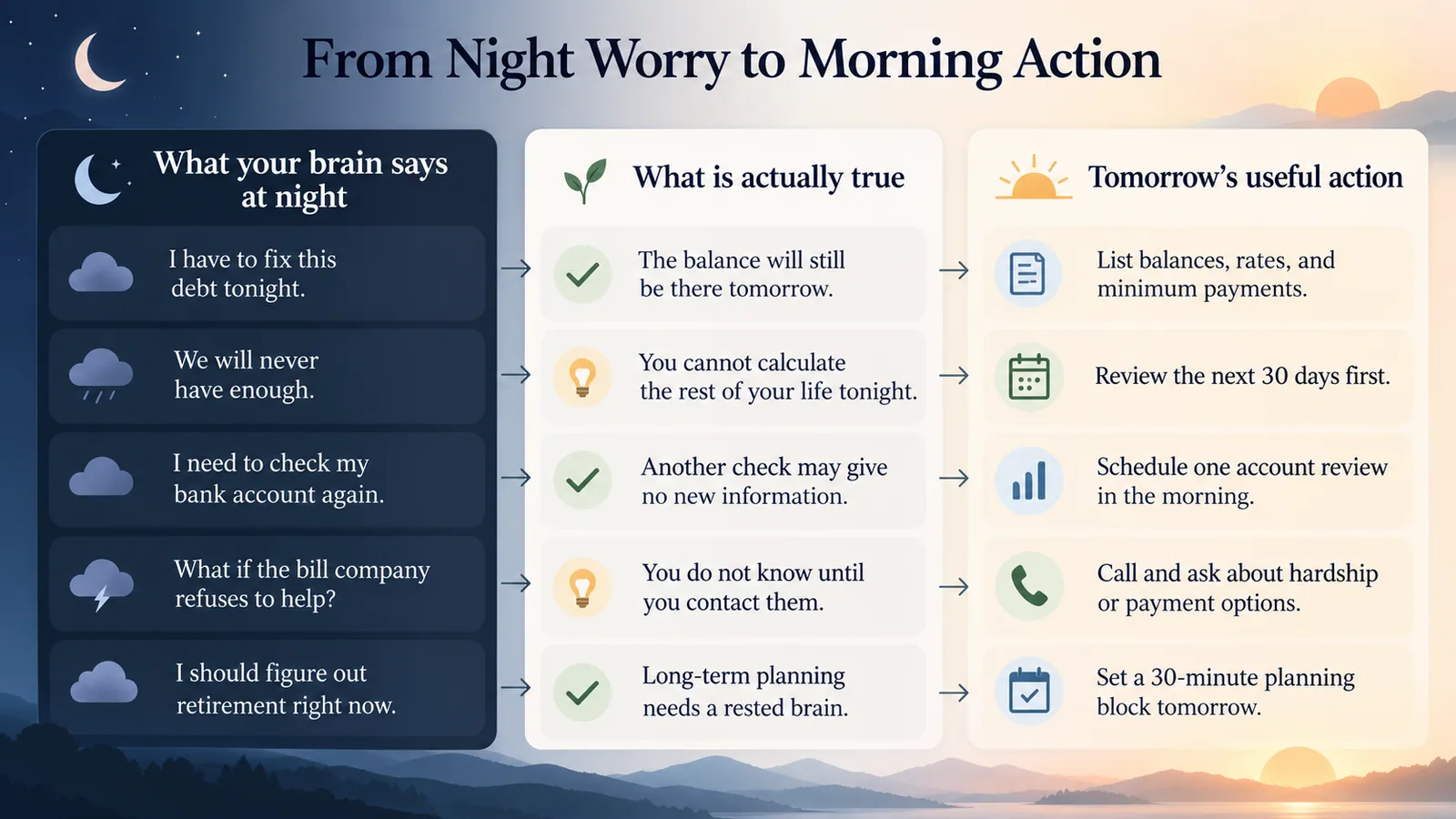
That is where Scripture and practical planning can work together.
If anxiety at night goes beyond finances, this broader guide to Bible verses for anxiety at night covers other forms of racing thoughts without repeating the money-specific steps below.
The Rule for Tonight: Calm Now, Calculate Tomorrow
This article does not tell you to ignore bills.
It separates two jobs.
Tonight's job: calm your mind, pray honestly, and write down the next action.
Tomorrow's job: open statements, make calls, move money, change the budget, ask for help, or make a decision.
That distinction matters because problem-solving in bed can become rumination.
A sleep-laboratory study found that people who spent five minutes writing a specific future to-do list before bed fell asleep faster than participants who wrote about things they had already completed. A separate study of “constructive worry” found that writing worries together with possible solutions reduced pre-sleep mental arousal.
The goal is not to pretend the problem disappeared.
The goal is to give the problem an appointment.
13 Bible Verses for Money Anxiety at Night
1. Matthew 6:34 — When You Are Trying to Pay Tomorrow's Bills Tonight
Jesus teaches His listeners not to carry tomorrow's trouble before tomorrow arrives.
That fits money anxiety almost perfectly. Your mind may be living through next month's rent, next year's retirement, a possible layoff, and an imaginary emergency all at once.
What this verse does not promise: It does not say tomorrow will contain no financial trouble. It tells you not to carry tomorrow's load with today's strength.
Prayer prompt: “God, help me deal with today's needs and stop borrowing fear from tomorrow.”
Postpone until morning: Forecasting every expense that could possibly happen over the next year.
Write instead: “Tomorrow at 9:00: review the next 30 days only.”
2. Philippians 4:6–7 — When the Same Numbers Keep Circling
Paul connects anxiety with a different action: bring specific requests to God in prayer.
Notice that prayer does not require pretending everything is fine. You can name the exact amount, bill, debt, or fear.
What this verse does not promise: It does not promise that prayer will instantly erase the balance or make every anxious feeling disappear.
Prayer prompt: “God, I am worried about the $___ I need. Give me peace tonight and wisdom for my next step.”
Postpone until morning: Checking the same bank balance for the fourth time.
You already know the number.
3. 1 Peter 5:7 — When You Feel Responsible for Every Possible Outcome
Peter tells believers to cast their cares on God because He cares for them.
Financial anxiety often says, “If I stop worrying, something will go wrong.” But worry is not the same thing as responsibility.
What this verse does not promise: Giving a worry to God does not mean you never need to budget, call a lender, work, plan, or seek advice.
Prayer prompt: “God, this problem matters, but I cannot carry every possible outcome tonight.”
Postpone until morning: Trying to predict whether your employer, customer, landlord, lender, or economy will behave exactly as you hope.
For a shorter method built around this passage, use this five-minute method for overthinking with 1 Peter 5:7.
4. Psalm 4:8 — When You Are Afraid to Let Yourself Sleep
Psalm 4 moves toward a simple act of trust: lying down in peace.
Sleep can feel irresponsible when money is tight. Your brain may argue that staying awake means staying prepared.
It does not.
What this verse does not promise: Sleep does not remove tomorrow's responsibilities.
Prayer prompt: “Lord, the problem will still exist in the morning. Help me trust You enough to rest before I face it.”
Postpone until morning: Making major financial decisions while exhausted.
Do not cancel an insurance policy, empty an investment account, borrow money, or send an emotional message at 2 a.m. unless there is a true emergency.
5. Matthew 6:31–33 — When You Are Worried About Basic Needs
Jesus specifically mentions food, drink, and clothing.
That matters because financial anxiety is not always about wanting more. Sometimes you are worried about groceries, housing, medicine, utilities, or caring for your children.
What this verse does not promise: This passage should not be turned into “God will make me wealthy” or “Christians never experience poverty.”
Jesus is teaching trust in the Father's knowledge and care, not a prosperity formula.
Prayer prompt: “Father, You know what my household needs. Show me the next faithful step.”
Postpone until morning: Solving six months of expenses.
Start with food, shelter, utilities, transportation, medicine, and the bills with the biggest consequences if missed.
If the immediate problem is that several bills genuinely cannot be paid, see what to do when the bills keep piling up for a more detailed financial triage process.

6. Philippians 4:19 — When “Not Enough” Is the Thought You Cannot Escape
Paul writes about God supplying needs according to His riches in Christ.
Read that word carefully: needs.
What this verse does not promise: It is not a blank check for every purchase, financial goal, desired lifestyle, or investment outcome.
The verse also comes from a letter involving generosity, partnership, hardship, and contentment. It should not be pulled out of that setting and used as a guarantee of easy money.
Prayer prompt: “God, help me separate what I need from what fear tells me I must have.”
Postpone until morning: Comparing your savings, salary, home, car, or lifestyle with someone else's.
Comparison rarely improves tomorrow's cash flow.
7. Psalm 23:1 — When Your Bank Balance Feels Like Your Shepherd
“The Lord is my shepherd” changes the center of the picture.
Money is useful. Savings are wise. Insurance can be wise. A stable income matters.
But none of those things were designed to become your shepherd.
What this verse does not promise: Psalm 23 does not guarantee that a Christian will never experience financial loss or seasons of lack.
It presents God as the One who guides, stays near, and cares for His people.
Prayer prompt: “Lord, money is a tool. You are my Shepherd. Guide me through what I cannot see yet.”
Postpone until morning: Refreshing investment or account values when you have no decision to make tonight.
You can also slowly read Psalm 23 and its themes of provision, rest, and shepherd-care before sleep.
8. Proverbs 3:5–6 — When You Are Desperate for Certainty
Financial anxiety often wants a guarantee.
Should I move? Change jobs? Pay debt or save? Sell the car? Help a relative? Stop investing? Start investing?
Proverbs points toward trust when your own understanding reaches its limit.
What this verse does not promise: “Lean not on your own understanding” does not mean “stop thinking.”
The book of Proverbs repeatedly values wisdom, planning, knowledge, and advice.
Prayer prompt: “God, help me use the facts I have without pretending I can predict everything.”
Postpone until morning: Reopening a decision when no new information has appeared.
This guide on how to trust God when your brain will not stop goes deeper into productive thinking versus anxious looping.
9. James 1:5 — When You Need Wisdom More Than Reassurance
Sometimes you do not need God to immediately change the number.
You need wisdom.
Maybe you need to choose which bill comes first, whether a purchase can wait, how to talk to your spouse, or who to ask for professional help.
What this verse does not promise: Wisdom does not mean every choice becomes obvious.
You may still need facts, counsel, and time.
Prayer prompt: “God, give me wisdom for the next decision, not answers to every future question.”
Postpone until morning: Researching dozens of financial strategies.
Choose one question tomorrow and find the information needed to answer that question.
10. Proverbs 21:5 — When Panic Is Pushing You Toward a Fast Decision
Proverbs praises diligent planning and warns against haste.
That is excellent financial wisdom.
Fear loves fast fixes: a desperate loan, a risky investment, a questionable debt-settlement promise, or an expensive purchase that temporarily makes you feel better.
What this verse does not promise: Good planning cannot remove every emergency or guarantee wealth.
It improves your ability to respond wisely.
Prayer prompt: “God, protect me from panic decisions. Help me make a patient plan.”
Postpone until morning: Anything involving a large transfer, new debt, cancellation, investment, or contract that does not truly need to happen tonight.
Sleep first. Read the terms tomorrow.
11. Hebrews 13:5–6 — When “More Money” Feels Like the Only Way to Feel Safe
Hebrews connects contentment with God's presence: He will not leave His people.
That does not make savings unimportant. It challenges the belief that peace can begin only after your account reaches some perfect number.
What this verse does not promise: Contentment does not mean accepting dangerous financial conditions without trying to improve them.
You can be grateful and still negotiate your pay, reduce debt, seek work, build savings, or ask for help.
Prayer prompt: “God, help me pursue financial stability without making money the source of my worth.”
Postpone until morning: Calculating the exact amount you believe would finally make you “safe forever.”
No number can remove every future risk.
12. Psalm 55:22 — When the Financial Weight Feels Physical
Money worry can feel heavy in the body.
Your shoulders tighten. Your stomach turns. Your mind keeps returning to the same amount.
Psalm 55 uses the language of placing a burden somewhere else.
What this verse does not promise: Giving God your burden does not mean refusing help from other people.
Sometimes the faithful next step is calling a family member, pastor, benefits office, nonprofit counselor, or qualified professional.
Prayer prompt: “God, I cannot keep carrying this alone. Show me what belongs in prayer and what needs outside help.”
Postpone until morning: Deciding that you must fix the problem privately because you feel embarrassed.
13. Isaiah 41:10 — When the Real Fear Is “What If I Cannot Handle This?”
Sometimes money is only the first layer.
Under it is another fear: “What happens if I lose the job? What if the car dies? What if the rent rises? What if I cannot protect my family?”
Isaiah speaks to fear with God's presence, help, and strength.
What this verse does not promise: It does not promise that frightening circumstances never arrive.
It tells God's people that fear does not have to be faced as though they are alone.
Prayer prompt: “God, I do not know what happens next. Give me enough strength for the next step.”
Postpone until morning: Mentally living through disasters that have not happened.
Prepare for reasonable risks in daylight.
Do not experience imaginary emergencies all night.
The 10-Minute Nighttime Scripture Routine for Money Anxiety
You do not need to read all 13 verses every night.
Choose one.
Then follow this routine.
Minutes 0–2: Name the Exact Money Fear
Do not write, “I'm stressed about money.”
Get specific.
“I am afraid there will not be enough for rent on the 5th.”
“I owe $8,400 on credit cards and do not know where to start.”
“My emergency fund is only $500.”
“My hours were cut and I am afraid they will be cut again.”
A named problem is easier to separate from a cloud of fear.
Minutes 2–4: Read One Verse Slowly
Read one passage twice.
Do not hunt for a verse that promises the exact outcome you want.
Ask instead:
“What does this passage tell me about God?”
“What does it tell me about fear?”
“What does it tell me about my responsibility?”
“What does it not promise?”
That last question protects you from turning Scripture into a guarantee of instant financial rescue.
Minutes 4–6: Separate the Fact From the Forecast
Fold a page into two imaginary columns.
Write the fact on one side and your prediction on the other.
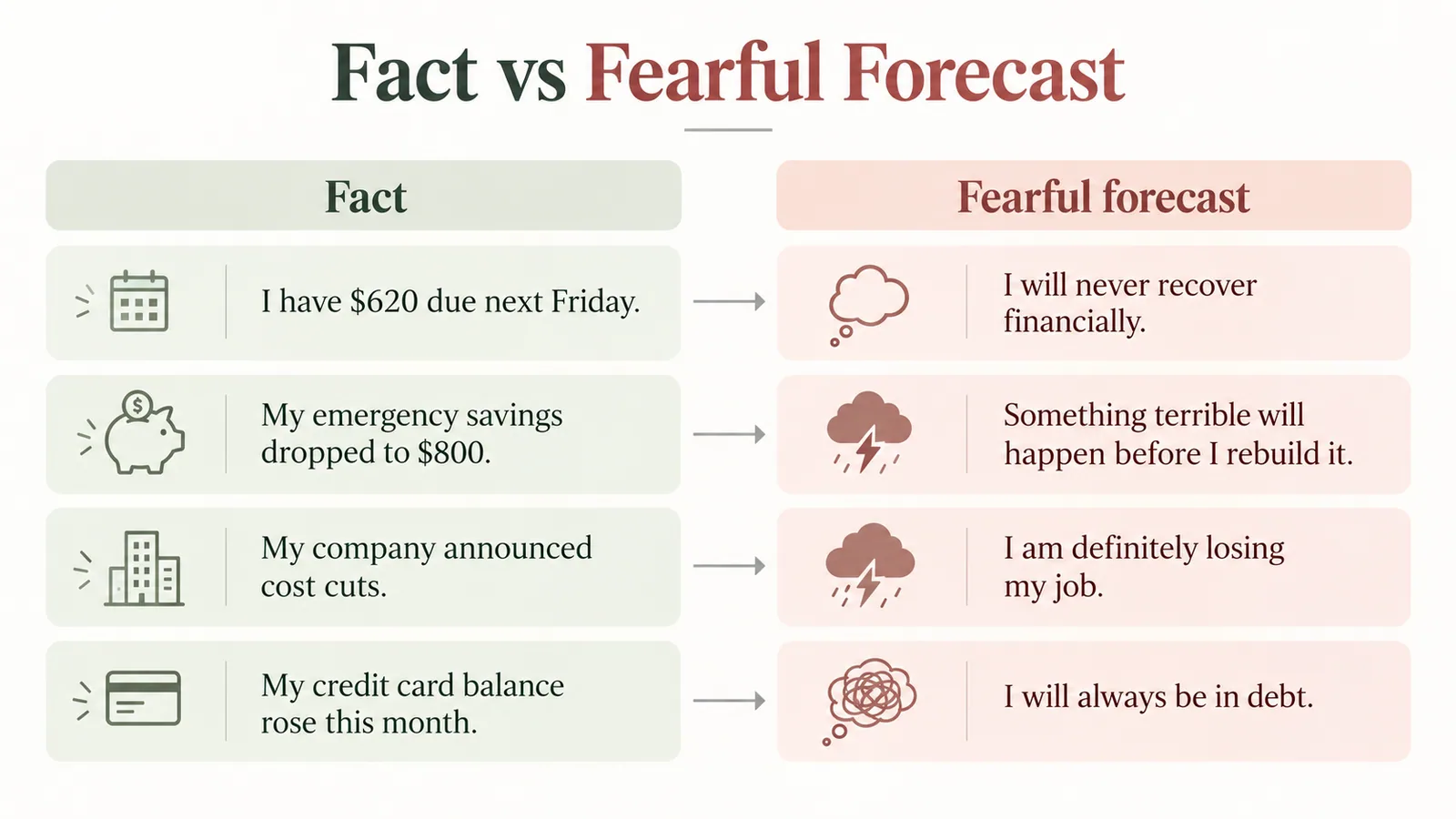
A forecast may become true.
But it is not a fact yet.
Minutes 6–8: Pray About the Real Problem
Keep the prayer short.
“God, this bill is real. My fear about the next ten years is not something I can solve tonight. Give me peace now and wisdom tomorrow.”
You do not need impressive words.
You need honesty.
Minutes 8–10: Give the Problem a Morning Appointment
Write one action.
Not twelve.
Examples:
“9:00 a.m. — call electric company about payment options.”
“12:30 p.m. — list all credit-card minimums.”
“6:00 p.m. — review grocery spending with spouse.”
“Saturday 10:00 a.m. — build a basic emergency-fund plan.”
Then stop.
Research on bedtime to-do lists suggests that putting future tasks onto paper can help reduce the mental load of trying to remember unfinished business.

Three Real-World Money-Anxiety Scenarios
The following are composite scenarios based on common financial problems. They are not presented as stories of identifiable individuals.
Story 1: The Credit Card Minimum Is Due Friday
Maria wakes at 1:40 a.m. thinking about a card payment.
She starts calculating how long repayment will take, what happens if the car breaks down, whether she should transfer the balance, and whether she should get another job.
None of those decisions can be made well at 1:40 a.m.
Her nighttime action is simple:
Verse: Proverbs 21:5.
Prayer: Ask for patience and wisdom.
Tomorrow task: Write down the balance, interest rate, minimum payment, and due date. Then compare repayment options.
That turns one giant fear into one financial task.
Story 2: Income Is Uncertain
Daniel is self-employed.
Two clients have not renewed yet, and his mind turns “two uncertain contracts” into “I will lose my home.”
His facts and fears are mixed together.
He uses Matthew 6:34 and writes:
Fact: Two contracts are undecided.
Fear: All income will disappear.
Tomorrow task: Follow up with both clients and calculate the minimum monthly income his household actually needs.
The situation is still uncertain.
But his mind no longer has to solve uncertainty while he is in bed.
Story 3: A Couple Keeps Having Money Arguments at Night
Chris wants to check the budget before sleeping. Taylor hears every money conversation as proof that they are in danger.
They start talking at 10:45 p.m., become defensive, and stay awake for two more hours.
A better boundary is: no major financial meetings in bed.
They keep a shared “money parking lot.”
When a problem appears at night, either person can write it there. They discuss it during a planned 30-minute money meeting the next day.
The problem is not ignored.
It is moved to a better time.
What to Do Tomorrow Morning When the Money Problem Is Real
Scripture should not become a way to avoid financial action.
When morning comes, act.
Start by asking, “What happens if I do not pay this?”
The Consumer Financial Protection Bureau advises people who are behind on bills to make an action plan, track income and spending, and prioritize bills and expenses. It also notes that missed payments can have very different consequences, ranging from fees to service shutoff, repossession, or housing problems.
That means the loudest creditor is not always the first priority.
Protect basic needs and understand the consequences of each missed payment.
Then make the call.
Ask directly:
“Do you have a hardship plan?”
“Can the due date be changed?”
“Is a payment plan available?”
“What happens if I make a partial payment?”
“Can any fee be waived?”
If debt has become too complicated to manage alone, a reputable nonprofit credit counselor may be useful. The National Foundation for Credit Counseling says its member agencies can review a person's finances, create a personalized action plan, and, where appropriate, discuss debt-management options.
This is general information, not personalized financial advice. Major decisions involving bankruptcy, taxes, investments, legal claims, or large debts may require a qualified professional who can review your actual situation.
A Simple Morning Financial Triage List
If last night's worry was based on a real shortfall, do these steps in order.
-
Write down the money currently available.
-
Write down income expected before the next payday or month-end.
-
List bills with due dates.
-
Mark basic needs such as housing, food, medicine, essential utilities, and necessary transportation.
-
Identify what happens if each bill is late.
-
Contact companies before assuming no help exists.
-
Remove or pause optional spending where practical.
-
Decide on one debt or savings task to focus on next.
Do not try to create the perfect five-year financial plan during a crisis.
First stabilize the next few weeks.

What These Bible Verses Do Not Mean
This matters.
Bible verses about money anxiety should not be used to make promises Scripture does not make.
They do not mean:
“Real Christians never worry.”
“God will make every believer wealthy.”
“If I pray correctly, the bill will disappear.”
“Budgeting shows a lack of faith.”
“Needing financial help means I failed.”
“Feeling anxious means my faith is fake.”
Biblical trust and responsible action can exist together.
You can pray and make a spreadsheet.
You can trust God and call the lender.
You can practice contentment and ask for better pay.
You can believe in God's provision and still build an emergency fund.
For more careful reading of biblical provision passages, see God's promises about provision, presence, and perseverance.
When Money Anxiety Needs More Than a Bedtime Routine
A short Scripture routine can help with ordinary nighttime worry.
It is not a substitute for professional care when anxiety or insomnia becomes persistent.
Consider getting additional support if money thoughts regularly keep you from sleeping, cause panic, interfere with work or relationships, lead to hours of repeated checking, or make daily decisions hard to complete.
Financial hardship and sleep problems can feed each other. Research has found associations between financial strain, insomnia, poor sleep quality, and psychological distress.
A pastor can provide spiritual support.
A qualified financial professional can help with complex money decisions.
A licensed mental-health professional or doctor can help when anxiety or sleep problems become persistent or severe.
Those forms of help do not have to compete with faith.
Frequently Asked Questions About Bible Verses for Money Anxiety at Night
What is the best Bible verse for worrying about money at night?
Matthew 6:34 is a strong place to begin because it directly addresses worrying about tomorrow.
For a racing mind, Philippians 4:6–7 and 1 Peter 5:7 are also helpful because they move the reader from carrying worry alone toward prayer and trust.
What Bible verse should I read when I cannot sleep because of bills?
Try Psalm 4:8 together with Matthew 6:34.
Psalm 4:8 focuses on lying down in peace, while Matthew 6:34 helps put tomorrow's trouble back into tomorrow.
Then write one bill-related action for the morning.
Does the Bible promise that God will pay my bills?
The Bible teaches God's care, provision, wisdom, generosity, and presence.
It should not be reduced to a promise that every bill will automatically be paid, every financial hardship will disappear, or faithful Christians will always be financially comfortable.
That is why passages such as Philippians 4:19 and Matthew 6 should be read in context.
Is worrying about money a sin?
Feeling worried is not the same thing as choosing rebellion against God.
Financial pressure can trigger real fear, especially when housing, food, debt, children, health care, or employment are involved.
Scripture repeatedly calls believers toward trust and prayer, but that should lead to compassion and wise action rather than shame.
What should I pray when I am scared about money?
Keep it specific.
Try:
“God, You know what I need and what I am afraid of. Give me peace for tonight, wisdom for tomorrow, courage to face the numbers honestly, and help with what I cannot control. Amen.”
Should Christians make financial plans if they trust God?
Yes.
Trust is not the same as refusing to plan.
Proverbs regularly praises wisdom, diligence, counsel, and careful action. Planning becomes unhealthy when we expect the plan to give us total control over the future.
What should I do if I cannot pay all my bills?
Do not simply pay whoever contacts you most aggressively.
List your bills, identify the consequences of missing each one, protect basic needs, and contact providers or creditors about available options.
If the situation is serious, consider a reputable nonprofit credit counselor or another qualified professional.
Why does money anxiety feel worse when I go to bed?
Night removes many daytime distractions.
There are also fewer useful actions available: the bank is closed, your employer is asleep, and the bill cannot be negotiated at 2 a.m.
That makes repetitive thinking especially tempting.
A written “tomorrow task” gives your brain a place to put unfinished business until action is actually possible.
What if I pray but still feel anxious?
Prayer is not a test where feeling calm proves you did it correctly.
You can pray faithfully and still have an activated nervous system, a difficult financial situation, or an anxiety condition that needs additional support.
Take the next wise step even if your emotions need longer to settle.
Should I check my bank account when I wake up worried?
Ask whether checking will give you useful new information.
If the balance has not changed and you already know what is there, another check may simply feed the worry loop.
Write down when you will review it tomorrow instead.
Tonight, You Need One Verse and One Tomorrow Task
You do not need to repair your credit, build six months of savings, solve retirement, repay every debt, protect yourself from every emergency, and understand God's entire plan before you fall asleep.
You need one verse.
One honest prayer.
One problem written down.
One next action for daylight.
Then let tonight be tonight.
The bill can have an appointment tomorrow.
Your bed does not need to become a financial planning office.

Key Statistics
U.S. adults negatively affected by money
43%
Share of U.S. adults who said money negatively affected their mental health at least occasionally, including anxiety, stress, worry, depression, or loss of sleep. Survey conducted March 19–21, 2025.
Source: S1 — Bankrate Money and Mental Health Survey
Everyday expenses as a money stressor
61%
Among U.S. adults whose mental health was negatively affected by money, 61% cited everyday expenses such as groceries and utilities.
Source: S1 — Bankrate Money and Mental Health Survey
Credible Sources
Bankrate · April 30, 2025
Direct source for the article’s 43%, 61%, 57%, and 43% money-stress statistics. It also identifies the survey dates and population.
Sleep Health: Journal of the National Sleep Foundation · January 22, 2025 online; April 2025 issue
Primary peer-reviewed research supporting the connection between perceived financial hardship and insomnia, poor sleep quality, and sleep duration. It also supplies the 4,388-person sample size and effect estimates.

About the Author
Editorial Team
Editorial Team
Daily Faith Path articles are prepared by the editorial team to help readers find scripture-centered guidance for healing, faith, prayer, and spiritual encouragement.
Expertise: Healing scriptures, Bible study resources, prayer guidance, devotional writing, Christian encouragement
Experience: The team researches scripture references, reviews surrounding biblical context, compares translation wording where useful, and updates articles to improve clarity, usefulness, and trust for readers.
Credentials: Editorial review, devotional writing, scripture study, content updating
This article is published by the Daily Faith Path editorial team to help readers use scripture carefully, prayerfully, and in ways that are practical for real-life seasons of illness, grief, waiting, and spiritual reflection.
Continue Reading
Related articles

October 7, 2026
12 Bible Verses About Hiding Money From Your Spouse
Explore 12 Bible verses about secret spending, hidden debt, financial honesty, confession, forgiveness, boundaries, and rebuilding trust in marriage.

October 6, 2026
15 Bible Verses for Couples Who Keep Fighting About Money
Money fights are rarely just about dollars. These 15 Bible verses help couples address spending, saving, debt, secrecy, unequal income, giving, and financial control with practical next steps and conversation questions.

October 5, 2026
Should You Tithe While in Debt? 11 Bible Passages to Study First
Should you tithe while in debt? Explore 11 Bible passages on tithing, debt, generosity, family responsibility, and giving according to your means—plus a practical plan for deciding what to do.