17 Bible Verses When the Bills Keep Piling Up
When bills keep piling up and money is running short, these 17 Bible verses offer biblical encouragement for financial stress—plus practical steps for prioritizing bills, asking for help, and making a 24-hour financial triage plan.

When the bills keep piling up and the money simply is not there, you do not need another person telling you, “Just stop worrying.” You need Scripture for the fear and a clear plan for what to do with the rent, groceries, utility notice, credit card balance, and next paycheck.
These 17 Bible verses about money when bills are piling up are organized around the moments financial stress actually hits: before you open the bill, when the numbers do not work, when you are scared about next month, and after you finish praying.
You will also find a simple 24-hour financial triage plan near the end.
Because trusting God does not mean pretending the electric bill is not due.
It means bringing the fear to God, getting clear about what is true, asking for wisdom, and taking the next responsible step.

You Are Not the Only Person Struggling to Make the Numbers Work
Financial stress is not a rare problem.
The Federal Reserve's 2026 report on U.S. household finances found that 16% of adults had not paid all their bills in full during the previous month. It also found that only 63% said they could cover a $400 emergency expense completely with cash or its equivalent.
Rent is especially hard for many households. In the same survey, 23% of renters said they had fallen behind on rent at some point during the previous year.
So if you are moving money from one bill to another, delaying a payment, or staring at a bank balance that cannot cover everything, you are dealing with a real financial problem.
That does not mean you have failed spiritually.
And Scripture does not require you to pretend the problem is smaller than it is.
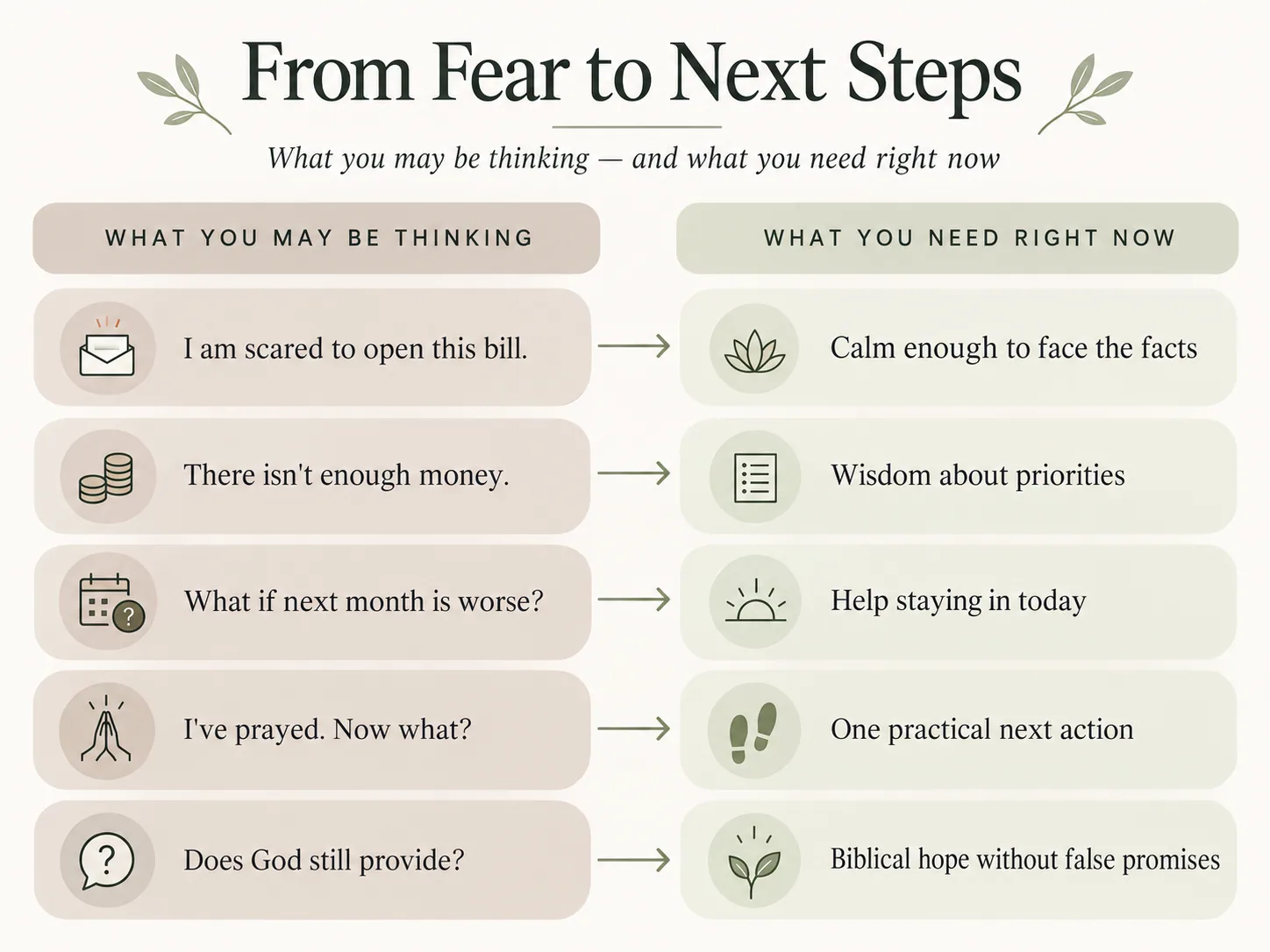
Before Opening the Bill: Read These Verses First
Sometimes the hardest part is not paying the bill.
It is opening it.
You see the envelope or notification and already feel your stomach tighten. Your mind starts calculating late fees, shutoff notices, overdrafts, or how many days remain until payday.
Start here.
1. Psalm 56:3 — When Fear Hits Before the Facts Do
“What time I am afraid, I will trust in thee.”
Notice what David does not say.
He does not say, “I never feel afraid.”
He says fear can become the moment when he deliberately turns toward God.
That matters when you are avoiding a bill because you are scared of the number.
Try this before opening it:
“God, I am afraid of what this bill may say. Help me face what is true and make a wise next decision.”
Then open it.
Fear grows in uncertainty. A real number, even a difficult one, gives you something you can work with.
2. Isaiah 41:10 — You Do Not Face the Problem Alone
Isaiah 41:10 begins with the command not to fear and grounds that command in God's presence: “for I am with thee.”
That does not mean the balance disappears.
It means the balance is not the only fact in the room.
You have a bill in front of you.
You also have a God who does not abandon His people in hard places.
If financial anxiety continues even after prayer, that does not automatically mean you are failing to trust God. Sometimes an anxious problem also requires a practical response such as reviewing the bill, contacting a provider, or asking someone for help.
For more on that distinction, read Isaiah 41:10 for anxiety when fear will not go away.
3. 1 Peter 5:7 — Put the Worry Somewhere
“Casting all your care upon him; for he careth for you.”
Financial anxiety makes you carry tomorrow, next month, Christmas, the car repair, rent, groceries, and retirement at the same time.
You were not built to solve all of those tonight.
Write down the exact worry instead:
“I am $280 short for rent.”
That sentence is easier to work with than:
“My whole life is falling apart.”
Give the fear to God, then work on the actual $280 problem.
4. Philippians 4:6–7 — Pray Before Panic Makes the Decisions
Paul tells believers to bring their requests to God through prayer and thanksgiving.
The promise in the passage is not that every financial request will immediately be granted.
It is that God's peace can guard you even while real needs remain.
That peace matters because panic makes expensive decisions.
Panic may push you toward a loan you do not understand, an unnecessary cash advance, hiding the problem from your spouse, or ignoring a creditor until the options become worse.
Pray first.
Then gather the facts.

When the Numbers Do Not Work: Bible Verses for Not Having Enough
Now suppose you have opened everything.
Rent: $1,200.
Utilities: $230.
Groceries needed: $180.
Car insurance: $140.
Minimum debt payments: $260.
Money available: $1,650.
The problem is no longer vague anxiety.
You are short.
What does faith look like here?
5. Matthew 6:31–33 — Needs Matter to God
Jesus specifically names food, drink, and clothing in Matthew 6.
These are ordinary needs.
That is important because financial fear often feels unspiritual. You may think you should be praying about bigger things than groceries or rent.
Jesus does not treat daily needs as embarrassing.
He teaches His followers to seek God's kingdom rather than letting those needs become the ruler of their lives.
This passage should not be twisted into:
“A Christian will never struggle to afford groceries.”
Christians throughout history have faced poverty, unemployment, famine, loss, and hardship.
The stronger message is this:
Your needs matter to God, but fear does not have to become your master.
For a broader look at what Scripture actually promises about presence and provision, see God's promises about provision and difficult seasons.
6. Philippians 4:19 — God Knows the Difference Between Need and Luxury
“But my God shall supply all your need according to his riches in glory by Christ Jesus.”
Philippians 4:19 is often printed on financial encouragement cards.
But it is not a blank check promising wealth.
Paul himself knew abundance and lack.
The verse sits inside a larger lesson about contentment, generosity, and God's care.
So pray for provision.
But do not turn the verse into a promise that money must appear by Friday.
Provision can arrive through work, generosity, community, a payment arrangement, reduced expenses, assistance, a new opportunity, or help you did not want to admit you needed.
7. Psalm 23:1 — “The Lord Is My Shepherd”
“The LORD is my shepherd; I shall not want.”
A shepherd provides, leads, protects, and stays near.
But sheep still walk through valleys.
Psalm 23 does not say God's people never enter frightening places. It says the Shepherd remains with them there.
When you are afraid there will not be enough next month, slowly reading the whole Psalm can be more useful than pulling one sentence away from its context.
You can read Psalm 23 as a passage about God's provision, guidance, and care.
8. Proverbs 3:5–6 — Trust Does Not Mean Stop Thinking
“Trust in the LORD with all thine heart; and lean not unto thine own understanding.”
This verse is sometimes treated as though thinking carefully about money shows weak faith.
The rest of Proverbs makes that impossible.
Proverbs praises planning, wisdom, work, counsel, and careful decisions.
Trusting God means your spreadsheet is a tool.
It is not your god.
Calculate what you can calculate.
Then stop demanding that your brain predict every possible disaster six months from now.
When financial problem-solving turns into endless mental looping, this guide on Proverbs 3:5–6 and financial overthinking can help you separate useful planning from anxiety.
9. James 1:5 — Ask God for Wisdom, Not Only Money
“If any of you lack wisdom, let him ask of God.”
Sometimes our first prayer is:
“God, give me $500.”
That is an honest prayer.
But also pray:
“God, give me wisdom about this $500 problem.”
Maybe you need to call the utility company.
Maybe you need to cancel three subscriptions.
Maybe you need to tell your spouse what is actually happening.
Maybe you need to ask your church, family, local charity, or community program for help.
Maybe you need professional debt advice.
Money can solve some problems.
Wisdom helps you decide what to do whether the money appears immediately or not.
A Real-World Example: $420 Short Before Payday
Consider this realistic example.
“Rachel” is a composite example, not a claimed individual testimony.
She has $980 left in checking.
Before payday, she owes:
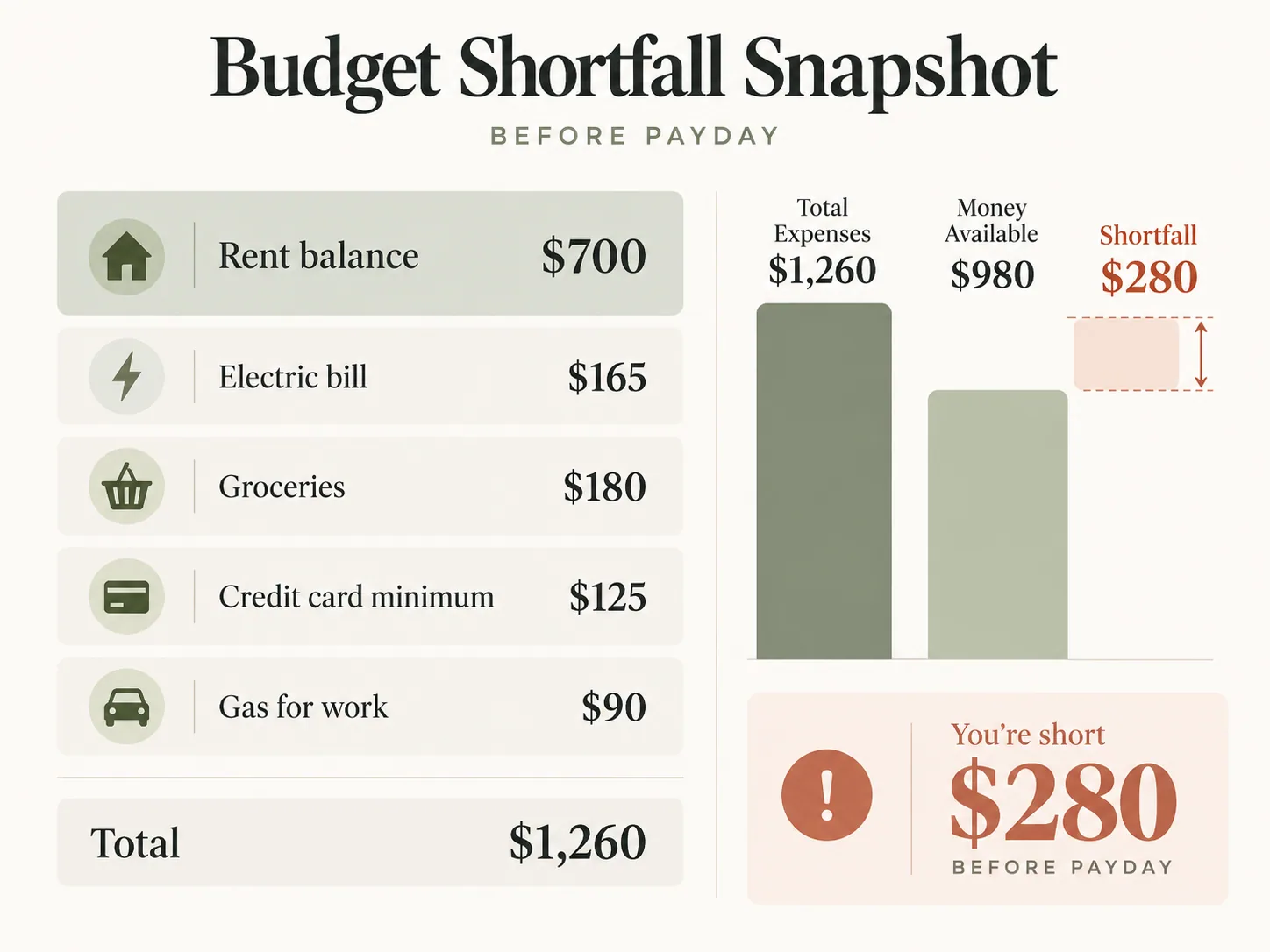
Rachel's first instinct is to spread the $980 across every bill.
That feels fair.
But it may not be wise.
Instead, she asks which expenses protect basic needs and her ability to keep earning money.
She buys essential groceries.
She keeps enough gas to reach work.
She protects housing as much as possible.
Then she calls the power company and credit-card issuer before simply missing the payments.
The CFPB recommends contacting companies you owe when you are struggling and asking what payment options may be available. Its bill-prioritization guidance also tells consumers to consider the consequences of missing each payment rather than simply paying the “squeakiest wheel.”
The important lesson is not that Rachel magically finds $280.
It is that she stops treating five problems as one giant emergency.
Now she can work them one by one.
When You Are Afraid of Next Month
This is where financial anxiety gets sneaky.
Today's bills may be handled.
But your mind says:
“Fine. What about next month?”
10. Matthew 6:34 — Do Not Pay Tomorrow's Emotional Bill Today
“Take therefore no thought for the morrow... Sufficient unto the day is the evil thereof.”
Jesus is not banning planning.
He is warning against carrying tomorrow's trouble before tomorrow arrives.
A budget is planning.
Lying awake imagining losing your home eight months from now is not the same thing.
Ask:
Is there something I can do about next month today?
If yes, do it.
If not, write it down and return to today.
If future-focused worry has become constant, these Bible verses for anxiety about the future go deeper into that pattern.
11. Psalm 37:25 — Remember God's Faithfulness Without Making Guarantees
David looks back over his life and reflects on God's care for the righteous.
This is testimony language.
It invites you to remember.
Think about difficult seasons you have already survived.
Who helped you?
What door opened?
What did you learn?
What did you think would destroy you but did not?
Remembering past provision cannot guarantee the exact form of future provision.
But it can keep fear from rewriting your whole history.
12. Lamentations 3:22–23 — Mercy Comes Daily
“They are new every morning.”
Financial fear wants a six-month supply of certainty.
Lamentations points toward daily mercy.
That changes the question.
Instead of:
“Can I prove everything will be okay for the next year?”
Ask:
“What do I need for the next faithful day?”
That question is smaller.
And often much more useful.
13. Hebrews 13:5–6 — Money Is Not the Same as Security
Hebrews warns against letting the love of money control us and reminds believers of God's presence.
That matters whether you have $50 or $500,000.
Money can solve many real problems.
It cannot make life completely safe.
Financial planning is wise.
Expecting money to remove every possible fear is impossible.
The goal is not to stop caring about your finances.
It is to put money back in its proper place.

What to Do After Praying: Bible Verses About Taking Action
Prayer is not the point where responsible action ends.
Very often, it is where clearer action begins.
14. Proverbs 21:5 — Make a Plan
“The thoughts of the diligent tend only to plenteousness.”
Good plans do not guarantee good outcomes.
But avoiding the numbers almost guarantees confusion.
Write down:
Income available.
Bills due.
Due dates.
Minimum payments.
Essential expenses.
What happens if each bill is late.
Now you are working with facts.
15. Proverbs 15:22 — Get Advice Before Making a Desperate Decision
“Without counsel purposes are disappointed: but in the multitude of counsellors they are established.”
Financial shame tells you to hide.
Wisdom tells you to find trustworthy help.
That might mean talking with a spouse, financially responsible family member, pastor, nonprofit credit counselor, housing adviser, benefits specialist, or other qualified person.
Be especially careful before taking high-cost debt simply because you need relief today.
A fast solution can create a bigger monthly problem.
16. Luke 14:28 — Count the Cost
Jesus uses the example of someone sitting down first to count the cost before building.
The direct context is discipleship.
But the basic picture is easy to understand: wise people look at costs before committing themselves.
Use that principle when someone offers you:
A personal loan.
A buy-now-pay-later plan.
A car refinance.
A balance transfer.
A “no payment for 90 days” deal.
Ask:
What will this cost in total?
Not only:
What is the monthly payment?
17. Galatians 6:2 — Let Other People Help Carry the Load
“Bear ye one another's burdens.”
Receiving help can feel humiliating when you are used to being independent.
But Christian community was never designed around everybody pretending they are fine.
Sometimes carrying a burden means someone prays for you.
Sometimes it means a meal.
Sometimes it means a job lead.
Sometimes it means childcare while you work.
Sometimes it means helping you understand a bill or fill out an assistance application.
Needing help is not the same as refusing responsibility.
The 24-Hour Faith-Based Financial Triage Checklist
If the bills are piling up right now, do not try to rebuild your entire financial life tonight.
Use the next 24 hours to stop the situation from becoming harder.
Hour 1: Pray, Then Open Everything
Do not make financial decisions based on unopened envelopes or guessed balances.
Gather every urgent bill.
Write down the amount, minimum due, due date, and consequence of nonpayment.
Your prayer can be simple:
“God, help me see clearly. Give me wisdom, courage, and honesty for the next step.”
Hour 2: Protect the Basics
Start with needs that protect life, shelter, health, safety, and your ability to earn income.
Depending on your situation, these may include:
-
Housing.
-
Basic utilities.
-
Essential food.
-
Needed medicine.
-
Transportation to work.
-
Essential insurance.
-
Childcare needed for employment.
This does not mean every other bill is unimportant.
It means when money cannot cover everything, you have to understand the consequences of each choice.
Hours 3–5: Call Before You Miss the Payment
Do not assume the answer is no.
Call the company.
Ask:
“I'm having a short-term financial hardship. What options do you have for reduced payments, due-date changes, payment plans, hardship programs, or fee waivers?”
The CFPB specifically recommends contacting companies when you are struggling to pay and discussing available options.
Write down the person's name, date, and what was offered.
Hour 6: Find the Exact Gap
Do not say:
“I need more money.”
Calculate:
“I am $347 short between today and payday.”
A specific problem creates specific choices.
Maybe $120 can be delayed.
Maybe $75 can be cut.
Maybe $50 can come from selling something unused.
Maybe a provider can move $102 to next month.
Now the gap is no longer an invisible monster.
Hours 7–10: Cut Fast, Not Blindly
Look for spending you can stop today without creating a bigger problem tomorrow.
Examples include:
Subscription renewals.
Takeout.
Nonessential shopping.
Optional memberships.
Convenience fees.
Unused software.
Entertainment purchases.
But do not cancel something essential to your work, health, insurance, or housing just because it appears expensive.
Cheap decisions can become costly decisions.
Hours 11–14: Look for Available Help
Check local programs for:
Food assistance.
Utility assistance.
Housing support.
Church benevolence.
Community food programs.
Prescription assistance.
Childcare support.
Unemployment benefits if applicable.
Do not wait until every account reaches zero before asking what exists.
Hours 15–18: Tell One Safe Person the Truth
Financial problems become harder when shame forces you to manage them alone.
Choose someone trustworthy.
Say:
“I'm short on my bills this month. I am working through the numbers, but I need someone who can help me think clearly.”
You are not required to tell everybody.
Tell somebody wise.
Hours 19–22: Make Tomorrow's Three-Item List
Do not write 28 financial goals.
Write three.
For example:
-
Call landlord at 9 a.m.
-
Apply for utility assistance.
-
Cancel two unused subscriptions.
That is enough for one day.
Hours 23–24: Stop
There is a point where more thinking is no longer useful.
You have prayed.
You have gathered the facts.
You have made calls.
You have chosen tomorrow's next steps.
Go to sleep if you can.
You are allowed to continue the problem tomorrow.

Another Real-Life Example: When Job Loss Hits All at Once
Imagine a two-income household suddenly losing one paycheck.
Again, this is a realistic composite, not a claimed documented testimony.
At first, the couple keeps spending normally because they believe another job will come quickly.
Six weeks later, savings are almost gone.
Now fear takes over.
A stronger response looks different.
They pray honestly about the job loss.
Then they calculate their new monthly income.
They freeze optional spending.
They contact lenders before missed payments multiply.
They update the résumé.
They tell trusted people they are looking for work.
They check whether they qualify for unemployment or community assistance.
They stop treating “trust God” as a reason to avoid uncomfortable decisions.
That is an important biblical safeguard.
Romans 8:28, for example, does not promise that losing a job will automatically lead to a better-paying job.
It promises something deeper about God's purpose even through suffering.
That is why faith still includes practical action when life goes wrong.
Three Financial Mistakes to Avoid When You Are Scared
Do Not Ignore the Bill Because You Cannot Pay It in Full
A bill you cannot pay may still be a bill you can negotiate.
Silence removes options.
Communication sometimes creates them.
Do Not Borrow Before You Understand the Full Cost
A payment of $70 a month may sound manageable.
But ask how many payments there are.
Ask the interest rate.
Ask the fees.
Ask what happens after a missed payment.
Ask for the total repayment amount.
Relief today should not quietly create a much larger problem next year.
Do Not Turn Every Financial Problem Into a Spiritual Verdict
A late bill does not tell you everything about your relationship with God.
Sometimes financial hardship follows poor choices.
Sometimes it comes from job loss, illness, rent increases, emergencies, low wages, family responsibilities, or several problems arriving together.
When there are choices you need to change, change them.
But shame is not a budget.
Wisdom is much more useful.
What God's Provision Does — and Does Not — Mean
Biblical teaching about provision is powerful.
But it becomes harmful when people promise more than Scripture promises.
God's provision does not mean every Christian will become wealthy.
It does not mean prayer guarantees a debt-free life.
It does not mean every overdue bill will be paid before the deadline.
It does not mean poverty proves weak faith.
It does not mean responsible planning shows a lack of trust.
Biblical trust lets you say two things together:
“God is my provider.”
And:
“I need to make three difficult phone calls this morning.”
Those sentences are not enemies.
They belong together.
Frequently Asked Questions About Bible Verses and Piling-Up Bills
What Bible verse should I read when I cannot pay my bills?
Start with Matthew 6:31–34 if fear about basic needs is taking over.
Then read James 1:5 and ask God for wisdom about your next practical step.
If you feel too afraid even to look at your bills, begin with Psalm 56:3.
What does the Bible say when you are struggling financially?
The Bible speaks about God's care, contentment, work, generosity, wise planning, avoiding greed, seeking counsel, helping people in need, and trusting God during uncertainty.
It does not promise Christians a life without financial hardship.
Will God help me pay my bills?
Christians can pray confidently for God's provision and help.
But Scripture does not promise that every bill will be paid in the exact way or time we expect.
Pray for provision and wisdom.
Then use the resources, relationships, work opportunities, payment options, and assistance available to you.
Is it wrong for a Christian to worry about money?
Financial fear is a normal human response to real uncertainty.
Jesus repeatedly speaks to worry because people experience it.
The goal is not to shame yourself for feeling afraid.
The goal is to bring the fear to God and keep fear from controlling your decisions.
Should I tithe if I cannot pay rent?
Christians hold different views on how Old Testament tithing applies to believers today, and churches teach this differently.
Do not make a major financial decision based on guilt or pressure from an article.
Study the relevant passages carefully and, if useful, talk with a trusted pastor or mature Christian leader who understands your actual situation.
What bills should I pay first if I cannot pay everything?
Start by understanding which payments protect essential needs such as housing, utilities, food, medicine, safety, necessary transportation, and income.
Then look at the consequence of delaying each remaining bill.
A secured debt, tax obligation, court obligation, credit card, medical bill, and subscription do not all carry the same consequences.
When the stakes are high, get qualified local financial or legal guidance.
Should I contact a company even if I know I cannot pay?
Yes.
Ask what options exist.
You may find payment plans, hardship programs, temporary reductions, due-date changes, or other arrangements.
You lose nothing by asking what is available.
What if I have already prayed and still feel anxious?
Prayer does not always make your body feel calm immediately.
Sometimes the next faithful step is practical.
Open the bill.
Check the balance.
Make the call.
Ask for help.
Then bring the next fear back to God.
When the Bills Keep Piling Up, Start With the Next Faithful Step
You do not need to solve the rest of your financial life tonight.
You need the next faithful step.
Open the bill.
Tell God the truth.
Write down the number.
Protect what matters most.
Make the phone call.
Ask for wisdom.
Accept help when you need it.
Then stop trying to live next month before next month arrives.
The Bible's answer to financial fear is not “pretend money does not matter.”
It is deeper than that.
Money matters.
Bills matter.
Food matters.
Housing matters.
Work matters.
And none of those things has to become bigger than God.
When the bills keep piling up, faith can look surprisingly ordinary:
A prayer.
A calculator.
A hard conversation.
A payment-plan request.
A meal somebody brings over.
A résumé sent before breakfast.
A budget with several uncomfortable lines crossed out.
And enough grace to take today's step without demanding that you already know how the whole story ends.
Key Statistics
Adults unable to pay all bills in full
16%
In the Federal Reserve’s 2025 household survey, 16% of U.S. adults said they had not paid all their bills in full during the previous month. This directly supports the article’s point that difficulty covering bills is a widespread financial problem.
Source: Federal Reserve — SHED 2025
Adults able to cover a $400 emergency with cash or equivalent
63%
63% said they could cover a hypothetical $400 emergency entirely using cash, savings, or a credit card paid off at the next statement. That leaves a substantial share needing another method or unable to cover the expense.
Source: Federal Reserve — SHED 2025
Credible Sources
Board of Governors of the Federal Reserve System · May 1, 2026
The strongest primary source for the article’s financial-hardship statistics. It supplies current national data on unpaid bills, emergency expenses, savings, housing, and broader household financial well-being.
Consumer Financial Protection Bureau · April 17, 2020
Supports the article’s practical advice to identify consequences, prioritize important bills, contact companies when payments are difficult, track bills, cut expenses, and create a short-term plan.

About the Author
Editorial Team
Editorial Team
Daily Faith Path articles are prepared by the editorial team to help readers find scripture-centered guidance for healing, faith, prayer, and spiritual encouragement.
Expertise: Healing scriptures, Bible study resources, prayer guidance, devotional writing, Christian encouragement
Experience: The team researches scripture references, reviews surrounding biblical context, compares translation wording where useful, and updates articles to improve clarity, usefulness, and trust for readers.
Credentials: Editorial review, devotional writing, scripture study, content updating
This article is published by the Daily Faith Path editorial team to help readers use scripture carefully, prayerfully, and in ways that are practical for real-life seasons of illness, grief, waiting, and spiritual reflection.
Continue Reading
Related articles

October 7, 2026
12 Bible Verses About Hiding Money From Your Spouse
Explore 12 Bible verses about secret spending, hidden debt, financial honesty, confession, forgiveness, boundaries, and rebuilding trust in marriage.

October 6, 2026
15 Bible Verses for Couples Who Keep Fighting About Money
Money fights are rarely just about dollars. These 15 Bible verses help couples address spending, saving, debt, secrecy, unequal income, giving, and financial control with practical next steps and conversation questions.

October 5, 2026
Should You Tithe While in Debt? 11 Bible Passages to Study First
Should you tithe while in debt? Explore 11 Bible passages on tithing, debt, generosity, family responsibility, and giving according to your means—plus a practical plan for deciding what to do.