Romans 8:28 Doesn't Mean What You Think
Romans 8:28 is often quoted as a promise that every hardship will eventually turn into a better earthly outcome. But Romans 8:29 reveals a deeper meaning: God's “good” is ultimately about conforming believers to the image of Christ and bringing them to final glory. This article explores the context of Romans 8, why suffering remains a reality for Christians, and how Romans 8:28 offers a stronger hope than the promise of improved circumstances.

Romans 8:28 does not promise that your bad situation will turn into the outcome you wanted. The next verse reveals something much bigger: God's "good" includes shaping his people to become more like Christ.
That changes how you read one of the most quoted verses in the Bible.
It also changes what you can expect when the cancer remains, the marriage ends, the job disappears, the prayer seems unanswered, or life simply refuses to "work out."
Romans 8:28 is not a promise that every painful chapter gets a happy ending before you die.
It is a promise that suffering cannot stop God's deeper purpose for those who belong to him.
And Romans 8:29 tells us what that purpose is.

What Does Romans 8:28 Actually Mean?
Romans 8:28 says that all things work together for good for those who love God and are called according to his purpose.
The key question is simple:
What does Paul mean by "good"?
Many popular explanations quietly fill in the blank for him.
Lost your job? God will give you a better one.
Relationship ended? God has someone better.
Business failed? Something bigger is coming.
Got rejected? That closed door will lead to an open door.
Those things can happen.
Romans 8:28 does not promise that they will.
Read one verse further.
Romans 8:29 says God's people are destined to be "conformed to the image of his Son." The connection is direct: verse 28 speaks about God's purpose, and verse 29 immediately describes where that purpose is going.
In simple words:
God's definition of "good" is bigger than improving your circumstances. His purpose is ultimately to make you like Christ and bring you into glory with him.
That is the overlooked key to the Romans 8:28 meaning.
Romans 8:29 Changes How You Read Romans 8:28
Imagine stopping a movie ten minutes before the ending.
You could easily misunderstand the story.
We often do something similar with Romans 8:28. We stop before Paul's next sentence.
Look at the movement:
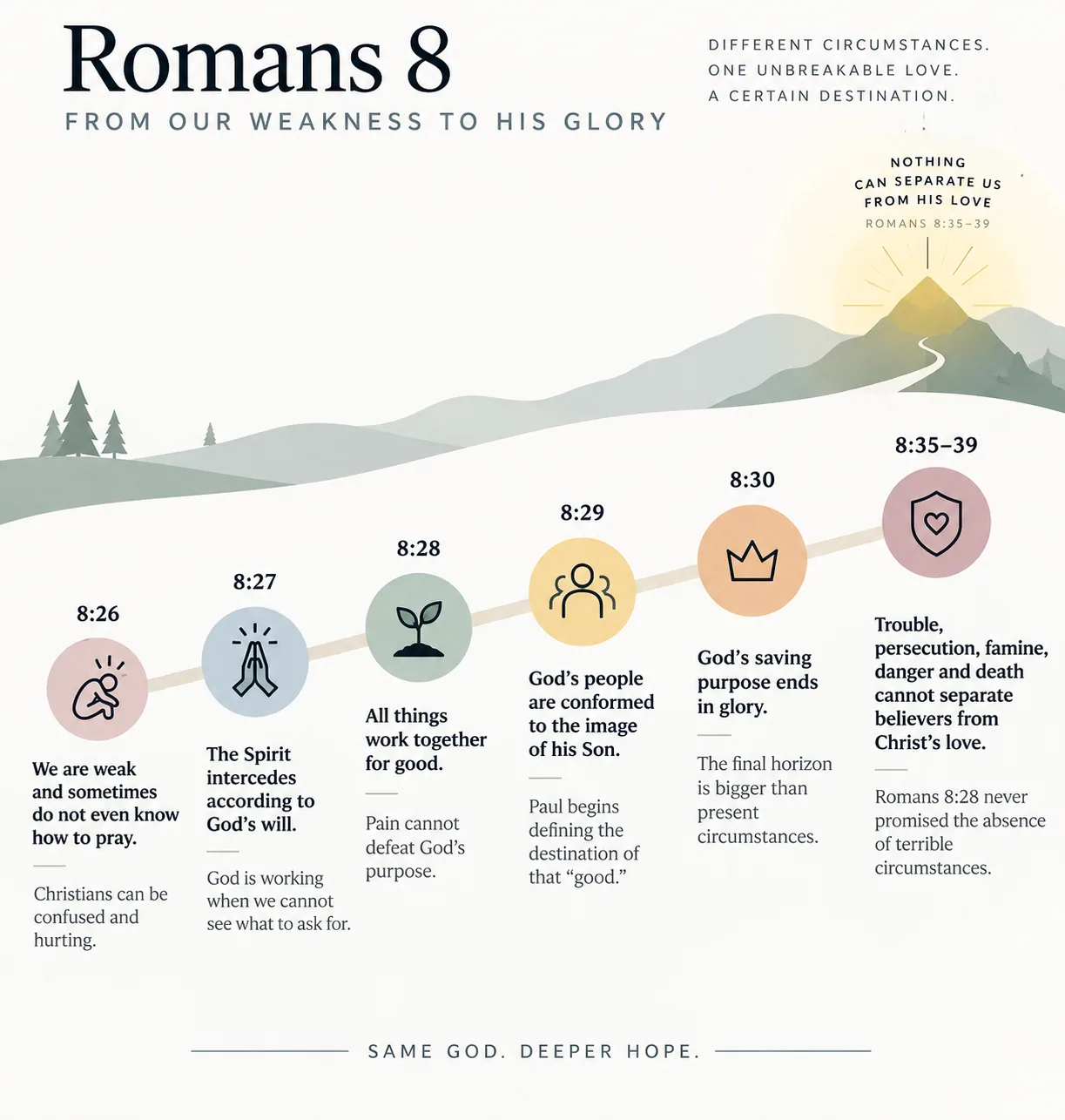
This is why verse 29 matters so much.
Paul is not mainly explaining how God turns disappointments into upgrades.
He is explaining how nothing in a believer's story can finally derail God's saving purpose.
The U.S. Conference of Catholic Bishops' notes on Romans 8:28–30 similarly describe these verses as outlining the Christian vocation of being conformed to the image of God's Son.
Romans 8:28 Does Not Say Everything Is Good
This distinction can prevent enormous spiritual confusion.
Paul does not say:
"All things are good."
He says all things work together for good.
Cancer is not good.
Abuse is not good.
Betrayal is not good.
A child's death is not good.
Losing your livelihood is not good.
Sin does not magically become good because God is sovereign.
The claim is stronger and more careful: evil and suffering are not powerful enough to make God's ultimate purpose fail.
This matters because Christians sometimes use Romans 8:28 too quickly.
Someone loses a parent, and within days hears, "Everything happens for a reason."
Someone receives a frightening diagnosis and hears, "Don't worry. God will turn it around."
Someone's marriage collapses and hears, "God has someone better."
Those sentences may be well meant. But they can promise something Romans 8 never promised.
Paul's own examples make that impossible.
Near the end of the chapter, he names tribulation, distress, persecution, famine, nakedness, danger and sword. He does not say believers escape all seven. His point is that these things cannot separate them from Christ's love.
That is a much stronger hope than "things will get easier soon."
The Forgotten Context: Romans 8 Is Full of Groaning
Romans 8:28 often appears on wall art.
Its original neighborhood is much less decorative.
Romans 8:18 begins with suffering.
Then creation groans.
Believers groan.
The Spirit meets believers in their weakness and intercedes with groanings beyond words.
Only then do we reach Romans 8:28.
That sequence matters.
Paul did not write Romans 8:28 for people whose plans were unfolding perfectly. He placed it inside a discussion about people waiting for something they do not yet have.
They are hurting.
They are weak.
They sometimes do not know what to pray.
They are waiting.
Then Paul says, in effect: God's purpose is still moving.

A Few Numbers Put the Passage in Perspective
Romans 8 does not treat suffering as unusual.
Modern life does not either.
In the American Psychological Association's 2023 Stress in America survey of 3,185 U.S. adults, 24% rated their average stress at 8–10 on a 10-point scale. That was up from 19% in 2019.
Sixty-two percent said they did not talk about their stress because they did not want to burden others.
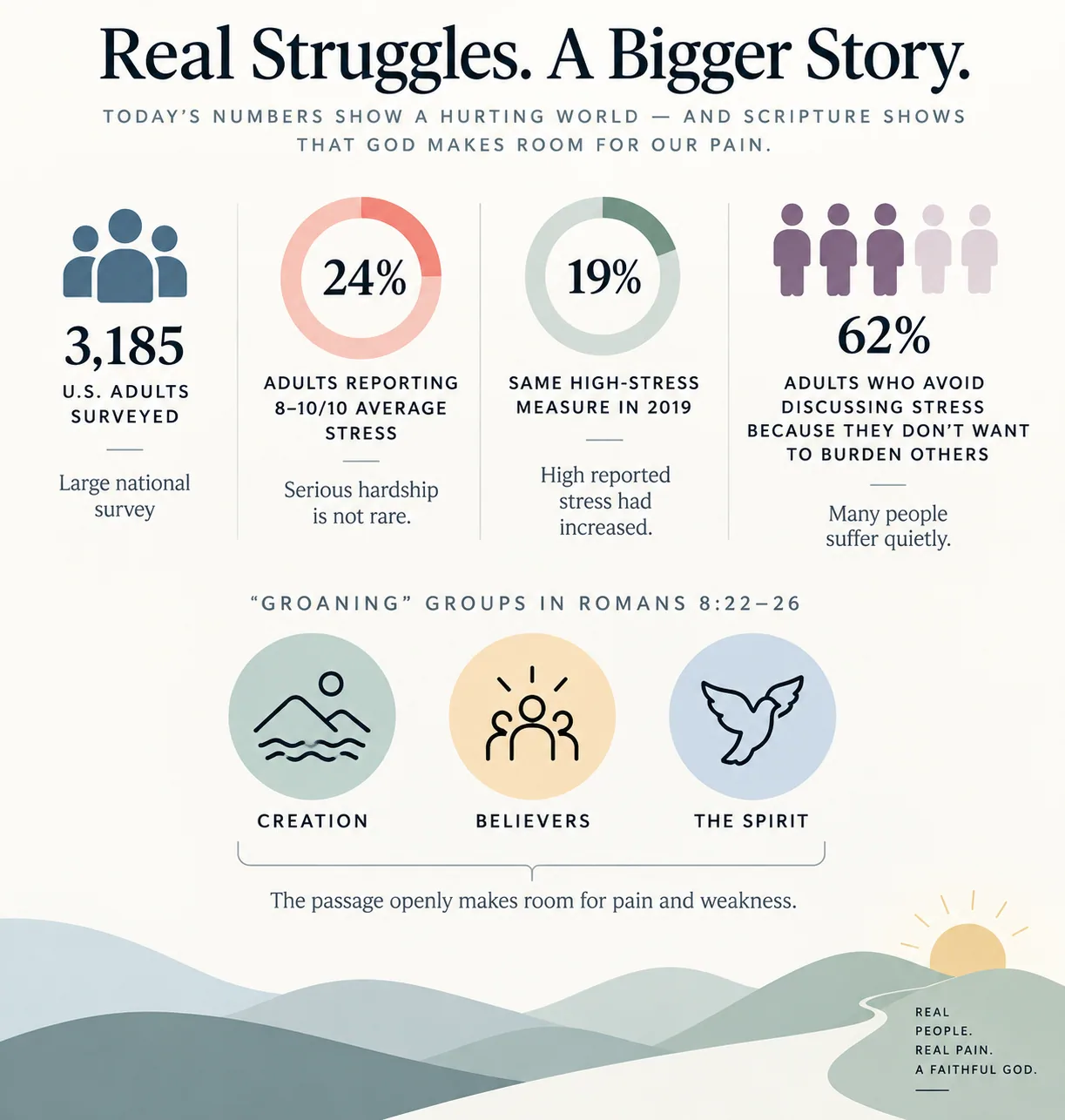
The APA statistics are not an interpretation of Scripture. They simply show why shallow answers to suffering can do real damage.
People reading Romans 8:28 may not need a slogan.
They may need permission to grieve while still trusting God.
What "All Things Work Together" Does—and Doesn't—Mean
There is an interesting translation detail here.
Ancient manuscripts differ slightly over whether "God" appears explicitly as the grammatical subject in Romans 8:28. This is why English translations sometimes phrase the verse differently.
The NET Bible's textual note explains the manuscript difference and notes two possible renderings: essentially, "he works all things together for good" or "all things work together for good." Either way, the context centers the confidence on God's sovereign purpose.
So the point is not positive thinking.
It is not karma.
It is not "the universe has a plan."
And it is certainly not that painful events naturally produce happy results.
Paul's confidence rests in God.
The "Good" May Happen in You Before It Happens Around You
Here is a practical way to understand the verse.
Suppose you lose your job.
You pray for another one.
Three months pass.
Nothing.
If you think Romans 8:28 means "God will quickly replace this with something better," every rejection creates a theological crisis.
"Why isn't God keeping his promise?"
But suppose Romans 8:29 controls how you understand verse 28.
Now you can pray for employment while also asking different questions:
Can this season teach me dependence instead of control?
Can I become more patient?
Can I become less ashamed to receive help?
Can I learn to separate my worth from my salary?
Can I become more generous toward unemployed people because I now understand the fear?
You should still apply for jobs.
You should still improve your resume.
You should still ask people for leads.
Romans 8:28 is not an excuse for passivity.
But now the unanswered prayer does not automatically mean God's purpose has stopped.
The situation may remain bad while something good is being formed in you.
And even that inner growth is not the entire promise. Romans 8 ultimately points toward final redemption and glory, not merely better coping skills.
Real-World Story: When the Job Doesn't Come Back
Consider "Marcus," a realistic composite based on common pastoral situations rather than a named testimony.
Marcus is 46. He has worked for the same company for 14 years.
Then his position is eliminated.
At first, friends tell him, "God obviously has a better job waiting."
Six months later, he is still unemployed.
Now he has two problems.
The first is financial.
The second is spiritual.
He begins wondering whether God failed him because the "better job" never appeared.
A wiser use of Romans 8:28 changes his plan.
Marcus stops trying to predict what the "good" must look like. He applies for work, reduces expenses, contacts former coworkers, talks honestly with his wife, and asks two friends to pray with him every week.
He also notices something uncomfortable.
His identity had become almost completely tied to being successful and needed.
The layoff did not become good.
But it exposed something he needed to see.
Months later, suppose Marcus finds work that pays roughly the same as his old position.
There is no miraculous salary increase.
No dramatic "God gave me double" ending.
Yet Marcus has changed.
He is more present with his family. He is less judgmental toward people struggling financially. He asks for help without feeling worthless.
That is much closer to the Romans 8:28–29 pattern.
The story is not simply:
bad job loss → better job.
It can also be:
real suffering → dependence → endurance → changed character → deeper likeness to Christ.
Real-World Story: When Healing Doesn't Arrive on Schedule
Now imagine Elena.
She has a chronic illness.
She prays for healing and pursues appropriate medical treatment. Her church prays too.
A year later, she is still sick.
Someone tells her, "Romans 8:28. God is going to turn this around."
But what if her symptoms continue?
Has Romans 8:28 failed?
No.
Paul has already told us that believers themselves groan while awaiting "the redemption of our bodies." The chapter's hope is large enough to include bodies that remain broken in the present.
Elena can pray boldly for healing without pretending God promised a particular medical result by a particular date.
She can seek good doctors.
She can take medicine.
She can rest without guilt.
She can ask her church for meals or rides.
She can grieve.
She can also ask God to form patience, courage, compassion and trust inside a life she did not choose.
For more scripture-centered support during illness, see comfort during illness.
Faith does not require pretending everything is fine.
Romans 8:28 Is Not a Formula for Getting What You Want
Here is the dangerous version of the verse:
Something bad happened + I trust God = God owes me something better.
That is not Paul's argument.
Romans 8:28 is not spiritual compensation.
You cannot calculate it like this:
Lost $10,000 → God owes me $20,000.
Lost one relationship → God owes me a better spouse.
Missed one opportunity → God owes me a bigger opportunity.
Experienced sickness → God owes me physical healing now.
Sometimes remarkable reversals happen.
Thank God when they do.
But making the reversal the promise puts words into the passage that Paul did not put there.
The Bible contains other promises that are often detached from their context too. A good example is Jeremiah 29:11 and what it means when life goes wrong.
That passage also shows why context can turn a shallow promise into a stronger one.
Four Questions to Ask When Life Doesn't "Work Out"
When something painful happens, do not immediately force yourself to find a hidden blessing.
Use these four questions instead.
1. What Is Actually Bad Here?
Name it.
"My marriage ended."
"My father died."
"I lost the pregnancy."
"I was betrayed."
"The treatment did not work."
Christian hope does not require dishonest vocabulary.
Calling evil or loss "good" is not what Romans 8:28 asks you to do.
2. What Did God Actually Promise?
Separate the biblical promise from your personal prediction.
Try two columns.
In the first, write:
What Scripture promises.
In the second:
What I hoped would happen.
Maybe Scripture promises God's presence, love, final redemption and transforming work.
Maybe you expected the interview to succeed.
Your hope was understandable.
It simply was not identical to God's promise.
A broader guide to God's promises in the Bible can help you make this distinction.
3. What Is the Next Faithful Action?
Romans 8:28 does not tell you to sit still and wait for circumstances to rearrange themselves.
If you lost your job, make the call.
If your marriage is in danger, seek qualified help where appropriate.
If you are ill, get medical care.
If debt is crushing you, make the budget and seek sound financial guidance.
If you have wronged someone, apologize.
If someone is harming you, prioritize safety and seek appropriate help.
Faith can look surprisingly ordinary.
Sometimes the next faithful action is an appointment, application, meal, conversation, boundary or night's sleep.
4. Who Am I Becoming While I Wait?
This is the Romans 8:29 question.
Not only:
"When will this end?"
But also:
"Who am I becoming here?"
Is suffering making you more compassionate or more cruel?
More honest or more hidden?
More dependent on God or obsessed with control?
You do not need to celebrate the suffering to let God work inside it.

A Practical Romans 8:28 Plan for the Next 24 Hours
When life collapses, deep theology must eventually reach Tuesday morning.
Try this five-step practice.
Step 1: Name the Loss
Write one sentence without spiritual editing.
"This hurts because ______."
Do not write what you think you are supposed to feel.
Write what is true.
Step 2: Remove the False Promise
Write down the outcome you have been assuming God owes you.
Then ask:
"Does Romans 8 actually promise this?"
This one question can remove enormous spiritual pressure.
Step 3: Identify One Christlike Response
Do not try to become "more like Jesus" in the abstract.
Make it concrete.
Patience may mean not sending the angry text tonight.
Love may mean checking on your child even though you are exhausted.
Humility may mean admitting you need help.
Courage may mean making the medical appointment.
Forgiveness may mean beginning to release revenge while still keeping a necessary boundary.
Step 4: Take One Practical Action
Prayer and practical wisdom belong together.
Send one application.
Call the counselor.
Ask for the payment plan.
Schedule the doctor's visit.
Tell one trusted person the truth.
If waiting is wearing you down, use these resources for strength, courage and endurance alongside the practical steps.
Step 5: Pray Without Writing God's Ending for Him
Try:
"God, I want this situation to change. Please change it. But do not let this situation pull me away from you. Show me today's faithful step. Form Christ in me while I wait, and help me trust the ending I cannot see."
That prayer asks boldly without pretending to know the future.
What Romans 8:28 Means After Betrayal
Suppose someone betrays you.
Romans 8:28 does not mean the betrayal was secretly good.
It does not mean you must immediately trust the person again.
It does not cancel justice, consequences, boundaries or grief.
The "good" may include becoming wiser without becoming bitter.
It may include learning healthy boundaries.
It may include discovering unhealthy patterns you previously ignored.
It may include forgiving without restoring unsafe access.
And it may include good you never recognize during this life.
God's ability to redeem evil does not turn evil into virtue.
That distinction matters.
What Romans 8:28 Means After an Unanswered Prayer
One of the most important details in Romans 8 appears immediately before verse 28.
Paul says believers sometimes do not know what they ought to pray for.
Think about that.
The same passage containing "all things work together for good" admits that faithful Christians may not even know what the right outcome should be.
That destroys the idea that strong faith always knows what God is about to do.
Sometimes faith says:
"God, I do not know."
That is not failed prayer.
Romans 8 says the Spirit meets believers right there.
What Romans 8:28 Means When Someone Dies
Death exposes shallow interpretations of this verse quickly.
Do not tell a grieving parent that losing a child was "for the best."
Do not tell a widow that her husband's death happened so she could learn something.
You do not know that.
Romans 8 gives a different kind of hope.
The chapter looks beyond present suffering toward resurrection, redemption and glory. It ends by insisting that even death cannot separate God's people from his love in Christ.
That lets Christians say two things at once:
This death is terrible.
And:
This death does not get the final word.
Christian hope does not need to make the funeral smaller.
It makes God's final promise bigger.
What Not to Say to Someone Who Is Suffering
Romans 8:28 is true.
That does not mean it is always the first sentence someone needs.
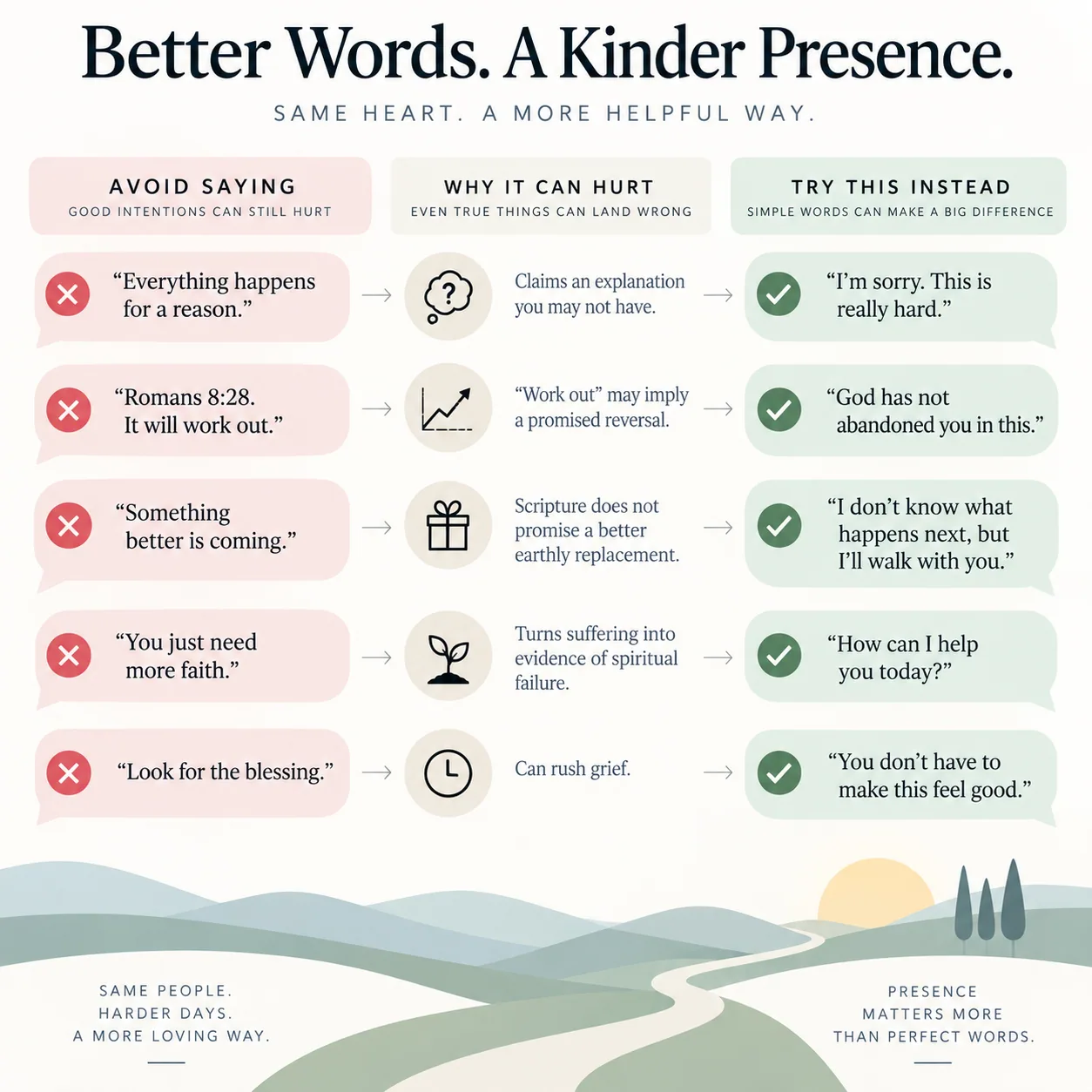
Good theology needs good timing.
Sometimes the most Christlike interpretation of Romans 8:28 is sitting quietly beside someone who is crying.
The Most Important Shift: From Outcome to Destination
Here is the unique lens that makes Romans 8:28 easier to understand.
Separate your preferred outcome from God's ultimate destination.
Your preferred outcome might be:
"I want the cancer gone."
"I want my spouse back."
"I want this job."
"I want my child to recover."
"I want the court case resolved."
Those are real prayers.
Pray them.
But Romans 8:29 points toward a larger destination: conformity to Christ, followed in Paul's argument by the final glory of God's people.
That means the promise can remain true even when your preferred outcome does not happen.
Your circumstance is not the destination.
Christlikeness and final redemption are.

Romans 8:28 Is Better Than the Popular Version
The popular version says:
"Don't worry. Something better is around the corner."
That sounds comforting until nothing better appears.
Paul gives you something harder but stronger.
You can groan.
You can be weak.
You can wait.
You can face trouble.
You can encounter circumstances you would never choose.
And none of those things has the authority to cancel God's final purpose for you.
That is why Romans 8:28 is not less comforting when read with Romans 8:29.
It is more comforting.
Your hope no longer depends on tomorrow becoming easier.
It depends on God's purpose being stronger than whatever tomorrow contains.
Frequently Asked Questions About Romans 8:28
What is the simple meaning of Romans 8:28?
Romans 8:28 means that suffering, setbacks and other circumstances cannot ultimately defeat God's good purpose for those who love him and are called according to his purpose. Verse 29 helps explain that purpose by pointing to conformity to the image of Christ.
Does Romans 8:28 mean everything happens for a reason?
The verse teaches confidence in God's purposeful work, but it does not give us permission to invent a specific reason for every tragedy.
You may not know why a particular event happened. Romans 8 offers confidence in God without giving a detailed explanation for every painful event.
Does Romans 8:28 mean bad things are actually good?
No.
Paul openly calls attention to suffering, weakness, decay, persecution, famine, danger and death throughout Romans 8. The promise is not that evil becomes good but that evil cannot finally defeat God's good purpose.
What is the "good" in Romans 8:28?
Romans 8:29 is crucial. Paul immediately speaks about believers being conformed to the image of God's Son.
So the "good" should not be reduced to comfort, money, success or improved circumstances. It belongs to God's larger saving purpose of making his people like Christ and bringing them to final glory.
Does Romans 8:28 promise that my situation will improve?
It does not promise that every situation will improve during this life.
Sometimes circumstances improve dramatically. Sometimes they do not. Romans 8 itself includes serious suffering while pointing toward ultimate redemption.
Does Romans 8:28 apply to everyone?
Paul specifically describes the promise in relation to those who love God and are called according to his purpose.
It should therefore not be turned into a generic promise that every event automatically produces a pleasant result for every person.
How are Romans 8:28 and Romans 8:29 connected?
Verse 28 mentions God's "purpose." Verse 29 immediately continues the thought and describes God's people as being conformed to the image of his Son.
Reading the verses together prevents us from defining "good" only as getting the earthly outcome we prefer.
Can I trust Romans 8:28 while still being sad?
Yes.
Romans 8 itself contains groaning, weakness, waiting and suffering before and after verse 28.
Grief is not proof that you lack faith.
What should I do when I cannot see any good in my situation?
Do not force yourself to invent one.
Name what hurts. Ask what God actually promised. Take the next wise and faithful action. Seek practical help where needed. Then leave room for the possibility that some of God's work is happening beyond what you can currently see.
Is Romans 8:28 about becoming more like Christ?
Romans 8:29 makes conformity to the image of God's Son central to the purpose Paul describes. That does not mean character development exhausts the meaning of "good"; Paul's horizon also includes justification, glory and the final redemption described throughout Romans 8.
But it does mean we should not reduce "good" to nicer circumstances.
The Verse Is Stronger Than the Slogan
Romans 8:28 does not give you a deadline for your suffering.
It does not promise a promotion after a firing, a marriage after heartbreak, money after loss, or immediate healing after sickness.
It gives you something that can survive even when those outcomes never arrive.
God's purpose is not trapped inside your circumstances.
Read Romans 8:28 with Romans 8:29 and the question changes.
Instead of only asking:
"When will God turn this into something I like?"
You can also ask:
"How is God carrying me toward the person and future he has promised, even here?"
You may not see the answer today.
Romans 8 makes room for that too.
After all, the people receiving this promise are still groaning, still waiting and still hoping for what they cannot yet see.
And that is precisely where Paul tells them God's purpose has not stopped.
Key Statistics
U.S. Adults Surveyed
3,185
Respondents included in the APA Stress in America 2023 survey
Source: American Psychological Association (Stress in America 2023)
Adults Reporting High Stress (8–10/10)
24%
U.S. adults who rated their average stress level between 8 and 10 on a 10-point scale
Source: American Psychological Association (Stress in America 2023)
Credible Sources
American Psychological Association · January 1, 2023
Provides the survey statistics used in the article regarding stress levels and reluctance to discuss stress, helping demonstrate that suffering and emotional burden remain common experiences.
Bible (New Testament) · Ancient text; modern translation available online
Primary source for all theological arguments in the article, including the relationship between Romans 8:28 and Romans 8:29.

About the Author
Editorial Team
Editorial Team
Daily Faith Path articles are prepared by the editorial team to help readers find scripture-centered guidance for healing, faith, prayer, and spiritual encouragement.
Expertise: Healing scriptures, Bible study resources, prayer guidance, devotional writing, Christian encouragement
Experience: The team researches scripture references, reviews surrounding biblical context, compares translation wording where useful, and updates articles to improve clarity, usefulness, and trust for readers.
Credentials: Editorial review, devotional writing, scripture study, content updating
This article is published by the Daily Faith Path editorial team to help readers use scripture carefully, prayerfully, and in ways that are practical for real-life seasons of illness, grief, waiting, and spiritual reflection.
Continue Reading
Related articles

September 17, 2026
When Jeremiah 29:11 Doesn’t Feel True
Jeremiah 29:11 promises hope, but not a quick fix. Discover what the verse meant to the exiles in Babylon and how to trust God’s good purpose when life gets worse instead of better.

July 27, 2026
Why Smart, Faithful Christians Still Can't Find a Spouse
Many faithful Christians assume the right dating app will solve their singleness, but the biggest obstacles are often geography, gender ratios, denominational barriers, unrealistic expectations, and limited community. Here's what actually improves your chances of finding a Christ-centered marriage.

July 27, 2026
Is It Healthy to Follow End-Times News?
Following end-times news isn't inherently unhealthy—but when prophecy content fuels anxiety, insomnia, and compulsive doomscrolling, it's time to step back. Learn how to distinguish biblical watchfulness from fear, understand the psychology behind prophecy anxiety, and discover practical, faith-based steps to regain peace.