Why Smart, Faithful Christians Still Can't Find a Spouse
Many faithful Christians assume the right dating app will solve their singleness, but the biggest obstacles are often geography, gender ratios, denominational barriers, unrealistic expectations, and limited community. Here's what actually improves your chances of finding a Christ-centered marriage.

You've done everything "right" — you love God, you have your life together, you even downloaded the apps — and you're still single. Here's the uncomfortable truth: the problem usually isn't you, and it definitely isn't which app you picked.
Almost every article about Christian singles is secretly an ad. It ranks dating apps, drops an affiliate link, and collects a commission when you sign up. That business model has one big rule: the app must always look like the answer.
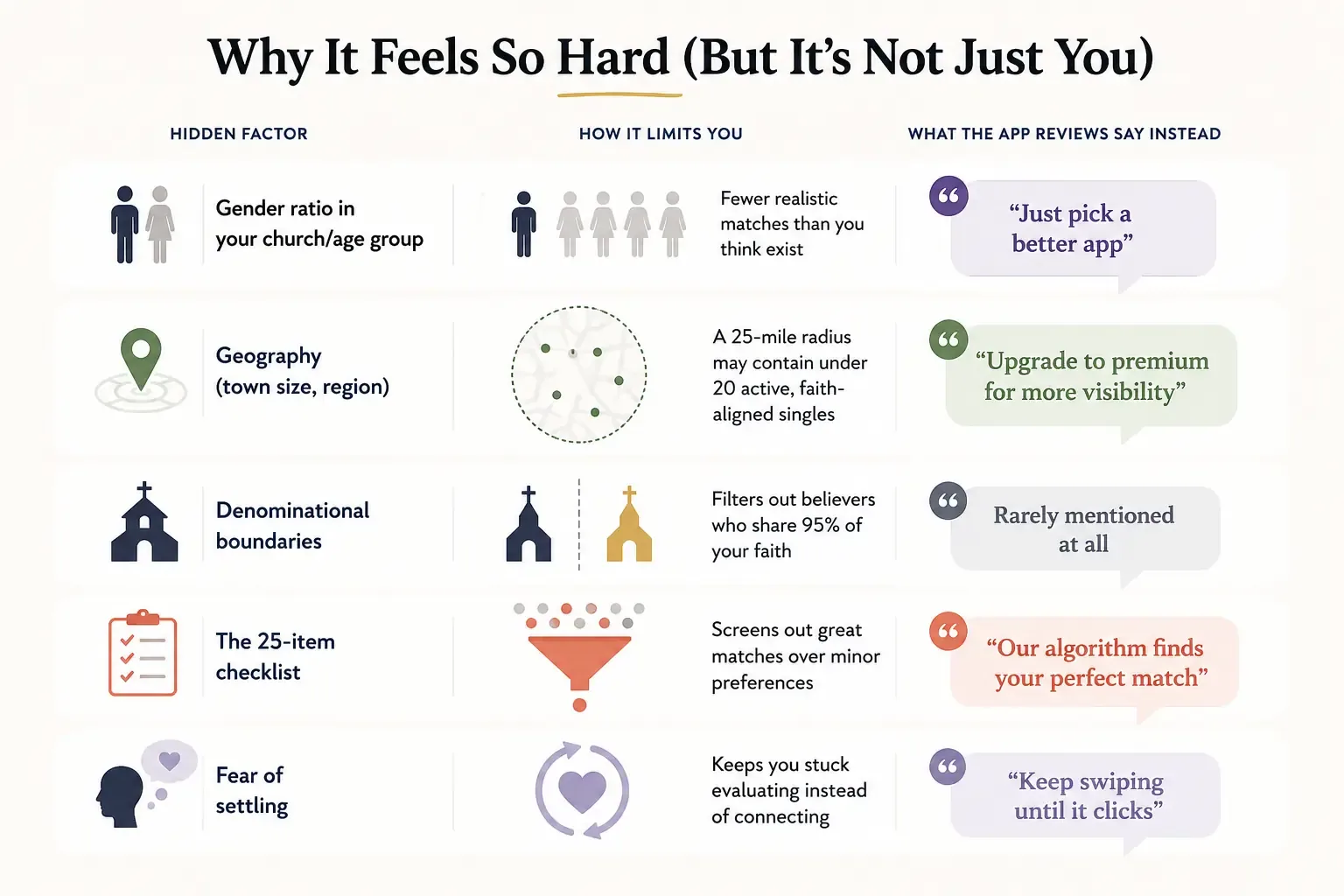
So nobody talks about the real reasons faithful Christians can't find a spouse. Geography. Lopsided gender ratios. Denominational walls. Impossible checklists. The fear of "settling."
This article talks about all of it. No app rankings. No affiliate links. Just the actual problem — and what you can actually do about it.

The Problem Isn't Your Profile. It's the Math.
Let's start with the numbers nobody puts in the app reviews.
Marriage keeps moving later. In 2024, the median age for a first marriage in the U.S. was 30.2 for men and 28.6 for women. And as of 2021, 25% of 40-year-olds had never been married — roughly a 400% increase from 1980, when it was just 6%.
So if you're 28, 32, or 38 and still single, you're not behind. You're normal. The entire timeline shifted underneath you, but church culture often still runs on a 1985 clock where everyone married at 23.
The gender ratio problem is real
For decades, single Christian women have asked, "Where are all the men?" The data says it's a fair question — with a twist.
UK research analyzed by Single Friendly Church found roughly two practicing Christian single women for every one single man in some demographics. In many American churches, single women in their late 20s and 30s have outnumbered single men for years.
But here's the twist: the pews are shifting. Barna's 2025 data shows 43% of men and 36% of women now attend church weekly — the largest gender gap in 25 years of tracking, and the first time men have consistently outpaced women. Young men, especially Gen Z men, are returning to church while young women drift away.
Translation: depending on your age, city, and denomination, you may be fishing in a pond where your odds are genuinely stacked against you. That's not a character flaw. That's arithmetic.
Geography quietly decides your options
Here's a real-world pattern I've seen play out again and again. Call her Rachel: 31, nurse, small town of 9,000 people, faithful member of a Baptist church with exactly three single men — one is 19, one is 62, and one is her cousin.
Rachel spent four years on dating apps set to a 25-mile radius. Her "pool" was maybe a dozen active Christian men, most of whom she'd already met. The app wasn't broken. Her radius was.
No listicle will tell you this, because "consider moving or expanding your search to a city with a large church community" doesn't earn anyone a commission. But for singles in small towns or rural areas, geography is often the single biggest factor — bigger than looks, personality, or profile photos combined.
Denominational Fragmentation: The Wall Nobody Admits Exists
Here's a question that stops a lot of singles cold: would you marry a faithful believer from a different denomination?
For many, the honest answer is "no" — sometimes for solid theological reasons, sometimes out of pure habit. And every "no" shrinks an already small pool.
Think about the layers of filtering happening:
First you filter for Christians. Then for practicing Christians. Then for your denomination. Then for your flavor of that denomination. Then for age, location, and attraction. By the end, you're choosing from a pool the size of a Sunday school class.
A real example of the cost
Consider a couple I'll call Daniel and Ana. He grew up Pentecostal; she grew up Lutheran. Both almost swiped past each other because of the denomination label. They decided to have one coffee anyway.
What they found: they prayed the same way at night, wanted the same kind of Christ-centered home, and disagreed mostly on worship style and a few secondary doctrines. They've now been married six years and attend a non-denominational church together.
Nobody is saying doctrine doesn't matter. Some differences are genuine dealbreakers — how you'd raise kids, views on baptism, church authority. But many singles reject people over differences they couldn't explain in two sentences if you asked them to.
A practical test: write down the specific doctrinal difference that makes someone from denomination X unmarriable to you. If you can't articulate it clearly, it might be tribalism wearing a theology costume.
The core question isn't "Do we use the same label?" It's "Do we love the same Jesus, and can we build one household of faith?" If you want to ground that in Scripture rather than habit, spend time with these biblical relationship verses and notice how little the Bible says about denominational matching — and how much it says about character.

The Checklist Problem: When Standards Become a Fortress
Standards are good. Checklists are where good standards go to become excuses.
Here's the pattern. Years of disappointment make singles build longer and longer lists: strong faith, leads devotionals, debt-free, over six feet (or under a certain age), loves kids, established career, funny, adventurous, plays guitar on the worship team, agrees on eschatology.
Each item feels reasonable alone. Stacked together, they describe someone who statistically may not exist within 100 miles of you — and if he or she does, they have a checklist too.
The 5-and-5 exercise
Here's a tool that has genuinely helped people I've watched go from perpetually single to happily married:
Take your full list. Now sort every item into exactly two columns — you only get five in each:
Column 1 — Foundation (non-negotiable): things that determine whether a Christ-centered marriage can exist. Example: genuine active faith, character and integrity, wants marriage and (if relevant) kids, treats people well when no one's watching, you're genuinely attracted to them.
Column 2 — Preferences (nice to have): everything else. Height. Income bracket. Worship style. Hobbies. How they dress.
Everything that doesn't fit in Column 1 goes to Column 2 — and Column 2 items are never allowed to end a promising connection by themselves.
One man, mid-30s, told me his turning point: he realized he'd rejected two godly, kind, attractive women over "energy" and "not sporty enough" — while praying every night for God to send him a wife. He'd been sending them back.
Notice what Scripture actually emphasizes. When Paul describes love in 1 Corinthians 13, it's patience, kindness, and faithfulness — not compatibility scores. If your list looks nothing like what the Bible says about love, the list is the problem.
"I Don't Want to Settle" — The Fear That Keeps You Single
This might be the most important section in this article, so let's be precise.
Settling is marrying someone whose character, faith, or treatment of you is genuinely deficient — and hoping marriage fixes it. Never do that.
What most Christians call settling is actually just marrying a real human instead of an imagined one. The person who is 85% of your list, deeply good, deeply faithful — but not the cinematic "the one" feeling you were promised by every rom-com and half the sermons you've heard.
Where this fear comes from
Christian culture accidentally teaches a soulmate theology the Bible never teaches. "God has ONE person picked out for you, and if you're patient and pure, He'll deliver them." So every good-but-imperfect match feels like a betrayal of God's "best."
Here's the theological correction, and it's freeing: God promises His presence, His provision, and His faithfulness. He never promises everyone a spouse, and He never promises the spouse will arrive by 30 feeling like a movie montage. Getting clear on God's promises — what He actually said versus what culture added — removes a crushing amount of false pressure.
Marriage in Scripture is a covenant you build, not a lottery ticket you scratch. The "right person" is far less about finding a unicorn and far more about two flawed believers choosing each other daily.
A story about the 85% person
A woman I'll call Priya, 34, had turned down a proposal at 29 from a man she described as "wonderful, but I wasn't sure he was The One." Five years later, still single, she told a mentor: "I wasn't waiting on God. I was waiting on a feeling."
That sentence is worth reading twice. Faith-filled waiting and fear-filled stalling can look identical from the outside. One trusts God with an open hand. The other uses "God's best" as armor against risk.
If you're wrestling with releasing your timeline and your mental image of how this was supposed to go, this guide on trusting God with your future goes deeper on surrendering outcomes without going passive.

The Loneliness Nobody Preaches About
Let's name the thing under all of this: it hurts.
It hurts to be the last single person in your friend group. To hold other people's babies at showers you organized. To hear "God's timing is perfect!" from someone who married at 22 and has never spent a single adult year alone.
Pew data shows nearly four in ten single women say a potential spouse's faith would be "very important" in deciding to marry, versus 26% of single men — meaning many faithful women are holding a standard the market punishes them for holding. That's a lonely place to stand.
And years of praying for a spouse with no answer can shake your faith itself. If you've prayed the same prayer a thousand times and heard nothing back, you're not faithless — you're in a documented, deeply biblical experience that saints from David to the prophets knew well. This piece on when God feels silent about your prayers speaks directly to that specific ache.
Two practical guardrails for this season:
Don't let singleness become your identity. Not "single Christian woman" or "single Christian man" — just a Christian, currently unmarried. The label you rehearse becomes the life you inhabit.
Don't isolate. Loneliness whispers that you're the only one. Statistically, your church almost certainly has other believers in the same season pretending they're fine. Find them.
What Actually Works: A Practical Plan (No Apps Required)
Everything above diagnoses the problem. Here's the treatment plan — concrete, tested, and free.
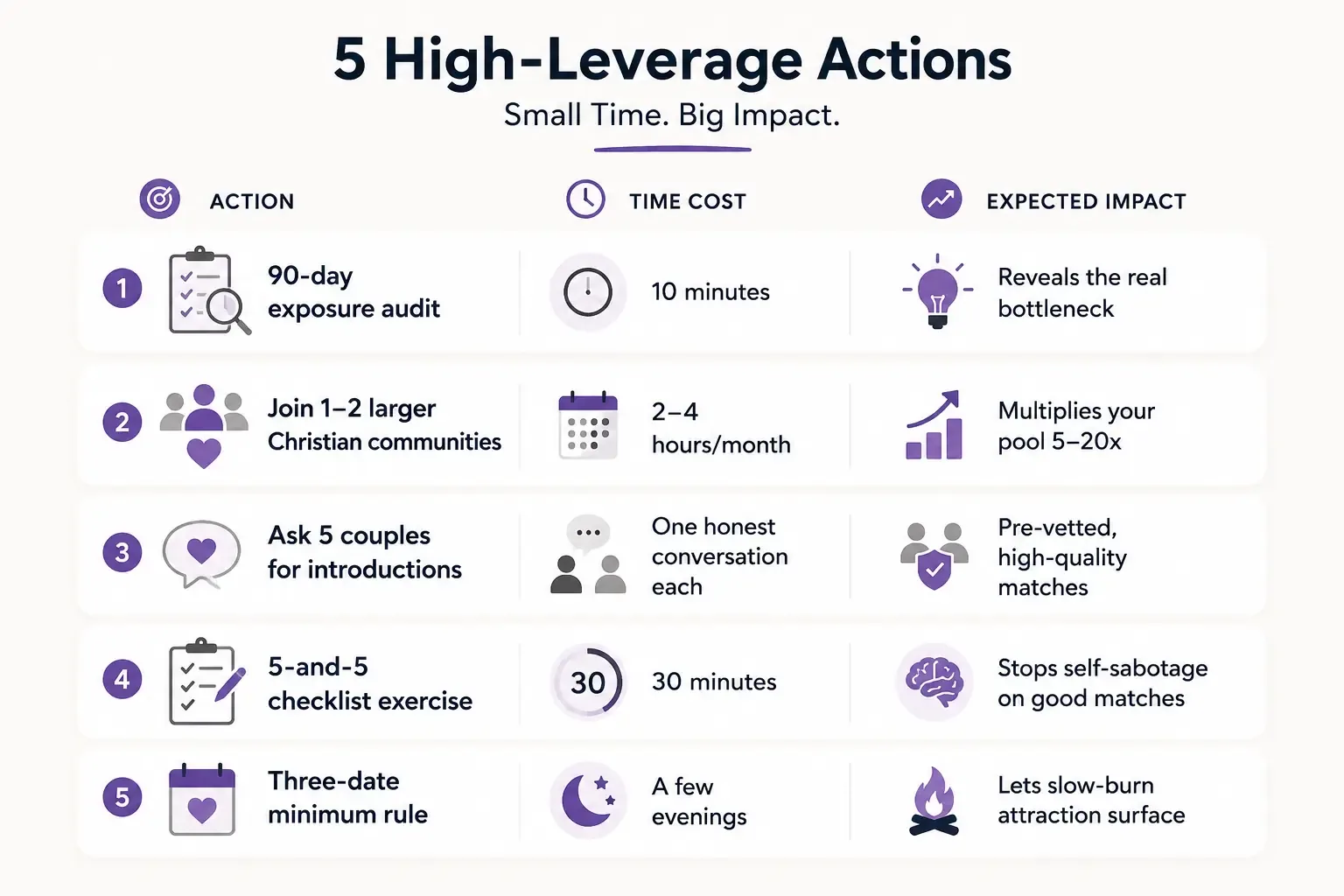
1. Audit your actual exposure
Count the number of new, single, faith-compatible people you met in person in the last 90 days. For most frustrated singles the honest number is between zero and two.
You cannot marry someone you never meet. Before blaming God, the apps, or the opposite sex, fix the exposure problem. Target: 5–10 new people per month, minimum.
2. Go where your ratio improves
If your church has three singles, join a second community without leaving your church: a citywide young adults network, a multi-church singles retreat, a Christian hiking or service group. Large churches in your nearest city likely run singles ministries with hundreds of members.
If you live in a town of 8,000 and marriage is a top-three life priority, seriously and prayerfully consider whether the next season of your life should happen in a bigger place. That sounds drastic. It's less drastic than 15 more years of a dating pool of six.
3. Recruit your community — out loud
For most of Christian history, singles didn't find spouses alone; families and communities connected them. We traded that for algorithms and got lonelier.
Tell five trusted married couples, in plain words: "I want to be married. If you know someone of solid character, I'd genuinely welcome an introduction." This feels embarrassing for about ten seconds and multiplies your reach immediately. Introductions come pre-vetted for character — the one thing no app can screen.
4. Run the 5-and-5, then honor it
Do the checklist exercise from earlier. Then enforce your own rule: no ending a connection over Column 2 items until at least date three. Attraction to character often grows; attraction to a checklist never does.
5. Date to discern, not to audition
One coffee is not a covenant. Say yes to more first dates with Column-1-qualified people, and stop treating each one as a final exam. You're gathering information about a person, not deciding your entire future in 60 minutes.
6. Build a life worth joining
The most attractive thing to a mature believer is not a perfect profile — it's a purposeful life. Serve somewhere. Master something. Get healthy. Not as bait, but because a full life makes both marriage and continued singleness good.
And if the disappointment of this season has knocked the wind out of your faith entirely, start here: trusting God when life isn't going as planned. Rebuild the foundation first. Everything else stands on it.

What Marriage-Minded Singles Get Wrong About Each Other
One more root cause worth naming: men and women in the church often misread each other, and it poisons the well.
What single Christian women often believe: the men aren't serious, won't lead, and won't commit. Sometimes true. But often the men are terrified — of rejection, of not measuring up financially, of being labeled creepy for expressing interest at church. Many were never taught how to pursue; they were only taught what not to do.
What single Christian men often believe: the women's standards are impossibly high and they only notice the worship leader. Sometimes true. But often the women have simply endured years of ambiguous "hangouts" that went nowhere, and their guardedness is scar tissue, not pride.
The fix is disarmingly simple: clarity and kindness. Men — ask directly, accept a no gracefully, and it's not weird. Women — a warm, clear "yes, I'd like that" does more than a hundred hints. Both — extend the grace you're hoping to receive.
FAQ: Real Questions Christian Singles Actually Ask
Is it wrong to want to be married this badly?
No. Marriage is a good, God-designed desire (Genesis 2:18, Proverbs 18:22). Wanting it isn't idolatry. Building your entire worth or faith on getting it — that's where the trouble starts. Desire it openly; hold it with an open hand.
Should I date someone from a different denomination?
If they share genuine, active faith in Christ and you can agree on how you'd worship and raise a family — often yes. If the differences touch core convictions you'd fight about weekly, no. Test the specific difference, not the label. Pew's latest Religious Landscape Study found about 74% of married U.S. adults share their spouse's religion — but "same religion" there means Christian, not same denomination.
Am I too old to find a Christian spouse?
The data says no. With median first marriages now near 30 and a quarter of 40-year-olds never married, meeting a spouse in your 30s and 40s is now common, not exceptional. Your pool changes shape with age — it doesn't disappear.
Is it unspiritual to move cities or change churches to find a spouse?
People relocate for jobs, schools, and weather without guilt. Marriage shapes your life more than all three. Prayerfully relocating to a place with real community — for many good reasons, spouse included — is stewardship, not desperation.
What if God is calling me to singleness?
A calling to lifelong singleness (1 Corinthians 7) typically comes with peace about it and gifting for it — not years of grief and longing. Persistent, deep desire for marriage usually indicates the desire itself is from God. Don't confuse an unanswered prayer with a divine "never."
How do I know if I'm being picky or discerning?
Discernment rejects people over character, faith, and core life direction. Pickiness rejects people over preferences — height, hobbies, vibe, résumé. If your last three rejections were Column 2 reasons, you have your answer.
What if I've prayed for years and nothing has changed?
Then change what you can measure — exposure, community, checklist — while continuing to pray. God typically works through means: through churches, introductions, and rooms you actually walk into. Praying for a harvest while never planting is not faith; it's avoidance wearing faith's clothes.
The Bottom Line
You're not single because you missed the right app, and you're not single because God forgot you.
For most faithful, marriage-minded Christians, the real culprits are structural: shrunken local pools, lopsided ratios, denominational walls, fortress checklists, and a fear of settling that was never really about settling.
Every one of those has a countermove, and every countermove is in this article. Audit your exposure. Widen your pool. Recruit your people. Cut the checklist to what Scripture actually cares about. And release the timeline to the only One who ever held it anyway.
The apps were never the solution. They were never really the problem either. The path forward runs through real rooms, real community, real courage — and a real trust that God is faithful in the season you're in, not just the one you're praying for.
Key Statistics
Median age at first marriage (men)
30.2 years
Median age for first marriage in the U.S. (2024)
Source: Barna / U.S. Census Bureau
Median age at first marriage (women)
28.6 years
Median age for first marriage in the U.S. (2024)
Source: Barna / U.S. Census Bureau
Credible Sources
Barna Group · November 12, 2025
Supports statistics on median age at first marriage and long-term marriage trends.
Barna Group · October 7, 2025
Provides the latest church attendance data by gender cited throughout the article.

About the Author
Editorial Team
Editorial Team
Daily Faith Path articles are prepared by the editorial team to help readers find scripture-centered guidance for healing, faith, prayer, and spiritual encouragement.
Expertise: Healing scriptures, Bible study resources, prayer guidance, devotional writing, Christian encouragement
Experience: The team researches scripture references, reviews surrounding biblical context, compares translation wording where useful, and updates articles to improve clarity, usefulness, and trust for readers.
Credentials: Editorial review, devotional writing, scripture study, content updating
This article is published by the Daily Faith Path editorial team to help readers use scripture carefully, prayerfully, and in ways that are practical for real-life seasons of illness, grief, waiting, and spiritual reflection.
Continue Reading
Related articles

October 7, 2026
12 Bible Verses About Hiding Money From Your Spouse
Explore 12 Bible verses about secret spending, hidden debt, financial honesty, confession, forgiveness, boundaries, and rebuilding trust in marriage.

October 6, 2026
15 Bible Verses for Couples Who Keep Fighting About Money
Money fights are rarely just about dollars. These 15 Bible verses help couples address spending, saving, debt, secrecy, unequal income, giving, and financial control with practical next steps and conversation questions.
October 5, 2026
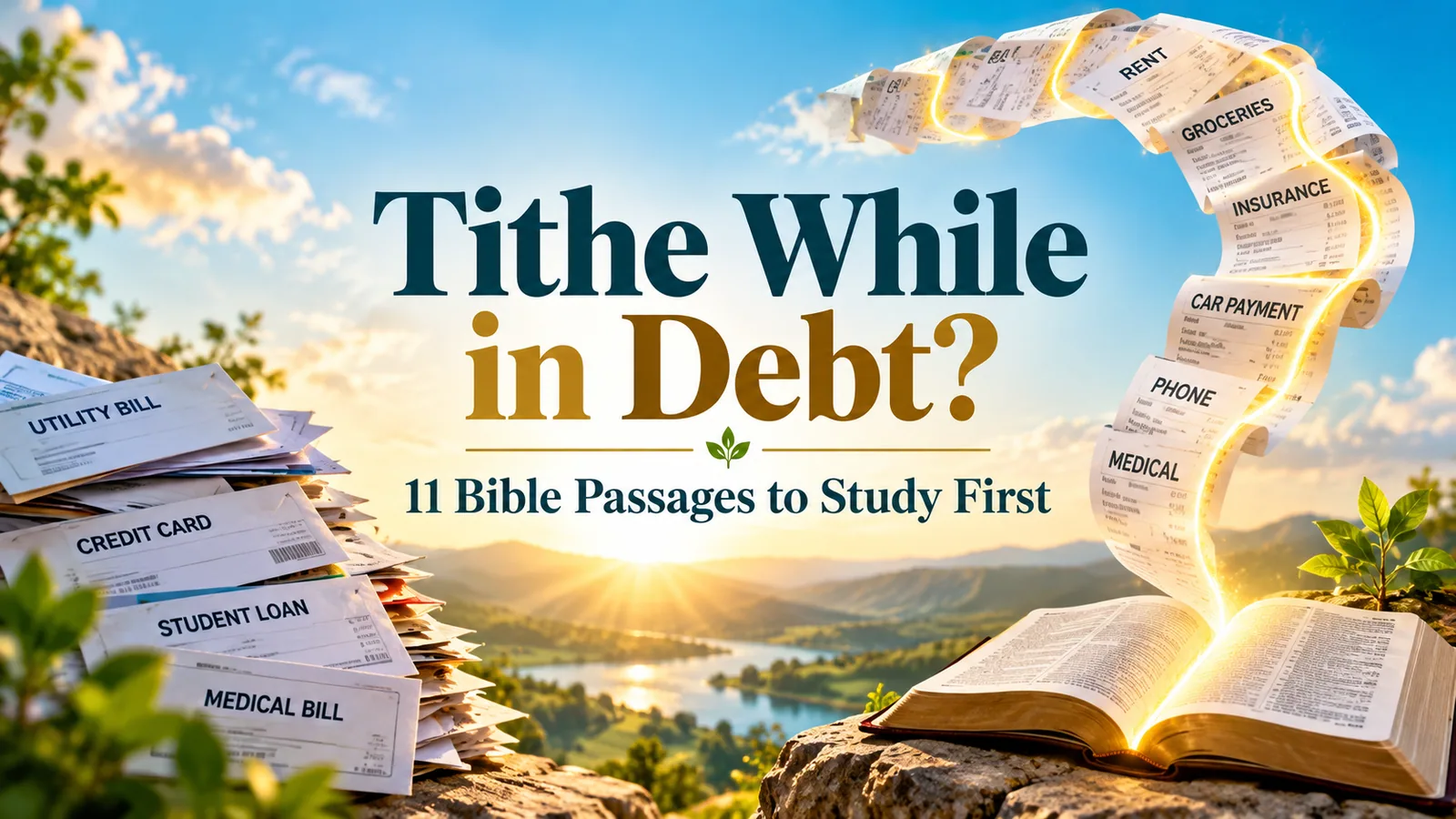
Should You Tithe While in Debt? 11 Bible Passages to Study First
Should you tithe while in debt? Explore 11 Bible passages on tithing, debt, generosity, family responsibility, and giving according to your means—plus a practical plan for deciding what to do.