Is It Healthy to Follow End-Times News?
Following end-times news isn't inherently unhealthy—but when prophecy content fuels anxiety, insomnia, and compulsive doomscrolling, it's time to step back. Learn how to distinguish biblical watchfulness from fear, understand the psychology behind prophecy anxiety, and discover practical, faith-based steps to regain peace.
Short answer: it depends on what it's doing to you — and if you're reading this at 1 a.m. with a knot in your stomach after three hours of red-heifer videos, it's not doing you good. This article won't give you another prophecy timeline. It will give you a way to breathe again.
Here's the strange thing about end-times content in 2026. The people producing it almost never talk about what it does to the people consuming it.
Prophecy channels track the Third Temple. They track Israel. They track earthquakes. What nobody tracks is the reader — the mom who can't sleep, the teenager checking headlines for "signs," the new believer who now feels dread instead of hope.
That's who this article is for.

The Problem Nobody in Prophecy Media Talks About
Let's name it plainly. There is now a real, measurable group of Christians who feel worse about God, life, and the future because of prophecy content — not better.
The data on news anxiety in general is stark. A 2024 American Psychiatric Association poll of more than 2,200 adults found 43% of U.S. adults felt more anxious than the year before, with 70% anxious about current events. Prophecy content sits right at the center of "current events" — it takes every scary headline and adds cosmic stakes.
And it hits sleep hard. The American Academy of Sleep Medicine found that 38% of U.S. adults say viewing news on a phone or tablet at bedtime worsens their sleep — rising to 46% among adults aged 18 to 24.
Now layer eschatology on top of that. Mental health professionals have started naming this specific pattern. Researchers studying religious trauma report that end-times fear is "a real thing" and "a chronic problem," linked to increased anxiety, depression, paranoia, and even OCD-like behaviors — like praying the salvation prayer over and over "just to be sure."
Therapists who work with this describe a familiar checklist: chronic hypervigilance — scanning news, sirens, and political headlines for "signs" — panic spikes during world events that mirror end-times storylines, and religious scrupulosity with intrusive fears about salvation.
If any of that sounds like your last six months, keep reading. You're not broken, and you're not faithless.
Why 2026 Made It Worse
The red heifer and Third Temple content cycle has been running hot. Every ceremony, every announcement, every rumor becomes fifty videos with countdown-style thumbnails.
The algorithm doesn't care about your soul. It cares about your watch time. And fear is the single most reliable way to keep you watching.
So the content that scares you most gets recommended most. That's not a conspiracy. That's just how engagement-based feeds work — and prophecy fear is premium engagement fuel.
A Quick Gut-Check: Watchfulness vs. Anxiety
Jesus told us to watch (Matthew 24:42). He never told us to panic. Those are two different postures, and mixing them up is where most of the pain comes from.
Here's a simple way to tell them apart:
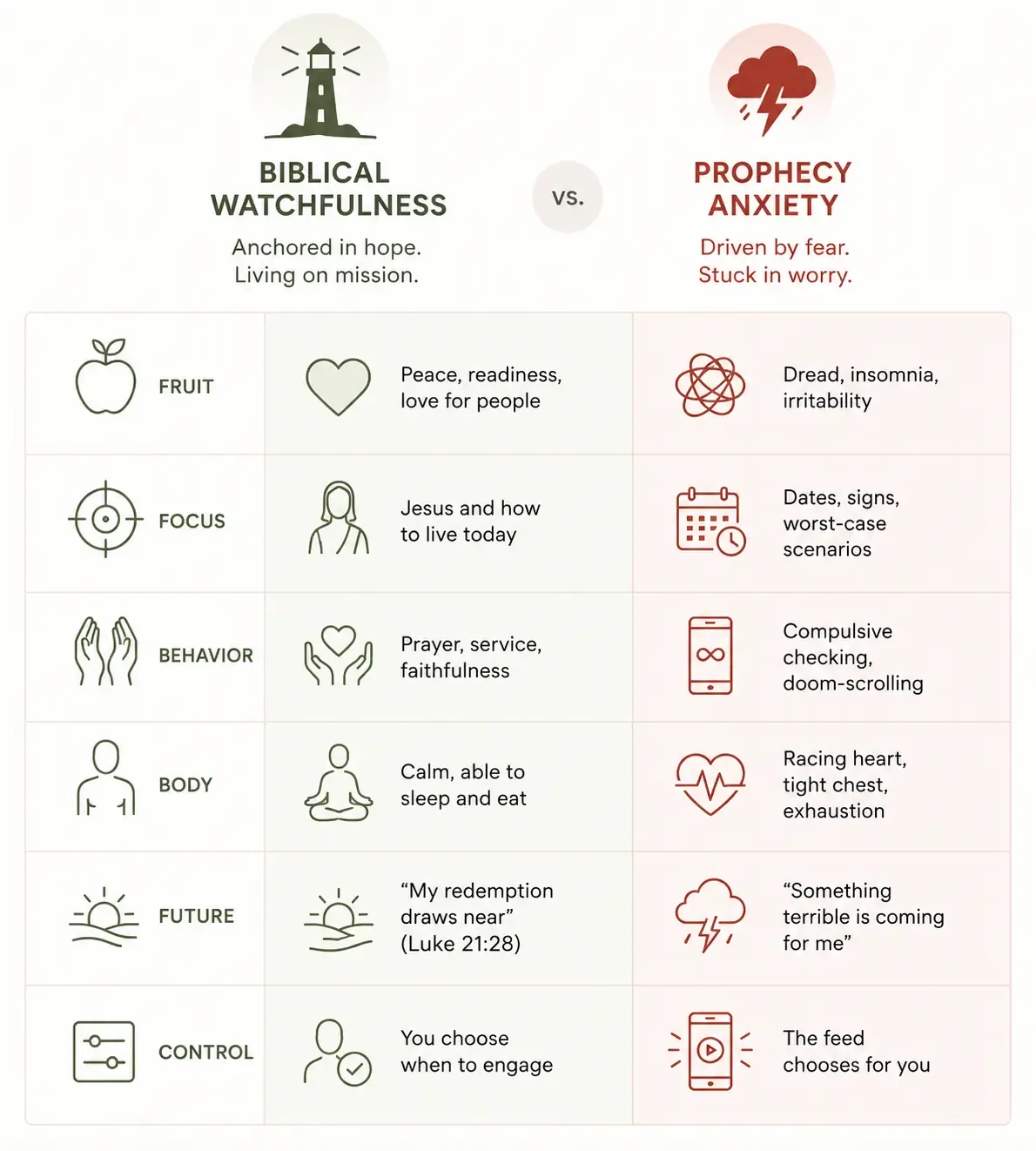
Notice Luke 21:28. When Jesus describes end-times signs, His instruction is literally: "stand up and lift up your heads, because your redemption is drawing near."
Heads up. Not stomach in knots. If your prophecy intake produces the opposite of what Jesus said it should produce, the problem isn't your faith — it's your intake.
For a deeper look at how Scripture separates healthy alertness from fear, see how to overcome fear with God.
Three Real Stories (Because You're Not the Only One)
Details below are anonymized or drawn from public accounts, but every pattern here is one pastors and counselors see weekly.
Sarah, 34 — The 2 a.m. Scroller
Sarah started following one prophecy channel during a hard season. One became six. Six became a nightly ritual: red heifer updates, Gog-Magog maps, "THIS is the final sign" thumbnails.
Within four months she was averaging five hours of sleep. She stopped planning a second baby — "why bring a child into the tribulation?" Her doctor flagged her blood pressure.
The turning point wasn't a prophecy debunk. It was her pastor asking one question: "Does this content make you love Jesus more, or fear the future more?" She couldn't say Jesus. That honesty started her recovery.
Marcus, 19 — Sign-Scanning as a Compulsion
Marcus grew up on rapture movies. As an adult, world events became triggers. An earthquake headline meant twenty minutes of checking. A Middle East story meant an hour.
This wasn't casual interest. It was what therapists call reassurance-seeking — a compulsion loop where checking briefly lowers anxiety, then spikes it higher. Religious-trauma therapists specifically list this pattern: hypervigilant scanning of headlines for "signs," followed by panic when events mirror end-times storylines.
Marcus needed two things: a counselor who understood the loop, and a hard app timer. Both. Neither alone worked.
April Ajoy — The Public Case
Her story ran on CNN and put a name to what thousands felt. She described a latent fear of an impending end, and researchers noted survivors recall crying themselves to sleep over people and pets who'd be "left behind".
The detail that matters most from her story: when she shared it, the most common response was "I thought I was the only one."
You're not the only one. That's half the healing right there.
Why Your Brain Can't Just "Stop Worrying About It"
This part matters, because a lot of Christians beat themselves up for anxiety as if it were a willpower failure. It isn't. Here's the simple mechanics, explained plainly.
Your Brain Has a Smoke Alarm
Deep in your brain is a threat detector (the amygdala). It can't tell the difference between a lion in the grass and a video titled "THE FINAL SIGN JUST HAPPENED."
Both trigger the same alarm: stress hormones, racing heart, tunnel focus. Watch three of those videos and your body has run three fire drills before bed. No wonder you can't sleep.
Uncertainty Is the Fuel
Research on doomscrolling shows the engine underneath is intolerance of uncertainty — studies find trait anxiety strongly predicts intolerance of uncertainty, which drives the compulsive scroll.
Prophecy content is uncertainty in its purest form. Nobody knows the day or hour — Jesus said so (Matthew 24:36). So the scroll can never actually deliver the certainty your anxious brain is searching for. It's a slot machine that never pays out.
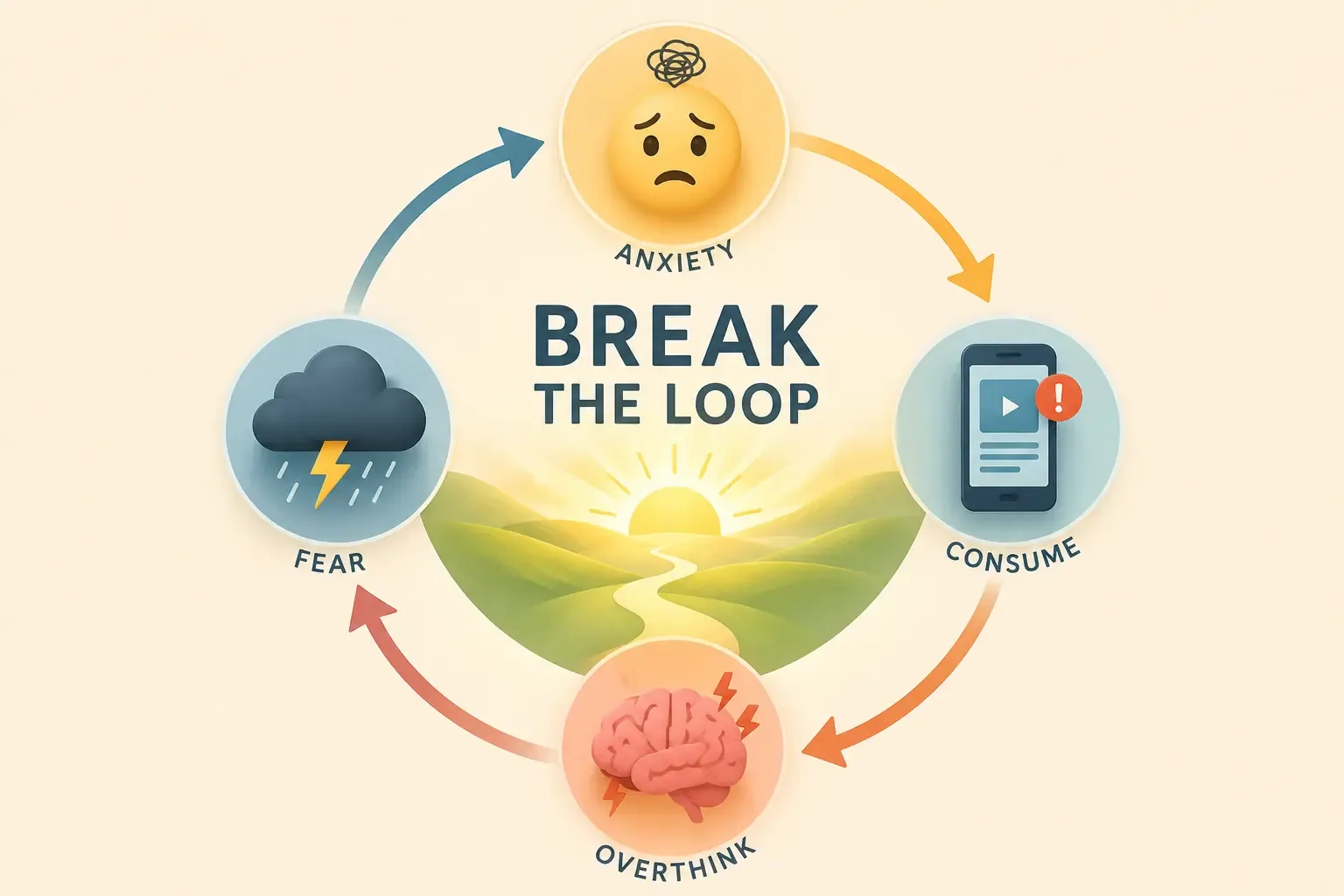
The Loop, Step by Step
- You feel anxious about the future.
- You check prophecy news to feel prepared.
- You get a brief hit of "at least I know what's happening."
- The content plants three new fears.
- You feel more anxious than before. Return to step 2.
Seeing the loop is the first step to breaking it. You're not weak. You're caught in a well-designed machine.
The 7-Day Prophecy-News Detox (Practical Plan)
You don't have to quit your faith, your church, or even your interest in eschatology. You have to detox the delivery system. Here's a week-long plan that pastors and Christian counselors commonly use variations of.
Day 1–2: Audit and Interrupt
Open your screen time settings. Write down the real number of hours on prophecy/news content. Don't judge it — just see it. Most people underestimate by half.
Then unfollow or mute the three channels that scare you most. Not all of them. Just the worst three. Small wins first.
Day 3–4: Replace the Slot, Don't Just Empty It
Anxiety hates a vacuum. If you delete the scroll but keep the 11 p.m. phone habit, you'll relapse by Thursday.
Replace bedtime scrolling with Scripture designed for exactly this moment — start with these Bible verses for anxiety at night. Same phone, same bed, completely different input.
Day 5: Move Your Body, Tell One Person
Take a 20-minute walk without earbuds. Physical movement burns off stress hormones your brain has been stockpiling.
Then tell one trusted person what you've been experiencing. Remember the most common response to April Ajoy's story: "I thought I was the only one." Silence keeps the fear big. Speaking shrinks it.
Day 6: Rebuild Your Information Diet
Now decide — on purpose — what comes back in. Use this rule of thumb:
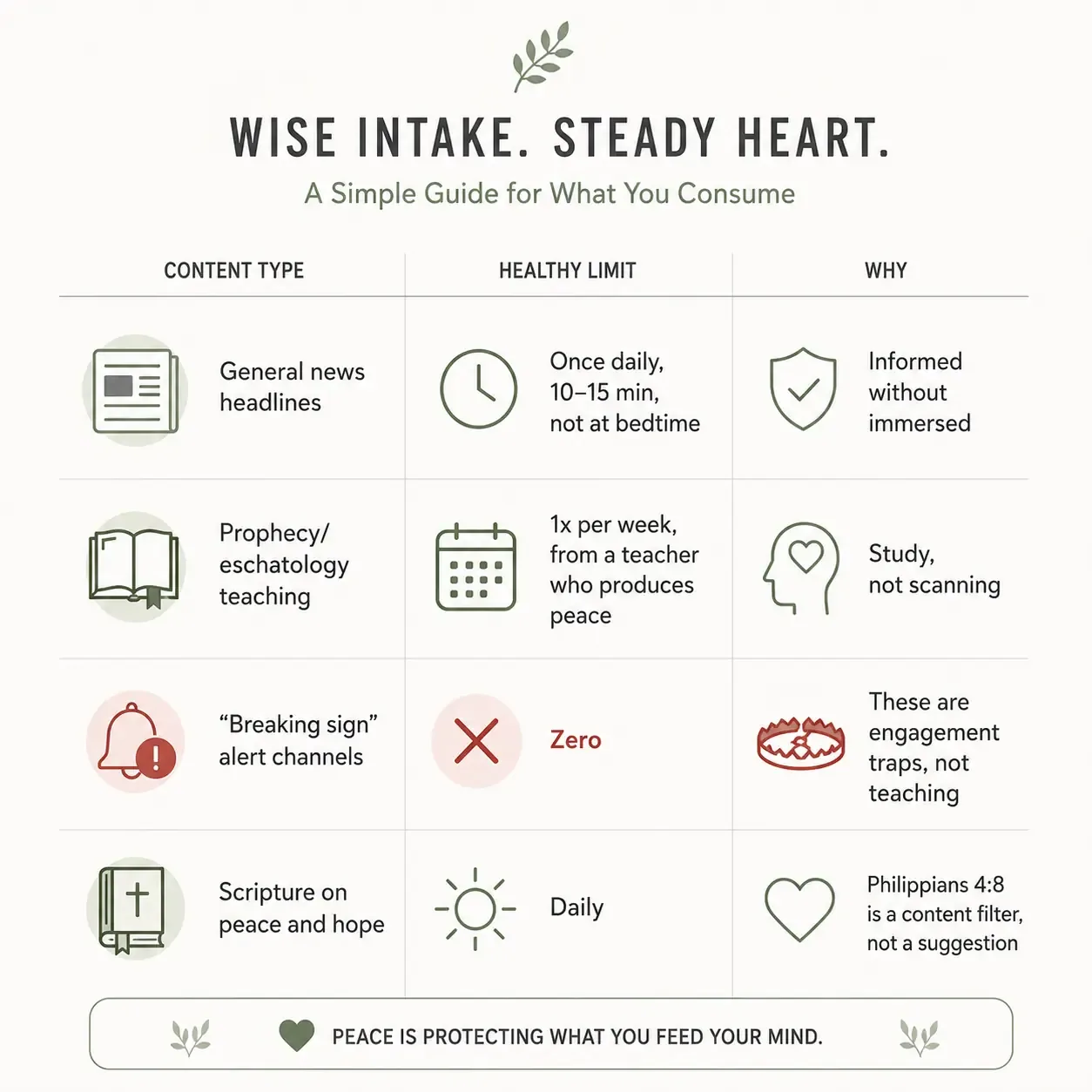
That Philippians 4:8 point is worth sitting with. "Whatever is true, noble, right, pure, lovely" is the exact opposite of a two-hour immersion in alarming content — and awareness of the world doesn't require compulsive consumption.
Day 7: Anchor the New Normal
Pick one anchor verse and put it on your lock screen — the first thing you see before any feed. Browse the faith over fear collection and choose the one that lands.
Then set two permanent guardrails: no news apps after 9 p.m., and no prophecy content on Sundays. Sabbath your feed.
What to Do in the Moment Panic Hits
The detox is the long game. But what about tonight, when a headline spikes your heart rate at 11:47 p.m.? Use this 5-step emergency protocol.
1. Put the phone in another room. Not face-down. Another room. Distance breaks the checking loop physically.
2. Breathe 4-7-8. In for 4 counts, hold for 7, out for 8. Do it four times. The long exhale tells your nervous system the lion is gone.
3. Say Scripture out loud, not silently. Speaking engages more of your brain than thinking. "God has not given us a spirit of fear, but of power, love, and a sound mind" (2 Timothy 1:7).
4. Name five things you can see. This grounding trick pulls your mind out of an imagined future and back into the actual room, where you are actually safe.
5. Pray a handover prayer, not an answer-seeking prayer. Not "God, tell me if this is the sign." Instead: "God, I hand You the timeline. It was never mine to carry."
Keep a shortlist of go-to passages ready before you need them — this filtered set of scriptures for when you feel anxious is built for exactly that moment.
When It's More Than a Bad Habit: Getting Real Help
Here's the pastoral-care truth most prophecy sites will never print: sometimes this needs a professional, and that's not a faith failure.
See a counselor or doctor if any of these are true:
- Anxiety has lasted more than a few weeks and is getting worse, not better
- You're losing sleep multiple nights a week
- You've made major life decisions from fear (quit a job, stockpiled, avoided having kids, withdrawn from people)
- You have repetitive rituals — re-praying salvation prayers, compulsive checking — that you can't stop
- You've had panic attacks or thoughts of hopelessness
A study in Health Communication found about 16.5% of people have "severely problematic" news consumption habits — the kind causing real physical and psychological harm. That's roughly one in six. This is common enough that therapists have frameworks for it, including therapists who specialize in religious trauma.
A tip that saves people months: when searching for a counselor, use the phrases "religious trauma" or "faith-friendly anxiety treatment." You want someone who won't dismiss your faith or dismiss your anxiety. Both matter.
And keep feeding the spiritual side while you do the clinical work — many people find daily Scripture a genuine stabilizer alongside therapy. These 50 Bible verses for depression and anxiety pair well with professional support, not instead of it.

The Theology That Actually Heals
Let's end where the healing really lives — not in avoiding prophecy, but in reading it the way it was written to be read.
Revelation Was Written to Comfort, Not Terrify
The book of Revelation was sent to persecuted churches. Its purpose was to say: the Lamb wins, hold on. First-century believers heard it and took courage.
If a book written to comfort suffering Christians is producing panic in you, something in the modern delivery — not the ancient text — has gone wrong.
"Do Not Be Afraid" Is a Command About the End Times Too
Jesus, describing wars and rumors of wars, says: "see to it that you are not alarmed" (Matthew 24:6). Read that slowly. Not alarmed. During the actual signs.
Fear of the end times isn't extra-spiritual. By Jesus' own words, it's a misreading of the assignment.
Your Job Was Never the Timeline
When the disciples asked about timing, Jesus answered: "It is not for you to know times or dates... but you will receive power... and you will be my witnesses" (Acts 1:7–8).
Translation: the timeline is God's job. Loving people is yours. Every hour spent decoding heifers is an hour taken from the actual assignment — and the assignment, unlike the timeline, produces peace.
That peace isn't passive, either. It's a settled thing Jesus specifically contrasted with the world's kind: "Peace I leave with you... not as the world gives" (John 14:27). The news cycle gives adrenaline and calls it awareness. Christ gives rest and calls it readiness. If you want to marinate in that difference, spend a week in these Bible verses about peace.
FAQ: End-Times News Anxiety, Answered Straight
Is it a sin to feel anxious about end-times prophecy?
No. Anxiety is a nervous-system response, not a moral choice. Scripture says "do not be anxious" the way a parent says "don't be scared" — as comfort and redirection, not condemnation. Guilt about your anxiety only adds a second layer of suffering. Address the anxiety with practical tools and grace, not shame.
Should I stop following prophecy content completely?
Not necessarily forever. Use the fruit test: if a teacher leaves you with more love, hope, and steadiness, that's teaching. If a channel leaves you scanning headlines at midnight, that's a trigger, and it goes — at least for a season. Many people do a full 30-day fast, then selectively reintroduce one calm, scholarly source.
What about the red heifer and Third Temple news — shouldn't I stay informed?
Here's the honest question: what would you do differently this week if a temple were built next year? For almost everyone, the faithful answer is identical either way — pray, love people, live ready. Information you can't act on but can panic over isn't stewardship. It's a stress subscription.
How do I talk to a family member who sends me scary prophecy videos daily?
Kindly and specifically: "I love you, and I've realized this content wrecks my sleep and my peace, so I'm taking a break from it. Send me anything encouraging instead." Set the boundary on the content, not the person. If they push back, remember: managing your mental health is not rejecting their faith.
Can end-times anxiety affect kids?
Yes, significantly — therapists document children developing hypervigilance, like calling out for parents to make sure they haven't been raptured, and guilt about not being "good enough" to be taken. Keep end-times media away from young kids, and frame the future for them the way Jesus did: as redemption drawing near, with a God who holds them safe.
Does taking a break from prophecy news mean I'm not "watching" like Jesus commanded?
No — it likely means you're finally starting to. Watching, in Jesus' teaching, means living faithfully and ready (see the parables in Matthew 25: lamps filled, talents invested, people served). It's a lifestyle, not a browser habit. A person who prays, serves, and sleeps in peace is more "watchful" than someone who's memorized every sign but lost their joy.
The Bottom Line
Following end-times news is healthy only when it produces what Jesus said it should: lifted heads, not knotted stomachs.
If prophecy content is stealing your sleep, your peace, or your hope — the content fails the test, not you. Audit it, detox it, replace it with Scripture that calms, tell someone, and get professional help if the anxiety is running your life.
The end of the story was never meant to scare the people who know how it ends. The Lamb wins. You can put the phone down now.
This article addresses a sensitive topic. If anxiety, hopelessness, or panic is affecting your daily life, please reach out to a doctor, licensed counselor, or trusted pastor — support is a strength, not a weakness.
Key Statistics
Adults anxious about current events
70%
APA survey found 70% of U.S. adults reported anxiety related to current events.
Source: American Psychiatric Association (2024)
Adults feeling more anxious than previous year
43%
Americans reporting higher anxiety compared to the prior year.
Source: American Psychiatric Association (2024)
Credible Sources
Health Communication (Taylor & Francis) · January 1, 2022
Introduces the concept of problematic news consumption and quantifies its prevalence, supporting the article's discussion of unhealthy media habits.
Frontiers in Psychology · January 1, 2023
Explains the psychological mechanisms behind compulsive news checking and uncertainty intolerance discussed in the article.

About the Author
Editorial Team
Editorial Team
Daily Faith Path articles are prepared by the editorial team to help readers find scripture-centered guidance for healing, faith, prayer, and spiritual encouragement.
Expertise: Healing scriptures, Bible study resources, prayer guidance, devotional writing, Christian encouragement
Experience: The team researches scripture references, reviews surrounding biblical context, compares translation wording where useful, and updates articles to improve clarity, usefulness, and trust for readers.
Credentials: Editorial review, devotional writing, scripture study, content updating
This article is published by the Daily Faith Path editorial team to help readers use scripture carefully, prayerfully, and in ways that are practical for real-life seasons of illness, grief, waiting, and spiritual reflection.
Continue Reading
Related articles

October 7, 2026
12 Bible Verses About Hiding Money From Your Spouse
Explore 12 Bible verses about secret spending, hidden debt, financial honesty, confession, forgiveness, boundaries, and rebuilding trust in marriage.

October 6, 2026
15 Bible Verses for Couples Who Keep Fighting About Money
Money fights are rarely just about dollars. These 15 Bible verses help couples address spending, saving, debt, secrecy, unequal income, giving, and financial control with practical next steps and conversation questions.
October 5, 2026
Should You Tithe While in Debt? 11 Bible Passages to Study First
Should you tithe while in debt? Explore 11 Bible passages on tithing, debt, generosity, family responsibility, and giving according to your means—plus a practical plan for deciding what to do.