When Jeremiah 29:11 Doesn’t Feel True
Jeremiah 29:11 promises hope, but not a quick fix. Discover what the verse meant to the exiles in Babylon and how to trust God’s good purpose when life gets worse instead of better.

You may have seen Jeremiah 29:11 on a graduation card, a coffee mug, or a wall print: “plans to prosper you and not to harm you, plans to give you hope and a future.” Those words are true. But when they are pulled away from verses 10 and 12–14, we can make them say more than God said.
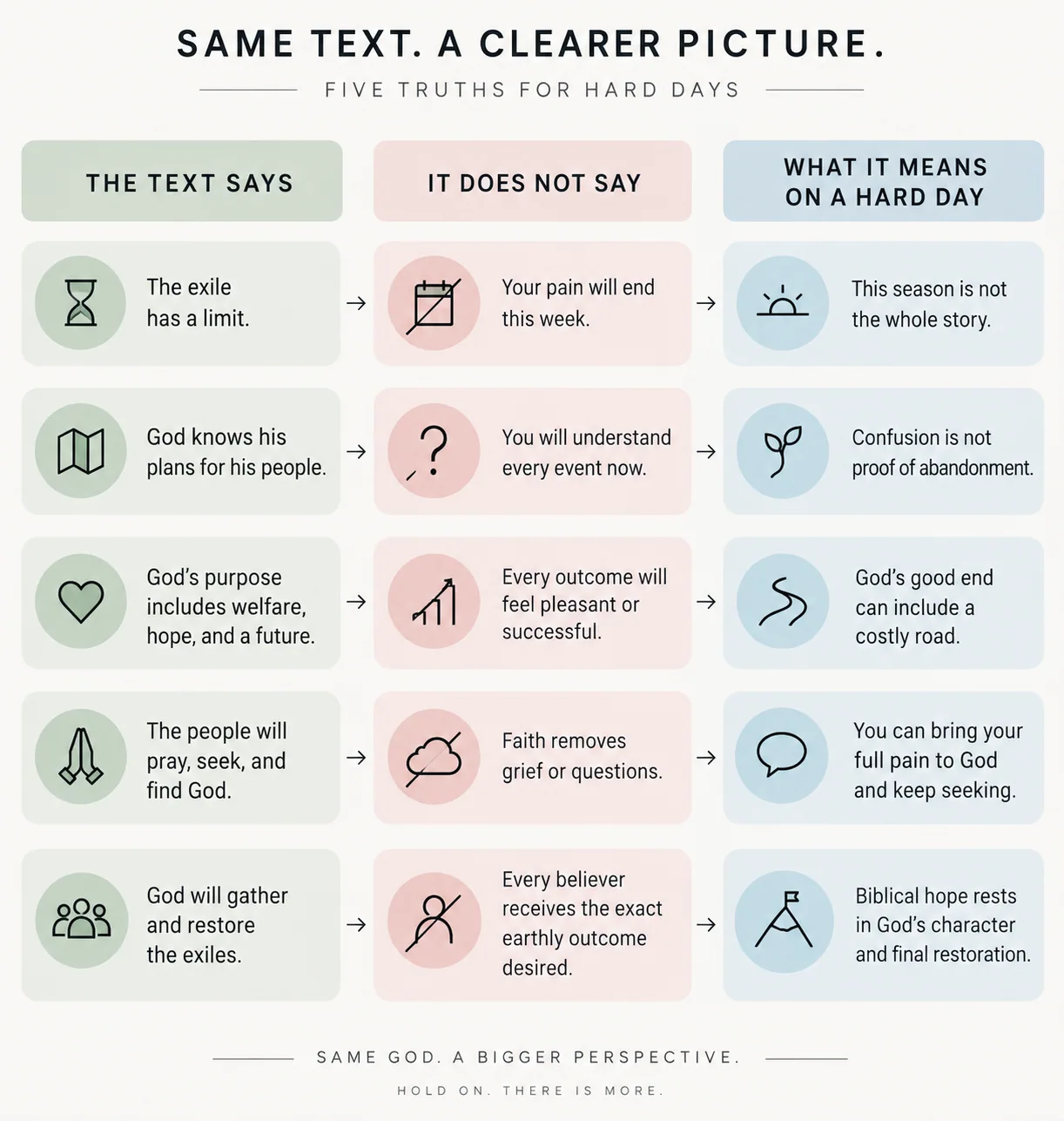
We often hear this: “God has a good plan, so this setback will turn around soon.” Jeremiah’s first readers heard something harder: “You will live in Babylon for a long time. Build a faithful life there. I have not abandoned you, and exile will not get the final word.”
For many exiles, seventy years meant the rest of their earthly lives. A scholarly lectionary commentary notes that the time span covered the lives of the first exiles and likely the next generation too. Hope was real, but it was larger than one person’s preferred schedule.

What Jeremiah 29:10–14 Actually Says
Jeremiah sent a letter from Jerusalem to Jewish leaders, priests, prophets, and other people Nebuchadnezzar had carried into exile in Babylon. They had lost home, temple, stability, and political freedom. False prophets were promising a fast return.
Jeremiah told them not to build life around that false deadline. Earlier in the chapter, God tells the exiles to build houses, plant gardens, marry, raise families, and seek the welfare of the city where they now live. Then verses 10–14 give the promise: after Babylon’s appointed period, God will attend to his people, bring them home, hear them when they pray, and let them find him when they seek him wholeheartedly.
The “You” Is Plural—and That Changes the Promise
The promise was addressed to a covenant community, not dropped into the Bible as a private prediction for every individual decision. God’s plan included people who would die in Babylon, children who would grow up there, and descendants who would return.
This does not make the verse less personal. It makes it sturdier. Your story belongs to a bigger story, and God’s faithfulness is not measured only by whether this month looks better than last month.
“Prosper” Does Not Mean a Trouble-Free Life
The Hebrew idea behind the word often translated “prosper” is shalom: welfare, peace, wholeness, or well-being. The same chapter tells the exiles to seek the shalom of Babylon. This is deeper than money, comfort, or winning.
God’s good purpose can be active while your bank account is strained, your body is sick, or your plans have closed. For more examples of how Scripture speaks about purpose, weakness, and waiting, see these Bible verses about life.
Why Jeremiah 29:11 Feels False When You Are Hurting
Pain shortens your view. When the loss is fresh, “future” may mean getting through Friday. That is not weak faith; it is a human nervous system trying to survive.
The American Psychological Association’s 2023 Stress in America survey found that 24% of U.S. adults rated their average stress at 8–10 on a 10-point scale. Chronic strain can narrow attention, drain energy, disturb sleep, and make wise choices harder. A spiritual struggle may also need practical and clinical support.
Problem 1: “I Obeyed God, and Things Got Worse”
Picture a nurse who reports unsafe staffing because patients may be harmed. She acts with courage, then loses hours and becomes the target of gossip. Obedience did not protect her from fallout.
Her next faithful step is not to call the damage good. It is to name the wrong, document what happened, seek proper advice, ask trusted believers for help, and refuse to treat retaliation as God’s verdict on her character. A good plan from God does not make every action by other people good.
Problem 2: “I Prayed, but the Door Stayed Shut”
A couple may pray for a child through years of infertility. A graduate may send fifty applications and hear no. A caregiver may ask for healing while the disease advances.
Jeremiah 29 does not let us promise a specific result on a specific date. It does let us say that delay is not absence, prayer is not wasted, and today can still hold faithful work. If waiting is wearing you down, these scriptures for trusting God when answers feel slow offer short passages to pray without pretending.
Problem 3: “Other Christians Make Me Feel Guilty for Grieving”
Sometimes the deepest wound comes from a sentence like, “God has a plan, so cheer up.” That skips the tears of Jesus, the laments of the Psalms, and Jeremiah’s own grief.
Hope and grief can share the same room. You can trust God and still miss what you lost. You can believe in resurrection and still cry at a grave. Mature faith tells the truth in God’s presence.

A Real Story: When the Circumstances Did Not Reverse
At age 17, Joni Eareckson Tada broke her neck in a 1967 diving accident and became quadriplegic. The injury was not a short chapter followed by a return to her old body. She has lived for decades with disability, pain, and dependence on daily care.
Her life is not proof that suffering is easy. It is evidence that hope can grow without the original loss being reversed. She became an author and disability advocate and founded Joni and Friends, a ministry serving people affected by disability. The future God gave her did not erase the wheelchair; it widened the reach of a life she once feared was over.
This is the crucial correction: restoration is not always restoration of the old normal. Sometimes it is the slow birth of a faithful new life inside conditions you did not choose.
Two Everyday Stories That Show What Hope Looks Like
The following examples are realistic composites, not named testimonies. They combine common pastoral situations so you can see the principles without confusing illustration with reporting.
Maya: Laid Off After Praying for Stability
Maya had finally paid off a credit card when her company cut her role. She felt mocked by the timing. Her first prayer was not calm: “God, I thought you were helping me.”
She made a two-list plan. The first list held losses she could not fix that week: the job, shame, and fear. The second held actions she could take: file for benefits, tell three safe people, cut two costs, update one resume section, and walk outside each day. She did not call the layoff a blessing. She practiced hope by protecting tomorrow with one honest action today.
Three months later, her situation was still uncertain. But she was no longer isolated, and a church contact helped her find contract work. The resolution was partial, not cinematic. That is often how real hope works.
Daniel: The Marriage Did Not Heal
Daniel spent a year praying for reconciliation. His spouse still filed for divorce. He assumed the failed marriage meant he had failed God.
A pastor helped him separate three questions: What do I regret? What was outside my control? What is faithful now? Daniel apologized where needed, stopped chasing conversations that became harmful, found a counselor, and built a steady rhythm with his children.
The divorce remained a loss. Yet his future was not canceled. He learned that repentance can be specific without becoming endless self-punishment, and hope can mean becoming safe and present even when the outcome you prayed for does not arrive.
What to Do When Life Gets Worse: The EXILE Plan
When pain is high, a five-year vision may be useless. Use the EXILE plan for the next 24 hours. It is drawn from the movement of Jeremiah 29: live faithfully where you are, seek God, and hold the future without forcing it.
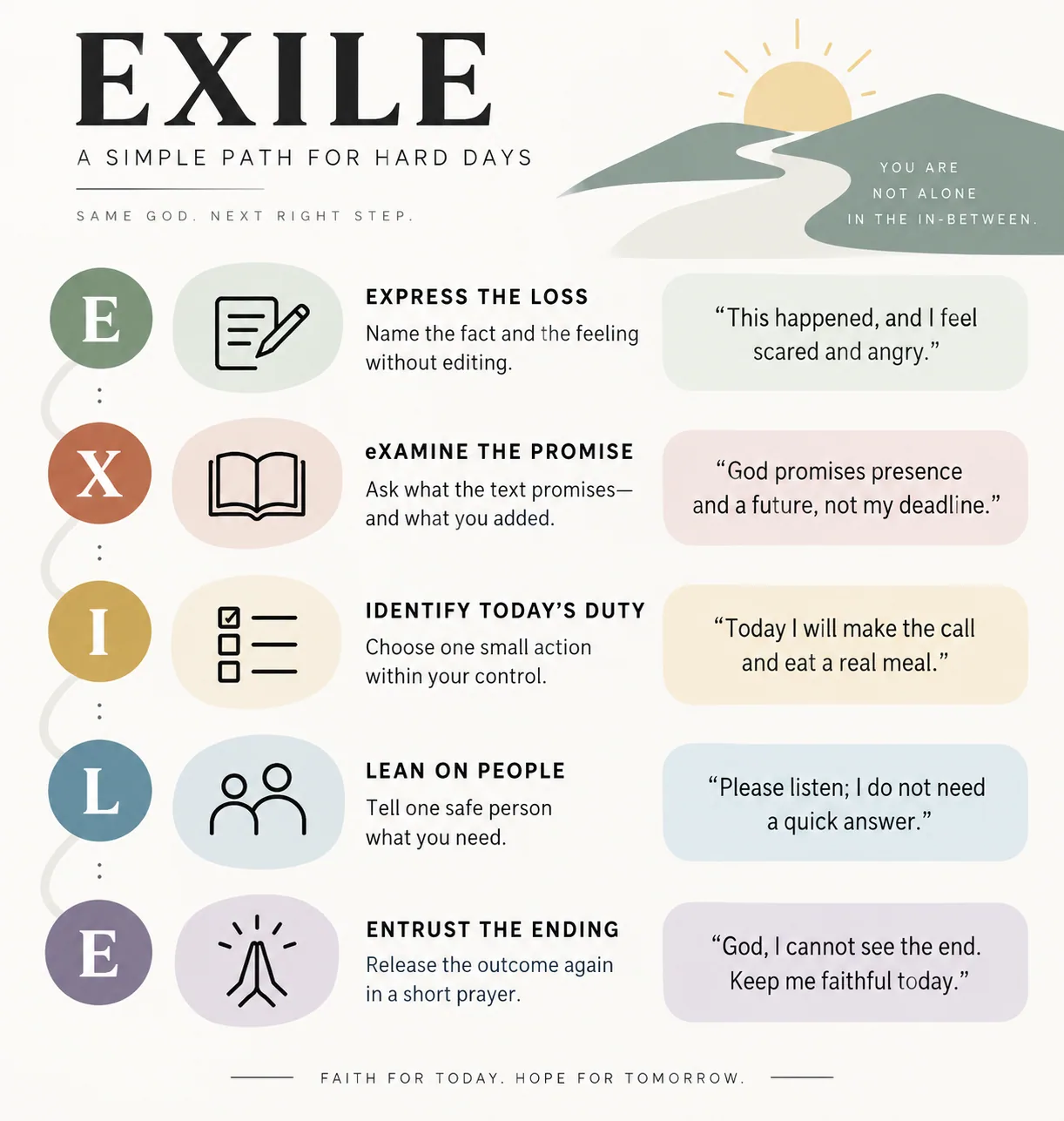
1. Tell the Truth Before You Try to Feel Better
Write one plain sentence: “The thing I feared happened,” or “I did my best and it did not work.” Then name the strongest feeling. Clear words reduce the fog and help you decide what support you need.
Lament is not unbelief. It is pain turned toward God. If you need a longer guide, use this step-by-step resource on how to trust God when life is falling apart.
2. Separate God’s Promise From Your Prediction
Fold a page in half. On the left, write “What God has promised.” On the right, write “What I expected.” You may find that God promised wisdom, presence, grace, resurrection, and final restoration, while you predicted a promotion, a cure, a marriage, or a date.
Your expectation may have been reasonable. It was simply not identical to the promise. This distinction protects you from accusing God of breaking words he did not speak. It also helps you handle God’s promises in the Bible with care.
3. Shrink Faithfulness to the Size of Today
The exiles were told to build, plant, marry, raise families, and seek the city’s welfare. These were ordinary actions in an unwanted place. Their hope had work clothes on.
Choose one body action, one responsibility, and one connection. For example: take your medicine, send the email, and text a friend. Small steps are not a small faith. They are how a future gets lived before it can be seen.
4. Ask for the Right Kind of Help
Tell people what support means. Try: “Sit with me for ten minutes,” “Help me make a budget,” “Drive me to the appointment,” or “Please do not give me a lesson today.” Specific requests are easier to answer than “I’m fine” or “Fix my life.”
A pastor can offer spiritual care. A licensed counselor can help with trauma, anxiety, or depression. A doctor can assess sleep, pain, or other symptoms. A lawyer, financial counselor, or support group may be the wise next step for the actual problem in front of you.
5. Use a Two-Horizon Prayer
Pray for the near horizon and the far horizon. Near: “Give me courage for today’s meeting.” Far: “Form me into a person who loves you even if this road is long.” This keeps hope practical without making it shallow.
When you cannot imagine a full recovery, borrow language about hope and restoration after hardship. You do not have to feel hopeful before you practice hope.

What Not to Say to Someone Whose Life Went Wrong
Good theology can be used with bad timing. If someone is grieving, avoid these shortcuts:
-
“Everything happens for a reason.” It may shut down honest pain and claim knowledge you do not have.
-
“Jeremiah 29:11 says it will all work out.” Define “work out.” The verse does not promise the outcome they want on your schedule.
-
“You need more faith.” Suffering is not a reliable measure of faith. Scripture is full of faithful people who hurt.
-
“At least…” Any sentence that begins this way usually makes the loss smaller.
Say this instead: “I am sorry. This is hard. I am here. What would help today?” Then keep showing up after the first week, when most messages stop.
When Hope Needs Immediate Help
Spiritual practices are not a substitute for urgent care. If you are thinking about suicide, harming yourself, or you cannot stay safe, contact local emergency services or a crisis line now. In the United States and its territories, call or text 988 for the Suicide & Crisis Lifeline. Elsewhere, use your country’s emergency or crisis service.
Also seek professional help if sadness, panic, sleeplessness, substance use, or inability to function continues or grows. Asking for treatment is not a failure to trust God. It is one way to care for the life in front of you.
A Better Way to Carry Jeremiah 29:11
Do not use the verse as a deadline. Use it as an anchor. The first readers still had to wake up in Babylon the next morning, make breakfast, raise children, and live among people they did not choose.
The promise did not deny exile. It denied exile the last word.
That is the Jeremiah 29:11 meaning when life goes wrong: God’s good purpose is bigger than immediate relief. You can grieve what is broken, seek help, do today’s work, and trust that the chapter you are in is not the author of the whole story.

A Short Prayer for When the Verse Does Not Feel True
God, I cannot see the good future from where I stand. I will not pretend this does not hurt. Show me what is mine to do today. Send people who can help me. Keep me from false deadlines and empty comfort. Hold the ending I cannot control, and help me seek you in the middle. Amen.
Frequently Asked Questions
What is the main meaning of Jeremiah 29:11?
God assured the Jewish exiles that Babylon would not erase his covenant purpose. After a long, appointed period, he would restore his people. The verse promises God’s faithful purpose and a real future; it does not promise each reader fast success or freedom from suffering.
Does Jeremiah 29:11 apply to Christians today?
Yes, but through its original context and the wider biblical story. Christians can trust God’s character, presence, and final restoration. We should not turn the verse into a personal guarantee of a job, healing, marriage, wealth, or a quick reversal.
Why did God make the exiles wait seventy years?
Jeremiah connects exile with Judah’s long rebellion and God’s judgment. The seventy years also exposed false hopes and formed a community that had to live faithfully away from home. The text gives the time span; it does not answer every personal “why” behind suffering.
Does “plans to prosper you” mean financial prosperity?
No. The context points to welfare, peace, and restoration for God’s people. Material provision can be a gift, but the verse is not a blank check for wealth or a life without loss.
What if my situation never improves?
Do not promise yourself an outcome Scripture does not promise. Seek wise help, protect your safety, do the next faithful thing, and hold to the larger Christian hope: suffering and death do not have the final word. A meaningful life can grow even when an original loss is not reversed.
Can I be angry with God and still have faith?
Yes. Biblical lament speaks confusion, grief, and even protest to God. The key move is not hiding the anger but bringing it into a truthful relationship with God and safe people.
How can I encourage someone with Jeremiah 29:11?
Start with presence, not explanation. Listen, name the pain, offer practical help, and share the verse only in a way that honors its long timeline. Say, “God has not abandoned you,” not, “This will be fixed soon.”
Key Statistics
Promised period of exile
70 years
Jeremiah tells the Babylonian exiles that restoration would not come quickly; the long timeline directly challenges interpretations of Jeremiah 29:11 as a promise of immediate improvement. The article builds its interpretation around this context.
Source: Jeremiah 29:10; Working Preacher
High stress among U.S. adults
24%
In APA’s 2023 survey, nearly one-quarter of U.S. adults rated their average stress at 8–10 out of 10, supporting the article’s discussion of how severe strain affects people experiencing hardship.
Source: American Psychological Association
Pre-pandemic high-stress rate
19%
The share of adults reporting average stress of 8–10 was 19% in 2019 versus 24% in 2023, providing useful context for the 2023 figure.
Source: American Psychological Association
APA survey size
3,000+ U.S. adults
APA says its 2023 Stress in America survey was conducted by The Harris Poll among more than 3,000 U.S. adults age 18+, giving context to the article’s cited stress statistic.
Source: APA / The Harris Poll
Credible Sources
Working Preacher, Luther Seminary · October 12, 2025
Provides scholarly historical context for Jeremiah 29, including the 597 BCE exile, the contrast with promises of a rapid return, and Jeremiah’s announcement of a 70-year period before major change.
American Psychological Association · November 1, 2023
Primary source for the post’s claim that 24% of U.S. adults rated their average stress between 8 and 10. It also provides methodology and comparisons with 2019.

About the Author
Editorial Team
Editorial Team
Daily Faith Path articles are prepared by the editorial team to help readers find scripture-centered guidance for healing, faith, prayer, and spiritual encouragement.
Expertise: Healing scriptures, Bible study resources, prayer guidance, devotional writing, Christian encouragement
Experience: The team researches scripture references, reviews surrounding biblical context, compares translation wording where useful, and updates articles to improve clarity, usefulness, and trust for readers.
Credentials: Editorial review, devotional writing, scripture study, content updating
This article is published by the Daily Faith Path editorial team to help readers use scripture carefully, prayerfully, and in ways that are practical for real-life seasons of illness, grief, waiting, and spiritual reflection.
Continue Reading
Related articles

September 18, 2026
Romans 8:28 Doesn't Mean What You Think
Romans 8:28 is often quoted as a promise that every hardship will eventually turn into a better earthly outcome. But Romans 8:29 reveals a deeper meaning: God's “good” is ultimately about conforming believers to the image of Christ and bringing them to final glory. This article explores the context of Romans 8, why suffering remains a reality for Christians, and how Romans 8:28 offers a stronger hope than the promise of improved circumstances.

July 27, 2026
Why Smart, Faithful Christians Still Can't Find a Spouse
Many faithful Christians assume the right dating app will solve their singleness, but the biggest obstacles are often geography, gender ratios, denominational barriers, unrealistic expectations, and limited community. Here's what actually improves your chances of finding a Christ-centered marriage.
July 27, 2026
Is It Healthy to Follow End-Times News?
Following end-times news isn't inherently unhealthy—but when prophecy content fuels anxiety, insomnia, and compulsive doomscrolling, it's time to step back. Learn how to distinguish biblical watchfulness from fear, understand the psychology behind prophecy anxiety, and discover practical, faith-based steps to regain peace.