Isaiah 41:10 for Anxiety: Why Am I Still Afraid?
Still feeling anxious after praying Isaiah 41:10? Discover what God's promise really means, why fear can persist, and practical ways to respond with faith, wisdom, and support.
You prayed. You read Isaiah 41:10. You asked God to take away your anxiety. So why is your heart still racing? Being afraid does not mean your faith has failed, and Isaiah 41:10 does not promise that believers will never feel fear.
This verse offers something deeper than an instant cure for anxiety: God's presence and help when you cannot make the fear disappear.
If you have ever felt guilty for being anxious after praying, this guide is for you. We will look at what Isaiah 41:10 means, why anxiety can stick around, and what to do when trusting God still feels hard.
What Does Isaiah 41:10 Really Mean for Anxiety?
The King James Version says:
“Fear thou not; for I am with thee: be not dismayed; for I am thy God: I will strengthen thee; yea, I will help thee; yea, I will uphold thee with the right hand of my righteousness.” — Isaiah 41:10 (KJV)
Notice what God promises. He does not say you will never face danger, uncertainty, or distress. He promises his presence, strength, help, and support.
That difference matters when you are dealing with anxiety that does not go away.
The original context: God was speaking to frightened people
Isaiah 41 was not first written as a personal anxiety treatment. God was addressing Israel, his chosen people, in a message of reassurance amid threats from powerful nations.
In verses 8–9, God reminds Israel that he has chosen them and has not rejected them. Verse 10 follows with a call not to fear because God remains with them.
The people had real reasons to feel afraid. God's answer was not to pretend their troubles did not exist.
It was to remind them who was with them.
Christians today can draw comfort from this picture of God's character. But the verse should not be turned into a guarantee that every personal problem will disappear or every anxious feeling will stop.
Four promises to remember when anxiety returns
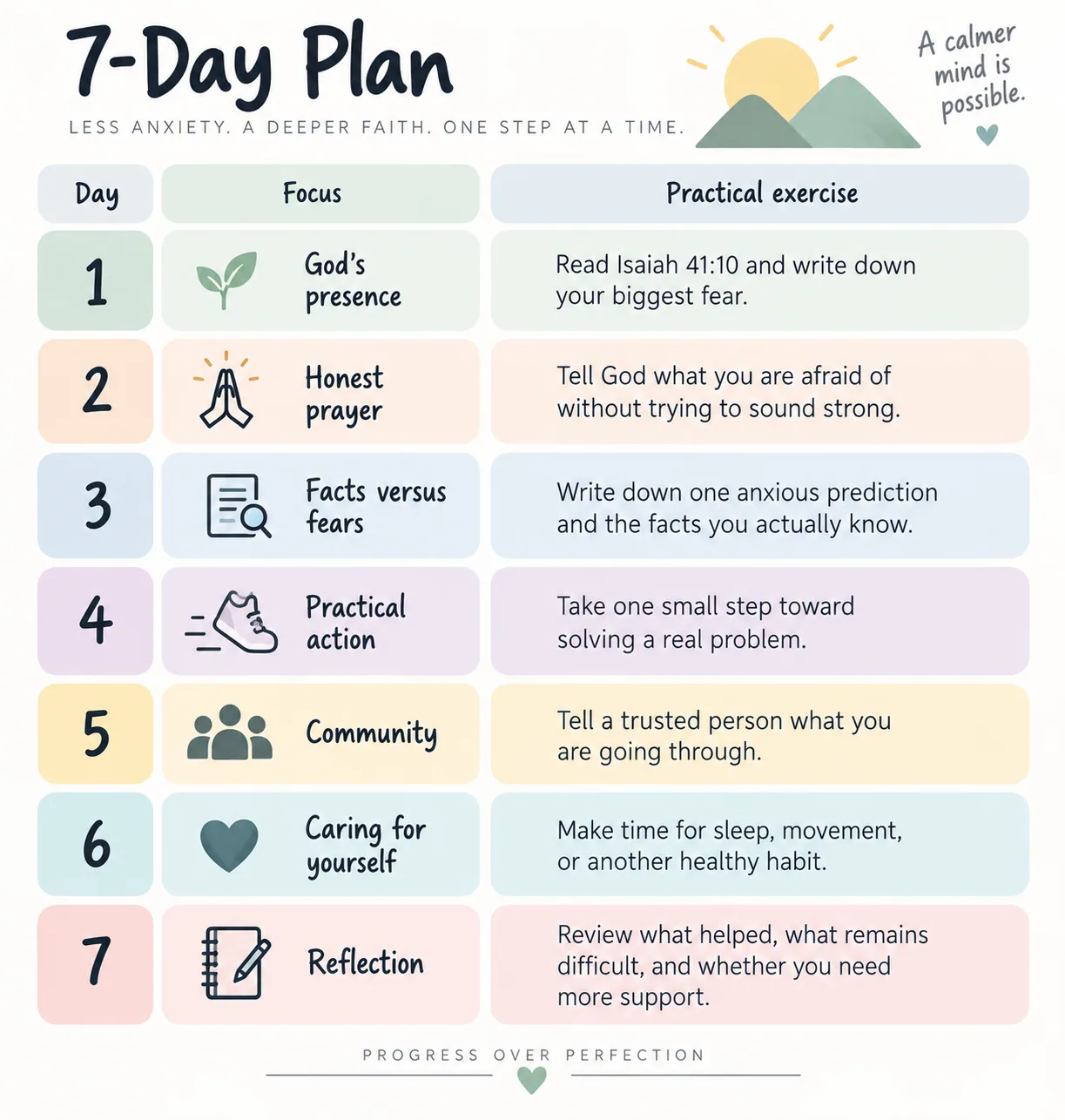
These are practical applications of the verse, not promises of a specific medical outcome.

Why Am I Still Anxious After Praying Isaiah 41:10?
You may believe every word of Isaiah 41:10 and still wake up with a tight chest.
That can happen because anxiety involves more than your thoughts about God. It can also involve your body's alarm system, past experiences, present problems, and mental health.
1. Your body can react before you have time to think
Imagine getting an unexpected message from your boss: “Can we talk tomorrow?”
Your stomach drops. Your mind jumps to the worst possible outcome.
You pray and remind yourself that God is with you. Yet your heart keeps pounding.
Your body has already started responding to a possible threat. A Bible verse can help you respond to that fear, but it is not a switch that instantly turns off every physical symptom.
Try this: Put your feet on the floor, notice your surroundings, and breathe slowly at a comfortable pace. Then ask yourself what you actually know about the situation.
You know your boss wants to talk. You do not yet know why.
That distinction can help you avoid treating a feared outcome as a fact.
2. You may be facing a problem that needs action
Prayer matters. But some worries point toward practical needs.
If you are anxious about overdue bills, the bills still need attention. If you fear a difficult conversation, you may need to prepare for it.
Trusting God does not require you to ignore reality.
For example, after praying about money, you could review your budget, contact a creditor, or ask a trusted person for help.
The goal is not to control everything. It is to take responsibility for what you can do today.
For more practical biblical responses to fear, read how to overcome fear with God .
3. You may be dealing with an anxiety disorder
Sometimes anxiety continues even when no clear danger exists.
You might worry about several things at once, struggle to sleep, avoid normal activities, or experience repeated panic attacks.
These symptoms deserve attention, not judgment.
The World Health Organization estimated that 359 million people worldwide had an anxiety disorder in 2021. It also reported that only about 27.6% of people needing treatment received it.
In the United States, National Institute of Mental Health data from 2001–2003 estimated that 19.1% of adults experienced an anxiety disorder within a year. These figures describe different populations and periods, so they should not be treated as directly comparable.
Anxiety disorders are health conditions. They are not proof that someone has failed to pray enough.
If anxiety is disrupting your daily life, consider speaking with a qualified mental health professional.
4. You may be expecting prayer to produce a particular feeling
It is easy to create an invisible rule:
“If I pray correctly, I should feel peaceful immediately.”
Then, when anxiety returns, you become anxious about being anxious.
This creates two struggles. First, you face the original fear. Second, you worry that the fear means something is wrong with your relationship with God.
Try changing the question.
Instead of asking, “Why haven't I stopped feeling afraid?” ask, “What would trusting God look like while I am afraid?”
You might pray, attend your appointment, ask for support, or rest.
None of those actions requires you to feel completely calm first.
Does “Fear Not” Mean Feeling Anxiety Is a Sin?
No. Feeling fear is not automatically the same as choosing to distrust God.
Fear can be a natural response to danger, pain, loss, or uncertainty. It can also arise from a health condition that needs treatment.
The Bible includes faithful people who experienced deep distress.
David admitted that he was afraid
Psalm 56:3 says:
“What time I am afraid, I will trust in thee.” (KJV)
David does not claim he never feels fear. He describes trusting God when fear appears.
That gives us a useful pattern: acknowledge the feeling, then turn toward God.
You do not need to deny your fear to express faith.
Jesus experienced deep distress
In Matthew 26:37–39, Jesus becomes sorrowful and troubled in Gethsemane. He prays honestly about the suffering ahead.
His distress does not mean he lacks trust in the Father.
Jesus' experience is not identical to a clinical anxiety disorder. Still, it shows that intense emotional suffering is not, by itself, evidence of spiritual failure.
Paul described severe pressure
In 2 Corinthians 1:8–9, Paul describes hardship so intense that he and his companions felt overwhelmed.
He does not present Christian life as constant emotional comfort.
Scripture repeatedly shows people turning toward God during trouble, rather than pretending trouble does not affect them.
The practical lesson: When fear appears, you can acknowledge it without accepting every frightening thought as true.

The Missing Step: Stop Using Isaiah 41:10 as an Anxiety Test
Here is a different way to approach the verse.
Many Christians read Isaiah 41:10, check how they feel, and decide whether the verse worked.
If they feel calm, they think they trusted God. If they still feel afraid, they think they failed.
But that makes their emotional state the measure of their faith.
Instead, use Isaiah 41:10 as a guide for what to do next.
The presence, problem, and next-step method
When anxiety strikes, ask three questions:
-
Presence: What does God's promise remind me about who is with me?
-
Problem: What is actually happening, and what am I imagining?
-
Next step: What is one useful action I can take without waiting to feel calm?
Consider someone waiting for medical test results.
They cannot force the results to arrive sooner. But they can pray, follow their doctor's instructions, avoid repeatedly searching frightening symptoms online, and talk to a trusted friend.
Their anxiety may remain. Yet they are responding to it differently.
This is not a method for earning God's help. It is a way to practice trust while accepting that some uncertainty remains.
Four Real-Life Anxiety Situations and What to Do
The following are realistic, illustrative situations, not verified personal testimonies. Each shows how Isaiah 41:10 can inform a practical response.
Story 1: The mother who cannot stop worrying about her children
Sarah's teenage son is late coming home. She has called twice, and he has not answered.
Her mind races through terrible possibilities.
She reads Isaiah 41:10 but keeps checking her phone. Soon, she feels guilty for not trusting God.
What can Sarah do?
First, she can take reasonable safety steps. She can contact her son, check with someone who may know where he is, and seek emergency help if there is a genuine reason to believe he is in danger.
Then she can separate what she knows from what she fears.
She knows her son is late. She does not know that something terrible has happened.
Her prayer might be:
“Lord, I am scared. Help me respond wisely instead of assuming the worst. Give me strength to handle what comes next.”
Sarah does not need to ignore a real safety concern to prove her faith.
Story 2: The employee who fears losing his job
Daniel hears that his company may cut jobs.
He has a mortgage and two children. He prays every morning, but his anxiety returns during the commute.
Instead of repeating Isaiah 41:10 until he feels better, Daniel can make a plan.
He can update his résumé, review his savings, reduce unnecessary spending, and ask his manager about the company's plans when appropriate.
He can also limit how often he checks workplace rumors.
Daniel cannot guarantee that he will keep his job. But he can prepare without letting fear make every decision.
For more Scripture and reflection on uncertain outcomes, explore Bible verses for anxiety about the future .
Story 3: The Christian who has panic attacks during church
Maria loves attending church. But one Sunday, she suddenly feels dizzy, her heart races, and she fears she might collapse.
She steps outside and prays. The next week, she becomes anxious about having another episode.
Eventually, she starts avoiding church.
Maria's problem is no longer just the original panic episode. She is also afraid of experiencing panic again.
She could speak with a healthcare professional about her symptoms and discuss whether treatment would help. If panic disorder is diagnosed, therapies such as cognitive behavioral therapy (CBT) can teach people to respond differently to frightening physical sensations.
She could also tell a trusted church leader that she is struggling and ask for practical support.
The goal is not to force herself through frightening situations without help. It is to develop a safe, appropriate plan for returning to activities she values.
Story 4: The person who feels anxious every night
James feels fine during the day. But once the house becomes quiet, he starts thinking about money, his parents' health, and everything he might have done wrong.
He prays in bed for an hour. Yet the more he tries to force himself to sleep, the more alert he feels.
James can move his worry time earlier.
Before bed, he can write down his concerns and identify anything that needs attention tomorrow.
He can also establish a regular sleep schedule, reduce late caffeine, and keep his phone away from his bed.
If his sleep problems continue, he can speak with a healthcare professional.
For additional bedtime Scripture and reflection, see Bible verses for anxiety at night .

A Practical Isaiah 41:10 Prayer and Reflection Guide
You do not need a perfect prayer. You need an honest one.
Use the following exercise when anxiety returns. It can take about five minutes, although you can go more slowly.
Step 1: Name your fear
Complete this sentence:
“God, I am afraid that ______.”
Be specific.
Instead of saying, “I am anxious about everything,” you might say, “I am afraid my medical results will be bad.”
Naming the fear helps you identify what needs attention.
Step 2: Read the verse without demanding instant relief
Read Isaiah 41:10 slowly.
Notice the promises about God's presence and help.
Do not check your pulse or ask yourself whether the anxiety has disappeared.
You are reading Scripture to remember God's character, not to test whether you can produce a particular feeling.
Step 3: Separate facts from predictions
Write two short columns.
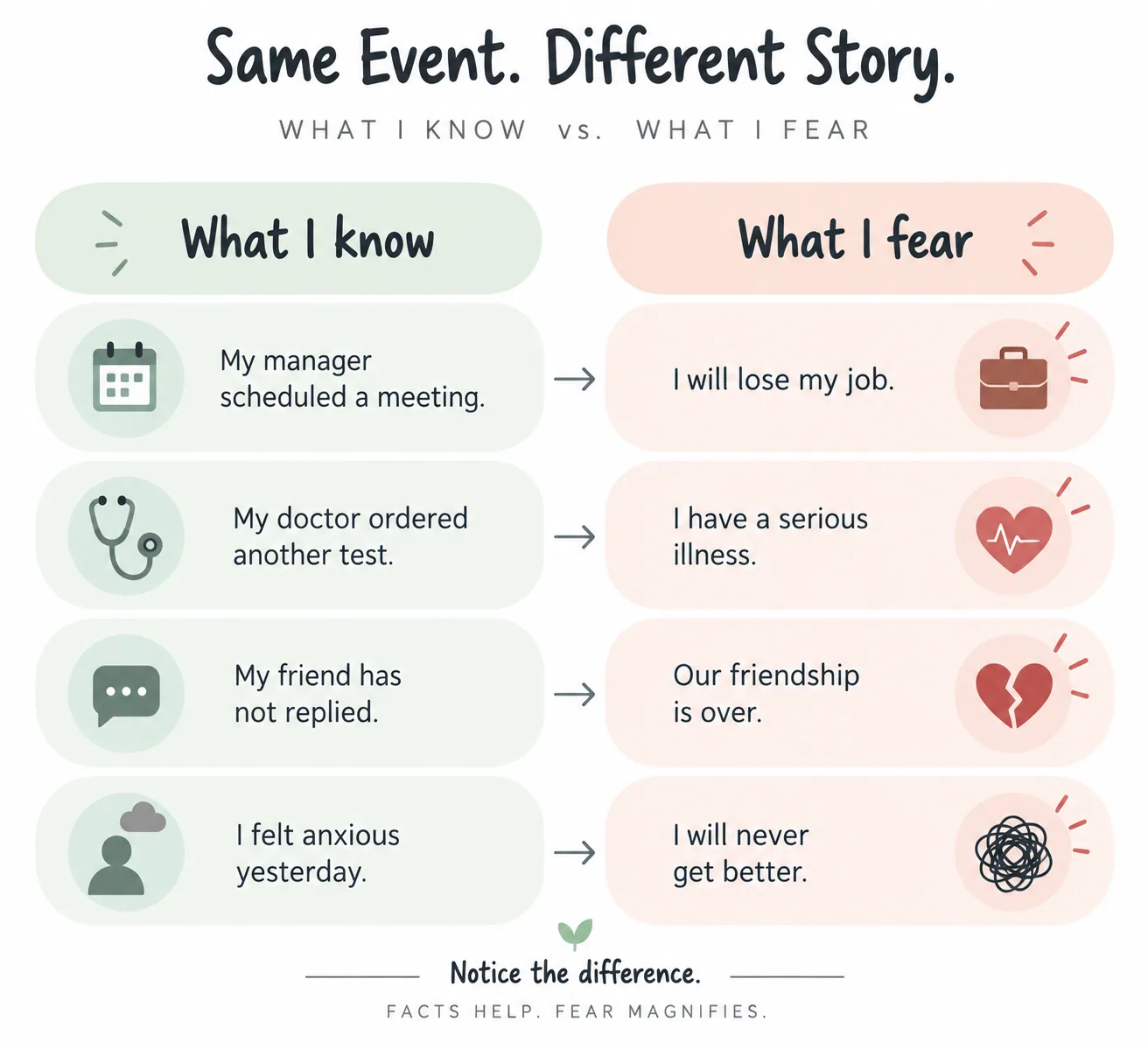
The second column may contain possibilities. But possibilities are not established facts.
Ask yourself whether there is useful evidence for the feared outcome and whether other explanations exist.
Step 4: Choose one next action
Ask, “What can I do about this today?”
If the concern is practical, take a practical step.
If nothing can be done yet, choose how you will care for yourself while waiting.
That might mean eating a meal, getting some rest, or spending time with someone you trust.
Step 5: Pray honestly
Use this prayer as a starting point:
A prayer for anxiety that will not go away
“Heavenly Father, I believe you are with me, but I still feel afraid.
“You know what I am worried about. You know the thoughts I cannot seem to quiet.
“Help me remember that my fear does not place me beyond your care.
“Give me wisdom to recognize what is true. Give me courage to take the next step, and help me accept the things I cannot control.
“Lead me toward the support I need. When I feel weak, remind me that I can ask for help.
“Thank you for hearing me, even when I do not feel peaceful.
“In Jesus' name, amen.”
You can return to this prayer whenever you need it. There is no required number of repetitions.
What to Do When Prayer Alone Is Not Enough
Prayer and professional care do not have to compete.
If your anxiety keeps disrupting your life, seeking treatment can be a responsible step.
When should you consider professional help?
Consider contacting a healthcare professional if you regularly experience:
-
Worry that feels difficult to control.
-
Panic attacks or fear of having another attack.
-
Sleep problems caused by persistent anxiety.
-
Avoidance of work, school, church, or social activities.
-
Anxiety that harms your relationships or daily functioning.
A clinician can assess your symptoms and consider whether a medical condition or anxiety disorder may be involved.
Seek urgent medical assessment for new or severe physical symptoms, such as significant chest pain or difficulty breathing. Do not assume they are caused by anxiety.
What does effective anxiety treatment look like?
Treatment depends on your symptoms, diagnosis, preferences, and medical needs.
CBT is a well-studied therapy that helps people recognize unhelpful thinking patterns and change how they respond to anxiety.
Acceptance and commitment therapy (ACT) helps people make room for difficult feelings while taking actions that reflect their values.
Medication may also be appropriate for some people. A qualified prescriber can discuss benefits, risks, and available options.
A Christian can pray, read Scripture, attend therapy, and follow a treatment plan.
Those activities are not mutually exclusive.

A Seven-Day Isaiah 41:10 Anxiety Practice
If anxiety has become a daily struggle, try this seven-day reflection plan.
The goal is not to become completely fearless by day seven. It is to practice responding to anxiety with honesty, wisdom, and support.
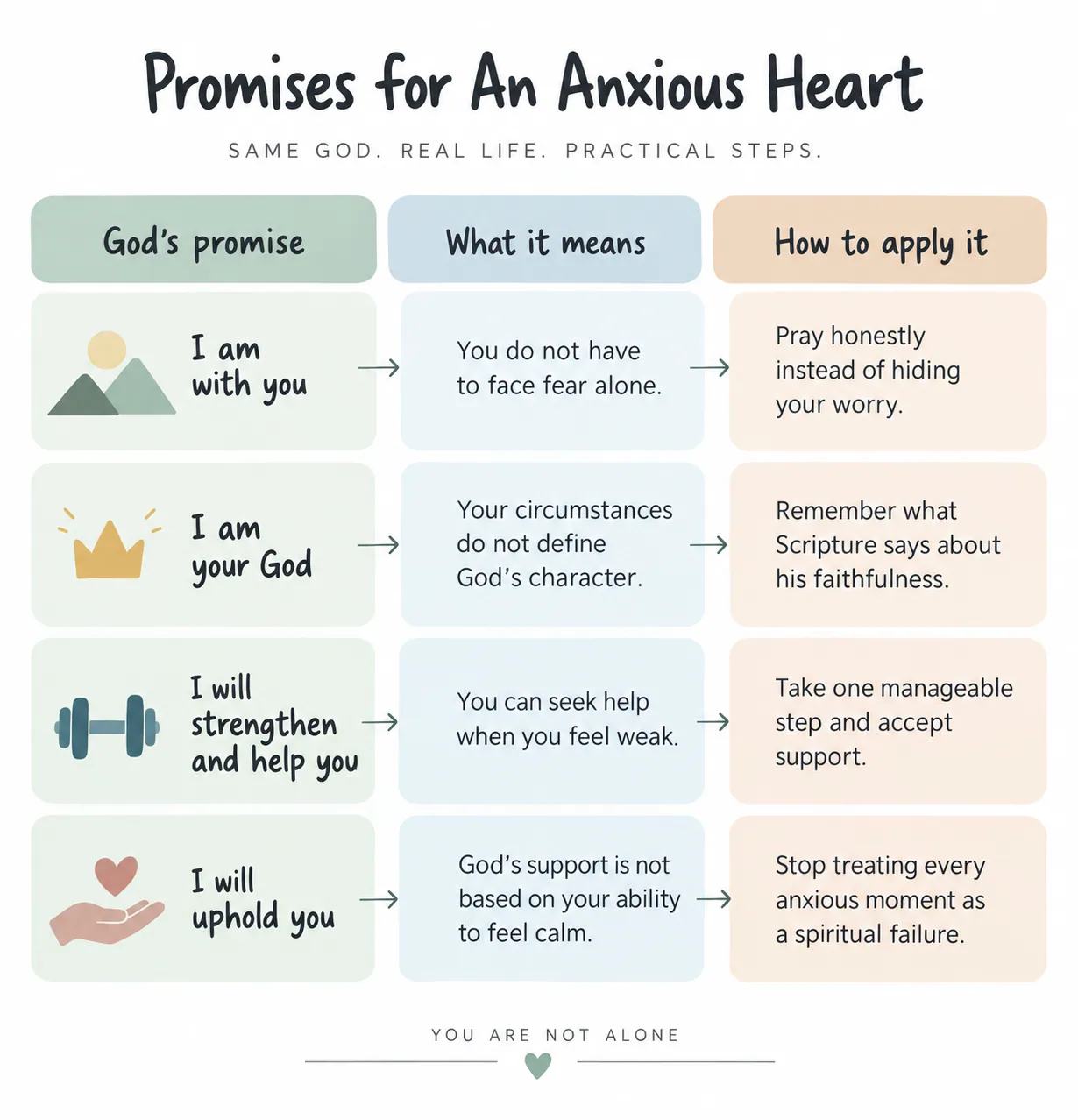
How do you know whether you are making progress?
Do not measure progress only by how often you feel anxious.
Notice whether you are becoming better able to respond when anxiety appears.
Perhaps you attended an appointment you previously avoided. Maybe you asked for help instead of hiding your struggle.
Those changes matter.
If you continue to experience significant anxiety, this exercise should not replace professional care.
Frequently Asked Questions About Isaiah 41:10 and Anxiety
What does Isaiah 41:10 say about anxiety?
Isaiah 41:10 tells God's people not to fear because he is with them. It promises strength, help, and support.
For Christians experiencing anxiety, the verse can be a reminder of God's faithfulness during difficult circumstances. It does not guarantee that every anxious feeling will disappear.
Why am I still afraid after praying?
Anxiety can involve physical stress responses, difficult life circumstances, learned patterns, and mental health conditions.
Prayer can provide spiritual support without immediately changing all those factors.
Persistent anxiety is not, by itself, evidence that you have prayed incorrectly.
Is having anxiety a lack of faith?
Not necessarily. Experiencing fear and choosing to trust God are not mutually exclusive.
Psalm 56:3 describes turning toward God while afraid. You can acknowledge your anxiety and still practice faith.
Can a Christian take medication for anxiety?
Yes. Christians can consider medication as part of appropriate medical care.
Medication is not necessary for everyone, and treatment decisions should be made with a qualified healthcare professional. Do not start, stop, or change prescribed medication without medical guidance.
What is the best way to pray Isaiah 41:10?
Start by naming your fear honestly. Then thank God for his presence and ask for wisdom about your next step.
You do not need to repeat the verse until you feel calm. Prayer is not a performance test.
What if I keep worrying about the future?
Focus on what you know and what you can do today.
Make a reasonable plan for practical concerns. When an outcome is outside your control, practice accepting that uncertainty without treating the worst possibility as certain.
Does God promise to remove my anxiety?
Isaiah 41:10 promises God's presence, strength, and help to his people. It does not make a specific promise that every believer will be free from anxiety symptoms.
Christians may pray for relief while also seeking practical and professional support.
How can I help a Christian friend who struggles with anxiety?
Listen before offering advice.
Avoid saying that your friend simply needs more faith or should pray harder. Ask what kind of support would help, and encourage professional care when anxiety is affecting daily life.
You can pray with someone without trying to fix every feeling they have.
Final Thoughts: You Can Trust God While You Are Still Afraid
Isaiah 41:10 does not ask you to pretend that life is easy.
It reminds you of God's presence when life is uncertain.
You may pray today and still feel anxious tomorrow. You may need support, treatment, rest, or time to work through a difficult situation.
None of those needs automatically means your faith has failed.
The next time anxiety returns, do not make feeling calm your test of whether God is with you.
Remember his promise. Tell him the truth about your fear. Then take the next wise step available to you.
You do not have to solve your entire future today.
Key Statistics
Global anxiety disorder prevalence
359 million
Estimated number of people worldwide living with an anxiety disorder in 2021.
Source: WHO, 2025
U.S. adult annual anxiety prevalence
19.1%
Estimated share of U.S. adults aged 18+ experiencing any anxiety disorder in a year, based on 2001–2003 survey data.
Source: NIMH, NCS-R
Credible Sources
Bible Gateway · Biblical text; webpage date not stated
Establishes the original context of Isaiah 41:10, including God's address to Israel in verses 8–9. Supports the article's interpretation of the verse as a promise of divine presence and help.
World Health Organization (WHO) · September 8, 2025
Verifies the global prevalence figure of 359 million, the 27.6% treatment coverage statistic, and the article's discussion of anxiety disorders as treatable health conditions.

About the Author
Editorial Team
Editorial Team
Daily Faith Path articles are prepared by the editorial team to help readers find scripture-centered guidance for healing, faith, prayer, and spiritual encouragement.
Expertise: Healing scriptures, Bible study resources, prayer guidance, devotional writing, Christian encouragement
Experience: The team researches scripture references, reviews surrounding biblical context, compares translation wording where useful, and updates articles to improve clarity, usefulness, and trust for readers.
Credentials: Editorial review, devotional writing, scripture study, content updating
This article is published by the Daily Faith Path editorial team to help readers use scripture carefully, prayerfully, and in ways that are practical for real-life seasons of illness, grief, waiting, and spiritual reflection.
Continue Reading
Related articles

September 20, 2026
Why Are There Two Versions of the Ten Commandments?
Why are the Ten Commandments different in Exodus 20 and Deuteronomy 5? Explore the two biblical accounts, discover why the Sabbath command emphasizes creation in Exodus and freedom from slavery in Deuteronomy, and examine the Hebrew wording, historical context, and practical lessons for Christian living.

September 18, 2026
Romans 8:28 Doesn't Mean What You Think
Romans 8:28 is often quoted as a promise that every hardship will eventually turn into a better earthly outcome. But Romans 8:29 reveals a deeper meaning: God's “good” is ultimately about conforming believers to the image of Christ and bringing them to final glory. This article explores the context of Romans 8, why suffering remains a reality for Christians, and how Romans 8:28 offers a stronger hope than the promise of improved circumstances.

September 17, 2026
When Jeremiah 29:11 Doesn’t Feel True
Jeremiah 29:11 promises hope, but not a quick fix. Discover what the verse meant to the exiles in Babylon and how to trust God’s good purpose when life gets worse instead of better.