Why Are There Two Versions of the Ten Commandments?
Why are the Ten Commandments different in Exodus 20 and Deuteronomy 5? Explore the two biblical accounts, discover why the Sabbath command emphasizes creation in Exodus and freedom from slavery in Deuteronomy, and examine the Hebrew wording, historical context, and practical lessons for Christian living.
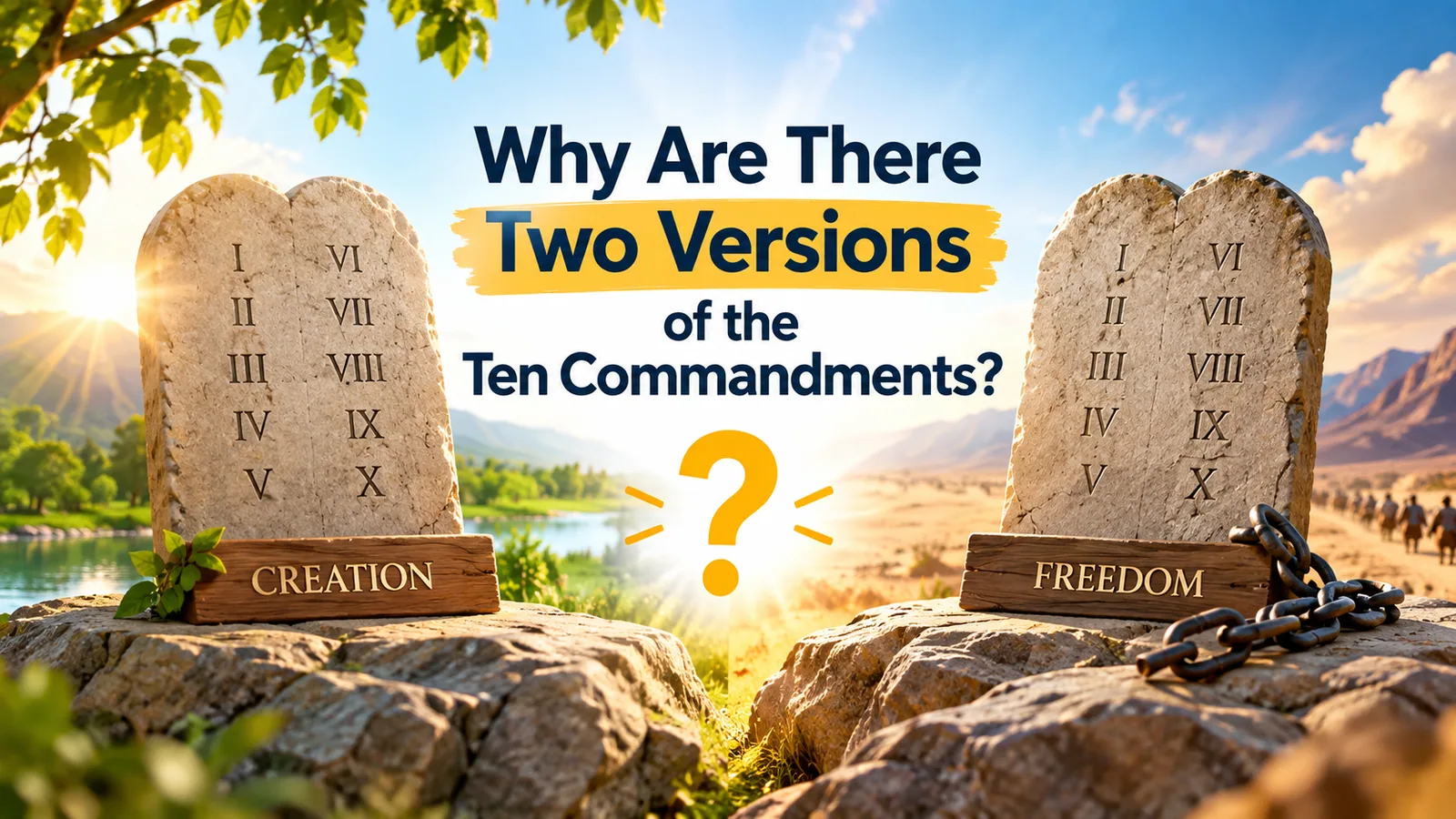
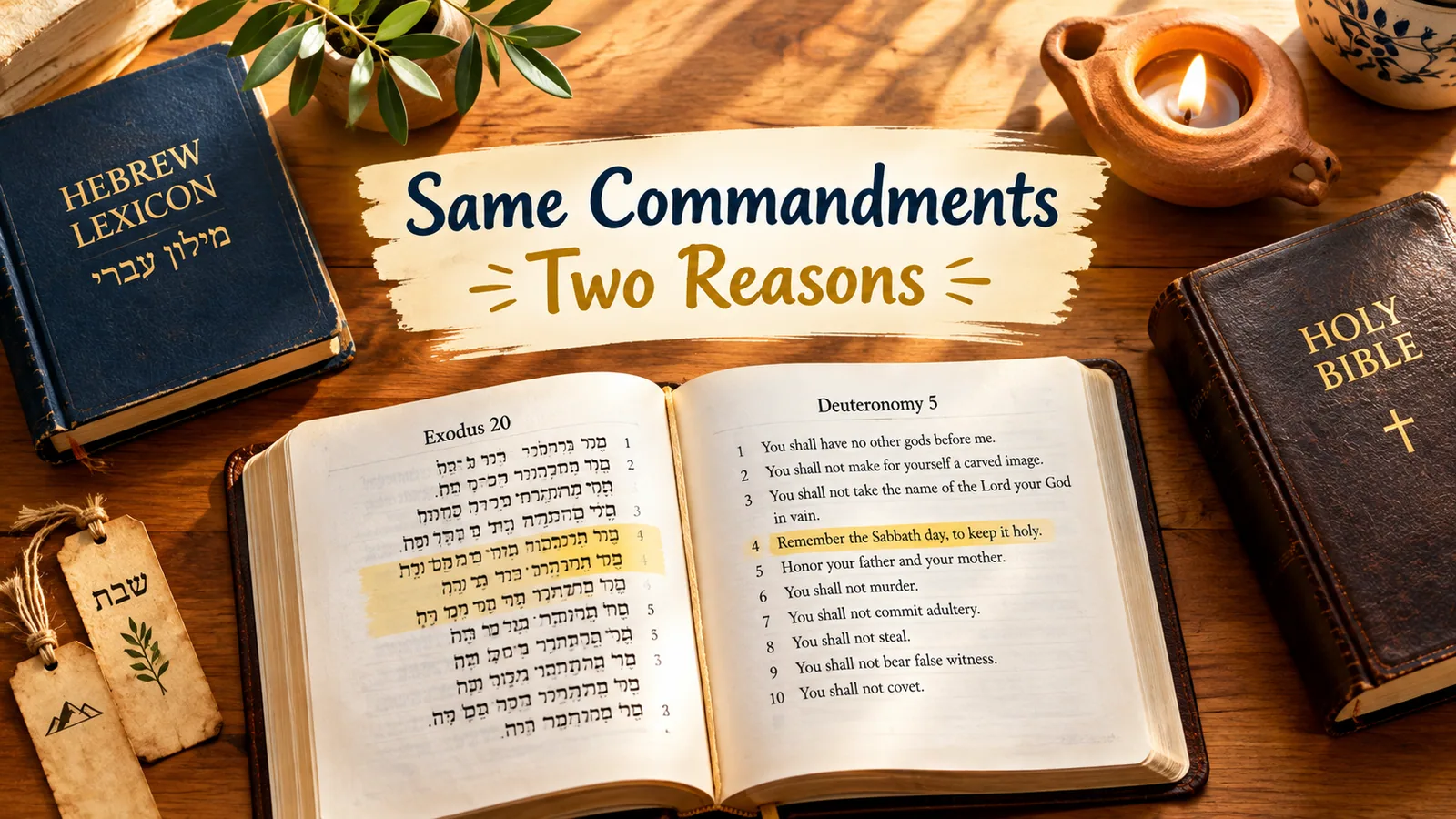
The Ten Commandments appear twice in the Bible, but the wording is not exactly the same. Exodus 20 connects Sabbath rest to God's creation of the world, while Deuteronomy 5 connects it to Israel's freedom from slavery. Why would Moses give two different reasons for the same command?
The answer lies in when each passage was spoken, who was listening, and what God wanted Israel to remember. Once you understand those details, the differences become a powerful lesson about worship, freedom, fairness, and how we treat other people.
Quick Answer: Why Are Exodus 20 and Deuteronomy 5 Different?
Exodus 20 records God's commandments at Mount Sinai after Israel left Egypt. Deuteronomy 5 presents those commandments again as Moses addresses Israel on the plains of Moab, before the people enter the Promised Land.
In the biblical narrative, roughly 40 years separate these settings.
The central commands remain the same. The differences appear mainly in the Sabbath command, the promise attached to honoring parents, the wording about false testimony, and the order and language of coveting.
Here is the key:
-
Exodus 20: Rest because God created the world and rested on the seventh day.
-
Deuteronomy 5: Rest because God rescued Israel from slavery, and everyone deserves rest.
-
Both passages: Worship God, honor others, protect life, tell the truth, and resist harmful desires.
Jewish interpreters have long examined these differences. Modern biblical scholars also study how the two passages relate to the development and transmission of the biblical text.
For a practical introduction to each command, read our meaning of the Ten Commandments guide.

1. The Historical Setting: One Covenant, Two Moments
Exodus 20: A nation newly freed from Egypt
Israel has just escaped Egyptian slavery. The people arrive at Mount Sinai, where God establishes his covenant with them.
Exodus 19 describes thunder, lightning, smoke, and the mountain trembling. Exodus 20 then presents the commandments as God's direct speech.
This setting matters. Israel is learning how to live as a people who belong to God rather than Pharaoh.
The commandments begin with a reminder of deliverance. God identifies himself as the one who brought Israel out of Egypt.
Obedience follows rescue in the narrative. The people are not being told to earn their escape.
Deuteronomy 5: A new generation preparing for a new home
Deuteronomy takes place later, east of the Jordan River. Moses addresses the Israelites before they enter Canaan.
Many of the adults who left Egypt have died during the wilderness years. Their children now need to understand the covenant for themselves.
Moses does more than repeat laws. He teaches the people how to remember their history and live faithfully in their new circumstances.
This explains why Deuteronomy frequently connects obedience with remembering slavery, caring for vulnerable people, and living well in the land.
For the wider covenant context, see our guide to the covenant blessings and warnings in Deuteronomy 28 .
Does Deuteronomy claim to quote the exact words spoken at Sinai?
Deuteronomy 5:4–5 presents the speech as God's words, with Moses acting as mediator. Verse 22 also says God spoke these words to the assembly.
That creates a genuine question: if both passages report the same revelation, why do their words differ?
Traditional Jewish and Christian approaches often understand Deuteronomy as a faithful restatement or inspired explanation. Jewish rabbinic tradition also offers an interpretation in which the Sabbath commands to remember and observe were spoken together.
Historical-critical scholars approach the question differently. They examine the literary formation of the Pentateuch and whether the two texts preserve distinct versions of an older commandment tradition.
These explanations reflect different assumptions about biblical authorship and revelation. The wording differences themselves are visible regardless of which approach a reader follows.
2. Exodus 20 vs. Deuteronomy 5: Complete Verse-by-Verse Comparison
Before studying the differences, review the Ten Commandments in order .
The table below compares all ten commandments. It uses the common Protestant numbering for convenience. Jewish, Catholic, and Lutheran traditions divide and number some commands differently.
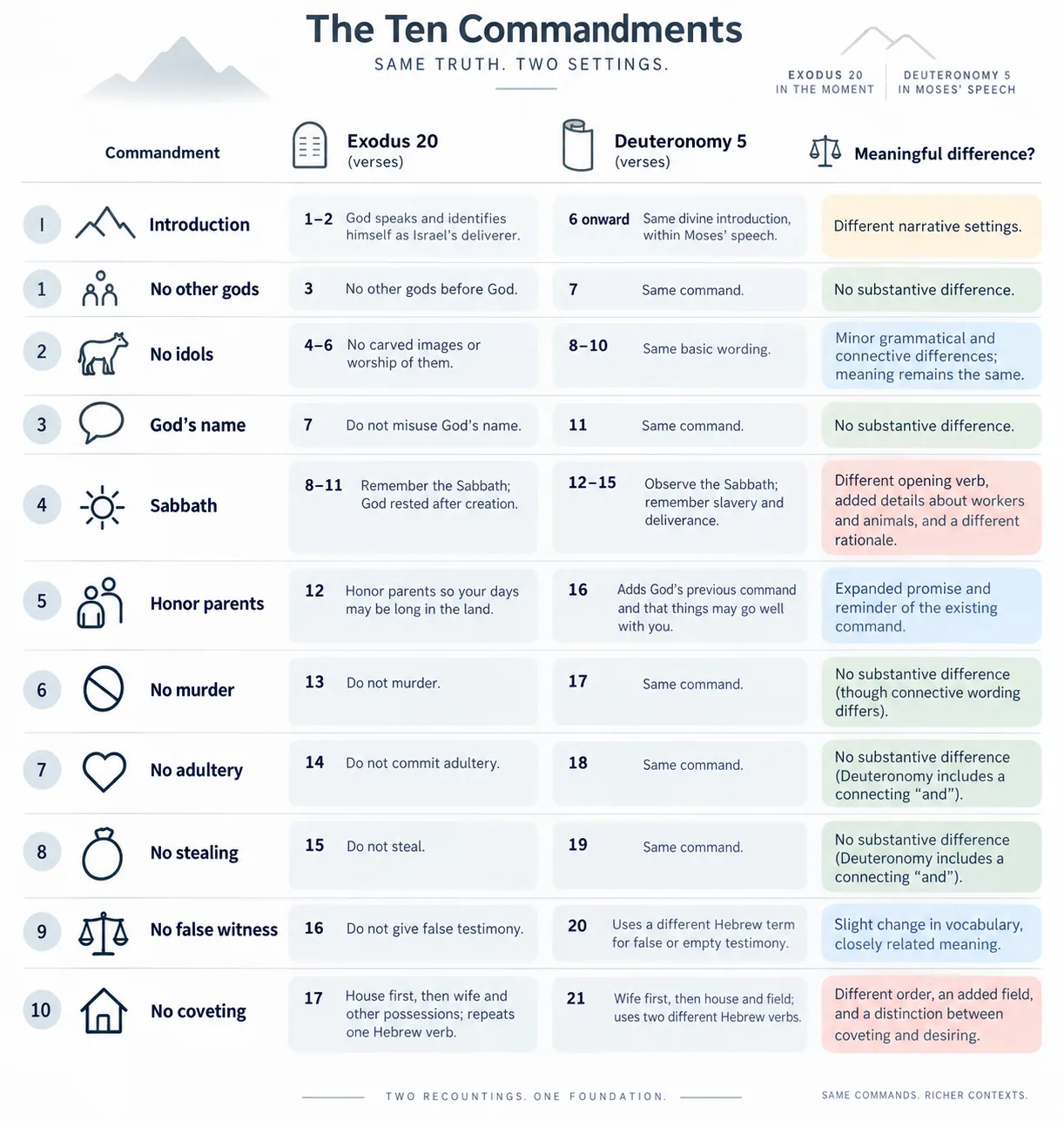
The comparison follows the Hebrew text represented in standard modern editions of the Bible. English translations may make some small differences less visible.
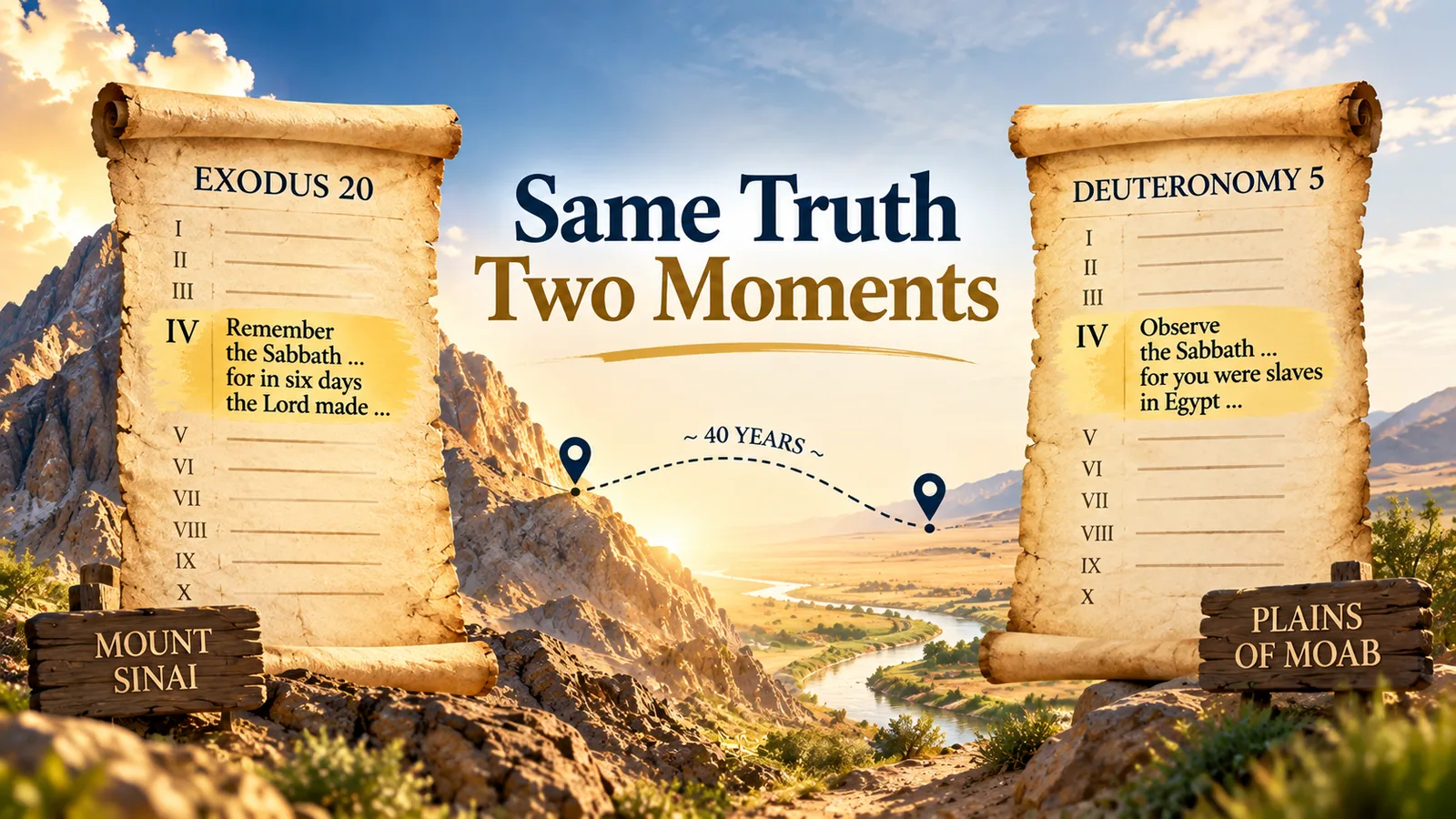
3. The Biggest Difference: Why Does the Sabbath Command Change?
The Sabbath is where the two accounts differ most.
Exodus emphasizes God's creation of the world. Deuteronomy emphasizes Israel's rescue from forced labor.
Neither passage presents rest as merely a day off. Both connect it to Israel's relationship with God.
Exodus 20: Remember the Creator
Exodus 20:8 begins with the Hebrew word zakhor, meaning "remember."
The command asks Israel to remember the Sabbath and keep it holy.
Verse 11 explains why: God made the heavens, earth, sea, and everything in them in six days and rested on the seventh.
The Sabbath therefore points back to creation. It reminds Israel that the world belongs to God and that human life is not defined only by work.
Genesis 2:2–3 provides the earlier creation background. God finishes his creative work, rests, and blesses the seventh day.
Deuteronomy 5: Remember what slavery felt like
Deuteronomy 5:12 begins with shamor, meaning "observe," "keep," or "guard."
The command still requires the Sabbath to be kept holy. But verse 14 adds a striking detail: servants must rest just as their masters do.
Verse 15 then explains the reason. Israel must remember being enslaved in Egypt and how God brought the people out.
Under Pharaoh, the Israelites had experienced forced labor. Their own society must not reproduce that experience by denying rest to others.
The Cambridge Bible commentary specifically connects Deuteronomy's slavery reminder to its emphasis on rest for servants.
Why creation and liberation belong together
The two explanations answer different questions.
Exodus asks: Why is the seventh day holy?
Deuteronomy asks: What should a people rescued from slavery do with that holy day?
Creation gives the Sabbath its place in the rhythm of the world. Deliverance shows how that rhythm should shape human relationships.
Consider a business owner who closes the shop for worship but requires employees to work without proper breaks.
The owner may understand the personal value of rest. Yet Deuteronomy raises another question: Who else is carrying the burden that makes my rest possible?
That is the often-overlooked practical force of the second Sabbath account.
4. Five Hebrew Details That Explain the Differences
Hebrew vocabulary helps us see why these passages are not simply interchangeable.
You do not need to know Hebrew to understand the commandments. But a few words reveal details that English readers can miss.
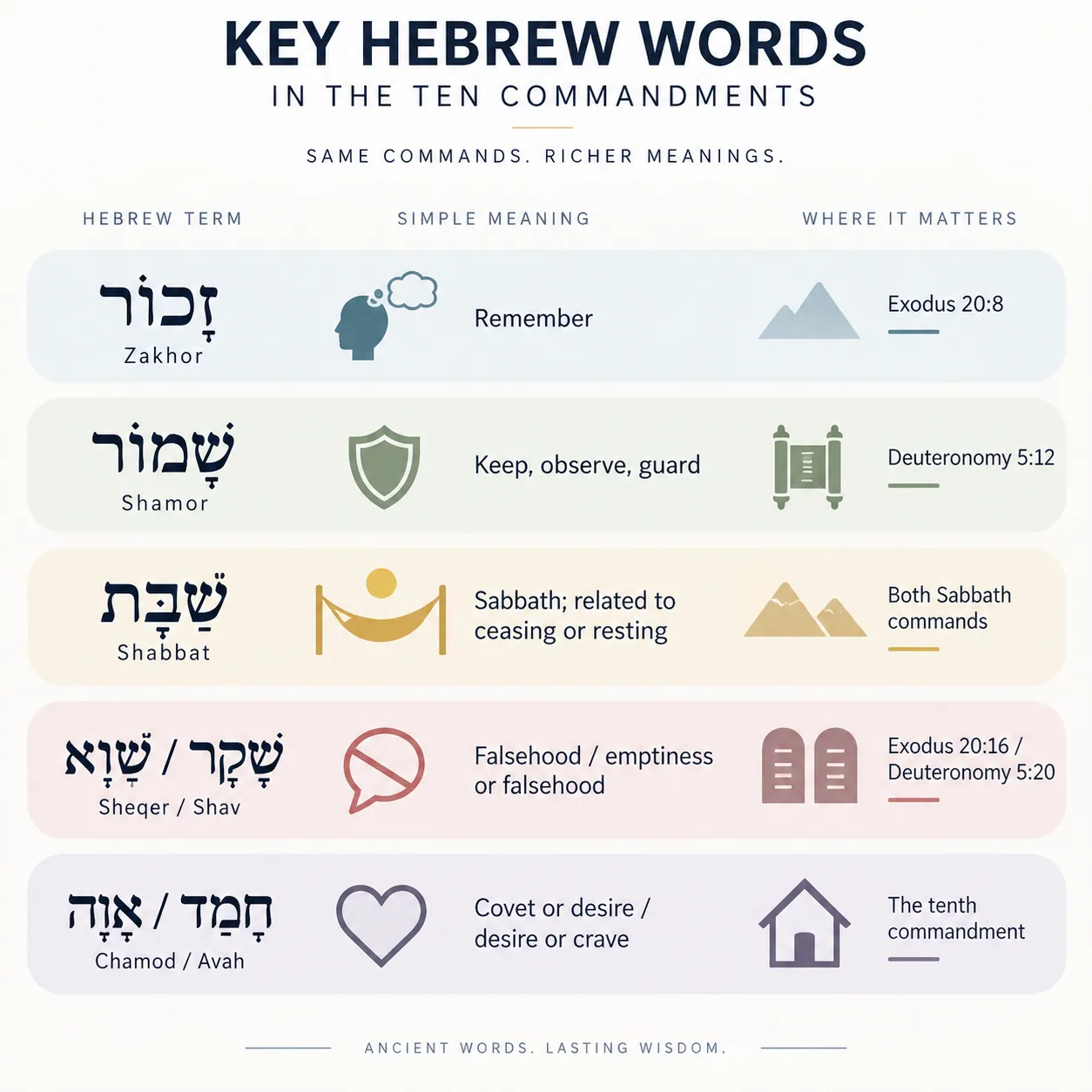
Remember and observe are complementary
In Jewish interpretation, remembering the Sabbath includes honoring its sacred character. Observing it includes protecting its boundaries.
The two verbs are not opposites.
Remembering without action can become empty talk. Observing without remembering can become a routine with little reflection.
Why does Deuteronomy use two words for desire?
Exodus 20:17 repeats the verb chamad when speaking about coveting a neighbor's belongings.
Deuteronomy 5:21 uses chamad for the neighbor's wife and avah for desiring the neighbor's house and other property.
The words overlap in meaning. Some Jewish interpreters distinguish them by emphasizing desire and the actions that may follow it.
The text does not, however, establish a simple universal rule that one Hebrew word always means an action and the other always means a thought. Context matters.
Study tip: Compare two reliable English translations, then consult a Hebrew lexicon or study Bible. Our guide to comparing Bible translations explains how to balance wording precision and readability.
5. Four Other Differences That Are Easy to Miss
Honoring parents: Deuteronomy expands the promise
Exodus 20:12 promises long life in the land to those who honor their parents.
Deuteronomy 5:16 adds that things may go well with them. It also reminds Israel that God has already commanded this duty.
The added language fits Deuteronomy's wider concern with life in the Promised Land.
Real-life example: An adult daughter wants to honor her aging father, but he has a history of abusive behavior.
Honoring him does not require accepting further abuse. She might arrange safe care, communicate through a trusted relative, or maintain appropriate boundaries.
The command calls for honor. It does not specifically require an adult child to surrender personal safety.
False witness: Two words, one serious warning
Exodus 20:16 uses sheqer, a word associated with falsehood.
Deuteronomy 5:20 uses shav, which can convey emptiness, worthlessness, or falsehood.
Both passages prohibit false testimony against a neighbor.
Imagine someone spreading an unverified accusation in a church group chat. Even if the person claims to be concerned, the accusation may damage another person's reputation.
A practical response is to stop forwarding the claim, check the facts, and correct any false statement you have already shared.
Coveting: Why does the order change?
Exodus lists the neighbor's house before the neighbor's wife. Deuteronomy mentions the wife first, then the house, field, and other possessions.
Deuteronomy's inclusion of a field also fits its setting before Israel enters an agricultural land.
Some interpreters see the changed order as giving special attention to marriage. Others focus on the passage's literary structure.
Neither explanation requires treating the two passages as different moral rules.
The connecting words: Why are some commands joined by "and"?
In Hebrew, Deuteronomy joins several of the short prohibitions with a conjunction, commonly translated "and."
Exodus presents those prohibitions without the same pattern of conjunctions.
The basic commands remain unchanged. This is an example of a wording difference that does not create a different obligation.
6. Does This Mean the Bible Contradicts Itself?
That depends partly on what a reader means by contradiction.
The two passages do contain different wording. It would be inaccurate to claim that they are identical.
But the different Sabbath explanations are not logically exclusive. A day can commemorate creation and deliverance.
The more difficult question concerns why two accounts of the same revelation use different words.
Traditional readers may understand Deuteronomy as an authoritative restatement of Sinai's commandments. Historical-critical scholars may understand the accounts as preserving different literary forms of the Decalogue.
The biblical text does not provide a detailed account of how every wording difference arose.
For a small-group discussion, distinguish three questions:
-
What exactly does each passage say?
-
How might its setting explain the difference?
-
What does the difference mean for interpretation and practice?
Do not rush from the first question to the third. Careful observation makes the discussion more useful.
7. Five Real-Life Problems the Two Sabbath Accounts Help Us Address
The following are illustrative situations, not documented personal testimonies. Each shows how the biblical principles can guide practical decisions.
Problem 1: "I feel guilty whenever I stop working."
A parent works full-time, manages household tasks, and feels anxious when the house is quiet.
Exodus 20 challenges the idea that endless productivity defines a person's value.
Practical resolution: Choose a regular period for worship and rest. Turn off nonessential work notifications, prepare necessary tasks beforehand, and let some unfinished chores wait.
Start with a realistic period if your schedule is difficult. The aim is to build a sustainable rhythm, not another stressful performance target.
Problem 2: "My rest depends on someone else doing everything."
A family decides that Sunday will be a peaceful day. Yet one person still cooks, cleans, organizes, and cares for everyone.
Deuteronomy 5 makes the household ask whether rest is being shared fairly.
Practical resolution: Prepare meals together, divide necessary tasks, and give caregivers protected time for their own rest.
For example, one parent can handle breakfast and childcare while the other attends worship or rests. They can switch responsibilities later.
Problem 3: "I have to work on weekends."
A nurse works rotating shifts. She cannot always attend a regular Sunday service and worries that her faith is inadequate.
The Sabbath passages originally concern Israel's seventh-day observance. Christian traditions differ over how that command applies today.
Practical resolution: Follow your church's teaching while making realistic room for worship, rest, and community.
A shift worker might attend another service, join a small group, or protect a regular rest period on a different day. Those arrangements should not be confused with identical Sabbath practices across every tradition.
Problem 4: "Our small group keeps arguing about the correct Sabbath day."
One member worships on Saturday. Another believes Sunday is the Christian day of worship.
Exodus 20 and Deuteronomy 5 both refer to the seventh day. They do not directly settle every later Christian debate about Sabbath observance.
Practical resolution: Read Genesis 2:2–3, Mark 2:27–28, Acts 20:7, Romans 14:5–6, and Colossians 2:16–17.
Ask members to explain their understanding without attacking another person's faith. Separate the original command to Israel from questions about its application under the New Testament.
Problem 5: "I cannot stop comparing my life with others."
A young professional sees friends buying homes, getting promoted, and taking expensive vacations.
The tenth commandment challenges the desire to possess what belongs to someone else.
Practical resolution: Identify what triggers comparison. Limit those triggers, write down three things you are grateful for, and set goals based on your actual needs.
Contentment does not mean abandoning ambition. It means pursuing good things without resentment toward someone else's life.

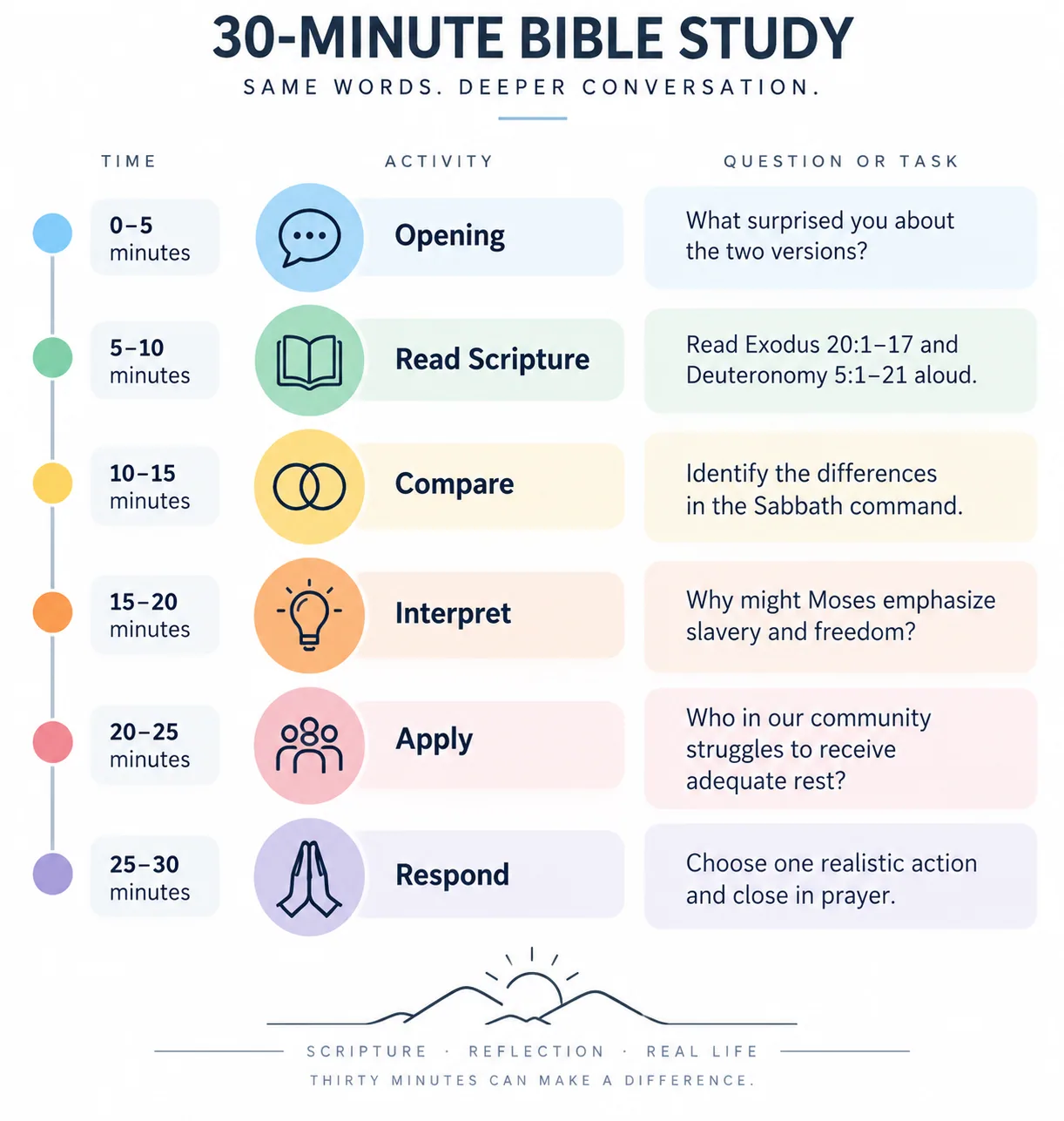
8. A 30-Minute Small-Group Bible Study Plan
Use this plan to turn the comparison into a discussion rather than a lecture.
Three discussion questions that go deeper
1. Who benefits from my rest, and who carries the cost?
This question connects Deuteronomy's concern for servants with modern families, workplaces, and caregiving.
2. What does my schedule reveal about what I trust?
Exodus connects rest with the Creator. Consider whether your schedule leaves room to acknowledge dependence on God.
3. How can we protect rest without making it a burden?
Invite members to discuss different responsibilities, including childcare, medical work, disability, and financial pressures.
Avoid assuming everyone has the same freedom to control their schedule.
9. A Simple Method for Comparing Bible Passages
When two passages appear different, use this five-step method.
-
Read both passages completely, including their introductions.
-
Highlight words that change, disappear, or appear for the first time.
-
Identify the speaker, audience, location, and historical setting.
-
Compare translations and consult reliable study notes.
-
Write down what the text says before deciding what it means.
For the Ten Commandments, this method reveals that Deuteronomy's differences are concentrated in specific places rather than spread equally across every command.
It also helps prevent a common mistake: using an English translation difference as proof that the underlying Hebrew text differs.
A study Bible can help with maps, cross-references, and historical context. For practical application, our Life Application Study Bible resource offers a useful starting point.
10. Frequently Asked Questions
Why are there two versions of the Ten Commandments?
Exodus 20 presents the commandments at Sinai. Deuteronomy 5 repeats them in Moses' covenant teaching before Israel enters the Promised Land. The central commands remain consistent, but several details and explanations differ.
Which version of the Ten Commandments came first?
In the biblical narrative, Exodus 20 comes first. Deuteronomy 5 recounts the commandments later, near the end of Israel's wilderness journey.
The dates when the texts reached their final written forms are a separate question studied by biblical scholars.
Why does Exodus say "remember" while Deuteronomy says "observe"?
Exodus uses zakhor, meaning remember. Deuteronomy uses shamor, meaning keep or observe.
The words emphasize related aspects of Sabbath practice: recognizing its sacred meaning and faithfully observing it.
Why does the Sabbath command mention slavery?
Deuteronomy 5:15 reminds Israel that God rescued them from Egypt. Because they had experienced forced labor, they were commanded to allow servants and others within their households to rest.
Did God change the Sabbath commandment?
Neither passage says that God canceled the Sabbath command and replaced it with another.
Both identify the seventh day as the Sabbath. Their differences concern wording, details, and the reason emphasized for observing it.
Are there actually more than ten commandments?
The Torah contains many laws beyond the Decalogue. The traditional Ten Commandments are the central set of covenant statements in Exodus 20 and Deuteronomy 5.
Religious traditions differ in how they divide those statements into ten.
Why do Catholics and Protestants number the commandments differently?
Catholic and Lutheran traditions generally combine the prohibition of other gods and idols while dividing the coveting command.
Many Protestant traditions separate the prohibition of other gods from the prohibition of idols and treat coveting as one command.
Jewish numbering also differs, beginning with God's declaration of deliverance.
These are differences in how the biblical text is divided, not evidence that the traditions use entirely different commandments.
Does the New Testament require Christians to keep Saturday?
Christian traditions interpret Sabbath observance differently.
Seventh-day Adventists and some other Christians observe Saturday. Many Christians gather for worship on Sunday, while views differ on whether Sunday functions as a Christian Sabbath.
Romans 14:5–6 and Colossians 2:16–17 are important passages in these discussions, alongside Jesus' teaching about the Sabbath.
Can Christians use both versions in personal Bible study?
Yes. Reading them together helps readers examine creation, freedom, worship, justice, family relationships, and contentment.
The comparison is especially useful for understanding how biblical laws are presented within their historical and literary settings.
Final Takeaway: Two Versions, One Call to Faithful Living
Exodus 20 and Deuteronomy 5 are not word-for-word copies. Their differences deserve careful study rather than being ignored.
Exodus connects Sabbath rest to the Creator. Deuteronomy connects it to the God who frees people from slavery. Together, they show that rest concerns both our relationship with God and our responsibility toward others.
The most useful question is not simply, "Why did the wording change?"
It is also this: If God cares about both my rest and my neighbor's rest, what needs to change in the way I live?
Start with one action this week. Protect time for worship, give someone else a genuine break, repair a damaged relationship, or practice contentment instead of comparison.
That is how studying the Ten Commandments can move beyond memorizing rules and begin shaping everyday life.
Key Statistics
Biblical accounts
2
The Ten Commandments appear in Exodus 20 and Deuteronomy 5.
Source: Exodus 20:1–17; Deuteronomy 5:6–21
Traditional commandments
10
Both passages contain the Decalogue, although religious traditions differ in numbering.
Source: Exodus 20; Deuteronomy 5
Credible Sources
Bible Gateway · January 1, 2011
Primary source for comparing all ten commandments, the Sabbath explanations, parental promises, and coveting language.
TheTorah.com · January 1, 2019
Scholarly examination of textual variations and the development of the Decalogue. Supports the historical-critical perspective.

About the Author
Editorial Team
Editorial Team
Daily Faith Path articles are prepared by the editorial team to help readers find scripture-centered guidance for healing, faith, prayer, and spiritual encouragement.
Expertise: Healing scriptures, Bible study resources, prayer guidance, devotional writing, Christian encouragement
Experience: The team researches scripture references, reviews surrounding biblical context, compares translation wording where useful, and updates articles to improve clarity, usefulness, and trust for readers.
Credentials: Editorial review, devotional writing, scripture study, content updating
This article is published by the Daily Faith Path editorial team to help readers use scripture carefully, prayerfully, and in ways that are practical for real-life seasons of illness, grief, waiting, and spiritual reflection.
Continue Reading
Related articles
September 19, 2026
Isaiah 41:10 for Anxiety: Why Am I Still Afraid?
Still feeling anxious after praying Isaiah 41:10? Discover what God's promise really means, why fear can persist, and practical ways to respond with faith, wisdom, and support.

September 18, 2026
Romans 8:28 Doesn't Mean What You Think
Romans 8:28 is often quoted as a promise that every hardship will eventually turn into a better earthly outcome. But Romans 8:29 reveals a deeper meaning: God's “good” is ultimately about conforming believers to the image of Christ and bringing them to final glory. This article explores the context of Romans 8, why suffering remains a reality for Christians, and how Romans 8:28 offers a stronger hope than the promise of improved circumstances.

September 17, 2026
When Jeremiah 29:11 Doesn’t Feel True
Jeremiah 29:11 promises hope, but not a quick fix. Discover what the verse meant to the exiles in Babylon and how to trust God’s good purpose when life gets worse instead of better.