Are Angel Numbers Biblical? What Scripture Actually Says
Angel numbers like 111, 222, and 11:11 have exploded in popularity, but are they actually biblical? Explore what Scripture says about numbers, divination, God's guidance, and whether repeating numbers are meaningful signs or simply coincidences.
You keep seeing 11:11 on the clock, and now you're wondering if it's God, your imagination, or something you shouldn't mess with — and the honest answer is: it's more complicated than either "yes, totally biblical" or "no, straight from the devil."
Millions of people search this question every month, and most of what they find is a TikTok video with a confident stranger telling them exactly what to believe. This article won't do that. It'll walk you through what the Bible actually says about numbers, signs, and hearing from God — and let you land somewhere honest.
What Are Angel Numbers, Exactly?
Angel numbers are repeating number sequences — like 111, 222, 444, or 1111 — that show up on clocks, receipts, license plates, or phone notifications. Believers say these numbers carry hidden spiritual messages from angels or "the universe."
The idea got popular through a numerologist named Doreen Virtue, who published a book called Angel Numbers back in 2005. It borrowed heavily from numerology, a New Age practice that assigns spiritual meaning to numbers. It has nothing to do with the Bible in its origin.
Here's a quick cheat sheet of what people online typically claim these numbers mean:
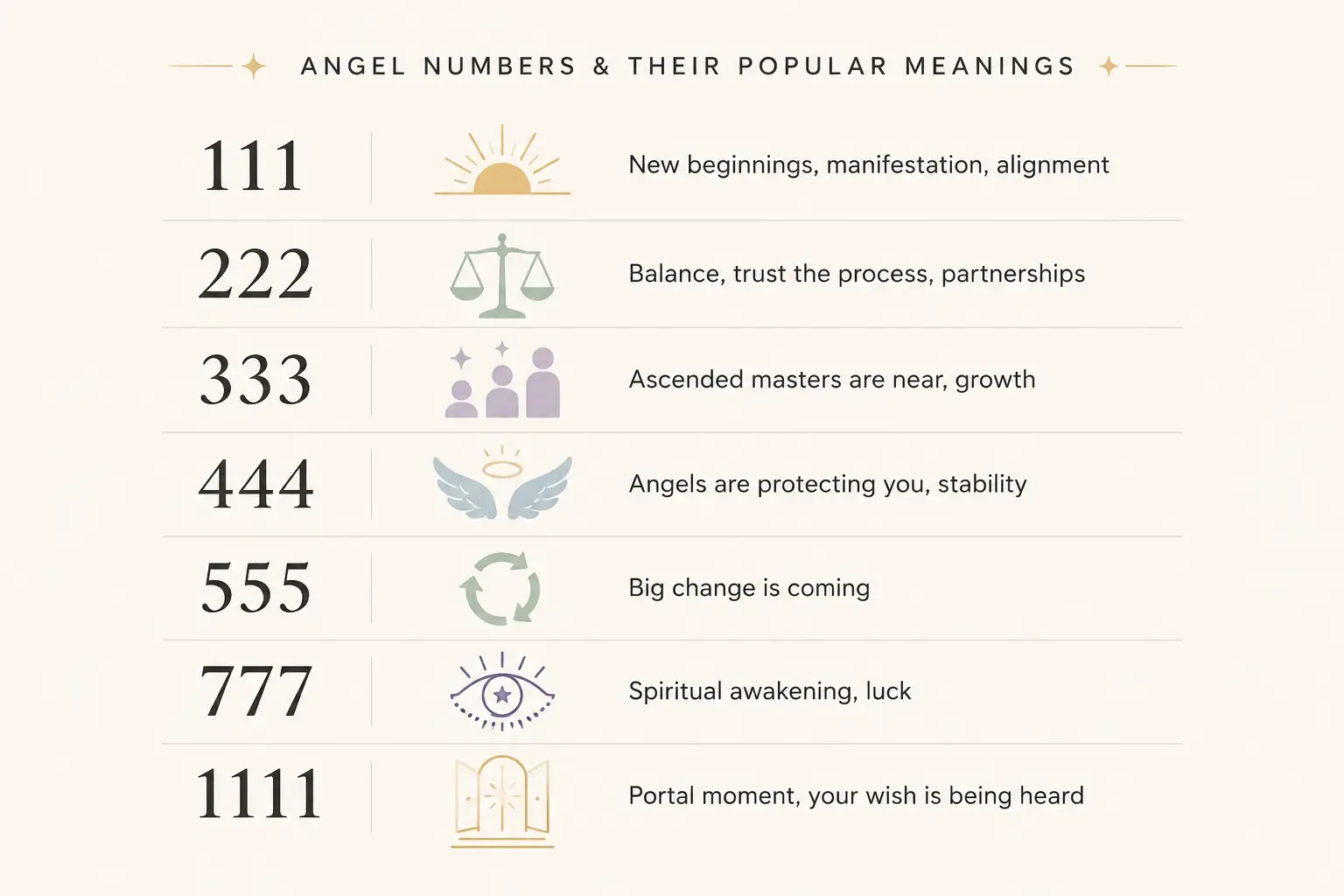
None of these definitions come from Scripture. They come from numerology traditions that predate Christianity by thousands of years, going back to ancient Babylon and Greek mystery religions like Pythagoreanism.
The Short Answer: No, Angel Numbers Aren't Biblical
Let's not dance around it. The specific practice of "angel numbers" — assigning fixed spiritual meanings to repeating digits like 111 or 444 — appears nowhere in the Bible. It's a modern invention, popularized in the 2000s and exploded by social media in the last five years.
But that's not the whole story, and it's why this topic is genuinely more nuanced than a 60-second video can capture.
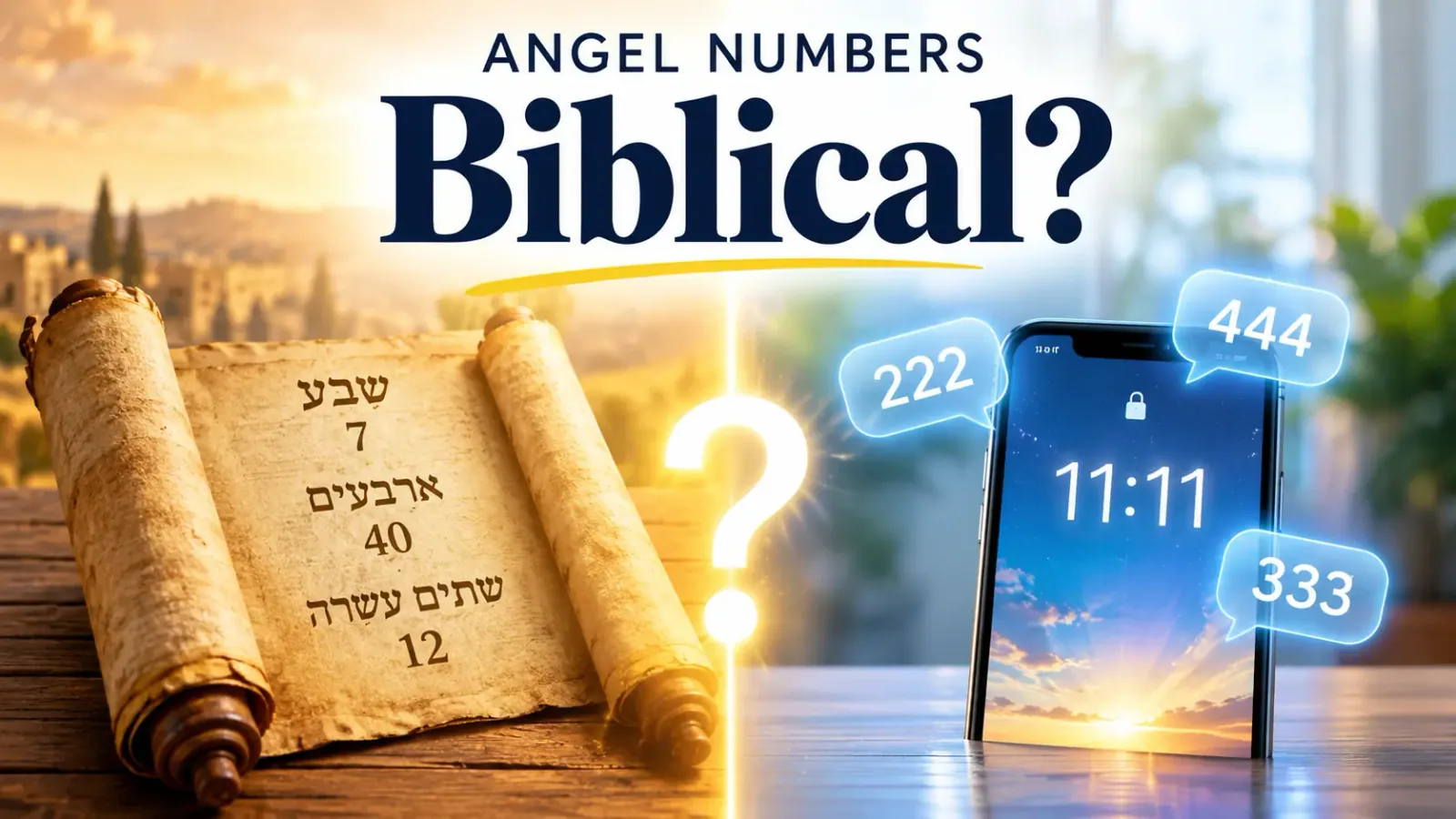
The Bible does use numbers symbolically. Seven often represents completion (the seven days of creation). Forty often represents testing or transition (forty days of rain, forty years in the wilderness). Twelve represents God's people (twelve tribes, twelve apostles). So Scripture isn't "numbers don't matter" — it's that the meanings come from God's revealed Word, not from a formula you found on an app.
That distinction is the whole ballgame. Biblical numerology is rooted in the text itself. Angel numbers are rooted in a system invented outside the text and applied to your personal clock-watching.
Two Honest Perspectives (Because This Isn't One-Sided)
Most content online picks a side and yells about it. Here's what thoughtful people on both sides actually argue, because you deserve to weigh this yourself.
Perspective 1: It's New Age Deception
A lot of Christian leaders and pastors flag angel numbers as spiritually risky, and here's their reasoning, not just their conclusion.
Deuteronomy 18:10-12 warns against divination — using signs, omens, or occult practices to predict or interpret spiritual meaning outside of God. Angel numbers function almost identically to divination: you see a sign, you consult an outside system (not Scripture) to interpret it, and you let that interpretation guide decisions or emotions.
There's also the source problem. Doreen Virtue, the person who popularized angel numbers, later became a Christian and publicly renounced her earlier New Age teachings, including angel numbers, saying she now sees them as spiritually dangerous. That's a significant detail almost no TikTok video mentions, and it matters for anyone weighing where this practice actually came from.
The concern isn't really about the number itself. It's about where you're told to look for answers. If 222 becomes your source of comfort instead of prayer, that's a heart-level shift worth noticing.
Perspective 2: God Can Use Patterns, Including Numbers
Other believers push back and say: God is the God of order, not chaos, and He's used patterns and signs throughout Scripture to get people's attention.
Gideon asked God for a literal physical sign (a fleece with dew) before going to battle, and God gave it to him twice (Judges 6:36-40). Joseph and Daniel both interpreted dreams as messages from God. The wise men followed a literal star. Scripture is full of God using unusual, even strange, means to reach people who weren't looking through a "proper" spiritual channel.
From this view, if someone glances at a clock reading 3:16 and it nudges them to open their Bible to John 3:16, that's not divination — that's God meeting someone where they are. The number itself isn't magic; it's just a trigger that redirects attention back to Him.
The key difference this group draws: using a number as a personal reminder to pray or read Scripture is different from treating a fixed numerology chart as a message system you consult like a horoscope.
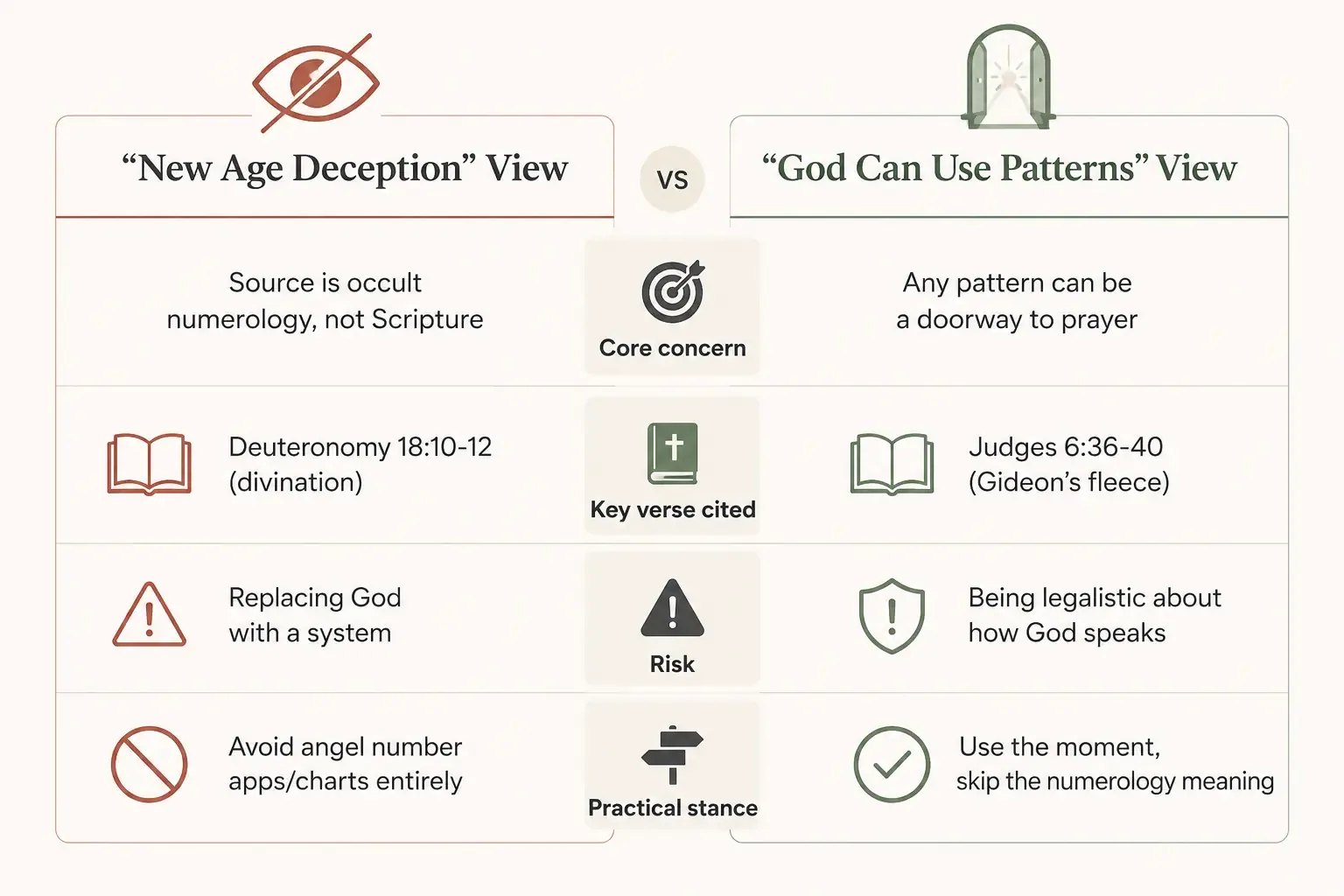
Both camps agree on one thing: the danger isn't in seeing a number. It's in where you go next for the meaning.
Real Story: Sarah's 11:11 Wake-Up Call
A woman named Sarah (name changed for privacy) shared in a church small group that she'd been seeing 11:11 constantly for months during a rough divorce. She'd downloaded an angel number app and it told her 11:11 meant "a new chapter is manifesting."
It felt good for about two weeks. Then she noticed something: she was checking the clock more than she was praying. The number had become her comfort object instead of God.
Her small group leader didn't tell her the number was evil. Instead, he asked her one question: "What if every time you see it, you use it as a reminder to pray for two minutes instead of opening the app?" She tried it for a month. Same trigger, completely different destination. She told the group it was the first time in months she felt like she was actually talking to God instead of decoding a message.
That's a useful real-world template — the number becomes a habit cue, not an oracle.
Real Story: Marcus and the Coincidence Trap
A man named Marcus described a season where he was job hunting and kept seeing 777 everywhere — job postings, addresses, timestamps. He took it as confirmation to accept a job offer that, on paper, wasn't a great fit.
Six months in, the job fell apart financially and he was let go. Looking back, he said the real problem wasn't the number. It was that he'd stopped doing the boring, practical discernment — praying specifically about the decision, talking to mentors, checking the actual numbers on the paycheck — because a repeating digit gave him a false sense of certainty.
This is the most common real-world problem with angel numbers: they can substitute for actual discernment instead of supporting it.
Why Angel Numbers Feel So Convincing (Even If They're Not Biblical)
There's a simple psychological reason repeating numbers feel meaningful: it's called the frequency illusion, or Baader-Meinhof phenomenon. Once your brain notices something (like 11:11), it starts flagging every future occurrence of it, making it feel like it's happening constantly when really you're just now paying attention.
That doesn't make the experience fake or dumb. It just means "I keep seeing this number" isn't proof of a supernatural message on its own — your brain is wired to do this with anything you fixate on, numbers or otherwise.
This is also exactly why so many people turn to numbers for reassurance in the first place: when God feels silent, a repeating number feels like something, and something feels better than nothing. That instinct is human and understandable. It's just worth aiming it at the right target.
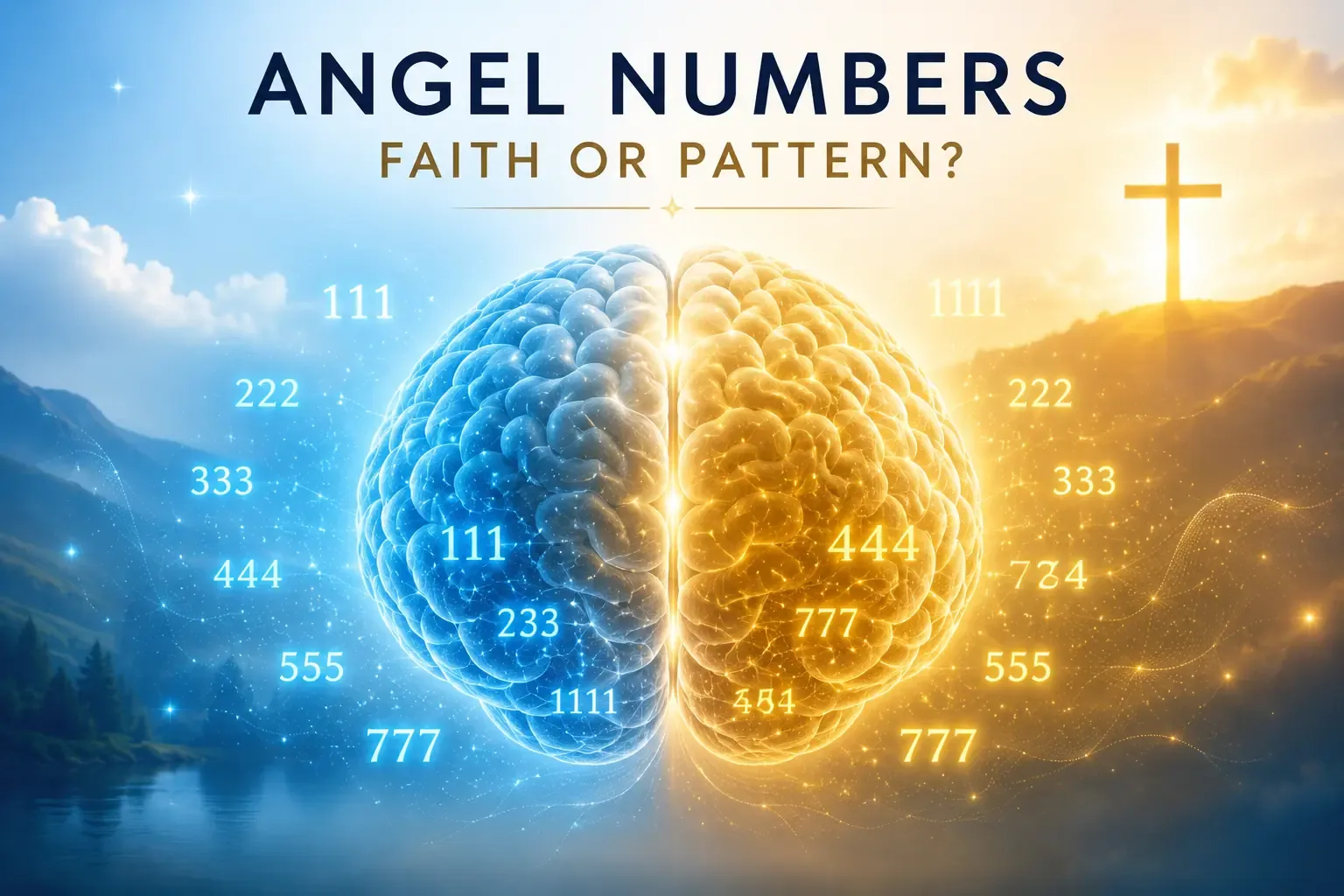
How to Tell If It's God or Just a Coincidence
This is the question underneath the question. Here's a practical framework instead of a vague "just pray about it."
1. Does it point you toward Scripture, or away from it? If seeing a number makes you open your Bible, that's a good sign. If it makes you open a numerology app instead, that's worth noticing.
2. Does the meaning come from the text, or from a chart? A repeating number reminding you of a specific Bible verse (3:16, 23:1) is very different from consulting a fixed "444 means angels are protecting you" definition that exists outside Scripture entirely.
3. Is it building your dependence on God or on a pattern? Ask yourself honestly: after this experience, do you feel closer to God, or more anxious to keep checking clocks for the next sign?
4. Would you make a big decision based on this alone? If yes, slow down. Scripture consistently pairs guidance with wise counsel (Proverbs 15:22), prayer, and the actual content of God's Word — never a number by itself.
Learning to sort real conviction from noise is a skill, and it's worth building on purpose rather than guessing every time. This deeper guide on how to discern God's voice from noise walks through the practical side of that in a lot more depth than one article on numbers ever could.
What the Bible Offers Instead of a Number System
Here's the part most angel number content skips entirely: Scripture doesn't leave you guessing with vague signs. It gives you direct, written promises you can actually stand on.
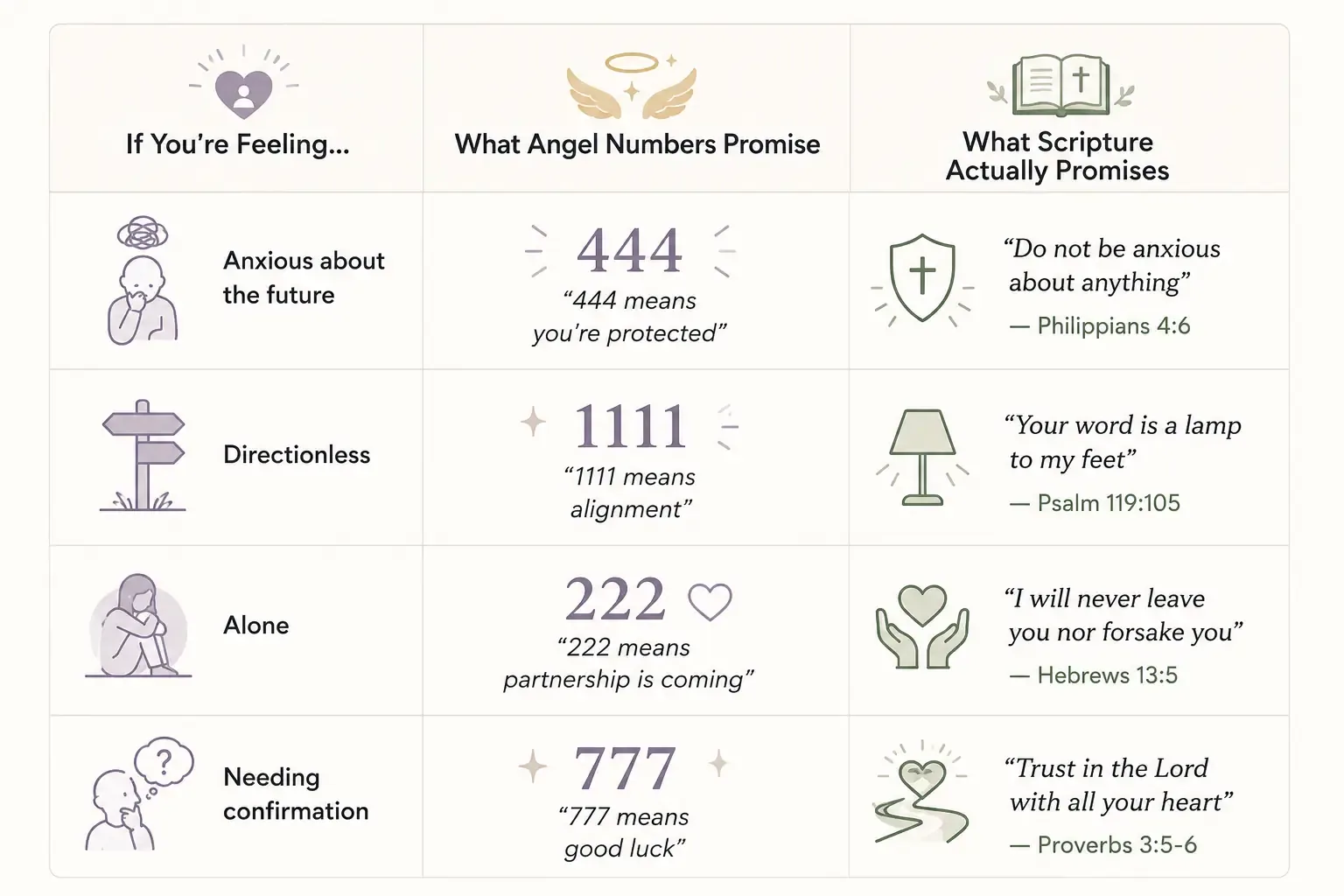
The difference is specificity and source. A number's meaning is assigned by a stranger's chart. A Bible promise is written, unchanging, and doesn't depend on the clock you happened to glance at. You can read more of these directly in this collection of God's promises in Scripture, which covers the exact anxieties most people are actually looking for reassurance about when they start chasing angel numbers in the first place.
The Deeper Concern: Divination and the First Commandment
If you grew up in church, you might remember hearing that God takes idolatry seriously — not just statues, but anything that takes His place as your source of guidance. This is where the "New Age deception" argument gets its real weight.
The first commandment isn't just "don't worship other gods" in an abstract sense. It's about where you place your trust for meaning and direction. When a numerology chart becomes your go-to for interpreting your life instead of prayer and Scripture, it's functioning the way idols historically functioned — as a stand-in source of guidance and comfort.
This doesn't mean everyone who's ever Googled "angel number 444 meaning" is committing serious sin. Curiosity isn't the same as devotion. But it's worth understanding the categories the Bible actually uses here, which you can see laid out clearly in the first commandment and idolatry.
Practical Advice: What to Actually Do When You See a Repeating Number
Here's a step-by-step you can use starting today, regardless of which side of this debate you lean toward.
Step 1: Pause instead of reaching for the app. When you notice 11:11 or 444, resist opening a numerology site first. Give yourself ten seconds before you react.
Step 2: Turn it into a prayer trigger, not a message decoder. Say something simple: "God, whatever this moment is, I want to hear from You, not from a chart." This reroutes the instinct without shaming the instinct.
Step 3: Open Scripture, even if the number doesn't match a chapter and verse. You don't need 3:16 specifically. Any moment of noticing something is a fine excuse to read a psalm or a promise.
Step 4: Journal the pattern, not the "meaning." Instead of writing "444 = angels protecting me," write what was actually happening in your life at that moment. Over time, you'll likely find the number correlates with your own attention, not a hidden code.
Step 5: Talk to a real person about big decisions. Never let a number be the deciding vote on a job, relationship, or move. Bring it to a pastor, mentor, or trusted friend alongside prayer.
If you're in a season where you genuinely don't know what you need to hear, there's a simpler tool than decoding digits: this find scripture for how you're feeling tool lets you search by your actual emotional state and get a real, sourced Bible passage back — no chart required.
Common Mistakes People Make With Angel Numbers
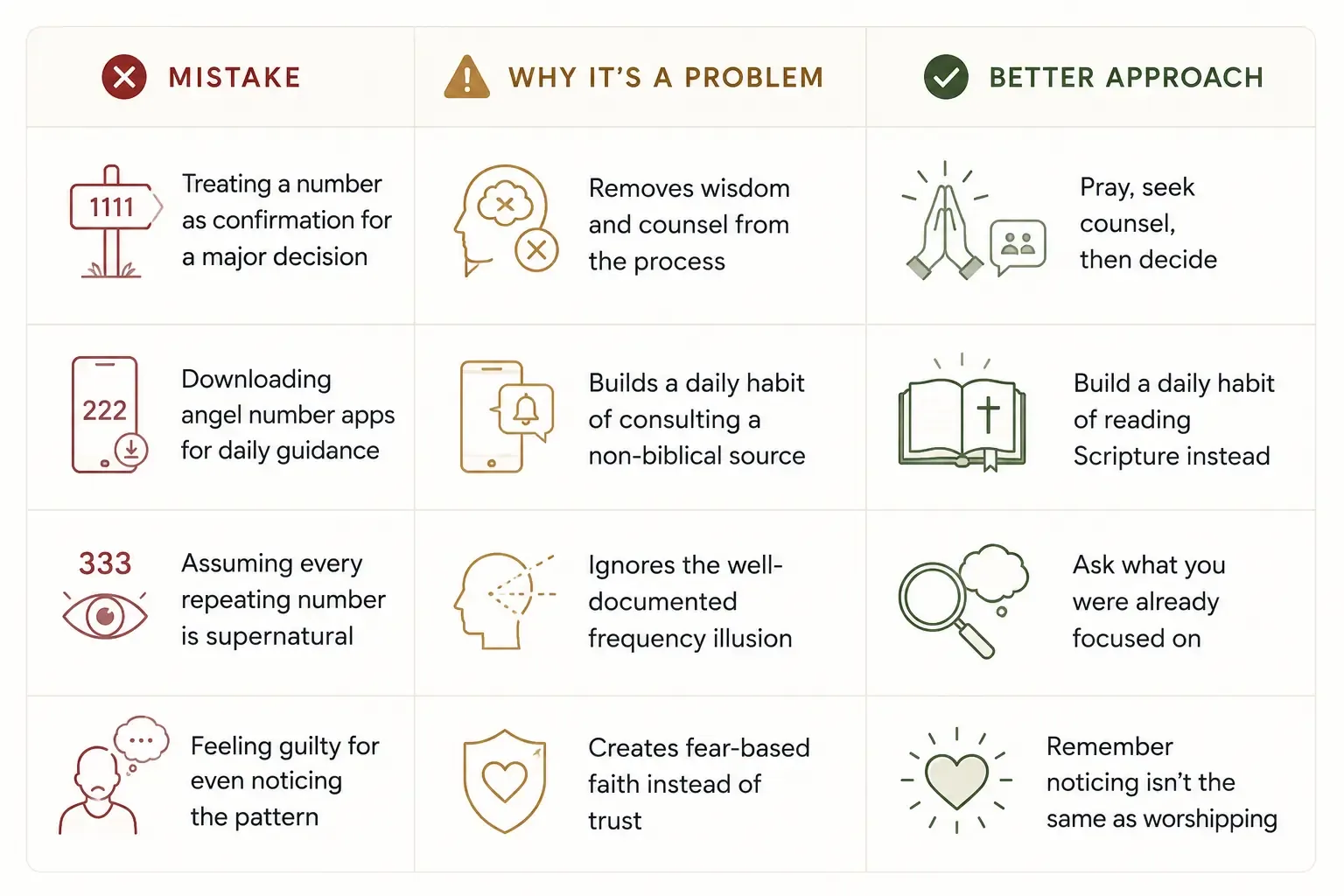
That last one matters more than people admit. If you've been anxious about "getting it wrong" spiritually just because a number caught your eye, that anxiety itself isn't from God. There are real, practical verses for exactly that feeling in this list of verses for spiritual courage, written for people who feel shaky about their faith rather than confident.
Why This Debate Isn't Going Away
Angel number content isn't slowing down online, and there's a real reason beyond trend-chasing: people are hungry for a sense that the universe (or God) notices them personally. That's not a shallow desire. It's actually a deeply Christian instinct — Scripture teaches that God numbers the hairs on your head (Luke 12:7) and knows you individually.
The disagreement isn't over whether God is personal and attentive. Both sides of this debate agree He is. The disagreement is over the delivery system — whether a numerology chart invented in the 2000s is a legitimate channel for that personal attention, or a counterfeit standing in for it.
That's ultimately a question about learning to trust God instead of signs — building a faith that doesn't need a clock to feel steady.

FAQ: Are Angel Numbers Biblical?
Is it a sin to believe in angel numbers?
Believing repeating numbers have automatic spiritual meaning isn't named as a sin verse-by-verse in the Bible, since angel numbers didn't exist as a concept back then. The closer concern is divination — seeking guidance from a source other than God — which Scripture does warn against directly in Deuteronomy 18:10-12.
What does the Bible say about 1111 specifically?
Nothing. There's no verse assigning meaning to 1111 as a standalone number. Some people connect it to a specific chapter and verse (like Psalm 111:1), which is a completely different, text-based practice than numerology.
Can God use a number to get my attention?
Many Christians believe yes, in the sense that God can use anything — a song, a stranger's comment, a number on a clock — to redirect your attention toward Him. The distinction is that the meaning would come from what you find in Scripture next, not from a numerology chart's fixed definition.
Why do I keep seeing the same number everywhere?
Usually it's the frequency illusion: once your brain flags a number as meaningful, it starts noticing it far more often than before, even though the actual frequency hasn't changed. It can also simply be because clocks, receipts, and addresses contain a limited set of digits, so repetition is mathematically common.
Is numerology condemned in the Bible?
The Bible doesn't address "numerology" as a modern system by name, but it consistently condemns divination, sorcery, and seeking hidden knowledge outside of God (Deuteronomy 18:10-12, Leviticus 19:26). Numerology, including angel numbers, falls under that broader category for many theologians.
What should I do instead of checking an angel number app?
Use the moment as a prompt to pray or read Scripture instead of decoding a chart. Over time, this rewires the habit from "check the app for meaning" to "check my heart and God's Word for meaning," which most people who've made the switch describe as far more stabilizing.
Did the creator of angel numbers ever change her mind?
Yes. Doreen Virtue, who popularized the angel numbers concept, later converted to Christianity and publicly distanced herself from her earlier New Age teachings, describing them as spiritually harmful. That's a detail worth knowing if you're weighing the credibility of the source material.
The Bottom Line
Angel numbers, as a fixed system for decoding spiritual meaning from repeating digits, aren't found in the Bible and share more DNA with numerology than Scripture. That's the honest, unavoidable answer.
But the instinct behind them — wanting to feel noticed, guided, and comforted by something bigger than yourself — is exactly what the Bible says God offers, just through a different, more reliable channel: His written Word, prayer, and the counsel of people around you. You don't need a chart to feel like God sees you. You need a Bible open and a habit of actually reading it.
Next time you glance at the clock and see 11:11, let it be the reminder, not the message.
Key Statistics
Angel Numbers publication
2005
Doreen Virtue popularized the modern angel numbers concept with her book Angel Numbers in 2005.
Source: Doreen Virtue / Angel Numbers
Popularity growth
Last 5 years
The article states angel numbers exploded in popularity through social media over the past five years.
Source: Blog content
Credible Sources
Bible Gateway · Various Bible translations
The key biblical passage discussing divination and occult practices, central to the theological discussion.
Encyclopaedia Britannica · Continuously updated
Provides scholarly background on numerology and its historical origins outside Christianity.

About the Author
Editorial Team
Editorial Team
Daily Faith Path articles are prepared by the editorial team to help readers find scripture-centered guidance for healing, faith, prayer, and spiritual encouragement.
Expertise: Healing scriptures, Bible study resources, prayer guidance, devotional writing, Christian encouragement
Experience: The team researches scripture references, reviews surrounding biblical context, compares translation wording where useful, and updates articles to improve clarity, usefulness, and trust for readers.
Credentials: Editorial review, devotional writing, scripture study, content updating
This article is published by the Daily Faith Path editorial team to help readers use scripture carefully, prayerfully, and in ways that are practical for real-life seasons of illness, grief, waiting, and spiritual reflection.
Continue Reading
Related articles

October 7, 2026
12 Bible Verses About Hiding Money From Your Spouse
Explore 12 Bible verses about secret spending, hidden debt, financial honesty, confession, forgiveness, boundaries, and rebuilding trust in marriage.

October 6, 2026
15 Bible Verses for Couples Who Keep Fighting About Money
Money fights are rarely just about dollars. These 15 Bible verses help couples address spending, saving, debt, secrecy, unequal income, giving, and financial control with practical next steps and conversation questions.

October 5, 2026
Should You Tithe While in Debt? 11 Bible Passages to Study First
Should you tithe while in debt? Explore 11 Bible passages on tithing, debt, generosity, family responsibility, and giving according to your means—plus a practical plan for deciding what to do.