Biblical Manhood vs. the Manosphere: What the Bible Actually Says
Young men are increasingly embracing both Christianity and manosphere influencers—but these worldviews often teach opposite ideas about strength, leadership, and identity. Discover what the Bible actually says about biblical manhood compared to modern masculinity culture, with Scripture, research, and practical guidance.

Two men can watch the same Andrew Tate clip on Monday and sit in the same church pew on Sunday, and nobody has told them these two messages actually contradict each other. This article puts them side by side, verse by verse, so you can see exactly where they clash and where the Bible gives a better answer.
The Collision Nobody's Talking About
Something strange is happening with young men right now. Barna Group's 2025 research found that commitment to Jesus among Gen Z men jumped 15 percentage points between 2019 and 2025, and Gallup's 2026 tracking shows 40% of young men now attend religious services weekly or monthly, the highest rate since 2012. Bible sales are up 22% in a single year.
At the exact same time, a 2025 Movember Institute study found that nearly two-thirds of men aged 16-25 regularly watch "men and masculinity" influencers. Equimundo's research found that half of young men trust at least one men's-rights, anti-feminist, or pro-violence voice online. Both things are true. The same guy scrolling Tate clips at midnight is showing up to youth group Sunday morning.
Nobody built the bridge between these two worlds, so a lot of young men are stitching together their own version of "manhood" from whatever fits. Some Bible verses, some gym-bro dominance talk, some "sigma male" memes. This piece is that bridge, built with actual scripture instead of vibes.

What the Manosphere Actually Teaches (No Strawmen)
Before comparing anything, let's define the term honestly. The manosphere isn't one guy or one podcast. It's a loose network of influencers, forums, and communities that share a few core beliefs about men, women, and power.
Here's the quick breakdown:
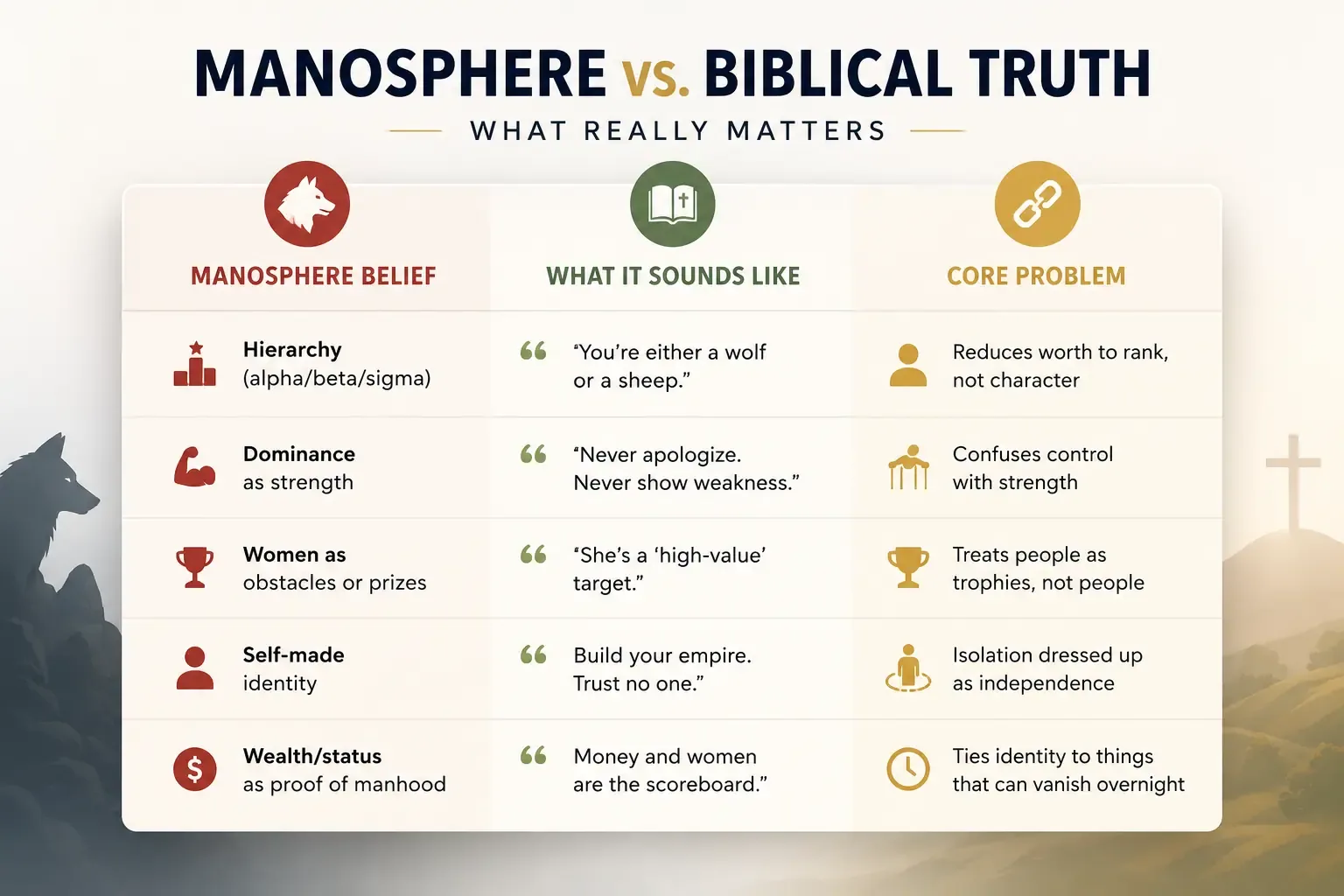
A 2025 Movember-backed study of over 3,000 young men found that guys who regularly watch masculinity influencers reported worse mental health, were less likely to prioritize their mental health, and placed more value on wealth and popularity among friends. The content isn't harmless entertainment. It's shaping how these guys treat themselves and everyone around them.
To be fair, not everything in this space is toxic. A lot of guys land there because they're lonely and nobody else is talking to them about discipline, fitness, or ambition. We'll come back to that later, because ignoring the real need underneath it is why so many "denounce the manosphere" posts fail to actually help anyone.
What the Bible Actually Says About Manhood
This is the part most articles skip. They'll say "be a godly man" without showing the actual text next to the actual manosphere claim. Let's do that here, side by side.
Strength Isn't Domination — It's Steadiness Under Pressure
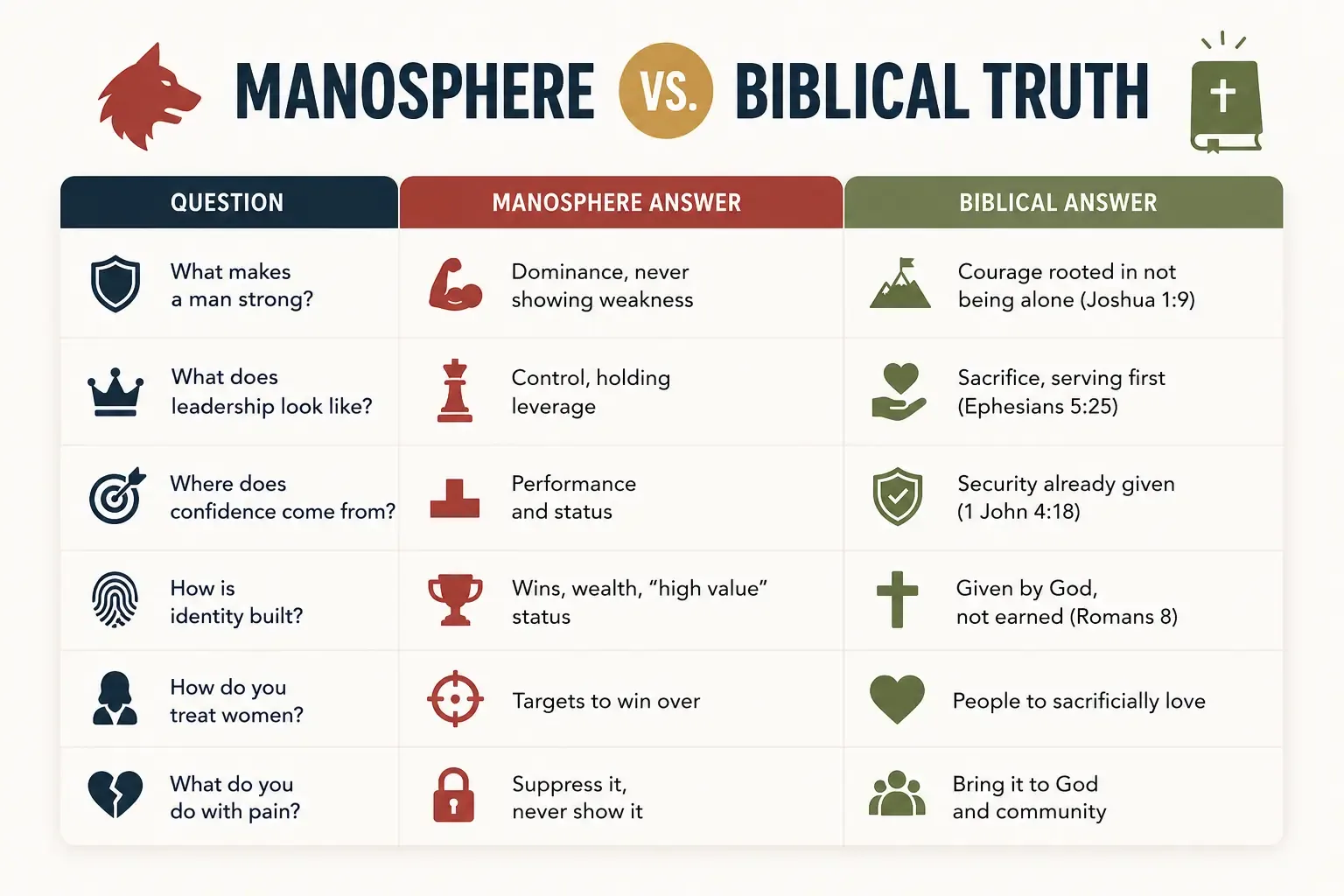
The manosphere says strength means never being afraid, never backing down, always winning. Joshua 1:9 says something different: "Be strong and courageous. Do not be afraid; do not be discouraged, for the Lord your God will be with you wherever you go."
Notice what's missing. There's no command to dominate anyone. The courage comes from not being alone, not from crushing whoever's in front of you. Real biblical strength is the ability to stay steady when things are hard, not the ability to make other people small so you feel big.
For a deeper dive on this, this collection of bible verses about strength is worth reading slowly, because almost every one of them ties strength to reliance on God, not personal willpower.
Ephesians 5:25 vs. "Alpha" Dominance
This is the verse the manosphere-vs-church debate actually hinges on, and almost nobody unpacks it properly. Ephesians 5:25 says: "Husbands, love your wives, just as Christ loved the church and gave himself up for her."
Now put that next to a typical manosphere dating clip: "Frame control. Don't chase, don't chase. She needs to earn your time." One is built on giving yourself away for someone else's good. The other is built on making sure you never lose leverage.
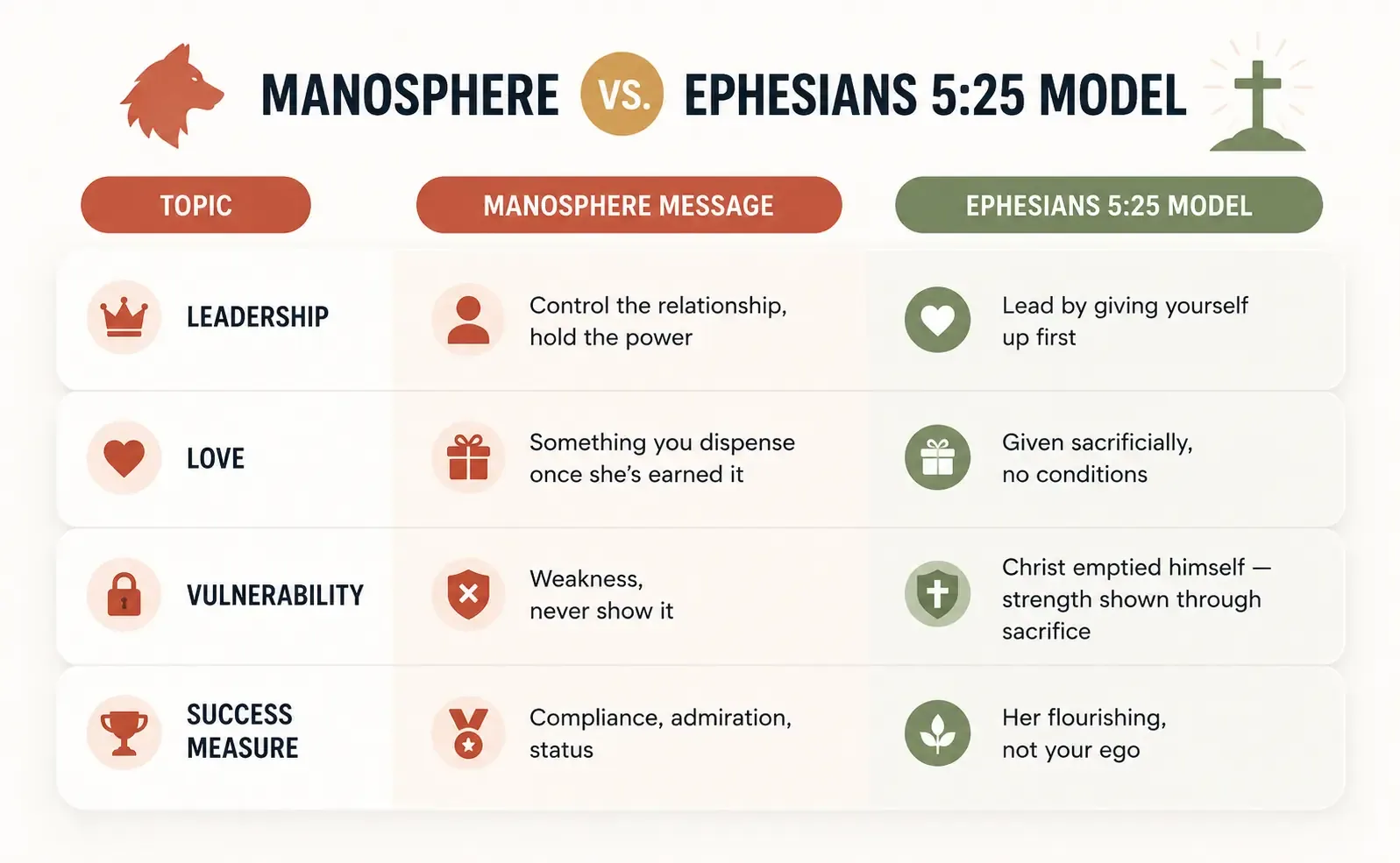
A husband who's "leading" by withholding affection until his wife behaves isn't leading biblically. He's just running a manosphere script with a wedding ring on. If you want the wider passage on marriage roles, these relationship verses put Ephesians 5:25 in context with the verses right before it, which actually call for mutual submission first.

Confidence vs. Bravado
Manosphere confidence is performance. It has to be loud because it's fragile — one insult, one rejection, and the whole thing can crack. That's why so much manosphere content is obsessed with never looking weak in public.
Biblical confidence works backward. It starts from being secure already, so nothing has to be proven. 1 John 4:18 says "perfect love drives out fear," which is the opposite mechanism from "project dominance so nobody sees your fear." One guy is performing confidence to hide fear. The other has actually dealt with the fear.
This faith over fear resource covers a lot of the specific verses on this, and it's a genuinely useful companion for anyone who feels like they have to fake it to be respected.
Identity: Built vs. Given
The manosphere tells guys to build their identity — grind, stack wins, become "high value." The problem is that identity built on performance has to keep performing forever. One bad year, one failed business, one breakup, and the whole identity wobbles.
Scripture flips the source. Your identity isn't something you build, it's something given to you. God's promises are full of language like this — you're called, chosen, and secure before you've proven anything. That's a completely different foundation than "you're worth what you produce."
Real Stories: Guys Who've Actually Lived This Tension
Marcus, 24, warehouse supervisor. Marcus got into Tate content during a rough breakup in 2023. "It felt like finally someone was telling me it's not my fault, just go be powerful," he said. He started lifting seriously, which was genuinely good for him, but he also started treating dating like a numbers game. A youth pastor at his brother's church invited him to a men's Bible study, mostly to get him out of the house. Marcus says the turning point was reading Ephesians 5 in a group and getting asked point blank: "Does this describe how you're treating women right now?" He didn't have a good answer. Two years later he leads that same men's group.
Diego, 19, community college student. Diego grew up in church but stopped going at 16. He filled the gap with gym-and-grindset YouTube. "The message was basically: feelings are for losers, just work harder," he said. What broke it open for him wasn't a sermon, it was watching his dad, a quiet, steady man, keep showing up for their family through a layoff without ever performing strength for anyone. Diego started going back to church specifically to understand where his dad's steadiness came from. He found it in Joshua 1:9 and Philippians 4:13, both of which he now has written on cards in his gym bag.
Both stories point at the same thing: the pull toward manosphere content usually starts with a real wound — rejection, loneliness, a father who wasn't around. The fix isn't shaming the wound. It's showing these guys a version of strength that actually heals it instead of numbing it.

Where the Manosphere Gets Something Right
Real talk: dismissing all of it makes churches look out of touch, and it also isn't honest. The manosphere is popular because it addresses real gaps.
- Discipline and fitness. Telling a guy to get off the couch, lift weights, and eat better is good advice. The Bible doesn't oppose physical discipline — 1 Corinthians 9:27 talks about Paul disciplining his own body.
- Financial responsibility. "Stop wasting money, build something" is not un-biblical. Proverbs is full of warnings about laziness and praise for diligent work.
- Ambition. Wanting to build a life, provide, and achieve something isn't the problem. The problem is when ambition becomes the whole identity instead of one part of a bigger life.
The difference is never "discipline vs. no discipline." It's what the discipline is for. Manosphere discipline usually serves status and control. Biblical discipline serves character and service to others.
The Practical Playbook: Building Actual Biblical Manhood
This is where most articles stop at "be a godly man" and leave you guessing. Here's the actual how-to.
Step 1: Audit Your Feed
Spend one week writing down every masculinity-adjacent video, podcast, or account you consumed. Next to each one, write one word: builds or drains. Be honest about what it's actually doing to how you talk about women, money, and yourself after 30 minutes of watching it.
Step 2: Replace One Habit at a Time
Don't try to quit everything cold turkey — that never sticks. Swap one thing. If you watch a "dating advice" channel every night, replace it with 10 minutes in Proverbs. Small swap, repeated daily, beats a total overhaul you abandon in a week.
Step 3: Find Three Men Older Than You
Not influencers. Actual men in your life — a coach, a dad, an uncle, a pastor — who you can watch handle real pressure. This is the single biggest predictor of whether a guy sticks with a healthier version of manhood: proximity to a real example, not a screen example.
Step 4: Practice Sacrificial Leadership in Small Ways
You don't need a wife to practice Ephesians 5:25. Give up your seat, cover a friend's shift when they're struggling, listen without needing to win the conversation. Sacrifice is a muscle. Build it small before you need it big.
Step 5: Get Honest About Loneliness
A lot of the pull toward manosphere content is loneliness wearing a costume of ambition. If you're isolated, that's the actual problem to solve, not your "market value." Join something — a men's group, a sports league, a church small group — where people know your name and notice when you're missing.

The Trap Hiding Inside Both Worlds: Grind Culture Burnout
Here's the part almost nobody connects. Manosphere "grindset" culture and burned-out church-guy hustle culture look almost identical from the outside. Both say: work harder, sleep less, never rest, prove yourself daily. The manosphere calls it "discipline." Some church circles call it "faithfulness." Either way, it's exhausting the same nervous system.
If you're running on empty chasing either version of "enough," it's worth reading signs of spiritual exhaustion and how to recover biblically. Rest isn't weakness in either framework that's actually healthy — even God rested on the seventh day, and that wasn't because He got tired.
Where This Fits Into the Bigger Picture
If you're reading this because you've felt torn between two feeds, you're not broken and you're not alone. Barna's data shows you're part of a real, measurable wave of young men walking back toward faith while still carrying the loud voices of the manosphere in the other ear. The goal isn't to hate the impulse that drew you to "become a man." It's to redirect it toward something that actually holds up under pressure — a love this collection on love describes as patient, not controlling, and a humility this guide on forgiveness shows is strength, not weakness. And when you inevitably fail at it, which every man does, that's what trusting God over self-reliance is actually for.
FAQ
Is the manosphere completely bad? No. Parts of it — fitness, discipline, ambition — are genuinely good advice poorly wrapped in a controlling, status-obsessed worldview. The problem isn't the discipline, it's what the discipline serves.
Does the Bible support "alpha male" behavior? Not in the way the term is usually used. Scripture never tells men to dominate, suppress emotion, or treat women as prizes. It repeatedly ties real strength to humility and sacrifice, which is close to the opposite of "alpha" branding.
Why are so many young men drawn to Andrew Tate-style content? Research points to loneliness, lack of male mentorship, and a real hunger for structure and purpose. The manosphere offers quick, confident-sounding answers to real questions nobody else is answering for these guys.
Can you be masculine and gentle at the same time? Yes, and the Bible assumes this constantly. Jesus wept, washed feet, and also flipped tables in the temple. Strength and gentleness aren't opposites in scripture — they're both part of the same character.
What's the first practical step if I want out of manosphere content? Do the feed audit from Step 1 above, then find one older man in your actual life to have coffee with weekly. Content habits change fastest when there's a real relationship replacing the screen time, not just willpower.
Does the church actually help with this, or is it just "don't watch that"? A good men's group or mentor does more than ban content — it gives you a lived example of steady, sacrificial manhood you can copy in real time, which is exactly what's missing from a screen.
Is wanting money, muscle, or success un-biblical? No. Wanting to provide, be strong, and build something is fine and encouraged. It becomes a problem only when it replaces your actual identity instead of just being one part of your life.
Bottom Line
The manosphere and the Bible both talk about strength, leadership, and confidence, but they're answering completely different questions. One is asking "how do I win?" The other is asking "how do I love well, even when it costs me something?" Ephesians 5:25 isn't a softer version of alpha-male leadership. It's a harder, more demanding one — because sacrifice is always harder than control.
Key Statistics
Gen Z men's commitment to Jesus
+15 percentage points
Commitment to Jesus among Gen Z men increased between 2019 and 2025 according to Barna research.
Source: Barna Group (2025)
Young men attending religious services
40%
Gallup reported that 40% of young men attend religious services weekly or monthly, the highest level since 2012.
Source: Gallup (2026)
Credible Sources
Barna Group · January 1, 2025
Provides the primary research supporting the increase in Gen Z men's commitment to Christianity.
Gallup · January 1, 2026
Tracks long-term trends in religious service attendance across demographic groups, including young men.

About the Author
Editorial Team
Editorial Team
Daily Faith Path articles are prepared by the editorial team to help readers find scripture-centered guidance for healing, faith, prayer, and spiritual encouragement.
Expertise: Healing scriptures, Bible study resources, prayer guidance, devotional writing, Christian encouragement
Experience: The team researches scripture references, reviews surrounding biblical context, compares translation wording where useful, and updates articles to improve clarity, usefulness, and trust for readers.
Credentials: Editorial review, devotional writing, scripture study, content updating
This article is published by the Daily Faith Path editorial team to help readers use scripture carefully, prayerfully, and in ways that are practical for real-life seasons of illness, grief, waiting, and spiritual reflection.
Continue Reading
Related articles

October 7, 2026
12 Bible Verses About Hiding Money From Your Spouse
Explore 12 Bible verses about secret spending, hidden debt, financial honesty, confession, forgiveness, boundaries, and rebuilding trust in marriage.

October 6, 2026
15 Bible Verses for Couples Who Keep Fighting About Money
Money fights are rarely just about dollars. These 15 Bible verses help couples address spending, saving, debt, secrecy, unequal income, giving, and financial control with practical next steps and conversation questions.

October 5, 2026
Should You Tithe While in Debt? 11 Bible Passages to Study First
Should you tithe while in debt? Explore 11 Bible passages on tithing, debt, generosity, family responsibility, and giving according to your means—plus a practical plan for deciding what to do.