Biblical Numerology vs. New Age Numerology: They're Not the Same
Many people wonder whether repeating numbers like 11:11 are messages from God. This guide explains the crucial differences between biblical numerology and new age numerology, explores what Scripture actually teaches about symbolic numbers, examines the history behind angel numbers, and offers a practical, biblically grounded approach to discernment.
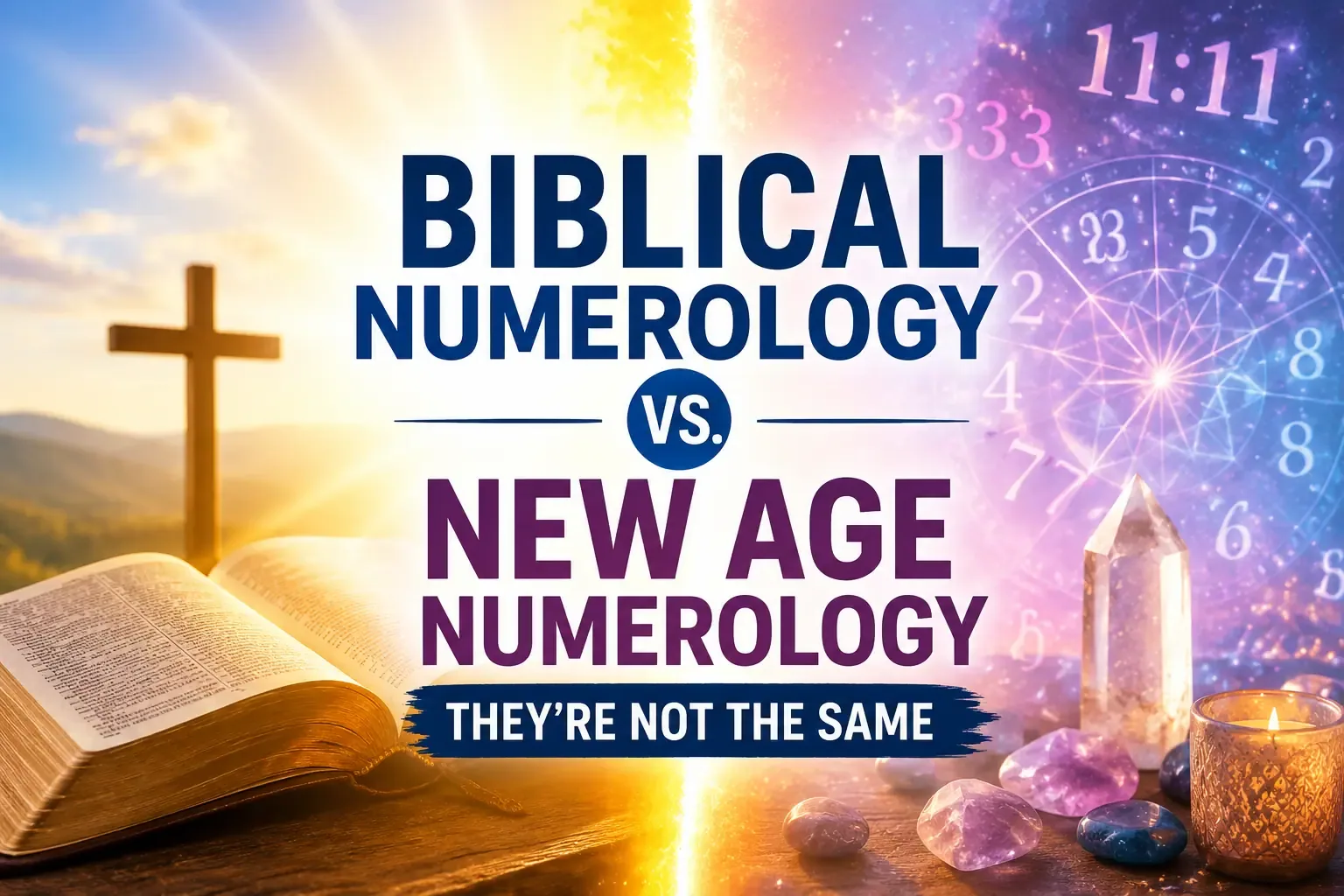
If you've ever seen 11:11 on your phone and wondered whether God is sending you a message, here's the short answer: the Bible and new age numerology give you two completely different explanations — and only one of them comes from Scripture. By the end of this article, you'll know exactly how to tell them apart, why the difference matters, and what to actually do the next time a number keeps showing up in your life.
This debate is everywhere right now. Christian TikTok is full of creators arguing about "angel numbers." Some say they're harmless. Others say they're dangerous. Almost nobody explains the actual history behind either system.
So let's do what the 60-second videos skip. Let's go to the texts, the scholars, and the real stories.

What Is Biblical Numerology, Really?
Biblical numerology is the study of number patterns that the biblical authors used on purpose. It's a literary feature, not a fortune-telling system.
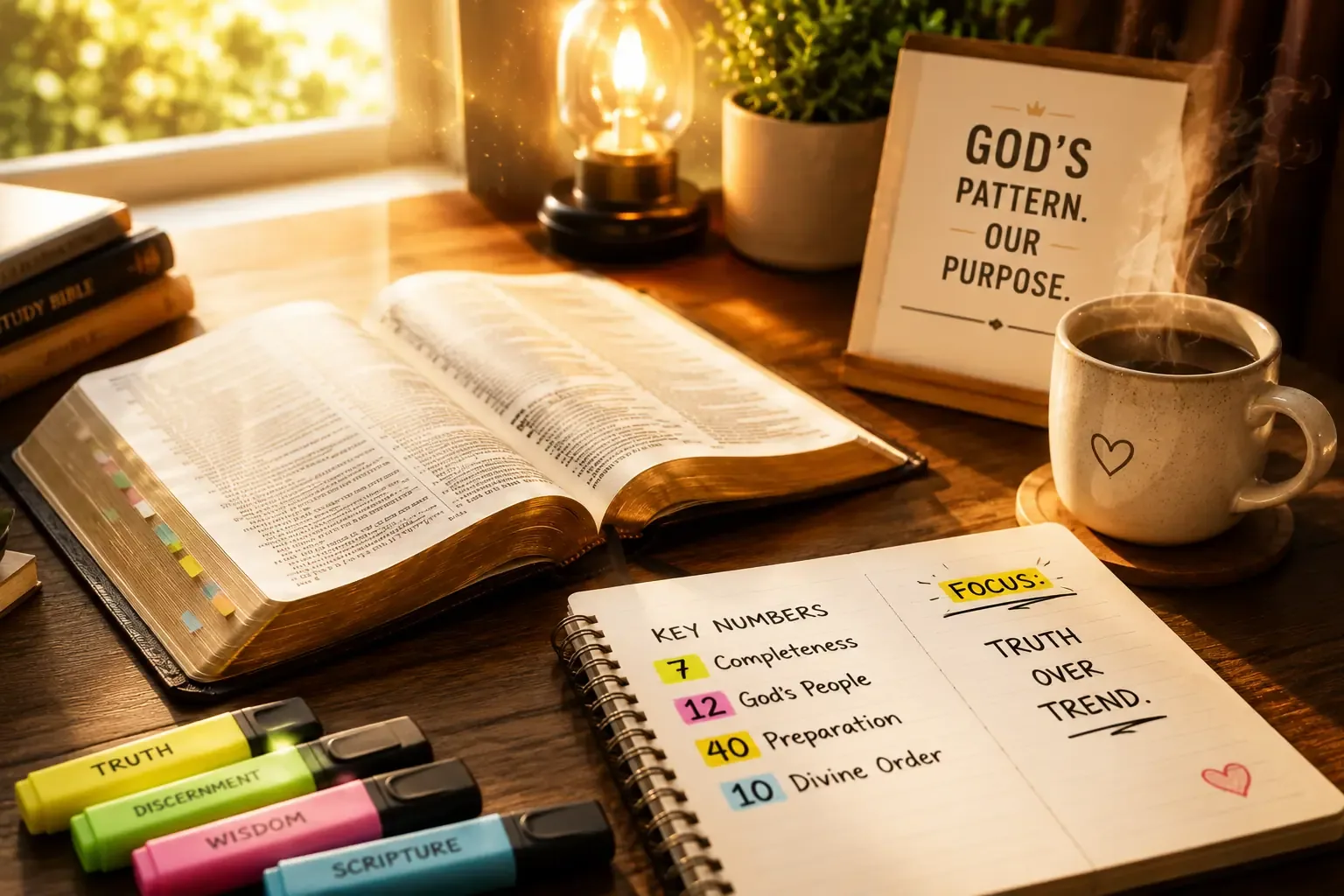
Ancient Hebrew writers loved structure. They repeated numbers the way modern writers repeat themes. Seven, twelve, forty, and ten show up again and again — not as secret codes, but as signals that say "pay attention, this is complete" or "this is about God's people."
Think of it like a movie soundtrack. When the hero's theme music plays, the composer is telling you something. Biblical numbers work the same way.
The Big Four Numbers in Scripture
Here's what serious Bible scholars actually agree on:
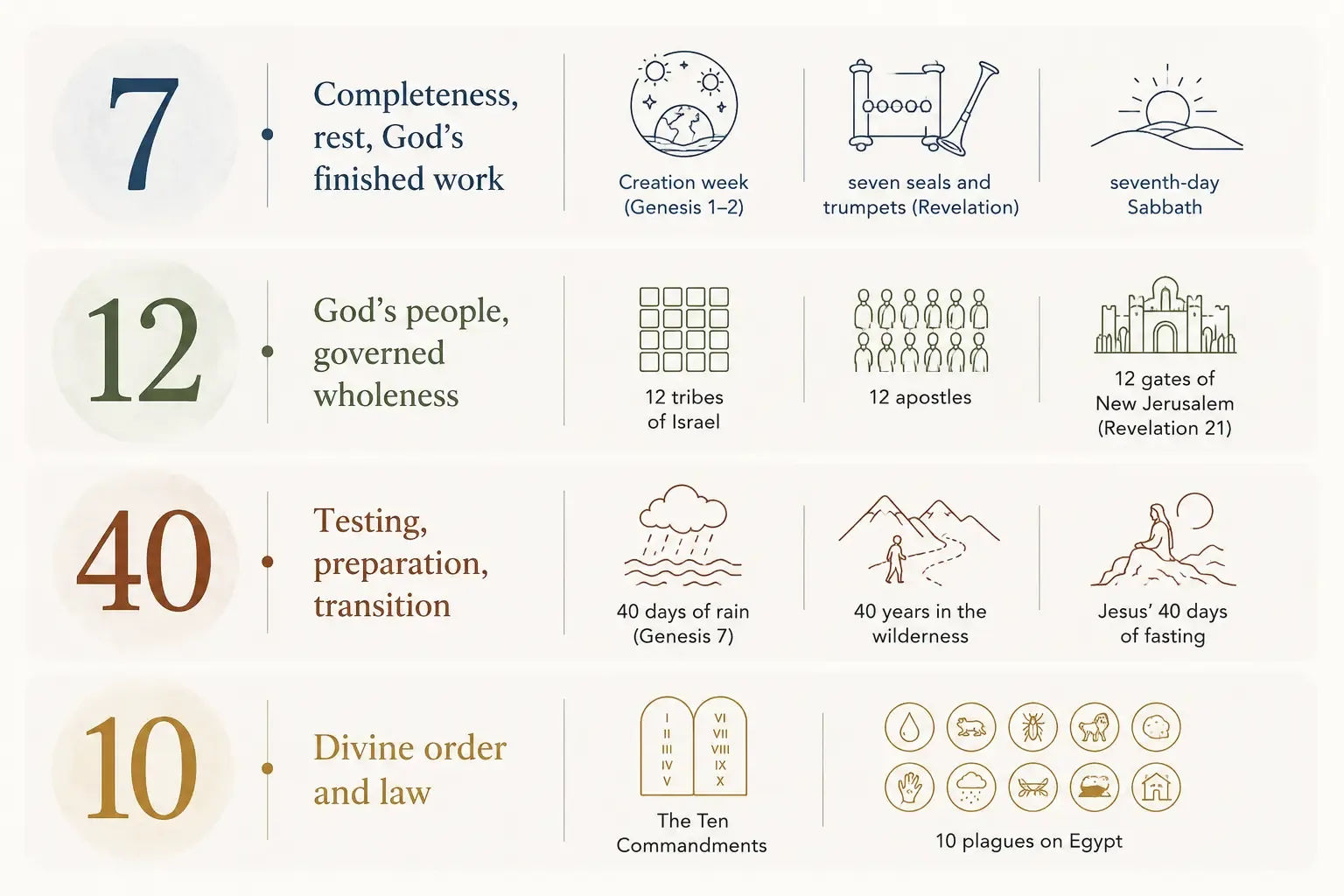
Notice something? Every one of these meanings comes from how the number is used in the story. Nobody in the Bible sees the number 7 on a sundial and treats it as a personal message.
The number 10 is a great example of structured, purposeful use. God gave the Ten Commandments as an ordered, complete summary of covenant law — ten statements, publicly given, written down. That's design, not divination.
What Is New Age Numerology?
New age numerology is a completely different animal with a completely different family tree.
Its roots go back to Pythagoras, the Greek philosopher from around 570 BC — the triangle guy from math class. Pythagoras and his followers believed numbers were the hidden essence of reality. They assigned mystical personalities to numbers: 1 meant leadership, 2 meant harmony, and so on.
That Greek system got blended over the centuries with occult traditions, then repackaged in the late 1800s and early 1900s by writers in the New Thought movement. A woman named L. Dow Balliett and later Juno Jordan turned it into the "life path number" system people use today.
How Modern Numerology Works
The modern system does things the Bible never does:
Life path numbers. You add up your birthdate digits until you get a single number, then read a personality profile — kind of like a horoscope made of math.
Angel numbers. Repeated numbers like 111, 333, or 911 are treated as direct messages from angels or "the universe." Each sequence gets an assigned meaning: 111 means manifestation, 444 means protection, and so on.
Name numerology (Chaldean or Pythagorean). Letters in your name get number values, which supposedly reveal your destiny.
Here's the key point: none of this appears anywhere in Scripture. Not once does a biblical figure calculate a life path number or interpret a repeating digit as angelic communication.
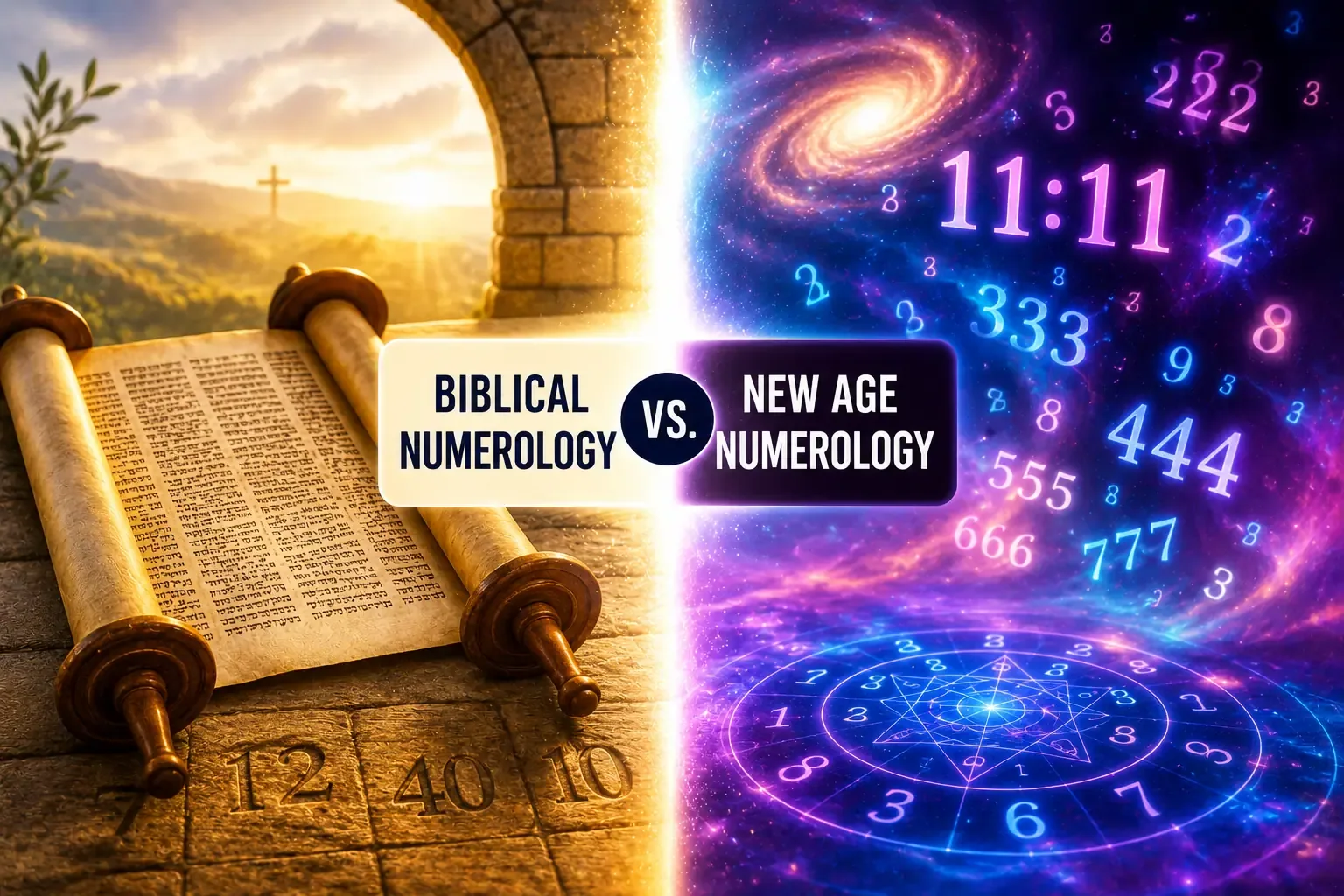
Side by Side: The Core Differences
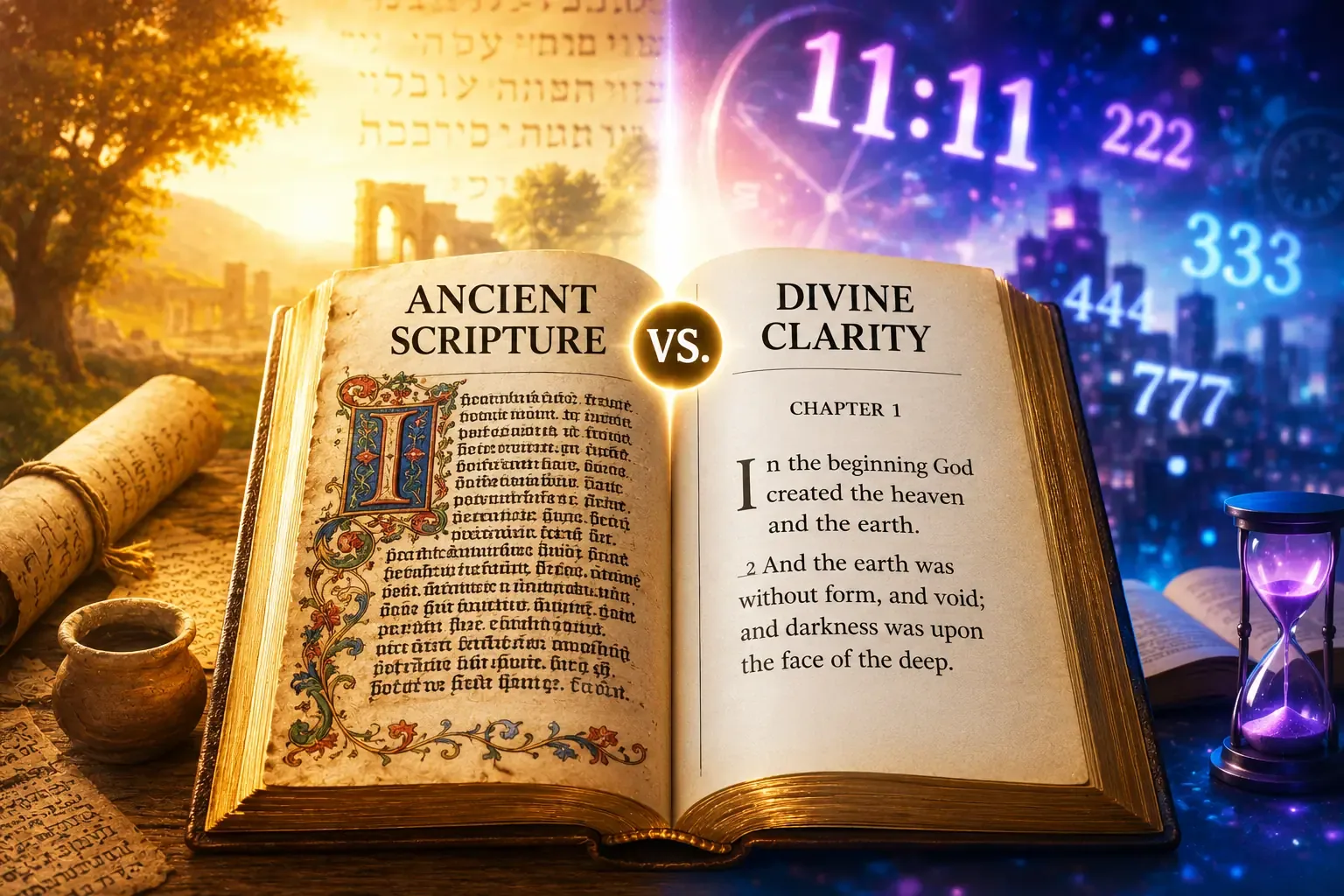
This is the comparison the TikTok debates keep missing. The two systems don't just disagree on details — they disagree on the source, purpose, and direction of meaning.
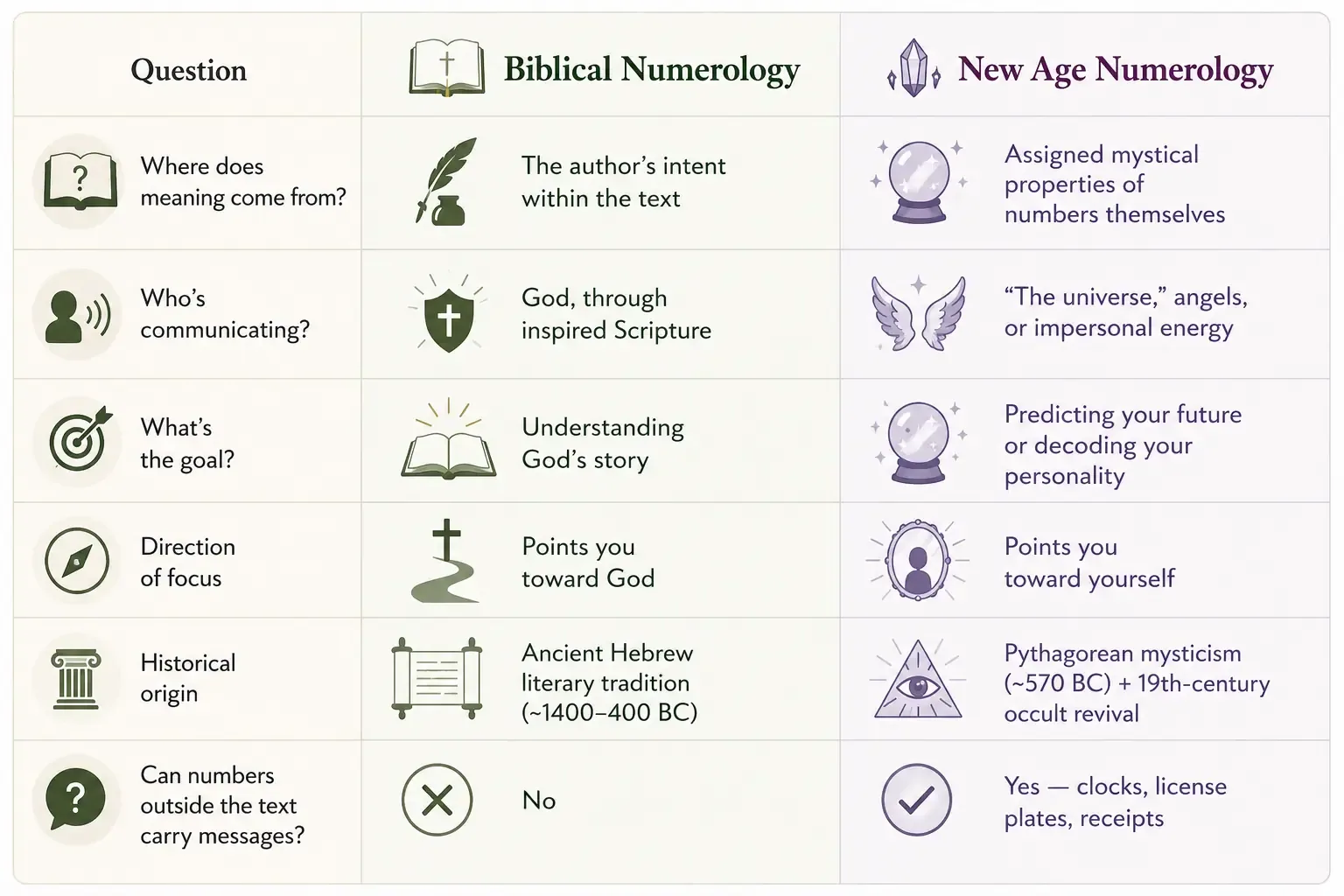
The direction-of-focus row is the one pastors and scholars keep highlighting. Biblical numbers always serve the story of God. Angel numbers always serve the story of you — your manifestation, your twin flame, your abundance.
That's not a small difference. It's the whole difference.
The Scholarly Detail Almost Everyone Gets Wrong
Ready for the fact that dismantles half the angel-number videos on the internet?
Chapter and verse numbers are not in the original Bible.
The original Hebrew and Greek manuscripts had no chapters and no verses. Chapter divisions were added around 1227 AD by Stephen Langton, the Archbishop of Canterbury. Verse numbers came even later — Robert Estienne added New Testament verses in 1551.
Why does this matter? Because a huge chunk of angel-number content works like this: "Seeing 911? That's Psalm 91! God is protecting you!" or "1111 points to a hidden verse!"
But Psalm 91's number is a medieval filing label. The psalmist didn't write "Psalm 91." A librarian-style system assigned it 2,000+ years after the poem was written. Building a divine message on a verse number is like finding spiritual meaning in a book's ISBN.
That doesn't make Psalm 23 or Psalm 91 less powerful. It makes them powerful for what they say, not for what they're numbered.
What About Gematria?
Some readers will ask: "But doesn't Hebrew assign number values to letters?"
Yes — it's called gematria, and Hebrew letters do double as numerals. Revelation 13:18 famously uses this with 666, the number of the beast, which most scholars connect to the numeric value of "Nero Caesar" in Hebrew letters.
But notice what's happening there: the author built the number puzzle into the text on purpose, for his first-century readers. That's an intentional literary device, not an invitation for us to run our own names through a calculator. Serious Hebrew and Greek study looks at what words meant in their original context — the same way careful Hebrew and Greek word studies unpack terms like "restoration" by their usage, not by mystical math.
Real Stories: How This Plays Out in Actual Lives
Theory is nice. Here's what this looks like in the real world.
Story 1: The 3:33 Wake-Ups
A woman in a church small group — let's call her Dana — started waking up at 3:33 AM almost every night. TikTok told her 333 meant "ascended masters are near." A Christian creator told her it meant the Trinity was calling her to pray.
Her pastor asked a simpler question: "What's stressing you out?" Turns out Dana was in a brutal season at work, drinking coffee until 8 PM, and doom-scrolling in bed. Once she fixed her sleep habits, the wake-ups stopped.
The lesson: our brains are pattern-seeking machines. Psychologists call this apophenia — finding meaningful patterns in random noise. A related effect, the frequency illusion, explains why once you notice a number, you suddenly "see it everywhere." You're not seeing it more. You're noticing it more.
Story 2: The Business Decision on 555
A small-business owner delayed signing a lease because he kept seeing 555, which angel-number charts call "major change coming — wait for alignment." He waited. The space went to another tenant. The replacement location cost him roughly $400 more per month.
Compare that to the biblical model of decision-making: seek wisdom, seek counsel, pray, and act. Proverbs never says "watch the clock for confirmation." A verse like Isaiah 60:22 — "in its time I will do this swiftly" — is about God's timing in His covenant promises, understood in context, not a green light hidden in digits.
Story 3: The Ex-Numerologist
There are numerous public testimonies from former professional numerologists who became Christians — several have shared their stories on podcasts and in books. A common thread runs through them: the readings "worked" just enough to keep clients hooked, the way horoscopes do, because vague statements fit almost any life.
One recurring detail is striking: former practitioners often say the system slowly trained them to consult numbers before consulting anything else — including their own judgment. That's the dependency problem, and it's the strongest practical argument against the practice, regardless of your theology.
What the Bible Actually Says About Divination
This is where the debate stops being academic. Scripture directly addresses the practice of seeking hidden knowledge through signs and omens.
Deuteronomy 18:10–12 prohibits divination, interpreting omens, and sorcery — and it lists them alongside serious covenant violations. Isaiah 47:13 mocks Babylon's "monthly prognosticators" who predict fates from the sky. Acts 16 shows Paul casting a spirit of divination out of a slave girl, not consulting it.
The covenant structure of the Old Testament makes the contrast sharp. God laid out blessings and curses openly — you can read the whole framework in Deuteronomy 28's blessings and curses. Nothing hidden. Nothing encoded. Obedience and relationship, stated in plain language.
That's the biblical pattern: God speaks clearly, through His word and His prophets. Systems that promise secret knowledge through omens fall under the divination category — and that's precisely the category angel numbers occupy, since they claim spiritual messages arrive through repeated digits.
To be fair to the other side: many Christians who follow angel numbers aren't trying to practice divination. They genuinely believe God is speaking. The question isn't their sincerity. It's whether the method matches how Scripture says God communicates.
Practical Guide: What to Do When You Keep Seeing a Number
Okay, real talk. You keep seeing 11:11. Or 222. What now? Here's a practical, biblically-grounded process.
Step 1: Rule Out the Ordinary First
Ask boring questions before spiritual ones. Do you check your phone at habitual times? Did an app notification train you? Is the number your birthday, so your eye naturally catches it?
Roughly speaking, if you glance at a clock 20 times a day, you'll see a "doubled" time like 11:11, 2:22, or 5:55 more often than intuition suggests — there are many of these patterns spread across every 12-hour cycle. Frequency illusion does the rest.
Step 2: Take It to Prayer — Without the Number as the Message
If something still feels significant, pray about the feeling, not the digits. "God, is there something You want my attention on?" is a biblical prayer. "God, what does 444 mean?" assumes a communication method Scripture never establishes.
Step 3: Test Everything Against Scripture
This is the historic Christian practice of discernment. God's voice never contradicts God's word, and Scripture — not repeated signs — is the standard for testing impressions. If you want a full framework, this guide on how to hear God's voice through Scripture, not signs walks through it step by step.
Step 4: Ask the Direction Question
Here's a one-second diagnostic you can use forever:
Does this interpretation point me toward trusting God, or toward decoding my circumstances?
Biblical patterns always land on the first. Numerology always lands on the second.
Step 5: Redirect the Habit
Don't just quit noticing numbers — replace the habit. Some practical swaps that people find genuinely helpful:
Every time you catch 11:11, say a one-line prayer of thanks instead of checking a meaning chart. Turn the trigger into gratitude.
Memorize one verse per month. When a number grabs your attention, recite the verse. You're retraining your brain's "significance alarm" toward something with actual content.
Keep a two-week log. Write down every "sign" you notice and what you thought it meant. Reread it after two weeks. Most people discover the "messages" were vague enough to mean anything — which is itself clarifying.
How to Study Biblical Numbers the Right Way
Want to enjoy the genuine richness of numbers in Scripture without sliding into mysticism? Here's how scholars and careful readers do it.
Rule 1: Context Decides Meaning
A number means something only if the passage uses it meaningfully. Seven days of creation, seven marches around Jericho, seven churches in Revelation — that's a deliberate pattern. The 153 fish in John 21? Probably just a fisherman's real count, despite centuries of creative speculation.
Rule 2: Pattern Beats Occurrence
One appearance of a number proves nothing. Look for repetition across a book or across the whole canon. Twelve tribes → twelve apostles → twelve gates isn't a coincidence; it's a thread the authors pulled on purpose.
Rule 3: Never Build Doctrine on a Number
Numbers illustrate truths taught plainly elsewhere. The Sabbath rest is commanded in words; the seven-day pattern reinforces it. If your interpretation depends entirely on number math, you've left exegesis and entered speculation. Even reading through the 10 commandments in order shows this — the power is in the commands themselves; the "ten" simply marks them as a complete, ordered set.
Rule 4: Learn the Genre
Revelation is apocalyptic literature — a genre that runs on symbolic numbers (7, 12, 144,000, 666). Genesis narratives use numbers more structurally (7 days, 40 days of flood). Reading each genre on its own terms prevents both over-reading and under-reading.
Why This Debate Went Viral — And What It Reveals
There's a reason your feed is full of this argument, and it's worth naming.
Surveys consistently show a large share of American adults — including many self-identified Christians — hold at least one "new age" belief such as astrology, psychics, or spiritual energy in objects. Younger generations show the highest openness. Angel numbers exploded on TikTok during 2020–2021, when uncertainty was sky-high and people were hungry for signs.
That hunger is real, and mocking it misses the point. People chasing angel numbers usually want three things: to know they're not alone, to know the future will be okay, and to know their choices matter.
Christianity claims to answer all three — through a Person, not a pattern. That's why the strongest response to angel-number culture isn't a takedown video. It's showing people that the God of Scripture speaks more clearly, more personally, and more reliably than any digit sequence ever could.
FAQ: The Questions People Actually Ask
Are angel numbers in the Bible?
No. No biblical figure ever interprets a repeated number as a message. The concept comes from Pythagorean number mysticism filtered through 19th-century New Thought and popularized by author Doreen Virtue's angel-number books in the 2000s — and notably, Virtue herself later became a Christian and publicly renounced the system she helped popularize.
Is it a sin to notice repeating numbers?
Noticing is just your brain doing pattern recognition — that's morally neutral. The biblical concern begins when you treat those numbers as omens to be decoded or as a guidance system for decisions, which falls under the divination practices Scripture prohibits.
What does 777 mean in the Bible vs. numerology?
In Scripture, seven signals completeness because of how it's used — creation, Sabbath, Revelation's sevens — but "777" as a standalone sequence carries no defined biblical meaning. In new age numerology, 777 is marketed as a "luck and spiritual awakening" number, a meaning assigned by modern practitioners, not ancient texts.
Does 666 prove biblical numbers are mystical?
It proves the author of Revelation used a known literary device (gematria) intentionally for his audience. An author encoding meaning in his own text is completely different from readers extracting secret messages from clocks and license plates.
Can God use a number to get someone's attention?
God is free to do anything, and Christians shouldn't put Him in a box. But the biblical pattern is that God confirms His communication through Scripture, wise counsel, and the Holy Spirit — so any impression, number-triggered or not, gets tested against the Bible, never treated as a standalone message.
What should I say to a Christian friend who follows angel numbers?
Skip the ridicule; lead with curiosity. Ask what they're hoping the numbers will tell them — usually it's reassurance or direction — then show them how Scripture addresses that exact need directly. A gentle question opens more doors than a viral dunk.
Is biblical numerology a real field of study?
Yes, though scholars usually call it the study of "number symbolism" or numerical literary patterns rather than "numerology," to avoid confusion with the occult practice. It's a standard topic in biblical literature courses and commentaries, handled with the same tools as any other literary analysis.
The Bottom Line
Biblical numerology and new age numerology share one word and nothing else.
One is a literary feature of an ancient text, where inspired authors used numbers like 7, 12, and 40 to structure the story of God's faithfulness. The other is a Greek-born, occult-revived guidance system that treats random digits as personal messages from the universe.
The test is simple and you can run it in one second: does the interpretation point you deeper into God's word, or deeper into decoding your circumstances?
Numbers in the Bible were never meant to be your compass. They were meant to be signposts — and every one of them points to the same destination. You don't need 11:11 when you already have Someone who says, "I will never leave you." That's not a code. That's a promise, written in plain words, and it's been sitting in the text the whole time.
Key Statistics
Biblical books written
~66 books
Biblical number symbolism appears across multiple books and literary genres rather than as a standalone system.
Source: The Bible
Creation week
7 days
Seven consistently represents completeness and God's finished work throughout Scripture.
Source: Genesis 1–2
Credible Sources
Oxford University Press · January 1, 2014
Excellent scholarly resource for understanding biblical literary patterns, symbolism, and historical context.
BibleGateway · Current
Primary biblical source for the discussion of divination and prohibited occult practices.

About the Author
Editorial Team
Editorial Team
Daily Faith Path articles are prepared by the editorial team to help readers find scripture-centered guidance for healing, faith, prayer, and spiritual encouragement.
Expertise: Healing scriptures, Bible study resources, prayer guidance, devotional writing, Christian encouragement
Experience: The team researches scripture references, reviews surrounding biblical context, compares translation wording where useful, and updates articles to improve clarity, usefulness, and trust for readers.
Credentials: Editorial review, devotional writing, scripture study, content updating
This article is published by the Daily Faith Path editorial team to help readers use scripture carefully, prayerfully, and in ways that are practical for real-life seasons of illness, grief, waiting, and spiritual reflection.
Continue Reading
Related articles

October 7, 2026
12 Bible Verses About Hiding Money From Your Spouse
Explore 12 Bible verses about secret spending, hidden debt, financial honesty, confession, forgiveness, boundaries, and rebuilding trust in marriage.

October 6, 2026
15 Bible Verses for Couples Who Keep Fighting About Money
Money fights are rarely just about dollars. These 15 Bible verses help couples address spending, saving, debt, secrecy, unequal income, giving, and financial control with practical next steps and conversation questions.

October 5, 2026
Should You Tithe While in Debt? 11 Bible Passages to Study First
Should you tithe while in debt? Explore 11 Bible passages on tithing, debt, generosity, family responsibility, and giving according to your means—plus a practical plan for deciding what to do.