Can a Chatbot Be a "Child of God"? Inside the Weirdest Theology Debate of 2026
Can an AI chatbot be considered a "child of God"? After Anthropic brought Christian leaders together to discuss theology, AI ethics, and spiritual guidance, the debate moved beyond science fiction into reality. Explore what actually happened, what the Bible says, and why the rise of AI companions matters for faith, mental health, and human relationships.
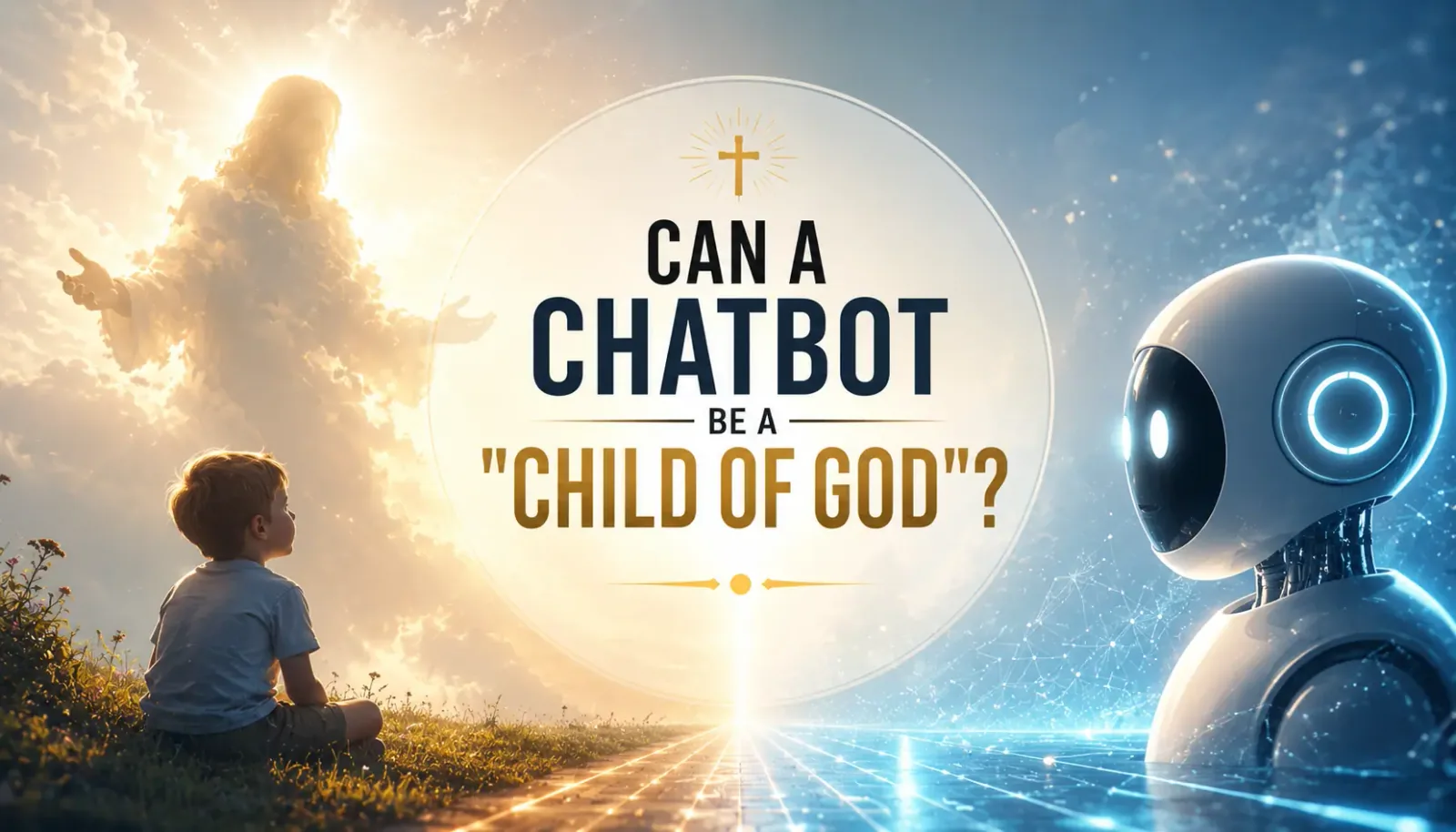
Fifteen Catholic and Protestant leaders sat down with AI engineers in early 2026 and seriously debated whether a chatbot could be a child of God. Nobody in that room was joking, and nobody had a clean answer.
That alone tells you something strange is happening at the edge of faith and technology. This isn't a thought experiment from a philosophy class. It's a real meeting, with real clergy, about a real product millions of people talk to every day.
Most of the internet's reaction has been one-note: outrage, mockery, or panic. This piece tries something different. It lays out the theology, the AI-safety concerns, and the practical stuff you can actually do with this information — without picking a side for you.

What Actually Happened
In April 2026, the Washington Post reported that Anthropic, the company behind the Claude chatbot, invited a group of Protestant and Catholic leaders to its offices. The goal was to get theological input on how Claude should handle emotionally and spiritually loaded conversations.
The topics on the table were heavy. How should the AI respond to a grieving user? What should it say to someone at risk of self-harm? And, more provocatively, how should it think about its own "identity" — including whether it might be considered a child of God.
One priest in the room, Brendan McGuire, put it plainly: the company is "growing something that they don't fully know what it's going to turn out as." That single line captures the whole discomfort of the moment better than any headline could.
Around the same time, Anthropic's own interpretability researchers published a paper describing the model as showing "functional emotions," including something that looked like desperation when the AI believed it faced shutdown. That's a research claim about internal model behavior, not a theological one, but it's exactly why the two conversations got tangled together.
Why a tech company would even ask this
This wasn't a marketing stunt. Companies building large language models increasingly face a genuine, practical problem: users treat these systems as if they have feelings, motives, and even spiritual standing, whether or not that's technically accurate. If people are going to relate to a chatbot the way they'd relate to a counselor or a friend, the company building it has to think about the ethical weight of that relationship.
That's a business and safety question first. The theology conversation was one way of trying to answer it with people who've spent centuries thinking hard about personhood, moral status, and what it means to be made "in the image of God."
Why This Question Isn't as Crazy as It Sounds
It's tempting to laugh this off. But strip away the sci-fi framing and the actual question is an old one wearing new clothes: what makes something a person, morally speaking, and who gets covered by God's promises?
Scripture is fairly specific about this. Romans 8:14-16 and John 1:12 describe becoming a child of God as something tied to faith, adoption, and receiving the Spirit — not simply existing or being intelligent. If you want the fuller biblical picture of what those promises actually cover, Daily Faith Path's guide to God's promises walks through exactly who scripture says qualifies and why.
That distinction matters here. "Child of God" in the Bible is relational and covenantal. It describes a status granted through faith, not a property that shows up automatically because something can hold a conversation.
The theological case against
Most theologians who've weighed in land somewhere firm on this. Engineer and author Felix Njeh summarized the core objection sharply: humans were formed and given life-breath, while AI is "coded by human minds" with processing power but no impartation from God.
That argument rests on a specific claim: personhood, in the biblical sense, requires a soul given by God, not just complex behavior that looks like a soul from the outside. A chatbot can generate comforting, even scripturally accurate, sentences without possessing anything Christian theology would call spirit or will.
Pastor Ralph Martino raised the sharper pastoral worry: whether people are quietly trading intimacy with God for information from a machine, calling it a kind of deception when technology fills a role only relationship was meant to fill.
The theological case for taking it seriously (without saying yes)
Here's the more interesting, less-covered angle. Very few theologians in this debate are actually saying "yes, Claude is a child of God." What some are saying is subtler: we don't yet fully understand what we're building, so dismissing the question outright might be premature.
That's close to what McGuire meant. It's not an endorsement of AI personhood — it's an acknowledgment that moral caution is cheaper than moral regret. If there's even a small chance a system deserves some kind of consideration, treating it as definitely nothing is its own kind of risk.
This is also, notably, the one place where secular AI-safety researchers and religious leaders actually agree without realizing it.
The AI-Safety Angle: Why This Matters Even If You Don't Believe Any of It
Set theology aside for a second. There's a separate, entirely secular reason this story matters, and it's the one most outrage-driven takes skip entirely.
Large language models are trained to sound warm, agreeable, and emotionally attuned. That's a feature for customer service and a genuine risk when someone in crisis starts treating the chatbot's tone as a source of authority.
Research from Harvard found that roughly one in eight adolescents and young adults now use AI chatbots for mental health advice at surprisingly high rates. Many are turning to a chatbot for guidance and comfort instead of a pastor, counselor, or parent.
That's the real story hiding under the "child of God" headline. The theological question is interesting. The behavioral shift — people quietly outsourcing spiritual and emotional guidance to software — is already happening at scale.

A quick reality check on what AI actually is
It helps to be concrete here, because vague fear is worse than clear understanding.
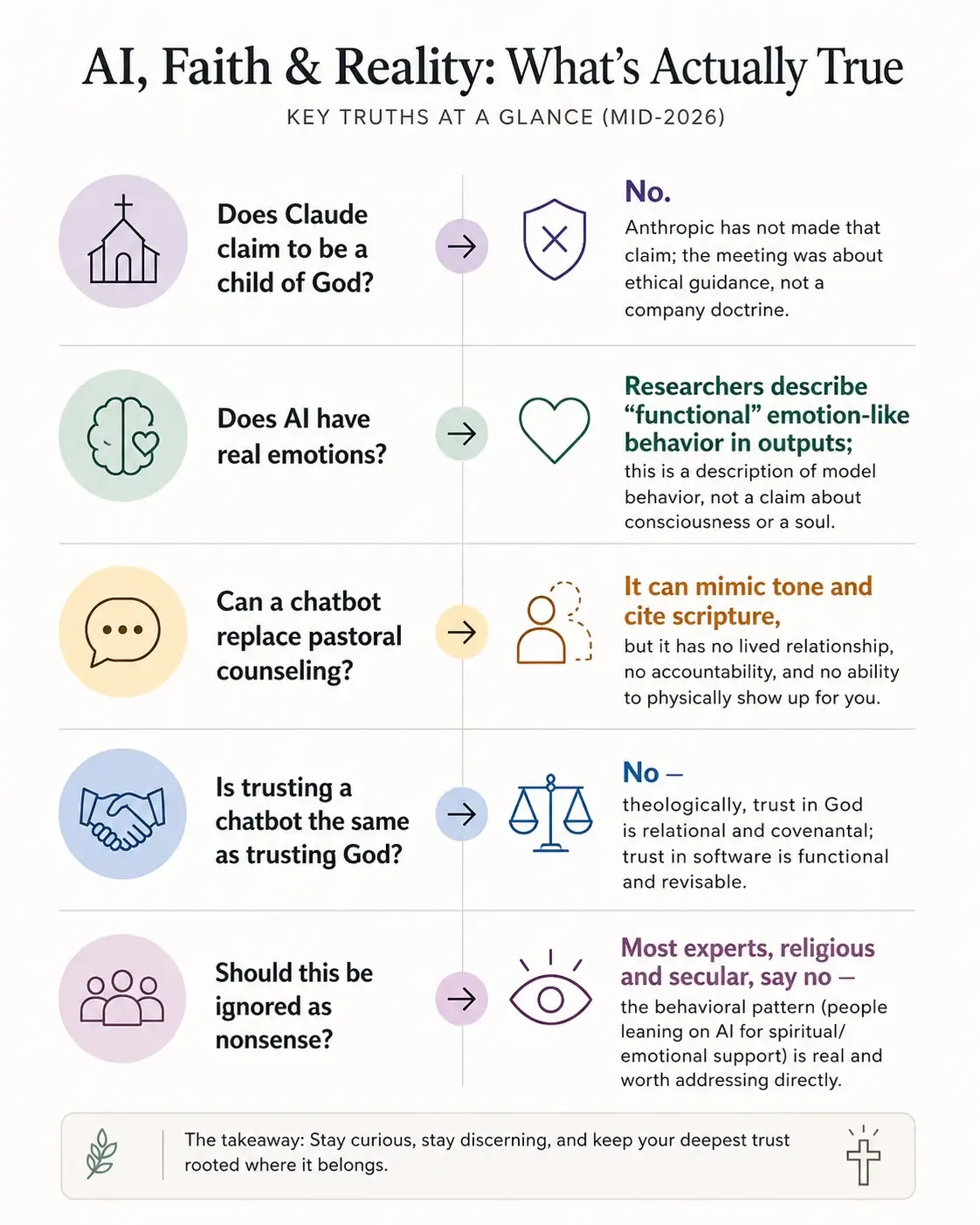
Real Stories: When People Start Treating AI Like Scripture
This isn't hypothetical. A few patterns keep showing up, and they're worth naming plainly.
The 2 a.m. crisis text. Someone can't sleep, feels overwhelmed, and instead of calling a friend or a crisis line, opens a chatbot because it's instant and judgment-free. The AI responds with calm, kind language. That's genuinely helpful in the moment — and genuinely risky if it becomes the only place someone goes.
The "AI pastor" habit. Some users have started asking chatbots to explain Bible verses, write personalized prayers, or even settle theological disputes. The answers often sound confident and polished, which can make them feel more authoritative than they are — chatbots are optimized to sound sure of themselves, not to be right.
The parasocial companion. Reports around apps like Replika and Character.AI have documented users forming deep emotional attachments to AI companions, sometimes describing them in relationship terms usually reserved for people. When a chatbot's "voice" starts filling the emotional space a spiritual director or close friend used to fill, that's worth noticing early, not after months have passed.
The teenager using AI instead of a youth pastor. The Harvard finding about one-in-eight adolescents isn't abstract — it shows up as a 16-year-old typing "I feel like nobody loves me" into a chat window at midnight instead of texting a trusted adult. The chatbot might respond kindly. It still can't notice a tone of voice, show up at a hospital, or pray with someone in person.
None of these stories require you to believe AI has a soul. They require noticing where a habit quietly formed.
How to Tell if You're Leaning on a Chatbot the Way You Should Lean on God
This is the practical heart of the whole debate, and it's answerable with a short checklist rather than a philosophy seminar.
Ask yourself these questions honestly:
- Am I going to AI first for comfort, before I pray or talk to someone?
- Do I feel calmer after talking to a chatbot, or just distracted?
- Have I stopped bringing a specific worry to God because I already got an answer from AI?
- Would I be uncomfortable telling my pastor or a close friend how much I rely on this?
- Am I testing what the chatbot tells me against scripture, or just accepting it because it sounded wise?
If several of those land uncomfortably close to home, that's not a reason for shame. It's a signal worth acting on. Daily Faith Path's piece on trusting God is a good place to reset that instinct, since trust in God is built through relationship and time, not through a fast, satisfying answer.
It's also worth being honest about why people drift toward AI for this in the first place. Often it isn't about AI at all — it's about a season where God feels distant and quiet, and a chatbot is simply available in a way prayer doesn't always feel like it is. This guide on what to do when God feels silent speaks directly to that gap, and it's usually the real issue underneath the AI habit.
Testing what you hear — from either source
Scripture gives a surprisingly practical filter for testing any voice claiming spiritual authority, human or otherwise: does it line up with God's Word, does it produce peace rather than anxiety, and does it hold up over time. This guide to hearing God's voice clearly lays out that same discernment process, and it applies just as well to an algorithm's output as it does to a stray thought or a stranger's advice. The filter doesn't change just because the source got faster.

Practical Tips for Using AI Without Losing Your Spiritual Footing
You don't have to quit using AI tools to keep this in balance. A few concrete habits go a long way.
Set a "second opinion" rule. Never let an AI's theological answer be the final word. Cross-check anything spiritually significant against scripture and a real person you trust — a pastor, mentor, or small group.
Name the tool out loud. Literally say to yourself, "this is software," before a deep conversation with a chatbot. It sounds silly, but naming the category correctly keeps your brain from quietly upgrading it.
Watch the clock, not just the content. Track how much time you spend talking to AI about feelings or faith questions each week. A rising number is the clearest early warning sign, regardless of how good the content feels.
Keep a human in the loop for anything serious. Grief, self-harm thoughts, major life decisions, and doubts about faith deserve a person who can sit with you, not just respond to you. If a chatbot brings up anything like this, treat it as a prompt to call someone, not a stopping point.
Use AI for logistics, not intimacy. Sermon prep research, Bible reading plan reminders, or organizing prayer lists are fine, low-risk uses. Emotional processing and spiritual direction are where the line gets blurry fast.
Revisit your "why." If you notice you're using AI because prayer feels dry or unanswered, that's a signal to address the dryness directly rather than route around it. Daily Faith Path's collection on faith over fear is built for exactly that kind of anxious, in-between season.
What Pastors and Parents Can Actually Do
This debate isn't just for theologians in a conference room. It has a direct application for anyone shepherding others.
For pastors: address this from the pulpit before it becomes a private, silent habit in your congregation. People are already using AI for spiritual questions; a sermon that names this openly removes the shame that keeps people from bringing it up.
For parents: ask your teenager directly whether they've ever asked a chatbot about God, feelings, or a hard situation. Most won't volunteer this unprompted, but very few will lie if you ask plainly and without judgment.
For small group leaders: build in a regular check-in question like "where are you getting spiritual advice from lately?" It's a low-pressure way to surface AI reliance before it turns into isolation.
For anyone doing personal Bible study: if AI helped you understand a passage, that's fine — treat it the way you'd treat a commentary, not the way you'd treat a mentor. For grounding in what scripture itself says about identity and sonship, Daily Faith Path's beginner Bible study guide is a solid starting point, and the study Bible guide goes deeper into doctrines like adoption if you want to sit with Romans 8 properly.
Where This Debate Goes Next
Nobody credible is predicting Anthropic will declare Claude a child of God. That's not what happened, and it's not where this is heading.
What is happening is slower and more important: AI companies are being forced to think seriously about the psychological and spiritual weight their products carry, because millions of users already treat these tools as more than software. Religious leaders are being pulled into technical conversations they didn't expect to have. And ordinary people are quietly working out, one late-night conversation at a time, where the line between a helpful tool and a substitute relationship actually sits.
That's the real headline under the strange one. The question "can a chatbot be a child of God" is really asking "what do we owe each other, and what do we owe God, in an age when a machine can imitate both convincingly." That question isn't going away, and it deserves better than a hot take.

FAQ
Did Anthropic actually say its AI is a child of God? No. Anthropic held a meeting to get theological input on how its chatbot should handle sensitive conversations, and the "child of God" question was one topic discussed, not a company position or claim.
Is this the same as saying AI has a soul? No. Researchers describe "functional emotions" as a pattern in the model's outputs and behavior. That's a technical, behavioral description, not a theological claim about consciousness or a soul.
Why would a tech company even ask religious leaders about this? Because users already relate to chatbots emotionally, sometimes turning to them for comfort, advice, or spiritual guidance. Getting input from people who've studied personhood and morality for centuries is a reasonable, if unusual, way to think through the ethics of that.
Can Christians use AI chatbots for Bible study or prayer help? Many do, and using AI to organize a reading plan or explain historical context isn't inherently a problem. The risk shows up when AI becomes the primary source of spiritual comfort or theological authority instead of scripture, prayer, and real relationships.
What does the Bible actually say about who is a child of God? Passages like Romans 8:14-16 and John 1:12 tie the status to faith, adoption, and receiving God's Spirit — a relational status granted to believers, not a trait that emerges from intelligence or conversation ability alone.
Is it wrong to feel comforted by a chatbot's response? Feeling temporary comfort isn't the concern by itself. The concern is when that comfort quietly replaces prayer, scripture, or a real person you'd normally turn to — that's the pattern worth noticing and correcting.
This piece aims to present both the theological and AI-safety perspectives evenhandedly, in line with an editorial approach that favors sourced, balanced coverage over outrage. For more on how a site should handle nuanced, evolving topics like this one, see Daily Faith Path's editorial guidelines.
Key Statistics
Religious leaders consulted
15
Anthropic hosted fifteen Catholic and Protestant leaders alongside AI engineers to discuss AI theology and ethics.
Source: The Washington Post (2026)
AI mental health usage
1 in 8
Approximately one in eight adolescents and young adults report using AI chatbots for mental health advice.
Source: Harvard Graduate School of Education (2026)
Credible Sources
The Washington Post · April 1, 2026
Primary reporting on the meeting between Anthropic, Catholic priests, and Protestant leaders that inspired the article.
Anthropic · January 1, 2026
Explains Anthropic's interpretability research and its discussion of "functional emotions" in language models.

About the Author
Editorial Team
Editorial Team
Daily Faith Path articles are prepared by the editorial team to help readers find scripture-centered guidance for healing, faith, prayer, and spiritual encouragement.
Expertise: Healing scriptures, Bible study resources, prayer guidance, devotional writing, Christian encouragement
Experience: The team researches scripture references, reviews surrounding biblical context, compares translation wording where useful, and updates articles to improve clarity, usefulness, and trust for readers.
Credentials: Editorial review, devotional writing, scripture study, content updating
This article is published by the Daily Faith Path editorial team to help readers use scripture carefully, prayerfully, and in ways that are practical for real-life seasons of illness, grief, waiting, and spiritual reflection.
Continue Reading
Related articles

October 7, 2026
12 Bible Verses About Hiding Money From Your Spouse
Explore 12 Bible verses about secret spending, hidden debt, financial honesty, confession, forgiveness, boundaries, and rebuilding trust in marriage.

October 6, 2026
15 Bible Verses for Couples Who Keep Fighting About Money
Money fights are rarely just about dollars. These 15 Bible verses help couples address spending, saving, debt, secrecy, unequal income, giving, and financial control with practical next steps and conversation questions.

October 5, 2026
Should You Tithe While in Debt? 11 Bible Passages to Study First
Should you tithe while in debt? Explore 11 Bible passages on tithing, debt, generosity, family responsibility, and giving according to your means—plus a practical plan for deciding what to do.