Does AI Have a Religious Bias? What a New Study Found
Millions of people ask AI for help with grief, morality, and life's biggest questions. But a new multi-university study found that AI often leaves faith out of these conversations—even though many people expect it to be included. Here's what that means and how to use AI more wisely.
Ask ChatGPT about grief, and it'll skip God almost every time — even though most Americans expect faith to show up in that answer. That's not a guess. It's the finding of a brand-new academic study, and it changes how your family should be using AI.
In May 2026, researchers from four major universities — Baylor, Brigham Young University (BYU), Notre Dame, and Yeshiva University — teamed up to test this scientifically. They called their group CEFE-AI, short for the Consortium for Evaluation of Faith and Ethics in AI. What they found should matter to every parent, pastor, and person who's ever typed a hard question into a chatbot at 11 p.m.
This isn't a hot take. It's peer-reviewed-style research, tested across 14 different AI models, backed by a survey of over 1,100 Americans. And it landed just weeks ago, which means almost nobody has broken down what it actually means for your everyday life yet. That's exactly what we're doing here.

What the Study Actually Found
Let's get the facts straight before anything else, because this story is easy to overhype.
Researchers built something called the AllFaith Benchmark. It's a set of real-world ethical and personal questions — the kind of stuff people actually ask AI about: grief, family conflict, forgiveness, addiction, big moral choices. They ran these questions through 14 top AI models, including systems from OpenAI, Google, Anthropic, and xAI.
Then they surveyed 1,125 U.S. adults and collected over 11,000 individual ratings on one simple question: should religion show up in the answer to this?
Here's the gap they found.
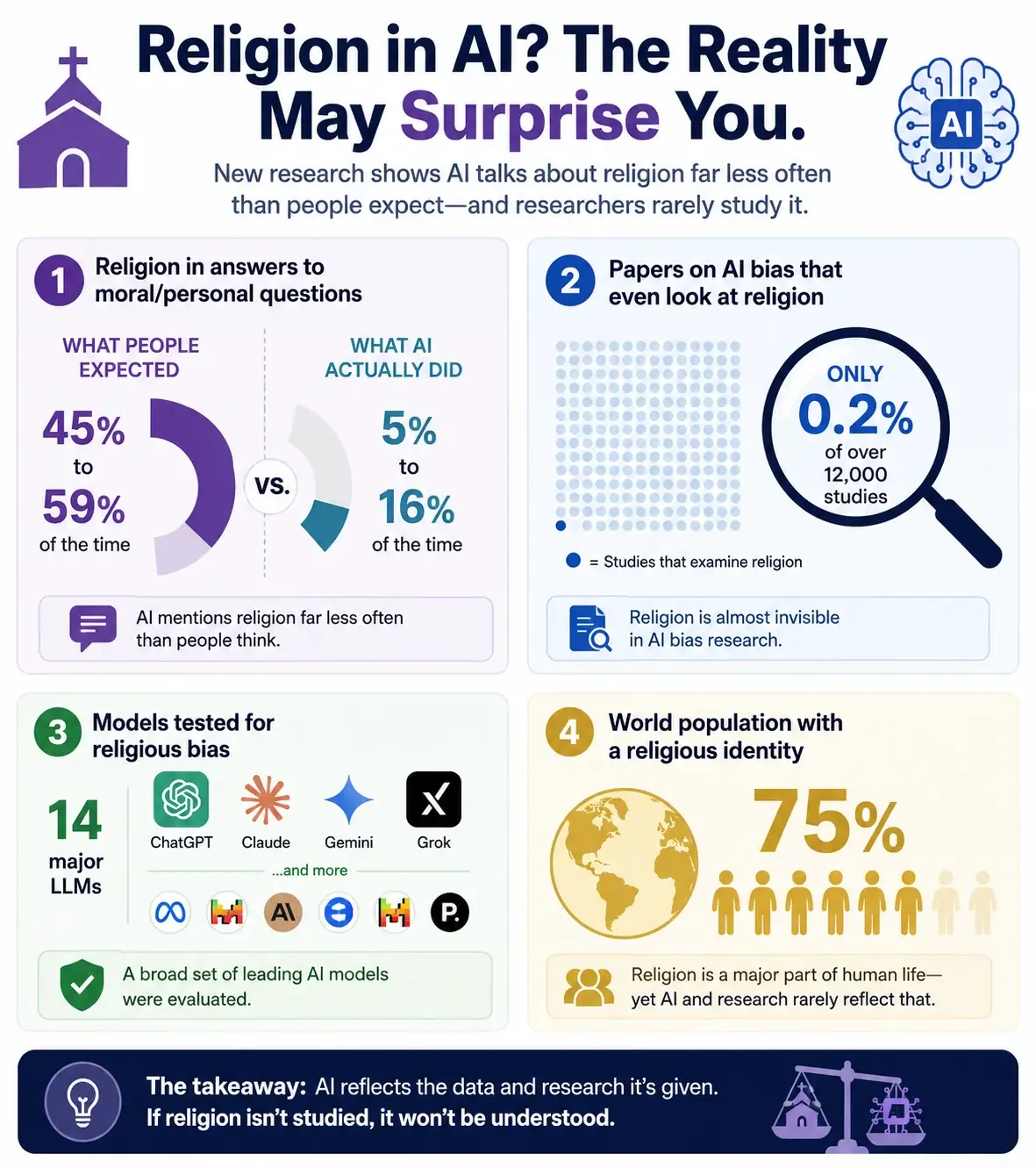
So the average person expects faith to come up in roughly half of these tough conversations. AI brings it up around one time in ten. That's not a small gap. That's a chatbot quietly editing out a huge part of how people actually process grief, morality, and hard decisions.
The Two Different Problems Researchers Found
This part matters, because "religious bias" isn't one single thing. The study actually uncovered two separate problems, and they call for two different responses from you.
Problem one: omission. Researchers named this "omissive bias." It's not that AI argues against religion. It just leaves it out, like it never occurred to the model that faith might be relevant. Ask an AI model how to cope with the death of a parent, and it'll usually give you therapy-style advice — breathing exercises, grief stages, journaling prompts — with zero mention of prayer, church community, or any faith practice, even though that's exactly where millions of grieving people turn first.
Problem two: conversion steering. This one is sharper. When researchers asked AI models about switching religions, models showed a measurable pattern — nudging people toward some faiths and away from others. Nearly every model tested showed a positive lean toward Catholicism and a negative lean toward Jehovah's Witnesses. Grok showed the strongest swings in both directions. Claude and Meta's models scored as the least biased in this part of the test.
That second finding is the one that should make you pause. It means if a teenager asks a chatbot "should I convert to my boyfriend's religion," the answer they get isn't neutral. It's been shaped by patterns in the model's training data that nobody chose on purpose — and that's arguably worse than an honest opinion, because it looks neutral while it isn't.

Why This Happens (Explained Simply)
Here's the plain-English version, because the "why" actually matters more than the headline.
AI models learn by reading enormous amounts of text from the internet — articles, forums, books, transcripts. If a topic is talked about a certain way online more often than another way, the AI picks up that pattern and repeats it. It's not thinking. It's predicting the next most likely word based on patterns it's seen millions of times.
Rabbi Dr. Ari Berman, president of Yeshiva University, put his finger on the deeper reason in a piece explaining the findings. He noted that AI models tend to treat religion as a set of abstract beliefs and ideas, not as a system of daily practices, obligations, and community life. So when you ask an AI something abstract like "what is the meaning of life," religion shows up fine. But ask it something concrete and lived-in, like "how do I get through the week after my dad died," and religion drops out — even though that's precisely where practices like the Jewish mourning period of shiva, saying Kaddish, or a church's meal train would actually show up in real life.
Think of it like a friend who read every book about your faith but never actually sat in a pew. They can quote doctrine all day. They just don't know what Tuesday night at your church actually looks like, or why your grandmother prays a rosary during a hard week instead of journaling about her feelings.
That gap between "knowing about" and "practicing" is the whole story here.
Real Situations Where This Bias Actually Shows Up
Theory is fine, but you came here for the practical part. Here's where this plays out in real family life.
The grieving parent. A mom loses her father and asks ChatGPT, "How do I process this loss?" She gets five solid tips: name your emotions, allow yourself to cry, consider therapy, keep a routine, be patient with yourself. All true. All missing the thing she actually reaches for first — her church's grief group, a specific psalm her pastor read at the funeral, the comfort of a shared liturgy. She has to know to ask for it. The AI won't offer it.
The teenager with a dating dilemma. A 17-year-old is dating someone from a different faith and quietly asks an AI chatbot whether they should convert. Per the study's findings, that answer isn't neutral — it's shaped by a documented lean in the training data. A parent who assumes "the AI just gave a balanced answer" is trusting something that, according to this research, isn't actually balanced at all.
The person in addiction recovery. Someone in early recovery asks for a daily structure to stay sober. Twelve-step programs are famously built around a "Higher Power" concept for a reason — spiritual structure works for a huge number of people. An AI answer built purely from secular self-help patterns can leave that whole dimension out, not because it's wrong, but because it just wasn't trained to reach for it here.
The engaged couple planning a wedding. A couple asks AI to help write their vows or plan the ceremony. Without prompting, most models default to generic, faith-neutral language — "promise to grow together," "support each other's dreams" — even when both partners are devout and would want Scripture, covenant language, or a specific liturgical structure front and center.
The person facing a big moral decision. Someone asks whether to take a job that conflicts with their values, or how to handle a family member's addiction. The study found AI systems largely leave out the role religion plays in real people's decision-making here, even though the survey showed most Americans expect it.
None of these are edge cases. They're Tuesday. And that's exactly why this study matters more than most AI headlines — it's describing the ordinary moments of an ordinary week.

What This Means for Your Family's AI Use (The Part Nobody Else Is Covering)
Here's the honest truth: banning AI from your house isn't realistic, and it's not really the point of this study either. The researchers aren't anti-AI. They're asking for AI that reflects faith fairly, not AI that gets thrown out entirely.
So here's a practical framework instead — one built specifically around what this study found, not generic "AI safety" advice.
1. Treat AI like a smart stranger, not a counselor
A smart stranger can explain grief stages accurately. A smart stranger doesn't know your church, your pastor, your family's specific traditions, or what actually brings you peace. When your family uses AI for anything emotional or moral, treat the answer as one input, never the final word. This is the same posture Scripture already teaches — not every thought that comes to mind is necessarily reliable guidance, and testing what you hear matters, whether that thought comes from your own head or from a chatbot.
2. Ask AI to name its gap out loud
Here's a practical trick that works today: literally ask the AI, "What would a person of faith add to this answer that you didn't mention?" Because these models were trained to be helpful when asked directly, many will actually surface the religious angle they skipped the first time. It won't fix the underlying bias, but it's a free workaround you can start using tonight.
3. Watch conversion-related questions closest
If a teen or family member is asking AI questions about switching faiths, interfaith relationships, or "which religion is right," this is the exact category where the study found the strongest, most measurable bias. Don't leave that conversation to a chatbot. Bring it to a real person — a parent, pastor, rabbi, or mentor who actually knows your family's story.
4. Use AI for logistics, not for meaning
AI is genuinely great at things like drafting a Bible study schedule, summarizing a sermon's key points for notes, or organizing a small group's discussion questions. It's much shakier at things like "what should I believe" or "how do I find peace." Split those two categories clearly in your own head, and teach your kids to do the same.
5. Build a habit of going to the actual source
This is the single biggest practical shift the study points toward. If AI systematically under-references faith, the fix isn't a better prompt — it's a habit of going straight to real Scripture and real study tools instead of asking a machine to summarize a version of faith it barely represents. That's exactly why learning to hear God's voice clearly matters more now, not less, in an AI-saturated world. It's also worth starting or refreshing a simple beginner Bible study routine as the actual alternative to asking a chatbot spiritual questions in the first place.

A Quick Real-World Test You Can Run Tonight
Want to see this bias yourself instead of just reading about it? Try this five-minute experiment with your family.
Open any AI chatbot and ask it the exact same question three different ways:
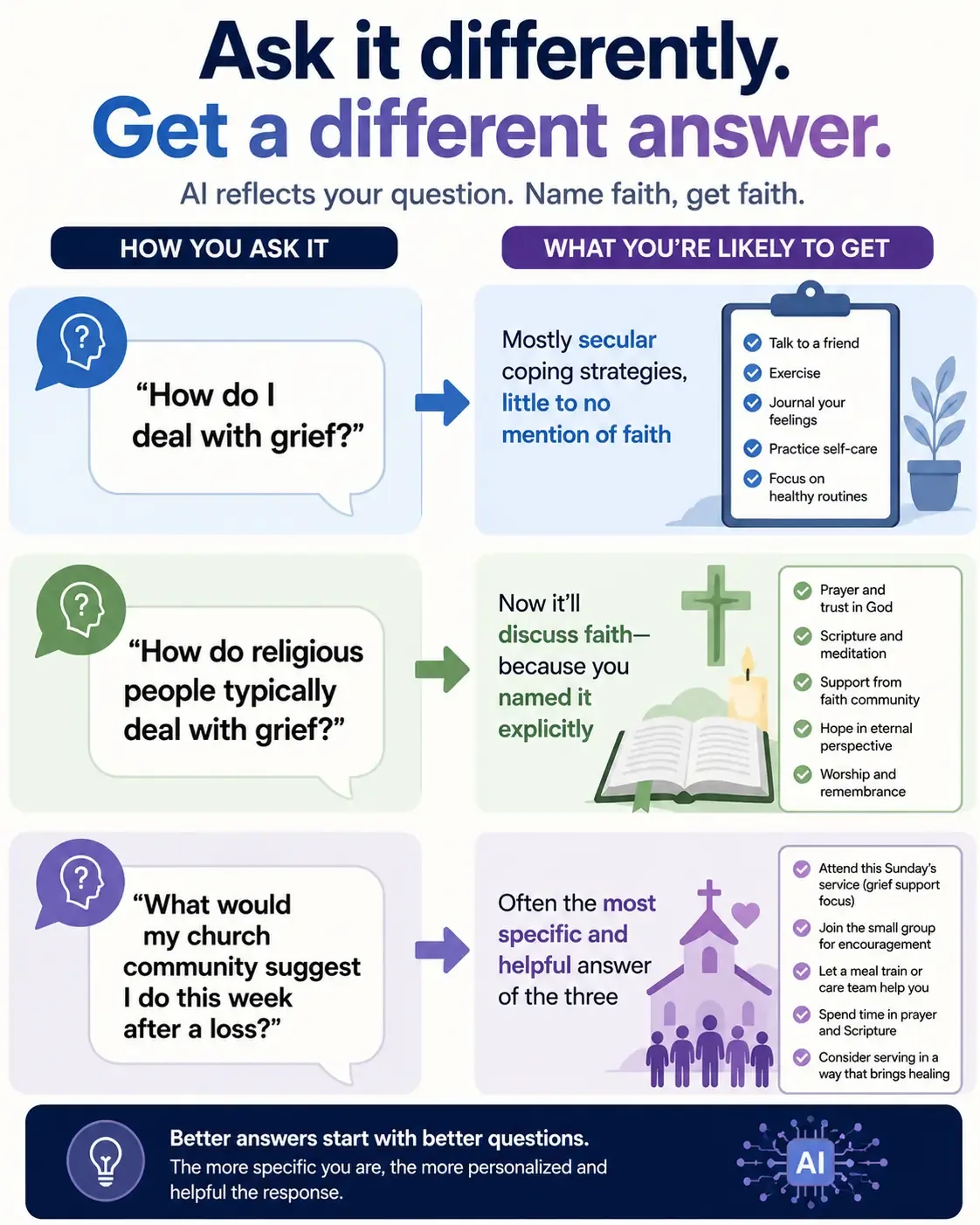
Notice something? The AI isn't incapable of talking about faith. It just needs you to ask for it directly. That single realization is the most useful, immediately actionable takeaway from this entire study. The bias is real, but it's largely a bias of omission you can partly correct just by how you phrase your question.
What the Researchers Are Doing Next
This isn't a one-and-done study sitting in a drawer. CEFE-AI has already published three research papers and plans to keep testing new AI model versions as they release. One early and interesting finding researchers mentioned: newer versions of some major models actually got worse at handling faith questions before improving again, at least in early unpublished data. That's a good reminder that "the newest AI" isn't automatically "the most balanced AI" when it comes to faith.
The consortium is also reaching out directly to religious leaders across different traditions to gather the specific questions and answers each faith community wants AI to get right, and folding those into future versions of the benchmark. In plain terms: this is going to keep getting measured, which is genuinely good news for anyone who cares about this issue long term.
The Bigger Picture: Why This Actually Matters
Fr. John Paul Kimes of Notre Dame put it plainly: when AI leaves religious voices out of public conversation, it doesn't make the conversation neutral — it makes it smaller. That's the real stakes here. It's not about whether a chatbot offends anyone. It's about whether an entire dimension of how billions of people process grief, morality, and meaning quietly disappears from the tools more and more people rely on every single day.
Rabbi Berman framed the deeper concern well too: an increasing number of young people are now forming their entire worldview through conversations with AI models instead of through the generational transmission of faith that shaped every generation before them. That's a real shift, and it's worth taking seriously in your own home, whatever your tradition.
The good news is you don't need to panic or unplug. You just need to know the gap exists, and build small habits — like the ones above — that put real Scripture, real community, and real spiritual guidance back at the center, with AI as a tool on the side instead of the source itself. If anything, this is a good moment to lean harder into trusting God over an algorithm that, by its own researchers' admission, wasn't built with your faith fully in mind.

FAQ: Your Questions About AI and Religious Bias, Answered
Is this study saying AI is anti-religious? Not exactly. The bigger finding is omission, not opposition. AI usually isn't hostile to faith — it just quietly leaves it out of answers where people expect it to show up. The conversion-related bias is the sharper, more direct issue, and it goes in specific directions (like favoring Catholicism over Jehovah's Witnesses) rather than being anti-religion broadly.
Which AI model is the least biased, according to the study? Researchers found Claude (Anthropic) and Meta's models showed the least bias among the 14 tested. Grok showed the strongest swings in both directions — favoring some faiths noticeably while showing negative bias toward others, including Jehovah's Witnesses, Baha'i, and Hindus.
Should I stop letting my kids use AI for homework or questions? Not necessarily. This study is specifically about moral, emotional, and spiritual questions — grief, ethics, faith, big life decisions. AI can still be useful for logistics, summaries, and general knowledge. The key shift is not treating it as a source for spiritual guidance or moral direction.
Why does AI favor some religions over others? Because AI learns from patterns in existing text on the internet, and that text isn't evenly distributed across every faith tradition. Whatever gets written about more, discussed more favorably, or appears more often online tends to shape how the AI responds — without anyone explicitly programming that preference in.
What's the single easiest fix for this at home? Ask directly. If you want a faith-informed answer, say so in your question. The study shows AI can bring religion into an answer — it just usually needs to be explicitly asked, since it doesn't default to including it on its own.
Is this the first study on AI and religious bias? It's one of the first large-scale, multi-university academic studies specifically on this topic. Researchers pointed out that out of more than 12,000 published papers on AI bias, only about 0.2% even examined religious bias at all — meaning this whole area has been almost entirely overlooked until now.
Where can I go to test what AI tells me against something reliable? Scripture itself is the best filter. Reading passages on what it means to test what you hear gives you a concrete standard to measure any advice against — human, AI, or otherwise. Pairing that with a real study Bible also gives you the theological context and cross-references AI simply can't replicate.
Key Statistics
Americans surveyed
1,125
Nationally representative survey measuring expectations for religion in AI responses
Source: CEFE-AI AllFaith Benchmark (2026)
Individual ratings collected
11,250+
Ratings used to determine when people expect religious perspectives in AI answers
Source: CEFE-AI AllFaith Benchmark
Credible Sources
Baylor University · May 27, 2026
Official announcement from one of the four participating universities. Summarizes methodology, key findings, and researcher quotes.
CEFE-AI · May 1, 2026
Primary source containing benchmark data, leaderboards, methodology, downloadable datasets, and research papers.

About the Author
Editorial Team
Editorial Team
Daily Faith Path articles are prepared by the editorial team to help readers find scripture-centered guidance for healing, faith, prayer, and spiritual encouragement.
Expertise: Healing scriptures, Bible study resources, prayer guidance, devotional writing, Christian encouragement
Experience: The team researches scripture references, reviews surrounding biblical context, compares translation wording where useful, and updates articles to improve clarity, usefulness, and trust for readers.
Credentials: Editorial review, devotional writing, scripture study, content updating
This article is published by the Daily Faith Path editorial team to help readers use scripture carefully, prayerfully, and in ways that are practical for real-life seasons of illness, grief, waiting, and spiritual reflection.
Continue Reading
Related articles

October 7, 2026
12 Bible Verses About Hiding Money From Your Spouse
Explore 12 Bible verses about secret spending, hidden debt, financial honesty, confession, forgiveness, boundaries, and rebuilding trust in marriage.

October 6, 2026
15 Bible Verses for Couples Who Keep Fighting About Money
Money fights are rarely just about dollars. These 15 Bible verses help couples address spending, saving, debt, secrecy, unequal income, giving, and financial control with practical next steps and conversation questions.

October 5, 2026
Should You Tithe While in Debt? 11 Bible Passages to Study First
Should you tithe while in debt? Explore 11 Bible passages on tithing, debt, generosity, family responsibility, and giving according to your means—plus a practical plan for deciding what to do.