How to Actually Heal From Purity Culture
Healing from purity culture doesn't require abandoning your Christian faith. Learn the research behind purity culture trauma, discover a practical 5-step healing framework, and rebuild intimacy, faith, and self-worth without shame.
You can heal from purity culture without leaving your faith — and this guide shows you exactly how, step by step. That sentence matters, because almost everything else written on this topic quietly assumes you have to pick one: your healing or your Christianity.
You don't.
Most articles about purity culture fall into two camps. Secular therapy blogs tell you the whole belief system was toxic, full stop. Apologetics sites tell you nothing was wrong and you just misunderstood the teaching.
Both leave out the millions of people in the middle. People who still pray. People who still love Jesus. People who also flinch when their spouse touches them, or feel dirty after sex inside their marriage, and can't figure out why.
This article is for you.
What Purity Culture Actually Was (And Why Your Body Still Remembers It)
Purity culture was a movement inside evangelical churches, strongest in the 1990s and 2000s. It grew alongside abstinence-only education and taught that your worth — especially if you were a girl — was tied to your virginity.
You probably remember the object lessons. The chewed gum. The rose with all its petals ripped off. The piece of tape that loses its stickiness.
Here's the problem. Those lessons didn't just teach "wait until marriage." They taught you are the gum. You are the crumpled rose. If you mess up, you are permanently less valuable.
That's not a sexual ethic. That's a shame machine.
The Difference Between a Boundary and a Curse
A boundary says: "This behavior isn't right for me right now."
A curse says: "If you cross this line, you are ruined forever."
Purity culture almost always delivered the second one. And curses don't expire on your wedding night. Your nervous system spent 15 years learning that sexual feelings equal danger, sin, and disgust. It cannot flip that switch because a pastor said "I now pronounce you."
That's why so many people describe their honeymoon as confusing, painful, or numb. Nothing is wrong with you. Your body is doing exactly what it was trained to do.
This Isn't a "You Problem" — The Research Proves It
If you think you're broken or alone, the data says otherwise. This is a documented, measurable pattern affecting a huge population.
A 2026 study published in The Journal of Sex Research by researchers at the University of Texas at Austin found that accepting purity culture beliefs as an adult significantly predicted higher sexual shame in both men and women. Related research presented in The Journal of Sexual Medicine found purity culture exposure predicted about 11% of the variance in women's sexual shame — a strong effect for a single cultural factor.
Author Linda Kay Klein, who interviewed hundreds of women raised in the purity movement for her book Pure, cites research showing girls are 92% more likely than boys to feel sexual shame — and highly religious girls most of all.
A 2024 study in the journal Sociology of Religion found that married Christian women who internalized purity culture beliefs reported higher rates of sexual pain disorders and lower marital satisfaction. Women who never absorbed those beliefs had more satisfying marriages.
And in 2026, Penn State University Press published Purity Culture, Bodies, and Beliefs: Stories of Religious Trauma, a 15-chapter academic collection of adults processing these exact wounds. Scholars now treat this as embodied trauma — something stored in the body, not just wrong ideas in the head.
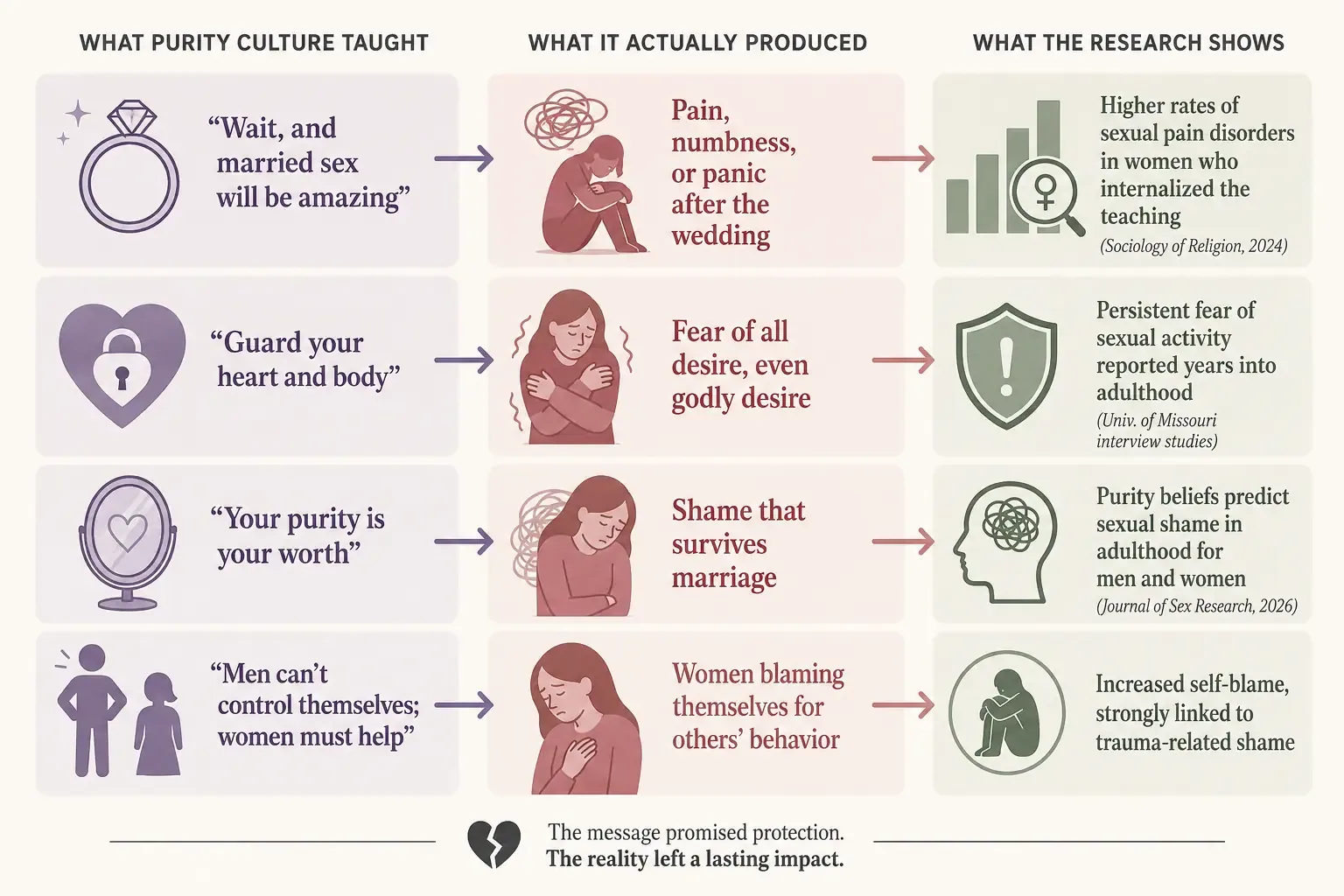
Read that table again slowly. Every "symptom" you thought was your personal failure is a predictable, studied outcome.
Three Real Stories (Because You Need to Know You're Not Crazy)
These stories are composites drawn from published memoirs, recovery groups, and research interviews, with details changed. If they feel like your diary, that's the point.
Sarah, 34: "I did everything right and sex still felt wrong"
Sarah signed a purity pledge at 13. Wore the ring. Never even kissed her husband before the wedding.
Then the honeymoon came, and her body locked up. Sex was painful for two years. She cried in the bathroom afterward and wondered if God was punishing her — but for what? She'd followed every rule.
A Christian pelvic floor therapist finally explained vaginismus to her: muscles that clench involuntarily because the brain has coded sex as threat. Fifteen years of "sex is dangerous" doesn't get canceled by one ceremony. Sarah's healing started the day she stopped calling it a spiritual failure and started calling it a trained reflex.
Marcus, 41: "Nobody talks about what it did to the guys"
Marcus grew up hearing that his lust could "defraud" his sisters in Christ, and that every attraction was basically assault-in-waiting. So he learned to feel disgusted by his own desire.
Twenty years later, married with kids, he avoided initiating intimacy because wanting his wife still triggered guilt. His wife assumed he wasn't attracted to her. It nearly ended the marriage.
The turnaround came in couples counseling, when a therapist asked him: "Who taught you that desire for your own wife is predatory?" He'd never once separated the teaching from the truth.
Renee, 29: "I left the church, then realized I didn't want to"
Renee deconstructed hard in her mid-20s. She was angry — at the youth pastor with the rose illustration, at her mom, at God.
But after two years away, she noticed something. She missed prayer. She missed communion. Her problem was never Jesus; it was a system that used Jesus as a threat.
Renee is back in church now — a different one — and in a 2026-era purity culture recovery group. She describes her faith as "smaller and realer." That's a common landing spot, and it's a good one.
The 5-Step Healing Framework (Faith Intact)
Here's the practical part. This framework comes from what actually works in trauma therapy, Christian sex therapy, and recovery groups — adapted for people who want to keep their faith.
Step 1: Name the teaching, separately from the Bible
Grab a journal. Make two columns.
Column one: "What I was taught." Write the actual messages. My body is a stumbling block. Sex is dirty. My worth left with my virginity.
Column two: "Where is that in Scripture?" Look it up honestly. You'll find something startling: most of the worst messages aren't there. Song of Solomon celebrates desire. Jesus consistently protected shamed women (John 8, Luke 7) instead of shaming them.
This step matters because shame hides inside "God said." When you discover God didn't say it, the shame loses its authority. If you want a deeper study on how God rebuilds what human systems distorted, start with what restoration means in the Bible — restoration, not abandonment, is the biblical pattern for broken things.
Step 2: Treat the shame as a wound, not a sin
You cannot repent your way out of a trauma response. Shame lives in the nervous system, so it needs body-level and heart-level care, not more self-condemnation.
Practical tools that work:
The shame interrupt. When the shame wave hits (during intimacy, in the shower, seeing your body in a mirror), say out loud: "This is old training, not truth." Naming it in real time slowly rewires the reflex. It feels silly. It works.
Somatic grounding. Shame triggers a freeze response. Counter it physically: press your feet into the floor, slow your breathing to a 4-count in and 6-count out, and let your shoulders drop. You're teaching your body that this moment is safe.
Pray honestly, not performatively. You don't need polished words. "God, this hurts and I don't understand it" is a psalm-level prayer. Many people healing from purity-based shame find guided words helpful when their own run out — these prayers for emotional healing were written for exactly this kind of inner wound.
Step 3: Rebuild your picture of God (this is the linchpin)
Purity culture handed you a God who is mostly disappointed. A hall monitor with a clipboard. Healing requires replacing that image, deliberately, with the God the Bible actually describes.
Try this 30-day exercise: every morning, read one verse about God's love and character — not rules, just character. Ask one question: "Would the God in this verse use a chewed-gum illustration on a 13-year-old?"
You already know the answer. Build a bank of these verses; a good starting collection is this set of Bible verses about God's love. The shame-based image of God and the love-based image cannot both survive in your head. Feed the right one.
And if you're in a season where God feels completely absent because church hurt got tangled up with Him — that's normal in this process, and there's a whole guide for when God feels silent.
Step 4: Forgive the messengers — on your timeline
Your youth pastor probably believed he was protecting you. Your mom probably taught what she was taught. This doesn't make the harm okay. It makes it human.
Forgiveness here is not saying "it didn't matter." It's refusing to let the people who hurt you keep renting space in your marriage bed. Three practical rules:
- Forgiveness is a process, not a moment. You may need to forgive the same person forty times. That's not failure; that's Matthew 18:22.
- Forgiveness doesn't require reconciliation. You can release someone and still limit contact.
- Include yourself. Many people's deepest anger is at their younger self — for signing the pledge, for believing it, or for "failing" it. That kid was doing their best with the information adults gave them.
For the scriptural foundation on grace toward others and yourself, spend time in these passages on forgiveness in the Bible.
Step 5: Write a new sexual ethic — don't just delete the old one
This is where secular advice often stops short for believers. Tearing down the old rules leaves a vacuum, and vacuums fill with anxiety.
Instead, build a positive ethic. Here's a healthy Christian framework to start from:
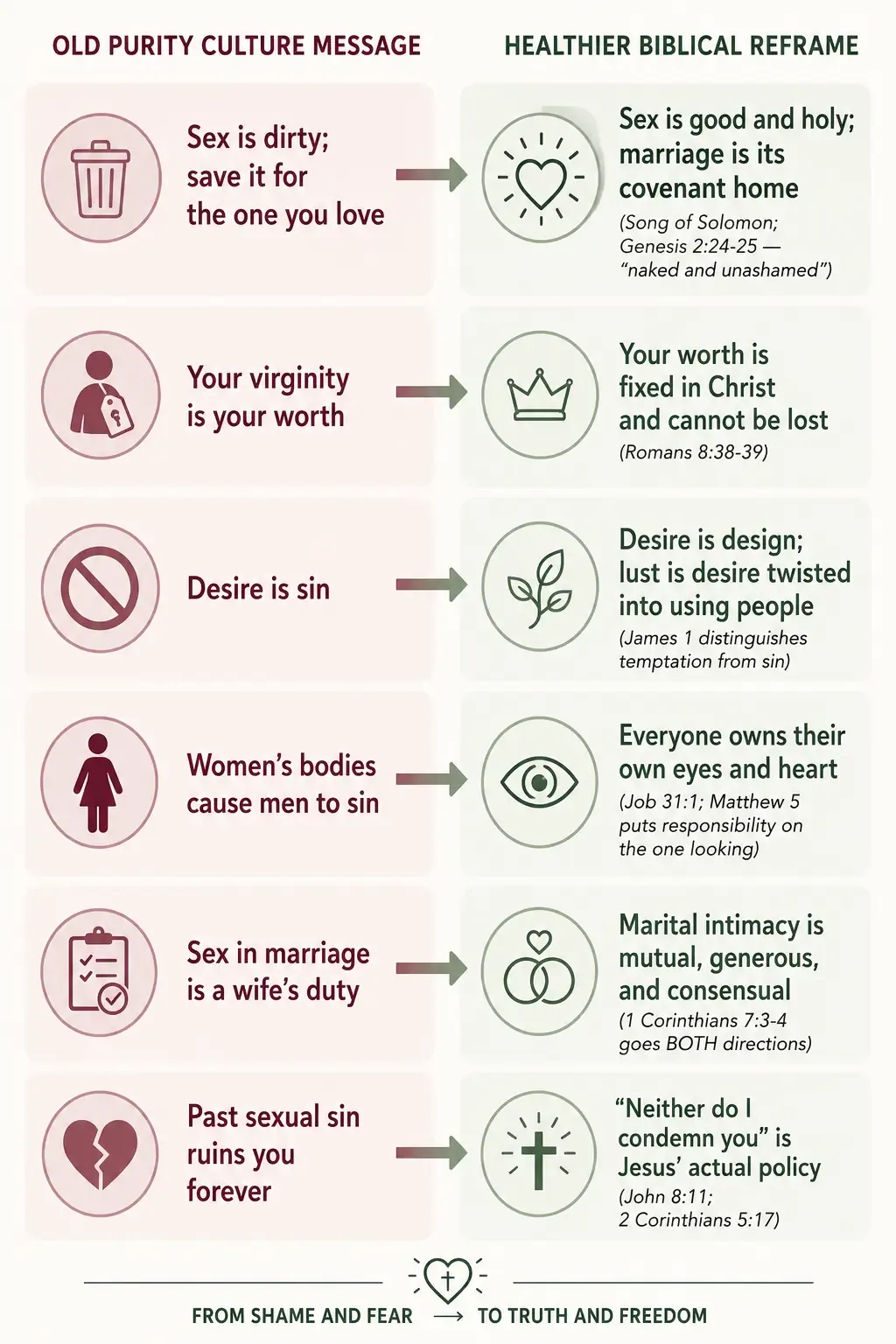
Print that table. Put it somewhere you'll see it. When you're rebuilding intimacy in marriage, anchor the work in what Scripture actually celebrates about covenant love — these biblical marriage verses are a solid anchor list.

Practical Tips for the Hardest Real-Life Situations
The framework above is the map. These are the roadside repairs for specific breakdowns.
If sex is physically painful
See a pelvic floor physical therapist — yes, that's a real specialty, and vaginismus and related pain conditions are highly treatable. This is medical, not spiritual. Studies link internalized purity beliefs with sexual pain disorders, so treat both tracks at once: body with a therapist, beliefs with the steps above.
Tell your spouse the truth: "My body learned fear, and I'm retraining it." A loving spouse becomes an ally the moment they understand it's not rejection.
If you feel guilty after sex with your spouse
Create a post-intimacy ritual that reclaims the moment. Stay close. Pray a one-line prayer of thanks together, or simply say to each other, "This is good, and God agrees." It sounds small. Neurologically, you're pairing intimacy with safety and blessing instead of shame — the exact reversal of your old training.
If you're single and were taught your desires are a ticking bomb
Your sexuality isn't an enemy to defeat until a wedding fixes it. It's part of you now, worth stewarding with kindness. Replace "fight your desire" with "understand your desire." Notice it without panic. A desire noticed calmly has far less power than a desire feared.
If your parents still defend the teaching
You will probably not win that argument, and healing doesn't require their agreement. One honest conversation is worth attempting: "I know you meant to protect me. Some of how it was taught hurt me, and I'm working through it." Then let their response belong to them.
If church itself is a trigger
Try a different congregation before concluding faith is the problem. Renee's story above is incredibly common: the issue was one system, not the whole Body. Look for churches where leaders talk about sex as good, where women teach, and where questions aren't treated as rebellion.
If you need more than an article
You probably do — articles start healing; they rarely finish it. Look for a licensed therapist who understands religious trauma AND respects your faith (search terms: "faith-informed sex therapist" or "religious trauma therapist"). Recovery support groups for purity culture are active and growing in 2026, both online and in person. Books worth your shelf: Recovering from Purity Culture by Dr. Camden Morgante (written by a Christian psychologist, for believers) and Pure by Linda Kay Klein.

What Healing Actually Looks Like (Set Realistic Expectations)
Healing is not a light switch. It's a dimmer that rises over months and years. Here are honest markers of progress:
Month 1-3: You can name the messages and separate them from Scripture. Shame still shows up, but now it has a name tag.
Month 3-9: The shame interrupt starts working faster. Intimacy improves in patches. You have setbacks and they don't destroy you.
Month 9-24: New default settings emerge. Desire stops feeling like danger. Prayer feels warmer because the God you're praying to changed faces.
Ongoing: Occasional flare-ups during stress. That's not relapse; that's scar tissue. Scars are healed wounds.
The goal was never to feel nothing about your past. The goal is a faith and a marriage where "naked and unashamed" is finally, actually possible.
FAQ: The Questions People Are Really Asking
Can I heal from purity culture and still be a Christian?
Yes — and this is the whole point most content misses. Purity culture was a 1990s American subculture, not historic Christianity. Rejecting the chewed-gum theology is not rejecting Jesus. Many people find their faith gets stronger through this work, because it's finally built on grace instead of fear.
Was everything purity culture taught wrong?
No, and pretending so isn't honest. Valuing commitment, covenant, and sexual integrity are ancient Christian goods. What was wrong was the method: shame, fear, worth-based-on-virginity, female responsibility for male behavior, and false promises about married sex. Keep the ethic if it's yours; throw out the shame delivery system.
Why do I still feel dirty during sex even though I'm married?
Because shame is stored in the nervous system, not the calendar. Your body spent years coding sexual feelings as threat and disgust. A wedding changes your theology's category for sex; it doesn't change your body's training. That takes deliberate rewiring — the steps and tips above — and often a therapist's help. It is very treatable.
Is what I'm experiencing really "trauma"? That word feels too big.
Researchers increasingly say yes. The 2026 Penn State University Press collection literally subtitles it "Stories of Religious Trauma," and peer-reviewed studies link purity teaching with measurable shame, fear, and sexual pain outcomes. Trauma doesn't require a single terrible event; chronic shame messaging during childhood qualifies. Using the accurate word helps you use the accurate tools.
Do men need to heal from purity culture too?
Absolutely. The 2026 Journal of Sex Research study found purity beliefs predicted sexual shame in men as well as women — and childhood exposure was actually a significant predictor for men specifically. Men were taught their desire was monstrous. That produces guilt-ridden husbands, avoidance, and marriages where wives feel unwanted. Men's healing is under-discussed and overdue.
How long does healing take?
Most people notice real change within 3-6 months of deliberate work and see major shifts by the two-year mark. Factors that speed it up: a supportive spouse, a good therapist, a healthy church, and consistency with the daily practices. Factors that slow it down: staying in a shaming environment and trying to white-knuckle it alone.
Should I confront the church or people who taught me this?
Optional, not required. If a conversation would bring you peace, have it once, calmly, without needing them to agree. Your healing cannot depend on their apology, because you may never get one. Forgiveness — for your freedom, not their comfort — is the path that doesn't require their cooperation.
The bottom line: Purity culture told you that your body was a problem and God was disappointed. Both were lies. The same faith that got weaponized against you contains the exact medicine for your healing — a God who restores, a Savior who refused to shame the shamed, and a design for intimacy that begins "naked and unashamed."
You don't have to choose between your healing and your faith. Take them both.
Key Statistics
Women more likely to experience sexual shame
92% more likely
Girls are significantly more likely than boys to experience sexual shame, particularly in highly religious environments.
Source: Linda Kay Klein, Pure (citing research)
Sexual shame prediction
Purity beliefs significantly predict adult sexual shame
Adult acceptance of purity culture beliefs predicted higher sexual shame among both men and women.
Source: Journal of Sex Research (2026), University of Texas at Austin
Credible Sources
Journal of Sex Research · January 1, 2026
Provides peer-reviewed evidence that internalized purity culture beliefs are associated with increased sexual shame in both men and women.
Journal of Sexual Medicine · January 1, 2026
Quantifies the relationship between purity culture exposure and women's sexual shame, including the reported variance explained.

About the Author
Editorial Team
Editorial Team
Daily Faith Path articles are prepared by the editorial team to help readers find scripture-centered guidance for healing, faith, prayer, and spiritual encouragement.
Expertise: Healing scriptures, Bible study resources, prayer guidance, devotional writing, Christian encouragement
Experience: The team researches scripture references, reviews surrounding biblical context, compares translation wording where useful, and updates articles to improve clarity, usefulness, and trust for readers.
Credentials: Editorial review, devotional writing, scripture study, content updating
This article is published by the Daily Faith Path editorial team to help readers use scripture carefully, prayerfully, and in ways that are practical for real-life seasons of illness, grief, waiting, and spiritual reflection.
Continue Reading
Related articles

October 7, 2026
12 Bible Verses About Hiding Money From Your Spouse
Explore 12 Bible verses about secret spending, hidden debt, financial honesty, confession, forgiveness, boundaries, and rebuilding trust in marriage.

October 6, 2026
15 Bible Verses for Couples Who Keep Fighting About Money
Money fights are rarely just about dollars. These 15 Bible verses help couples address spending, saving, debt, secrecy, unequal income, giving, and financial control with practical next steps and conversation questions.

October 5, 2026
Should You Tithe While in Debt? 11 Bible Passages to Study First
Should you tithe while in debt? Explore 11 Bible passages on tithing, debt, generosity, family responsibility, and giving according to your means—plus a practical plan for deciding what to do.