How to Use the Treasury of Scripture Knowledge: 5-Step Guide
Learn how to use the Treasury of Scripture Knowledge without getting overwhelmed by hundreds of cross-references. This practical guide shows you how to prioritize the strongest connections, study verses in context, and know when to stop.
Open the Treasury of Scripture Knowledge for one Bible verse and you may suddenly face dozens of references. The trick is not reading them all—it is knowing which three or four deserve your attention first.
That is what this guide will teach you.
The Treasury of Scripture Knowledge, usually called the TSK, is one of the largest collections of Bible cross-references ever published. It is commonly advertised as containing more than 500,000 Scripture references, although exact totals vary depending on how references and grouped passages are counted.
That size is both its strength and its biggest problem.
A beginner can open one verse, click five references, find another 30 references, and suddenly forget the question that started the study.
So instead of treating the TSK like a list you need to finish, we are going to treat it like a map.
You need a destination before you start following roads.
What Is the Treasury of Scripture Knowledge?
The Treasury of Scripture Knowledge is a Bible cross-reference system.
You look up a verse, and the TSK points you toward other Bible passages connected with its words, ideas, events, people, prophecies, or teachings.
For example, a verse about God being a shepherd might lead to other passages about shepherds, God's care, Christ as the Good Shepherd, protection, provision, or guidance.
The official TSK website describes the resource as containing more than 500,000 references collected from the work of Bible scholars over many generations. Its references are normally grouped around particular words or phrases in the verse.
That last point matters.
TSK references are not simply a random list of verses that sound similar.
They are often attached to a specific phrase.
So before clicking anything, ask:
“Which words in my verse are these references supposed to explain?”
That question alone removes a lot of confusion.
If you are completely new to Bible study, it can also help to establish a simple reading routine before adding a large cross-reference tool. Daily Faith Path's beginner Bible study method starts with a short passage and a small number of questions rather than a mountain of study material.
The Biggest TSK Mistake: Thinking More References Mean Better Study
Imagine you are studying Psalm 23:1:
“The LORD is my shepherd; I shall not want.”
You open the TSK.
You see references connected with “LORD,” others connected with “shepherd,” and still more connected with provision.
Your first instinct may be:
“I should read all of these.”
Do not.
That is how a useful 20-minute Bible study becomes a 90-minute browsing session.
The goal is not to visit the most verses.
The goal is to understand the passage you started with.
A cross-reference earns your time only when it helps answer your current question.
That gives us the most useful rule in this entire guide:
Never follow a TSK reference until you can explain why you are following it.
You might be asking:
“What does shepherd mean here?”
“How does the Bible describe God's provision?”
“Where else does David use this picture?”
“How does Jesus use shepherd language?”
Each question creates a different path through the TSK.
Without a question, every reference looks equally important.
With a question, most references become easy to skip.
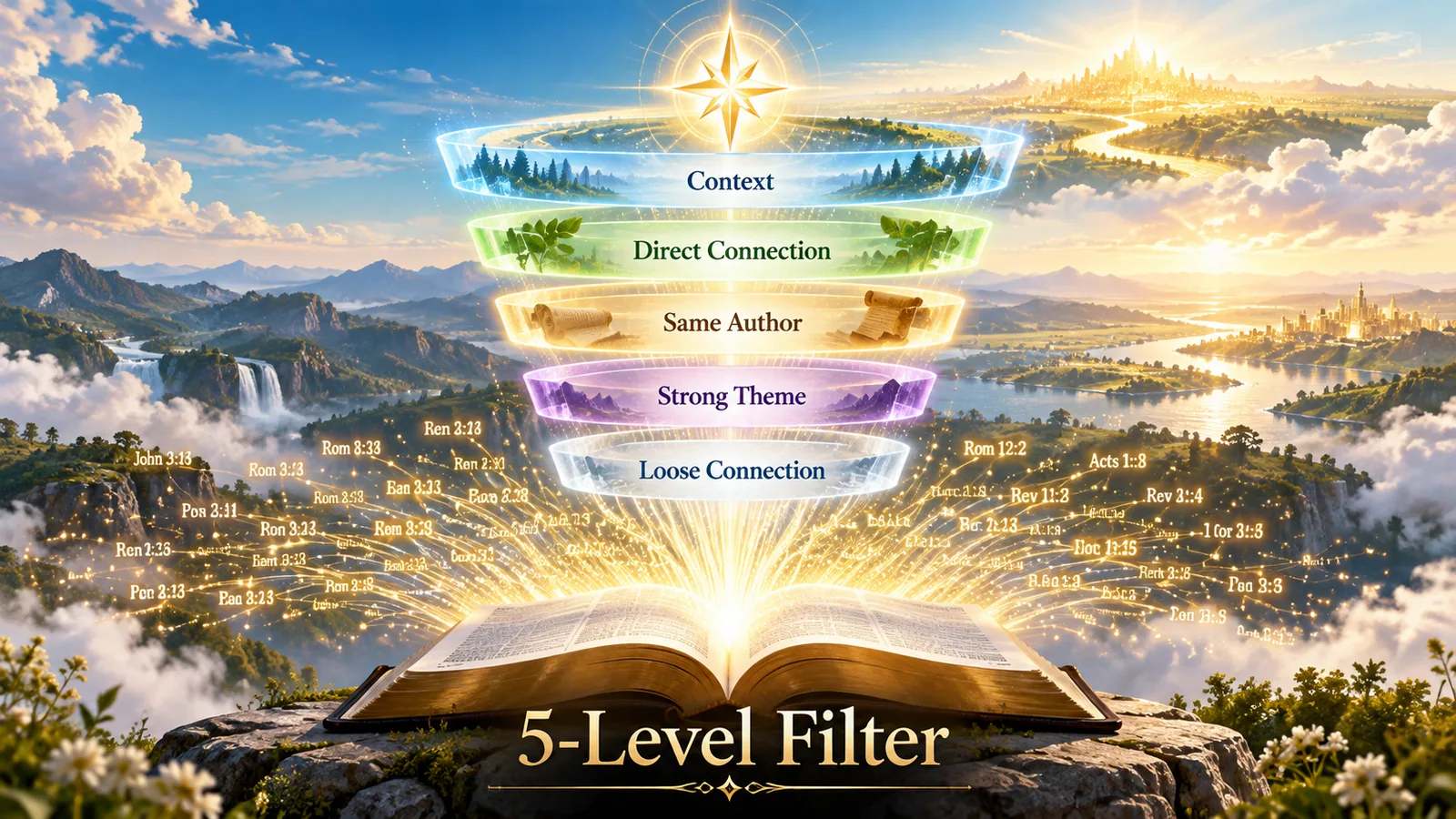
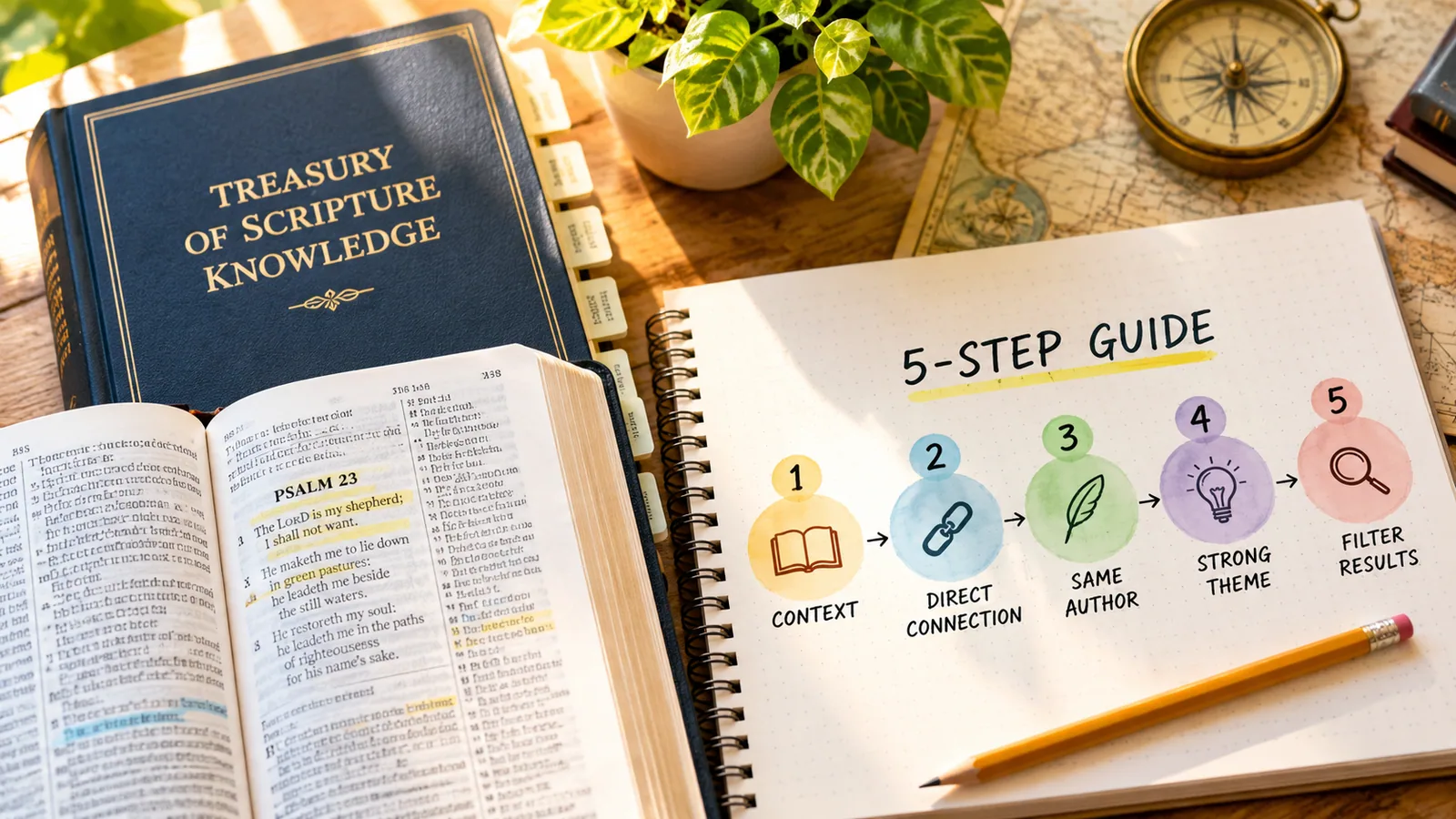
The 5-Level TSK Filter
Here is the system I recommend for deciding which Treasury of Scripture Knowledge references to read.
Use the levels in order.
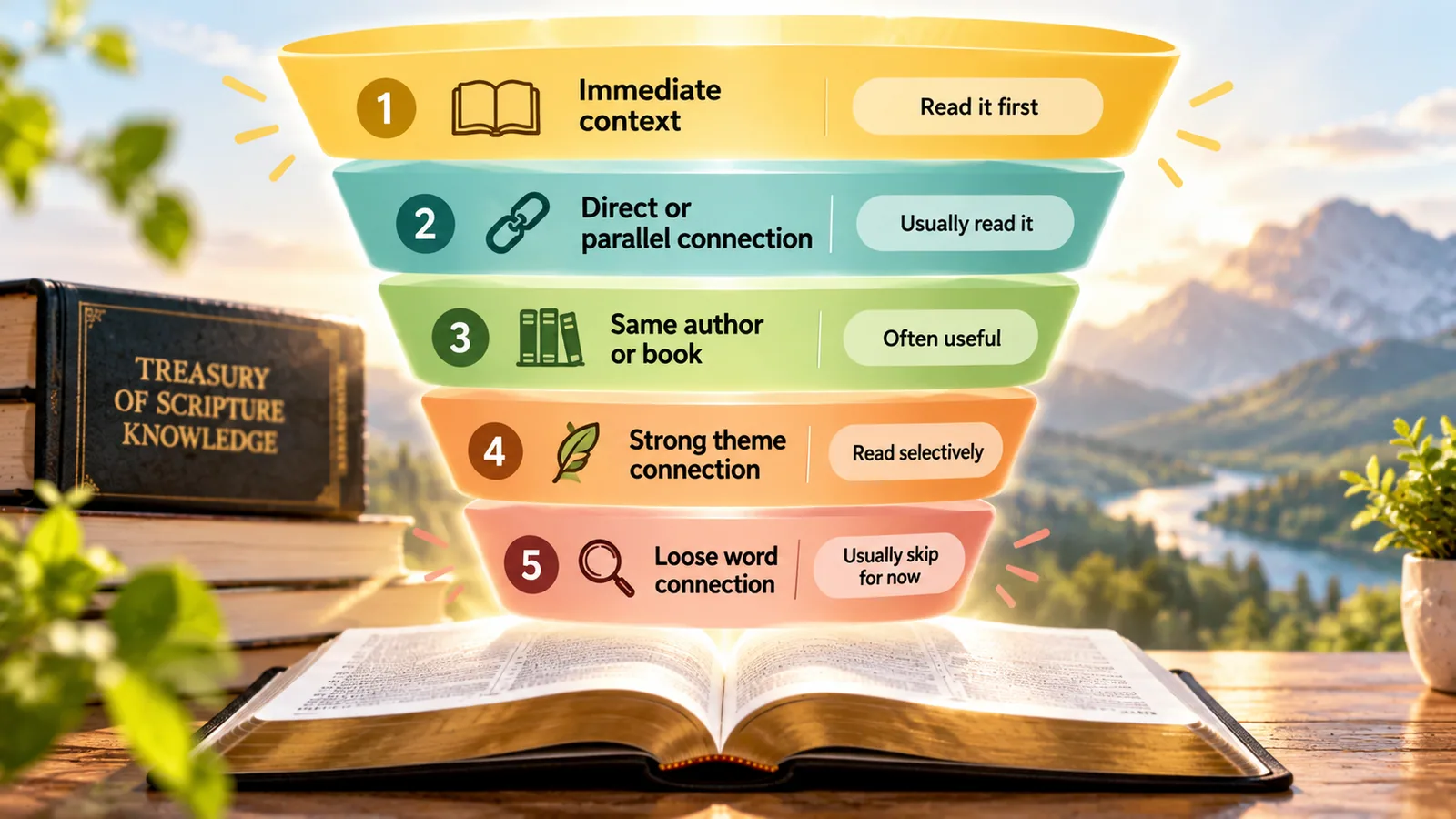
Think of this as a funnel.
Start narrow.
Only go wider when the narrow references do not answer your question.
Level 1: Read the Immediate Context First
Before using the TSK, read the verses around your passage.
Better yet, read the paragraph or section.
A cross-reference cannot rescue a verse that has already been pulled out of context.
Suppose you are studying Philippians 4:13:
“I can do all things through Christ which strengtheneth me.”
Before searching every verse about strength, read Philippians 4:10-14.
Paul is talking about learning contentment in very different circumstances.
That immediately gives you a better question for the TSK.
Instead of asking:
“What can Christians accomplish?”
you can investigate:
“How does Scripture connect Christ's strength with endurance and contentment?”
That is a much sharper study.
This is also why a good study Bible guide should put the biblical text before notes and cross-references. Daily Faith Path's guide uses the order passage first, tools second, application third.
Level 2: Look for Direct Connections and Parallel Passages
These are usually your strongest TSK references.
A direct connection may be:
-
another Gospel describing the same event;
-
an Old Testament passage quoted by a New Testament writer;
-
the same law repeated elsewhere;
-
another account of the same king or battle;
-
a prophecy and a passage showing its fulfillment.
If Matthew records an event and the TSK sends you to Mark and Luke describing the same event, those references usually deserve attention before a broad thematic connection from Proverbs.
Why?
Because parallel passages can give you additional details about the same event.
Consider the Ten Commandments.
They appear in Exodus 20 and again in Deuteronomy 5.
Reading the passages together allows you to compare wording, setting, audience, and emphasis instead of assuming that one passage exists in isolation.
For a worked example of that process, see Daily Faith Path's guide to comparing parallel Bible passages in Exodus 20 and Deuteronomy 5.
Practical rule: If a reference describes the same event, quotes your verse, or is directly quoted by your verse, open it early.
Level 3: Check References From the Same Author or Book
Now look closer to home.
If you are studying something Paul says in Romans, another clear statement from Paul can help you understand his normal vocabulary and thought.
If you are studying one Psalm of David, another Davidic Psalm using similar language may be especially interesting.
This does not mean the same author automatically settles every question.
Context still matters.
But it gives you a useful middle layer between direct parallels and broad Bible-wide themes.
Level 4: Follow Strong Theme Connections
Now you can widen the circle.
Suppose you are studying Psalm 23:1 and the phrase:
“The LORD is my shepherd.”
You may find passages involving:
-
God's care for His people;
-
shepherd imagery;
-
lost sheep;
-
leaders described as shepherds;
-
Jesus as the Good Shepherd.
Those passages do not all describe the same historical moment.
But they can show how the shepherd theme develops across Scripture.
This is where the TSK becomes especially powerful.
Blue Letter Bible describes its TSK implementation as identifying biblical and theological topics connected with a passage rather than merely matching identical English words. In 2024, it also updated more than 66,000 TSK entries so that users could more clearly see the full phrase connected with a group of references.
The key word here is selectively.
You still do not need every thematic reference.
Choose the ones closest to your question.
Level 5: Skip Loose Connections Unless You Need Them
This is the level that saves your study session.
Sometimes two verses are connected because of a word, image, secondary idea, or distant theme.
The connection may be legitimate.
It may also be completely unnecessary for today's study.
Suppose your goal is understanding shepherd imagery.
A passage that mentions sheep during a historical inventory may technically contain related vocabulary while contributing very little to your question.
Skip it.
You can always return later.
Skipping a reference is not failed Bible study. It is focused Bible study.
Use the “3 Reference Rule” Before Going Deeper
Here is an easy rule for beginners:
Start with three cross-references.
Not thirty.
Choose:
-
one direct or parallel reference;
-
one same-author or closely related reference;
-
one strong thematic reference.
Read those passages in context.
Then stop and ask:
“Do I understand my original verse better?”
If yes, you may already be finished.
If not, open another two or three.
This turns TSK study into controlled rounds instead of endless clicking.
A Realistic Example: Studying Psalm 23:1
Suppose Sarah has 25 minutes before work.
She wants to understand:
“The LORD is my shepherd.”
She could spend all 25 minutes opening references.
Instead, she uses the filter.
First, she reads Psalm 23 from beginning to end.
Now she knows the shepherd picture includes provision, rest, guidance, danger, comfort, and God's presence.
Next, she chooses three useful connections.
She might compare the shepherd theme with Ezekiel 34, John 10, and another shepherd passage closely related to God's care.
She reads those passages carefully.
Now she writes one sentence:
“Psalm 23 does not picture God as distant; the shepherd image describes active care, direction, protection, and provision.”
The sentence is not valuable because Sarah opened the most references.
It is valuable because the references helped her see the original Psalm more clearly.
If you want to practice this process with the full chapter, Daily Faith Path has a dedicated Psalm 23 KJV study page.
The Most Important Question to Ask Before Clicking a Cross-Reference
Ask:
“What kind of connection am I looking at?”
Cross-references can connect passages for very different reasons.
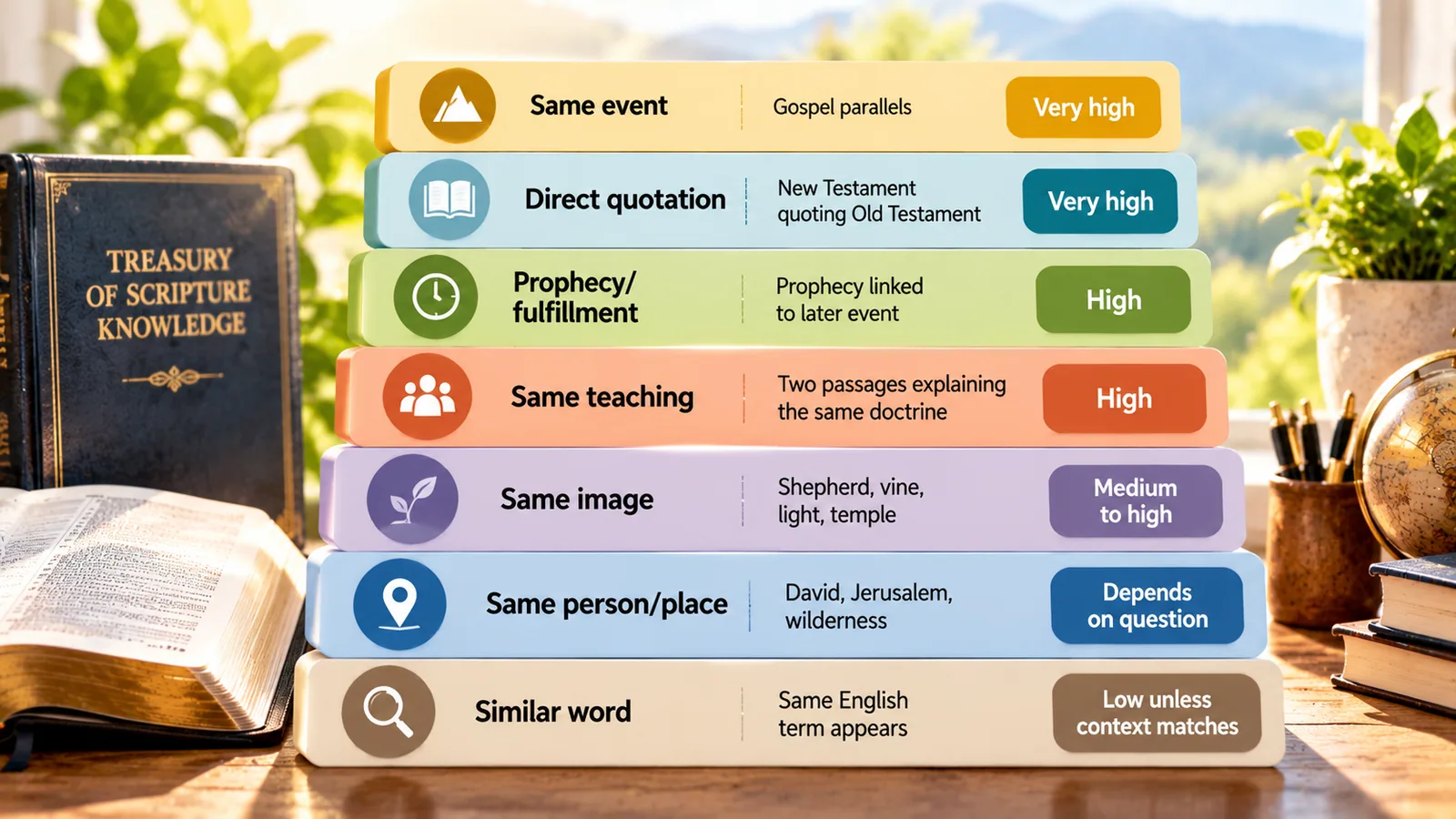
This distinction prevents a common mistake.
Two passages containing the same word do not automatically teach the same thing.
“Light” can describe physical light, moral goodness, revelation, glory, guidance, or another idea depending on context.
The word may be identical.
The meaning may not be.
Do Not Confuse Cross-References With Proof
TSK gives you connections.
It does not automatically tell you what those connections prove.
That distinction matters.
Suppose you find six passages that appear to support your first interpretation.
Before declaring the question solved, read each one in its own paragraph or chapter.
Ask:
Who is speaking?
Who is being addressed?
What happened before this verse?
What problem is the author discussing?
Is this history, poetry, prophecy, wisdom literature, a letter, or another genre?
A list of references can look impressive while still being interpreted poorly.
Good cross-reference study moves in both directions:
Original verse → related verse → context of related verse → back to original verse.
Do not stop in the middle.
What to Do When the Cross-Reference Uses Different Words
Beginners often experience this:
You read a verse in your Bible.
You open the TSK.
Then the linked passage seems to use completely different wording.
That does not automatically mean the reference is wrong.
TSK developed around the King James Version, while modern readers may be using another translation. A translated word or phrase can therefore appear differently even when the passages remain closely connected.
You may also be looking at a conceptual connection rather than an identical-word connection.
Try this:
Read the entire linked verse.
Read the paragraph.
Identify the shared idea rather than hunting only for the exact English word.
If the difference still matters, compare translations.
Daily Faith Path's guide to Bible translations for study can help when different English wording makes a cross-reference harder to recognize.
The 20-Minute TSK Study Method
You do not need an entire afternoon.
Try this.
Minutes 0-5: Read
Read your passage at least twice.
Read enough surrounding verses to understand the basic situation.
Write down one question.
Not five.
One.
Example:
“Why does Jesus call Himself the Good Shepherd?”
Minutes 5-10: Filter
Open the TSK.
Look at the phrases attached to the references.
Ignore references unrelated to your question.
Choose your first three using the filter:
direct connection → same author/context → strong theme.
Minutes 10-17: Compare
Read each selected passage.
Do not read only the single verse.
Read enough context to understand why it matters.
Write one short note beside each reference.
For example:
“John 10:11 — shepherd gives his life.”
“Psalm 23 — shepherd provides and guides.”
“Ezekiel 34 — God condemns bad shepherds and promises care.”
You now have three useful observations instead of 30 unexplored tabs.
Minutes 17-20: Return
Close the references.
Read your original passage again.
Ask:
“What can I see now that I did not see 20 minutes ago?”
Write one or two sentences.
Then stop.
That final step is important because the purpose of the TSK is to bring you back to the passage with greater understanding, not keep you permanently moving away from it.
How to Know When to Stop Using TSK
Many guides tell you how to begin cross-referencing.
Very few tell you when to quit.
Use the 2-of-3 Stop Rule.
Stop when at least two of these are true:
-
Your original question has a reasonable answer.
-
New references are repeating ideas you have already found.
-
Additional references are moving farther away from the original passage.
If two happen, close the TSK.
You can return another day.
This protects you from what I call reference drift.
Reference drift happens like this:
Psalm 23 leads to John 10.
John 10 leads to Ezekiel 34.
Ezekiel 34 leads to Jeremiah.
Jeremiah leads to kings.
Kings leads to covenant passages.
Forty-five minutes later, you are studying ancient kings and cannot remember why Psalm 23 was open.
Nothing you read was necessarily bad.
You simply lost the original question.
Problem: “Every Reference Looks Important”
Use a ranking question:
“If I could read only one of these passages, which would most directly explain the phrase I am studying?”
Read that one.
Then choose the second.
This forces priority.
Problem: “I Keep Opening References Inside References”
Do not automatically follow second-generation references.
Finish your first layer first.
A simple note helps:
Parking lot: Romans 8:___ — investigate later.
You are not ignoring the connection.
You are scheduling it for another study.
Problem: “I Have 15 Tabs Open and Cannot Remember Anything”
Close them.
Keep only:
-
your original passage;
-
your TSK page;
-
the reference you are currently reading.
If something is useful, record the Bible reference in your notes.
Your browser should not become your memory system.
Problem: “The Cross-Reference Seems Unrelated”
Three possibilities exist.
First, you may not have read enough surrounding context.
Second, the connection may belong to a particular phrase rather than the whole verse.
Third, the connection may simply be too distant for your current question.
Check the first two.
If it still does not help, skip it.
You do not need to force meaning into every reference.
Problem: “I Found Two Passages That Seem to Disagree”
Slow down.
Do not solve the tension by immediately collecting ten more verses.
First compare:
speaker;
audience;
historical setting;
literary genre;
question being addressed;
meaning of important terms.
Apparent contradictions often require closer context rather than a larger pile of references.
If the issue remains difficult, that is the point where a good commentary, study Bible, Bible dictionary, or trusted teacher can become useful.
TSK is powerful.
It is not the only Bible study tool you will ever need.

TSK Should Come After Observation, Not Before It
There is a simple order that prevents many bad study habits:
Read → Observe → Ask → Cross-reference → Interpret → Apply.
Do not reverse it.
If you immediately open TSK before noticing anything yourself, other passages can begin controlling what you see in the verse.
Spend a few minutes with the text first.
What repeats?
What contrasts?
What changes?
What does the author emphasize?
What question do you actually have?
Then bring in the TSK.
The tool becomes much more useful because you know what you are looking for.
A Better Way to Take Notes
Do not copy every verse.
Use a four-column note.
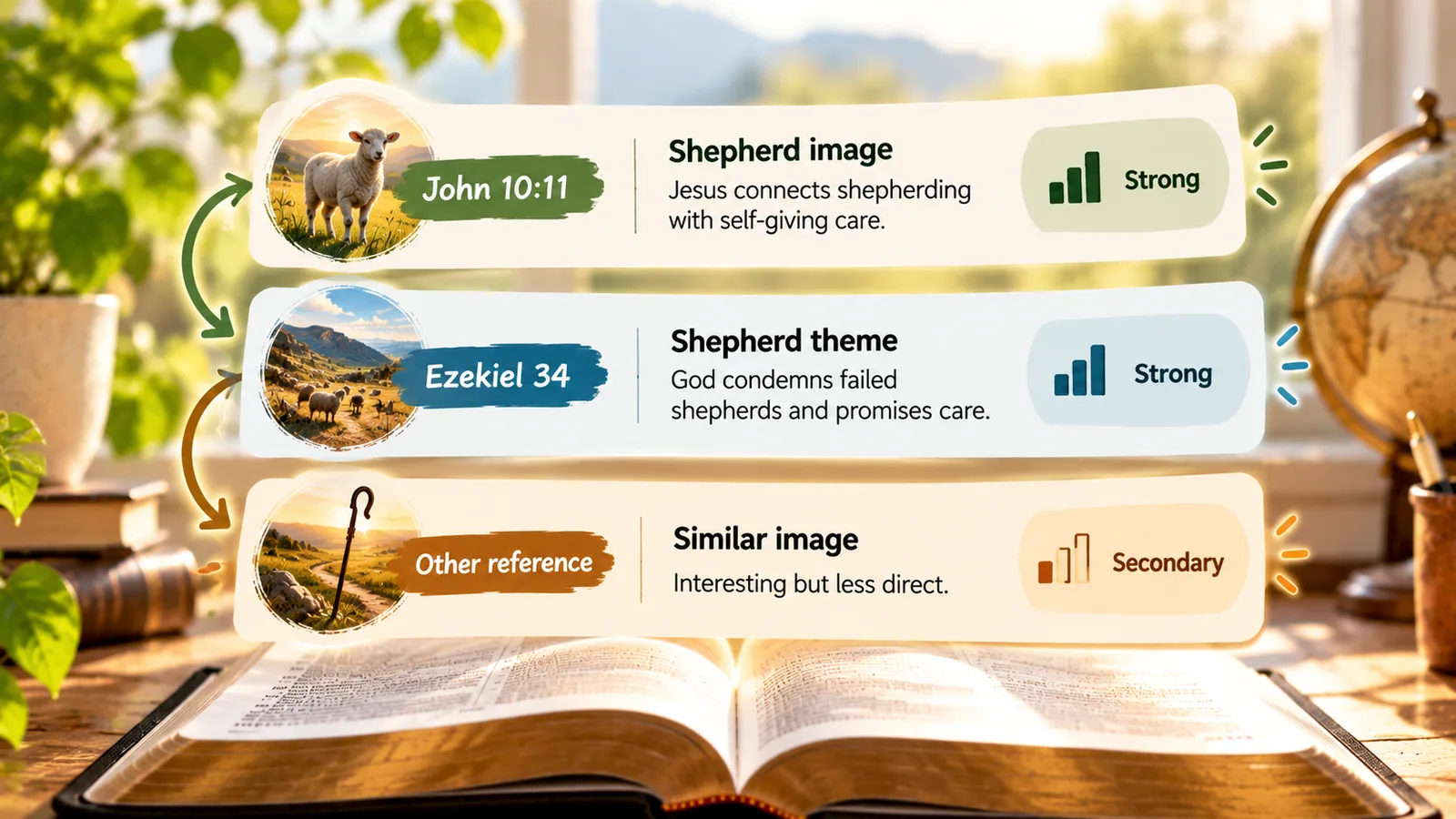
The “Confidence” column is useful.
It forces you to admit that not every connection is equally strong.
That is a good habit for any serious Bible study.
Use a Different TSK Strategy for Different Goals
Not every study needs the same depth.
For Devotional Reading
Choose one or two references.
Your main goal is reflection and application.
Do not turn every morning reading into research.
For Teaching a Bible Study
Use several strong references.
Prioritize direct parallels, quotations, clear context, and passages that genuinely clarify your main text.
Check every reference before teaching it.
For Sermon Preparation
You may study many more references, but the same filtering principles still apply.
More preparation time does not remove the need for prioritization.
For Answering a Doctrinal Question
Do not build a doctrine from one chain of related words.
Look for clear passages that directly address the issue.
Pay attention to context and passages that may challenge your initial interpretation.
For Studying a Bible Theme
TSK is especially useful here.
You can trace themes such as covenant, sacrifice, shepherd, kingdom, temple, wisdom, holiness, or resurrection across many books.
In thematic study, going deeper makes sense because tracing the theme is your actual goal.
Your TSK Cheat Sheet
Save this.
Before TSK:
Read the passage.
Read the context.
Write one question.
Inside TSK:
1. Direct parallel or quotation
2. Same author/book
3. Strong theme
4. Loose connections only if needed
Start with three references.
Read every selected verse in context.
Return to the original passage.
Stop when the references start repeating themselves or drifting away from your question.
That is how you use the Treasury of Scripture Knowledge without getting lost.
Frequently Asked Questions
How do you use the Treasury of Scripture Knowledge?
Look up the Bible verse you are studying and find the word or phrase connected with your question. Start with the most direct cross-references, read them in context, and return to your original passage before opening more.
The official online TSK follows a similar basic workflow: select a verse, identify the relevant phrase and its reference list, then open the linked Bible passages.
Should I read every TSK cross-reference?
No.
The TSK contains an enormous number of references. Reading all of them is normally unnecessary.
Start with two or three strong references and add more only when they help answer your study question.
What cross-references should I read first?
Use this order:
Immediate context → parallel passages or direct quotations → same author/book → strong thematic references → loose connections.
The more direct the relationship, the earlier you should normally investigate it.
Is the Treasury of Scripture Knowledge a commentary?
Not in the normal sense.
Its main function is cross-referencing Scripture with other Scripture rather than giving you long explanations written by a commentator.
Some editions contain brief notes or related study material, but cross-references are the heart of the resource.
Is the Treasury of Scripture Knowledge only for the KJV?
The traditional TSK is closely tied to the wording and organization of the King James Version, but the references can still be useful when studying other translations.
You may simply need to compare wording when a phrase looks different in your translation.
How many cross-references should a beginner follow?
Three is an excellent starting point.
Choose one very direct connection, one close contextual or author connection, and one strong thematic connection.
If those answer your question, stop.
What if a TSK reference does not make sense?
Check which phrase the reference belongs to and read the linked passage in context.
If the connection still seems weak or irrelevant to your question, skip it.
Not every valid connection needs to become part of your current study.
Can TSK replace a study Bible or commentary?
No single tool does every job well.
TSK is excellent for finding connections between biblical passages. A study Bible can add historical background, maps, introductions, textual notes, and explanations that a cross-reference list cannot provide.
Use each tool for what it does best.
Is TSK good for beginners?
Yes, if you limit the number of references you follow.
Without a filtering system, it can feel overwhelming. With a clear question and a three-reference starting rule, it becomes much easier to use.
How long should a TSK study take?
A useful session can take 15 to 30 minutes.
You can always spend longer on a difficult passage, but length is not the goal.
Understanding is.
Final Rule: Let the Cross-References Serve the Passage
The Treasury of Scripture Knowledge becomes overwhelming only when every reference receives equal attention.
They are not equal.
Some directly explain your passage.
Some provide helpful background.
Some reveal a larger biblical theme.
Others are interesting connections you simply do not need today.
Start with the passage.
Ask one question.
Follow the strongest three references.
Read them in context.
Then return home.
The best TSK study is not the one that takes you through the most verses. It is the one that sends you back to your original passage seeing it more clearly.
Key Statistics
Advertised Scripture references
500,000+
The official TSK site describes the Treasury as containing more than 500,000 Scripture references. This is the conventional published figure, though exact counts can vary depending on how grouped references are counted.
Source: TSK-Online
TSK entries updated by Blue Letter Bible
66,000+
In November 2024, Blue Letter Bible said it had updated more than 66,000 TSK entries so the full phrase associated with each group of cross-references was displayed more accurately.
Source: Blue Letter Bible
Credible Sources
TSK-Online / The Treasury of Scripture Knowledge · Not stated
Primary source for the official description of the resource, the 500,000+ references claim, its purpose, and its historical compilation from multiple earlier cross-reference works.
Blue Letter Bible · November 19, 2024
Best source for the article's claim about Blue Letter Bible updating 66,000+ TSK entries. It also explains that TSK cross-references can represent biblical and theological topics rather than simple identical-word matches.

About the Author
Editorial Team
Editorial Team
Daily Faith Path articles are prepared by the editorial team to help readers find scripture-centered guidance for healing, faith, prayer, and spiritual encouragement.
Expertise: Healing scriptures, Bible study resources, prayer guidance, devotional writing, Christian encouragement
Experience: The team researches scripture references, reviews surrounding biblical context, compares translation wording where useful, and updates articles to improve clarity, usefulness, and trust for readers.
Credentials: Editorial review, devotional writing, scripture study, content updating
This article is published by the Daily Faith Path editorial team to help readers use scripture carefully, prayerfully, and in ways that are practical for real-life seasons of illness, grief, waiting, and spiritual reflection.
Continue Reading
Related articles

October 7, 2026
12 Bible Verses About Hiding Money From Your Spouse
Explore 12 Bible verses about secret spending, hidden debt, financial honesty, confession, forgiveness, boundaries, and rebuilding trust in marriage.

October 6, 2026
15 Bible Verses for Couples Who Keep Fighting About Money
Money fights are rarely just about dollars. These 15 Bible verses help couples address spending, saving, debt, secrecy, unequal income, giving, and financial control with practical next steps and conversation questions.
October 5, 2026
Should You Tithe While in Debt? 11 Bible Passages to Study First
Should you tithe while in debt? Explore 11 Bible passages on tithing, debt, generosity, family responsibility, and giving according to your means—plus a practical plan for deciding what to do.