I'm a New Bible Reader and No One Told Me These 5 Things
Starting to read the Bible can feel overwhelming, but it doesn't have to. Discover five practical truths every beginner should know—from choosing the right translation to building a simple daily habit that actually lasts.
You opened a Bible for the first time in years, got lost by page three, and quietly closed it feeling dumb. You're not dumb. Nobody told you the five things that actually make this easier, and that's the whole problem.
Why So Many Adults Are Starting From Zero Right Now
Here's something wild: recent research from Barna Group and the American Bible Society shows Bible engagement among younger adults actually went up in 2025, reversing years of decline. Millions of people are picking up a Bible for the very first time as actual adults, not as kids in Sunday school.
That matters because almost everything written about "how to read the Bible" assumes you already know the basics. It assumes you know what a "epistle" is, why there are two Testaments, or why Matthew and Genesis don't read the same way. If you're starting from zero, that stuff is confusing, not helpful.
So this guide skips the assumptions. No shame, no jargon dump, no pretending you should already know this.
Thing #1: You're Allowed to Skip Around (Nobody Reads It Front to Back)
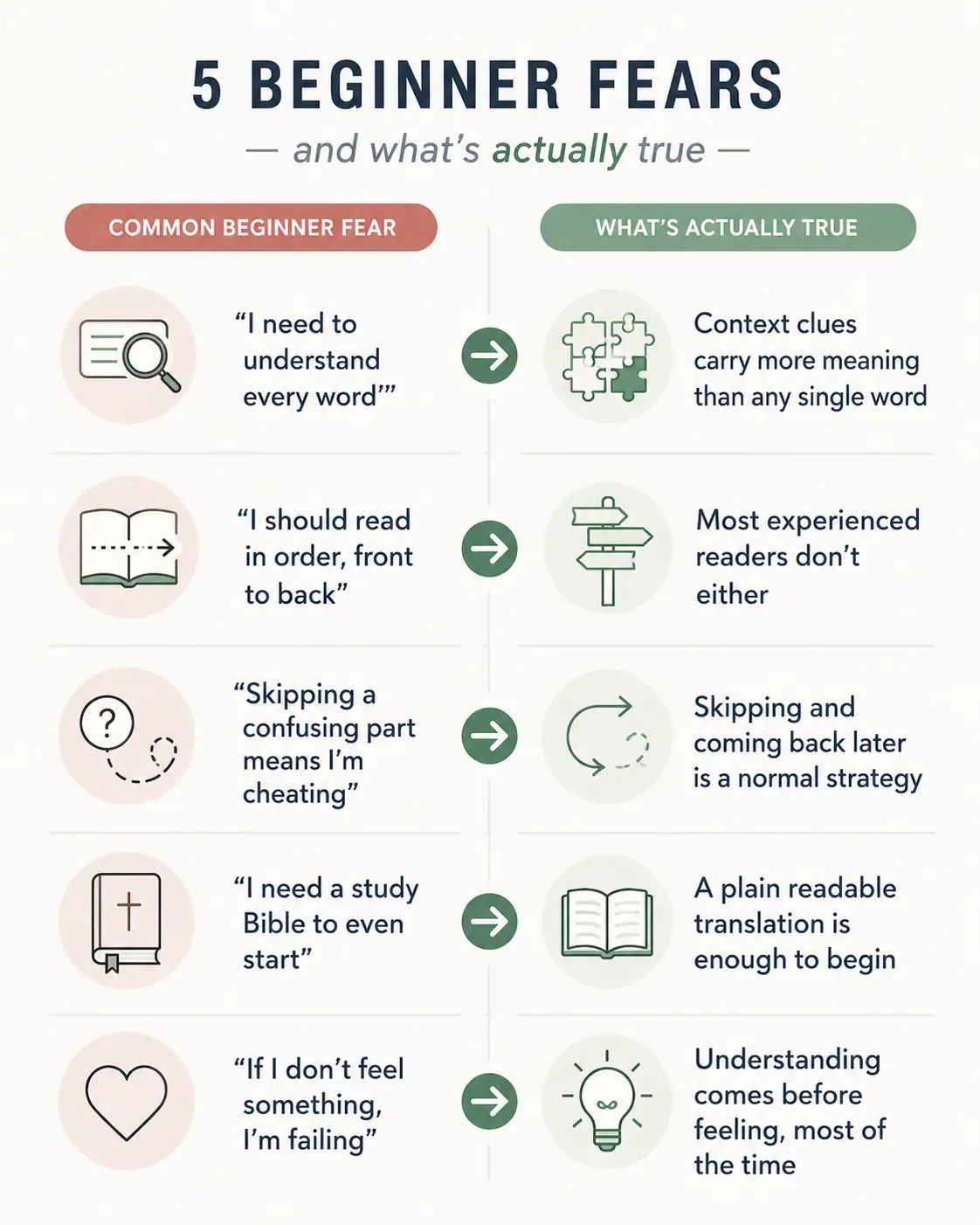
Here's a secret that took me two failed attempts to learn: almost nobody who loves the Bible read it start to finish the first time. Genesis to Revelation, in order, is actually one of the hardest ways to begin.
Why? Because right after the punchy stories in Genesis and Exodus, you hit Leviticus. It's a book of ancient priestly law, full of instructions about sacrifices and skin conditions. It stops most beginners cold, and it's not even close to representative of the whole book.
A real example: A woman named Priya told her small group she'd tried three times to read the Bible cover to cover and quit at Leviticus every single time. She thought that meant something was wrong with her. It didn't. It meant she was using a plan built for people who already had 20 years of church background.
What actually works instead: Start with one Gospel (Mark is the shortest, and gets moving fast), then a few Psalms, then maybe Genesis. You can hop around. The Bible isn't one book telling one story in order — it's 66 books written over roughly 1,500 years, and treating it like a novel you must finish in sequence sets you up to quit.
If you want an easy starting rhythm instead of guessing which book to open next, a simple beginner Bible study method can walk you through choosing a passage, noticing what it says, and responding, without needing to already understand the whole structure of the book first.

Thing #2: You Don't Need to Understand Every Verse to Get Something Real Out of It
New readers often think if they don't fully "get" a verse, they're doing it wrong. That pressure kills more reading habits than confusion ever does.
Think of it like watching a foreign film with subtitles for the first time. You won't catch every cultural reference, but you still follow the story, feel something, and walk away changed. The Bible works the same way for a beginner.
Real talk: A man named Derek started reading Romans because a friend recommended it. He got three verses in, hit a sentence about "justification" and "propitiation," and felt like an idiot. He almost quit. Instead he just underlined the words he didn't know and kept reading. By the end of the chapter, the main idea (that he didn't have to earn love he already had) came through clearly, even though two vocabulary words stayed fuzzy.
Practical rule: If a sentence confuses you, read the whole paragraph around it before panicking. Meaning usually clicks with context, not with looking up every single word.
Stat worth knowing: Barna's research on newer Bible readers found that people who read short passages regularly reported feeling more connected to the text than people who tried to power through long chapters they didn't understand. Frequency beats depth when you're just starting out.
Thing #3: Picking a Translation Is the Most Embarrassing Question Nobody Answers Simply
This is the question people are most afraid to ask out loud, because it feels like everyone else already knows the answer. They don't. Translation choice trips up longtime churchgoers too.
Here's the actual short version. Bible translations sit on a spectrum from word-for-word (very literal, closer to the original language structure) to thought-for-thought (reads more like modern conversational writing). Neither is "more correct." They're built for different jobs.
A quick way to think about it:
- Word-for-word (like the ESV or NASB): great once you want precision, harder for a first read
- Thought-for-thought (like the NLT or the CSB): easier to read casually, especially out loud
- A middle-ground option (like the NIV): balances both
If you're not sure which fits your reading style, comparing beginner-friendly translations side by side on a passage you already sort of know can make the difference obvious in about five minutes.
Real example: A guy named Marcus picked up a King James Version because it was the only one on his shelf from a relative. He tried reading it for two weeks and thought he just "wasn't smart enough" to understand the Bible. The problem wasn't him. The KJV uses 400-year-old English. He switched to an NLT and finished the Gospel of John in four sittings.
Thing #4: Consistency Beats Intensity, Every Single Time
New readers often go big in week one: an hour a day, a whole book by Sunday. Then life happens, they miss two days, feel like failures, and stop entirely. This is the single most common reason people quit.
The fix is almost boringly simple: read less, more often. Five minutes a day for a month beats one 90-minute session that never repeats.
Behavior researchers call this "habit stacking" — attaching a new habit to something you already do daily, like coffee or brushing your teeth. Read one paragraph while your coffee brews. That's it. That's the whole plan for week one.
Real story: A woman named Talia set a goal of reading for 30 minutes every morning before work. She lasted four days. She switched to reading exactly one page while her toast was in the toaster. Two minutes, max. Eight months later she's still doing it, and she's read through most of the New Testament without ever feeling like she was "behind."
If you want a built-in structure instead of guessing what to read each day, a simple reading plan to build the habit removes the decision fatigue completely, since the next passage is already picked for you.
Thing #5: Asking "Basic" Questions Doesn't Make You Behind — It Makes You Normal
This is the thing that stops people cold and nobody says it plainly enough: feeling embarrassed to ask "what does this word mean" or "wait, who is this person again" is the single biggest silent reason adults quit reading the Bible.
Church culture sometimes (unintentionally) rewards people who already know the answers and quietly shames people who don't. If you grew up outside church, or you're returning after decades away, that gap can feel like a spotlight on your ignorance. It isn't. It's just a gap in exposure, not intelligence.
A grounding fact: the Bible has roughly 1,700 named people and dozens of overlapping timelines. Even pastors keep reference books open while reading. Nobody holds all of it in their head. Asking "wait, is this the same Herod as before?" is a completely normal question, not a red flag that you don't belong.
What helped one reader specifically: A college student named Ben joined a Bible study and was terrified to ask what "covenant" meant, assuming everyone else knew. He finally asked. Half the room admitted they'd been nodding along without knowing either. The leader thanked him for asking, because it let everyone actually learn instead of pretending.
Practical permission slip: Write your questions in the margin instead of swallowing them. "Who is this?" "Why does this matter?" "Wait, what?" are legitimate notes, not embarrassing confessions.

When You're Ready to Go a Little Deeper
Once daily reading actually feels steady, not stressful, that's the moment to add a bit more structure. Not before. Adding notes, historical context, or cross-references too early is what turns a fragile new habit back into homework.
At that point, it helps to look at when you're ready to go deeper for guidance on adding study tools without losing the simplicity that got you reading in the first place.
Should You Get a Study Bible? Here's the Honest Answer
Short answer: not on week one. A study Bible adds footnotes, maps, historical background, and cross-references in the margins. That's genuinely useful, but it's a lot of extra text competing for your eyes before you've built the habit of reading at all.
If you do want one, know there are two very different styles:
If you want dense theological notes, historical detail, and maps, look for a study Bible with built-in notes aimed at readers who want depth on demand.
If academic language makes you nervous, and you'd rather have plain-language, daily-life application notes instead of footnotes about ancient manuscripts, a more practical, plain-language study Bible is built specifically so you don't feel like you're back in a classroom.
Either way, wait until you've read consistently for a few weeks first. Add the tool once you know what problem you're actually trying to solve.
A Simple First-Month Plan You Can Actually Follow
You don't need a spreadsheet. Here's a stripped-down version that works for total beginners:
Week 1: Read the Gospel of Mark, one chapter a day (it's only 16 chapters, and it moves fast)
Week 2: Read five Psalms of your choosing, one a day, plus two more Mark chapters if you're behind
Week 3: Read the book of Philippians, a short and encouraging letter, one chapter every other day
Week 4: Go back to anything that confused you in weeks 1–3 and reread it slower, now with a bit more context
This isn't the "correct" order. It's just an order that front-loads short, story-driven, encouraging content before anything dense.
The Questions People Are Too Embarrassed to Ask Out Loud
Do I have to read it in order from Genesis to Revelation?
No. Most experienced readers didn't start that way either. Starting with a Gospel, then Psalms, then working outward is far more common in practice than most beginner guides admit.
What if I don't understand a passage at all?
Read the paragraph around it, not just the confusing sentence. If it's still unclear, mark it and move on. You can come back once you've read more of the surrounding book and have context.
Which translation should a total beginner actually use?
Something in the thought-for-thought or middle-ground category, like the NLT, CSB, or NIV. Save more literal translations like the ESV or NASB for once you're comfortable with the flow of the text.
Is it okay to read on an app instead of a physical Bible?
Yes. There's no rule requiring paper. Apps make it easier to build a daily habit because your phone is already in your pocket, and many include audio versions for when reading feels like too much.
How long should I read each day when I'm starting out?
Five to ten minutes. That's not a starter amount you'll "graduate" from — plenty of long-time readers still keep it that short and just stay consistent for years.
Do I need to pray before or after reading?
No requirement exists. Some people do, some don't, some just sit quietly for a moment after. Do whatever actually feels natural, not whatever feels performative.
What if I feel nothing when I read?
Completely normal, especially at first. Understanding tends to arrive before emotional connection does. Give it weeks, not days, before deciding whether it's "working."
Is it weird to write notes in the margins?
No, it's one of the most useful habits you can build early. Questions, reactions, even "I don't get this" are all valid margin notes, and they make rereading later far more useful.
Should I join a group, or is reading alone enough?
Either is fine to start. Reading alone builds the habit; a group later on helps with the questions that come up once you've got some material under your belt.
What if I want a Bible that feels more personal, not just another copy off the shelf?
That's a real and common desire, especially for people starting this as a meaningful adult decision rather than a childhood default. Looking into a Bible that feels like your own through a personalized or giftable edition can make the object itself feel less like a borrowed textbook.
The One Thing to Remember Above Everything Else
Nobody starts as an expert. The people who seem to "just get it" either grew up surrounded by this material their whole lives, or they went through the exact same confused, embarrassed, skip-Leviticus phase you're in right now and just didn't talk about it.
Read a little. Ask the "obvious" question anyway. Come back tomorrow. That's the whole secret, and now someone's actually told you.
Key Statistics
Americans who use the Bible
41%
Americans who read the Bible outside of church at least three times per year in 2025, up from 38% in 2024.
Source: American Bible Society – State of the Bible 2025
Increase in Bible users
+10 million adults
Approximately 10 million more Americans became Bible users between 2024 and 2025.
Source: American Bible Society – State of the Bible 2025
Credible Sources
American Bible Society · April 10, 2025
Primary research supporting nearly every statistic in the article, including Bible use trends, digital reading habits, and beginner engagement.
American Bible Society · June 12, 2025
Adds evidence showing that regular Bible engagement is associated with higher measures of flourishing and well-being, reinforcing the value of consistent reading.

About the Author
Editorial Team
Editorial Team
Daily Faith Path articles are prepared by the editorial team to help readers find scripture-centered guidance for healing, faith, prayer, and spiritual encouragement.
Expertise: Healing scriptures, Bible study resources, prayer guidance, devotional writing, Christian encouragement
Experience: The team researches scripture references, reviews surrounding biblical context, compares translation wording where useful, and updates articles to improve clarity, usefulness, and trust for readers.
Credentials: Editorial review, devotional writing, scripture study, content updating
This article is published by the Daily Faith Path editorial team to help readers use scripture carefully, prayerfully, and in ways that are practical for real-life seasons of illness, grief, waiting, and spiritual reflection.
Continue Reading
Related articles
October 7, 2026
12 Bible Verses About Hiding Money From Your Spouse
Explore 12 Bible verses about secret spending, hidden debt, financial honesty, confession, forgiveness, boundaries, and rebuilding trust in marriage.
October 6, 2026
15 Bible Verses for Couples Who Keep Fighting About Money
Money fights are rarely just about dollars. These 15 Bible verses help couples address spending, saving, debt, secrecy, unequal income, giving, and financial control with practical next steps and conversation questions.
October 5, 2026
Should You Tithe While in Debt? 11 Bible Passages to Study First
Should you tithe while in debt? Explore 11 Bible passages on tithing, debt, generosity, family responsibility, and giving according to your means—plus a practical plan for deciding what to do.