Isaiah 40:31 for Burned-Out Christians
Feeling exhausted even though you're trusting God? Discover what Isaiah 40:31 really means for burned-out Christians, why rest isn't a lack of faith, and practical steps toward renewed strength.

You love God, but you’re exhausted. If Isaiah 40:31 promises renewed strength, why do you still feel drained after another long day? God’s promise is not a command to keep pushing until you collapse. It offers hope to people who have reached the end of their own strength.
This guide explains what Isaiah 40:31 means, why rest is not a lack of faith, and how to recover from work-related burnout without turning spiritual renewal into another task on your to-do list.
You’ll also find practical workplace examples, a burnout self-reflection worksheet, and a realistic recovery plan for days when soaring like an eagle feels impossible.

What Does Isaiah 40:31 Mean for Someone Experiencing Burnout?
Isaiah 40:31 (KJV) says:
"But they that wait upon the LORD shall renew their strength; they shall mount up with wings as eagles; they shall run, and not be weary; and they shall walk, and not faint."
The verse describes people who depend on God when their strength runs out. It does not say Christians will never feel tired, become sick, or need sleep.
To understand the promise, we need to read the verses around it.
Isaiah 40:28–31: The Context Changes Everything
Isaiah 40 speaks to God's people in a setting of fear, weakness, and uncertainty. The chapter offers comfort by pointing them toward God's power and faithfulness.
In verse 28, Isaiah reminds them that God does not grow tired.
Verse 29 says God gives power to the faint.
Verse 30 adds something important: even young, strong people become weary and fall.
Then verse 31 promises renewed strength to those who wait upon the Lord.
Notice the difference. God never runs out of strength. People do.
The passage does not erase that difference. It invites tired people to rely on the God who does not become tired.
For a burned-out Christian, this means you can admit that your strength is limited without giving up hope.
What Does It Mean to Wait Upon the Lord?
Waiting on God is more than sitting around and doing nothing. It means trusting Him, looking to Him for help, and refusing to make your own strength your only source of security.
Sometimes, waiting involves taking action. Other times, it means accepting that a problem cannot be fixed today.
For example, imagine you've spent six months covering two positions at work. You pray for strength, but your workload stays the same.
Waiting on God may involve asking for help, discussing your workload, and trusting Him while you consider your next steps.
It does not require accepting every new task without question.
Why Does Isaiah Mention Soaring, Running, and Walking?
The eagle is the image people remember. But the passage doesn't stop with flying.
It also talks about running and walking.
That matters when you barely have enough energy to get through breakfast.
The three images describe strength and endurance. They are not a required sequence or a promise that every day will feel amazing.
Sometimes, renewed strength may look like courage to face a hard conversation.
Sometimes, it may look like enough hope to keep going through a difficult season.
And sometimes, the faithful next step is simply to walk.
For more biblical context, explore the biblical meaning of restoration .
Strength Is Not the Same as Unlimited Productivity
Here is an important distinction: God's strength is unlimited. Your capacity is not.
You cannot measure God's faithfulness by how many hours you work, how quickly you answer emails, or how much you accomplish before bedtime.
Isaiah 40:31 is not a divine productivity hack.
Consider two prayers.
"God, give me enough strength to complete everything on my list."
"God, give me wisdom to know what matters today, courage to do my part, and peace to leave the rest."
Both ask for help. But the second also recognizes that one person cannot do everything.
That is an important shift for Christians who feel guilty whenever they stop working.
The Difference Between Faithful Work and Endless Work
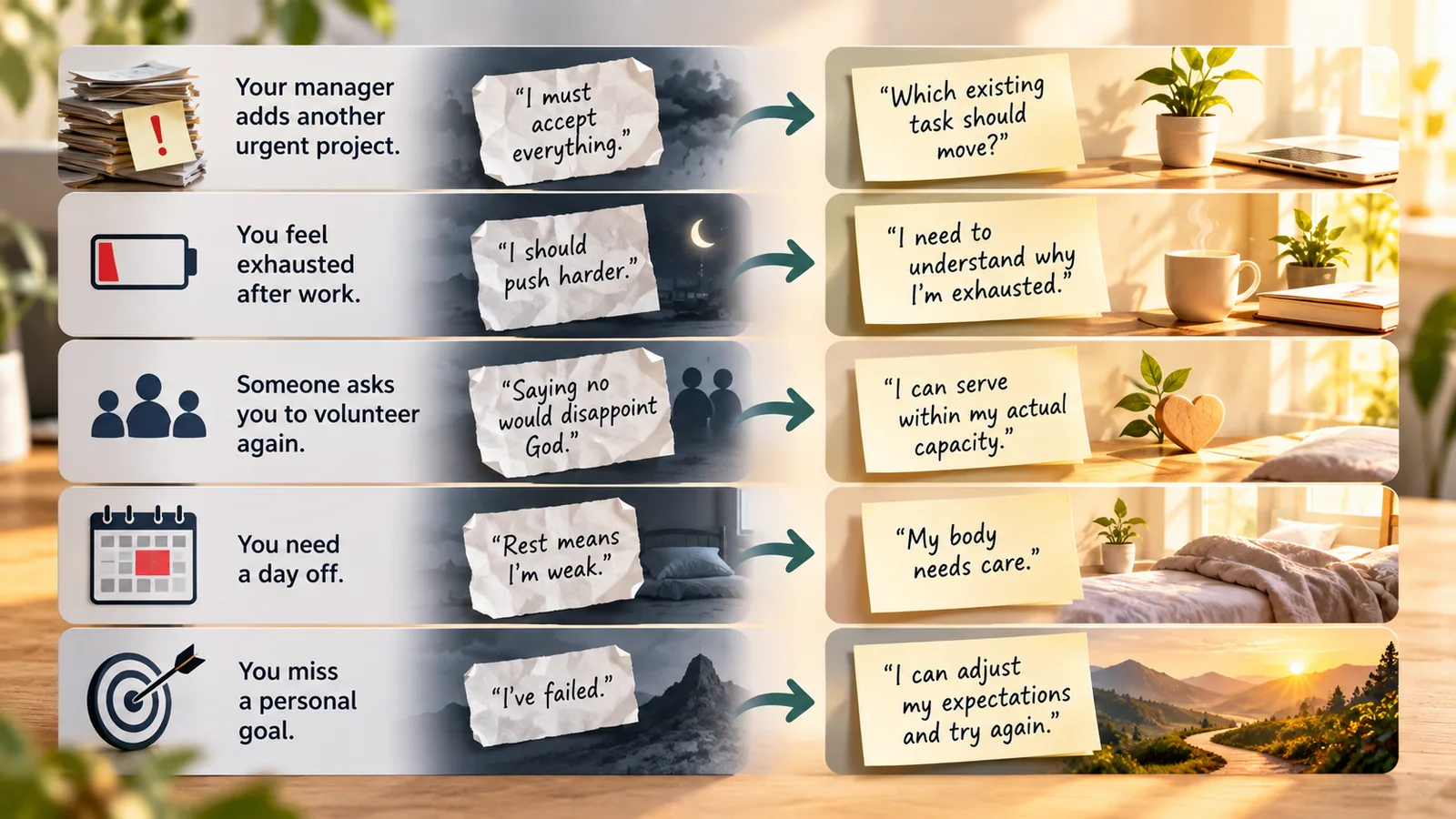
Faithful work involves effort, honesty, responsibility, and care for others. It does not require pretending that you have limitless time and energy.
Jesus also recognized the need for rest. In Mark 6:31, He invited His disciples to withdraw to a quiet place after a busy period of ministry.
Their important work did not make rest unnecessary.
Recognizing Emotional and Spiritual Exhaustion
Burnout is more than feeling tired after a difficult Monday.
The World Health Organization defines occupational burnout as a response to chronic workplace stress that has not been successfully managed. It describes three dimensions: exhaustion, growing distance or negative feelings toward work, and reduced professional effectiveness.
Burnout is classified as an occupational phenomenon, not a medical diagnosis.
However, its effects can reach into your relationships, health, and spiritual life.
The Three Signs of Work-Related Burnout
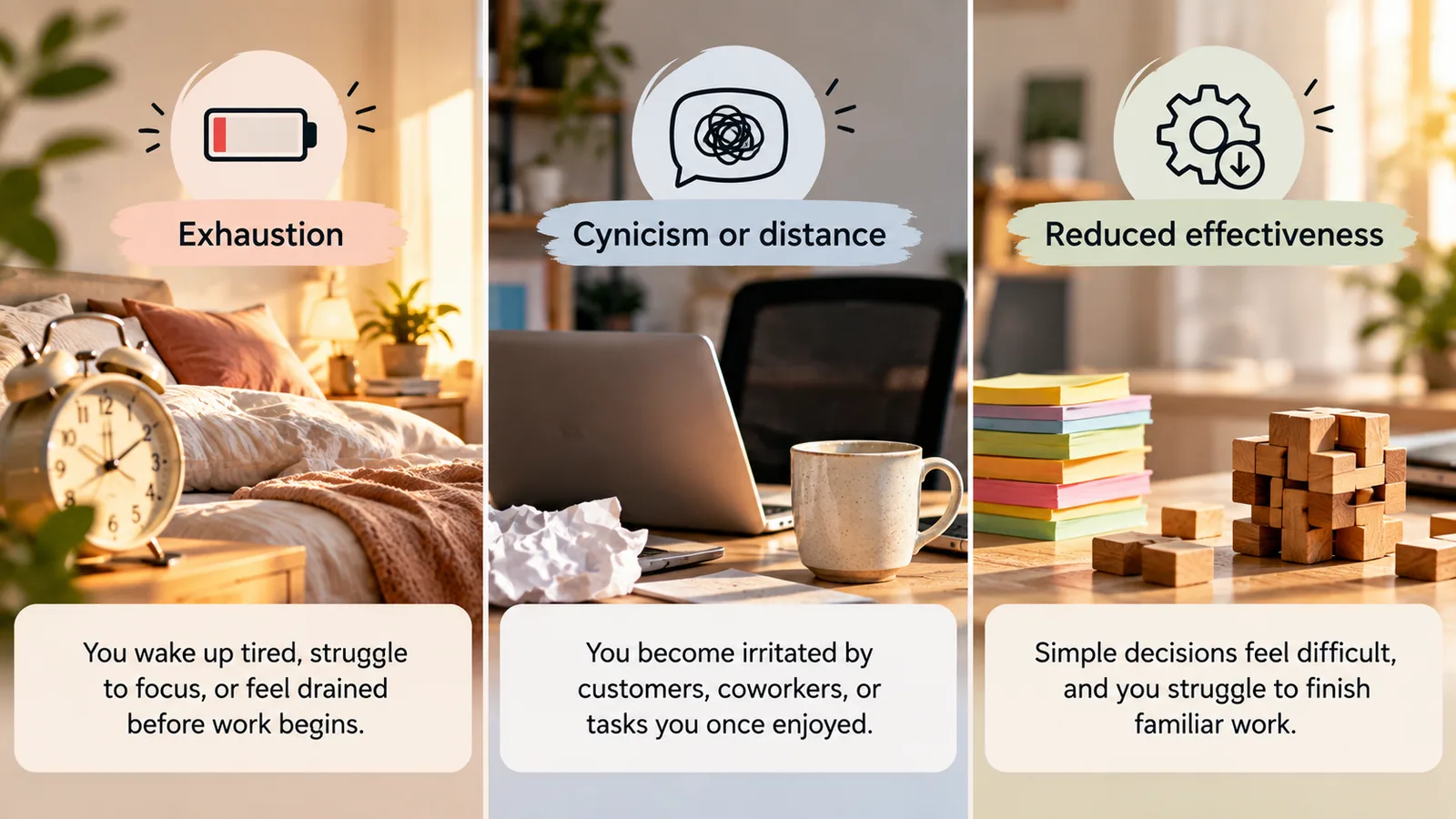
You do not have to experience every sign to deserve help.
Depression, anxiety, sleep disorders, and other health conditions can also cause exhaustion. A qualified healthcare professional can help distinguish these concerns when symptoms persist or affect daily life.
What the Workplace Research Shows
Burnout is not simply an individual failure to manage time.
In Gallup's 2026 State of the Global Workplace report, based on data collected in 2025, only 34% of employees worldwide were classified as thriving in their overall life evaluation. Another 56% were struggling, and 9% were suffering. These figures measure general well-being, not burnout prevalence.
The WHO also estimated in its 2022 workplace mental health guidelines that depression and anxiety cost the global economy about $1 trillion annually in lost productivity. That figure refers to depression and anxiety, not burnout alone.
These findings point to an important truth: workplace conditions affect how people feel and function.
A person cannot always solve an unhealthy work environment by developing better habits.
When Burnout Starts Affecting Your Faith
You might notice that:
-
Prayer feels difficult because your thoughts keep returning to unfinished work.
-
You avoid church because another commitment feels overwhelming.
-
You become impatient with your family, then feel guilty afterward.
-
You struggle to enjoy activities that once helped you recharge.
-
You assume God is disappointed because you cannot do more.
These experiences do not automatically mean you have a spiritual problem.
They may mean your emotional, physical, and spiritual needs have gone unmet for too long.
Recognizing the problem gives you a starting point for change.

Rest Is Not a Lack of Faith
Some Christians feel uneasy when they rest because they believe there is always more they could do for God.
But Scripture does not describe constant activity as the highest expression of faith.
God established a pattern of work and rest in Genesis 2:2–3. The Sabbath command in Exodus 20:8–11 also treats rest as a serious part of life.
Rest is not an emergency measure reserved for when your body stops cooperating.
It belongs within a healthy rhythm of living.
Elijah's Exhaustion: A Real Biblical Story
In 1 Kings 19, the prophet Elijah reached a point of deep distress.
He was afraid, exhausted, and overwhelmed. He fled into the wilderness and told God that he had had enough.
God's response is worth noticing.
Elijah was given food, water, and sleep. Later, God spoke to him and provided direction.
The account doesn't offer a universal medical treatment for burnout. It does show that physical care is not beneath God's concern.
You can read more about this connection in why your physical needs are a spiritual priority .
Why Resting Can Feel So Uncomfortable
Imagine a Christian teacher named Rachel who spends her weekdays teaching and her evenings preparing lessons.
She also leads a Sunday class at church.
When Saturday arrives, she feels guilty for watching a movie instead of planning another activity.
Rachel's problem is not that she dislikes serving others. It is that she has begun to treat every free hour as something she must justify.
Her first step might be to stop preparing lessons on Saturday afternoons and ask another volunteer to share her church responsibilities.
That one change will not solve every problem. But it creates room for recovery.
Rachel is an illustrative example, not a documented patient or interview subject.
The Rest-Guilt Test
When you feel guilty about resting, ask:
"Have I neglected an important responsibility, or am I uncomfortable because I'm not being productive?"
These are different problems.
If you have neglected something important, you may need to address it.
If you have completed your responsibilities and simply feel uneasy while resting, the problem may be an unhealthy belief about your worth.
You do not have to earn the right to be human.
Your value before God is not calculated from your completed tasks.
What Renewed Strength Actually Looks Like in Real Life
Sometimes, recovery begins before you feel strong.
You may still wake up tired. Work may remain difficult. Your circumstances may not change immediately.
Yet you can begin making choices that protect your health and allow you to rebuild.
Example 1: The Employee Who Cannot Keep Working Late
Imagine Daniel, an accountant working 55 hours a week during a busy season.
He reads Isaiah 40:31 every morning but feels frustrated when he is still exhausted by Friday.
He assumes he needs more discipline.
A more useful first step is to examine his workload. Daniel starts recording his actual working hours and identifies tasks that repeatedly push him past his scheduled finish time.
He then speaks with his manager.
He says, "I'm working about 55 hours each week. I can complete the monthly reports or take on the new client this week, but I cannot finish both by Friday. Which is the priority?"
This conversation addresses the workload instead of treating Daniel's exhaustion as a personal failure.
His renewed strength may include the courage to be honest about his limits.
Example 2: The Christian Parent Who Has Nothing Left
Imagine Maria works full time and cares for two children.
By evening, she is exhausted. She feels guilty because she has not completed her Bible reading plan.
Instead of adding another demanding routine, Maria starts listening to a short passage of Scripture during her commute.
She also asks her spouse to take over bedtime twice a week.
Her spiritual life does not depend on completing an hour-long devotional every morning.
Small, regular moments of prayer can still be meaningful.
Example 3: The Church Volunteer Who Needs a Break
Imagine James volunteers at church three evenings a week while working a demanding job.
He loves his community, but he has begun to dread the next meeting.
Rather than quitting without explanation or continuing until he collapses, James meets with his ministry leader.
He explains that he needs to step away from one responsibility for the next six weeks.
He also helps document his tasks so someone else can cover the essentials.
The important lesson is not that every volunteer should take six weeks off. It is that honest communication and shared responsibility can protect both the person and the ministry.
These three stories are fictional, practical examples. They illustrate possible responses rather than guaranteed recovery outcomes.

A Practical Burnout Recovery Plan
Burnout recovery rarely happens because of one perfect weekend.
Start by lowering avoidable pressure. Then identify what needs to change so the same pattern does not continue.
The WHO's workplace mental health guidelines include changes to workplace conditions, manager training, and individual support. Research on specific interventions varies in quality, but the guidance recognizes that recovery requires more than asking workers to cope better.
Step 1: Protect Your Basic Physical Needs
Begin with sleep, regular meals, hydration, and reasonable breaks.
If you're missing meals to finish work, start by protecting a lunch break.
If you are regularly working late, set a realistic stopping time where your circumstances allow.
A short walk or quiet break may help you reset, but it should not become another productivity target.
If caring responsibilities, shift work, or financial pressure limit your choices, focus on the changes available to you and seek practical support where possible.
Step 2: Identify What Is Draining You
Write down your three biggest sources of exhaustion.
For example:
-
Unexpected requests from your manager.
-
Late-night messages from clients.
-
Taking on church responsibilities when you are already stretched.
Choose one problem you can influence.
Perhaps you can ask your manager to prioritize tasks. Perhaps you can stop checking nonurgent messages after work.
You do not need to fix every problem this week.
Step 3: Make a Boundary Specific
A useful boundary describes what you will do.
Instead of saying, "I need a better work-life balance," try:
"I will finish my scheduled workday at 5:30 p.m. unless there is a genuine emergency."
Or:
"I can volunteer once a month, but I cannot commit to every Sunday."
If a boundary is difficult because of job demands, discuss reasonable changes with your supervisor or HR rather than assuming you must handle the situation alone.
Step 4: Ask for Support Before You Reach a Crisis
Talk with a trusted friend, family member, pastor, counselor, or healthcare professional.
Different people can help with different needs.
Your pastor may offer prayer and spiritual guidance. A therapist can help with stress, anxiety, or unhealthy thought patterns. A medical professional can assess persistent fatigue and possible health concerns.
Seeking professional support does not compete with trusting God.
Step 5: Rebuild a Sustainable Routine
Once you begin feeling better, resist the urge to refill every available hour.
Restore commitments carefully.
You can use prayers for recovery and renewed strength as part of a simple spiritual routine.
But remember that recovery is not a race. The goal is a healthier way of living, not a faster return to exhaustion.
Your Burnout Self-Reflection Worksheet
Use these questions to identify your next practical step.
This worksheet is not a medical test or a burnout diagnosis. Its purpose is to help you notice patterns and decide where support may be needed.
Part 1: Notice Your Energy
Think about the past two weeks.
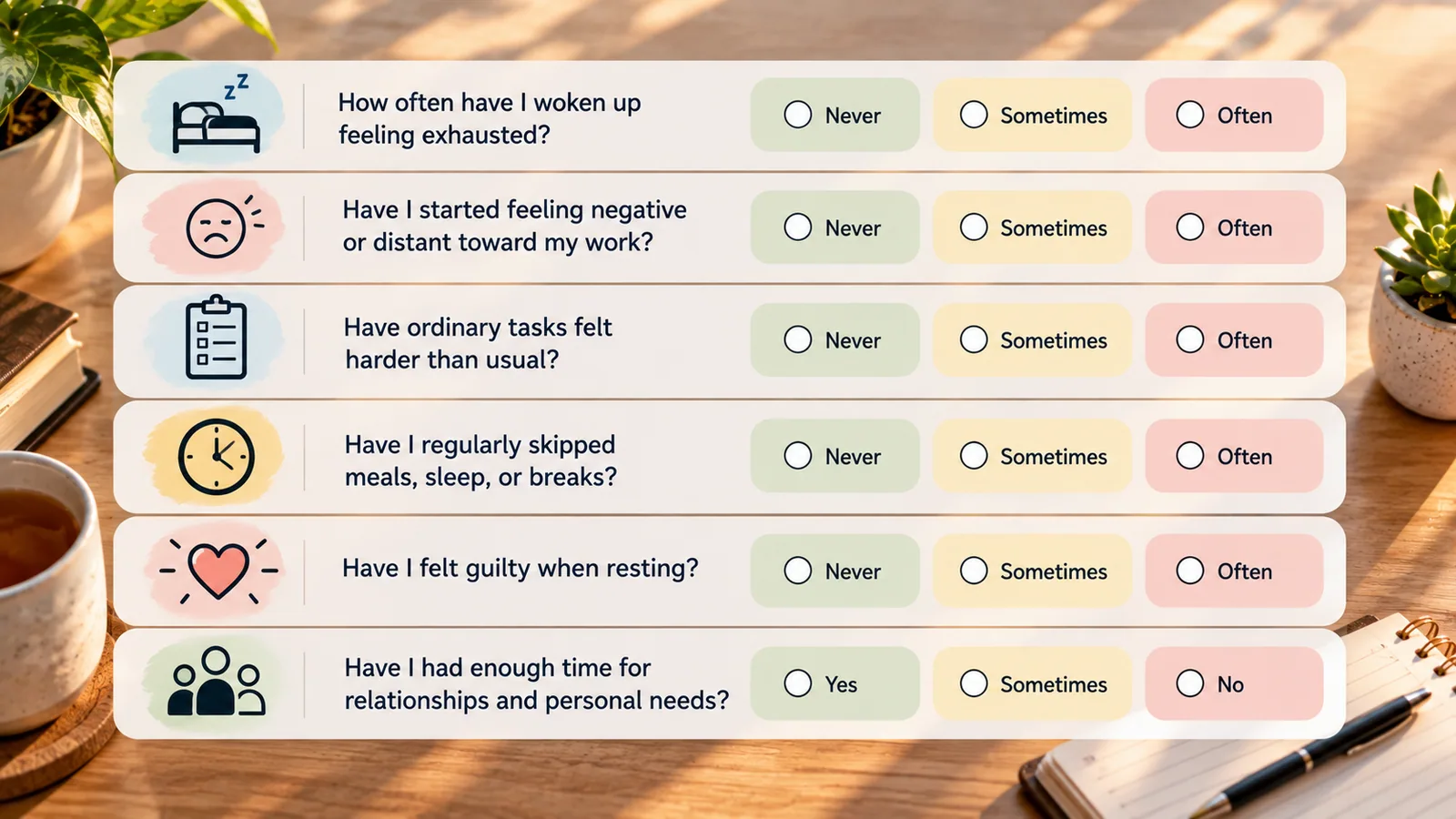
If several answers concern you, consider talking with a qualified professional.
Do not use the number of concerning answers as a diagnostic score.
Part 2: Find the Source of Pressure
Complete these sentences in a notebook:
"My biggest source of stress right now is..."
"One responsibility that may need to change is..."
"The support I need but have not requested is..."
"One thing I am afraid will happen if I slow down is..."
Read your answers without judging yourself.
Then identify which concerns require a conversation, a change in routine, or professional support.
Part 3: Choose One Faithful Next Step
Ask yourself:
"What is one small action I can take today that respects both my responsibilities and my limits?"
Your answer might be asking for help, scheduling a medical appointment, eating a proper meal, or leaving work on time.
It does not have to be impressive.
The point is to move from guilt toward a practical response.

When You're Too Exhausted to Pray
Burnout can make spiritual habits feel difficult.
You may sit down with your Bible and struggle to concentrate. You may begin praying and find that you have no words.
That does not mean you need a longer prayer routine.
Romans 8:26 describes the Spirit helping believers in their weakness, including moments when they do not know what to pray.
Begin with one honest sentence.
"Lord, I'm tired. Please help me today."
You can also read a single verse slowly, listen to a Psalm, or sit quietly.
For more guidance, see how to pray when you're overwhelmed .
Spiritual renewal is not measured in minutes.
Does God Promise Immediate Relief?
Isaiah 40:31 promises renewed strength, but it does not provide a timeline for relief from every difficult circumstance.
Some problems change quickly. Others require months of recovery, workplace changes, medical care, or ongoing support.
You may pray faithfully and still need time off.
You may trust God and still decide that a particular job is no longer sustainable.
You may experience spiritual encouragement while continuing to manage physical fatigue.
These situations are not proof that God's promise has failed.
The passage directs our hope toward God's enduring power. It does not guarantee that every source of suffering will disappear immediately.
Renewed strength is not always the ability to do more. Sometimes, it is the wisdom and courage to live differently.
FAQ: Isaiah 40:31 and Christian Burnout
1. What does Isaiah 40:31 teach about burnout?
Isaiah 40:31 teaches that God's people can look to Him for renewed strength when they are weary. It offers hope and endurance, not a guarantee of endless energy or freedom from physical limitations.
2. Is burnout a sign of weak faith?
No. Burnout can result from ongoing workplace stress and demanding conditions.
Christians can experience exhaustion while maintaining a genuine relationship with God. Seeking help and adjusting responsibilities can be wise responses.
3. Is it a sin to take time off work?
Taking time off for rest is not inherently sinful. Scripture recognizes rest as a meaningful part of human life.
If you need extended leave, discuss your options with your employer and a qualified healthcare professional.
4. Does Isaiah 40:31 mean God will give me energy to finish everything?
No. The verse promises renewed strength to those who wait upon the Lord, but it does not promise unlimited productivity.
Sometimes, you need to reduce your workload rather than ask for enough energy to maintain an unhealthy schedule.
5. How can I wait upon the Lord when I feel overwhelmed?
Start by admitting your need for help.
Pray honestly, read a short passage of Scripture, seek wise counsel, and take the next reasonable step.
Waiting on God does not mean avoiding practical action.
6. Can Christians seek therapy for burnout?
Yes. Therapy can provide tools for managing stress, understanding emotions, and addressing unhealthy patterns.
A qualified mental health professional can also assess whether symptoms suggest another condition.
Faith and professional care can work together.
7. What if I cannot afford to stop working?
Begin with realistic changes that do not threaten your immediate needs.
Document your workload, ask for clearer priorities, explore available leave or workplace support, and protect whatever recovery time you can.
If your job remains harmful, consider getting advice about your options while developing a financially realistic plan.
8. How long does burnout recovery take?
There is no fixed timeline.
Recovery depends on your symptoms, working conditions, support, health, and opportunities for rest.
Persistent or worsening symptoms deserve professional attention.
9. What should I do if resting makes me anxious?
Start by noticing what you fear will happen when you stop working.
You may worry about disappointing people, losing control, or falling behind.
Try a manageable period of rest and notice your thoughts. If guilt or anxiety is severe or persistent, a counselor can help you work through it.
10. What is a short prayer based on Isaiah 40:31?
"Lord, You know how tired I am. Renew my strength, guide my decisions, and teach me to trust You with what I cannot carry. Give me courage for today and peace when it is time to rest. Amen."
A Final Word: You Don't Have to Soar Today
If you're reading Isaiah 40:31 while feeling completely worn out, remember that the verse includes walking as well as soaring.
You do not have to turn your exhaustion into a spiritual achievement.
You can rest. You can ask for help. You can admit that your current workload is too much.
God's promise of renewed strength invites you to rely on Him, not to deny your limitations.
Today, your next step may be a difficult conversation, an overdue appointment, or an earlier bedtime.
Take that step.
You don't have to soar today. You can begin by walking.
Key Statistics
Employees thriving globally
34%
Percentage of employees worldwide classified as thriving in their overall life evaluation, based on Gallup's 2025 data, published in 2026. Not a measure of burnout prevalence.
Source: Gallup — State of the Global Workplace 2026
Employees struggling globally
56%
Percentage of employees worldwide classified as struggling in their overall life evaluation in 2025.
Source: Gallup — State of the Global Workplace 2026
Credible Sources
Bible Gateway · Biblical text; no modern publication date
Provides the primary biblical passage. Establishes the surrounding context for God's enduring strength, human weariness, and the promise of renewal
World Health Organization · May 28, 2019
Establishes WHO's three burnout dimensions and clarifies that burnout is classified as an occupational phenomenon rather than a medical condition.

About the Author
Editorial Team
Editorial Team
Daily Faith Path articles are prepared by the editorial team to help readers find scripture-centered guidance for healing, faith, prayer, and spiritual encouragement.
Expertise: Healing scriptures, Bible study resources, prayer guidance, devotional writing, Christian encouragement
Experience: The team researches scripture references, reviews surrounding biblical context, compares translation wording where useful, and updates articles to improve clarity, usefulness, and trust for readers.
Credentials: Editorial review, devotional writing, scripture study, content updating
This article is published by the Daily Faith Path editorial team to help readers use scripture carefully, prayerfully, and in ways that are practical for real-life seasons of illness, grief, waiting, and spiritual reflection.
Continue Reading
Related articles

October 7, 2026
12 Bible Verses About Hiding Money From Your Spouse
Explore 12 Bible verses about secret spending, hidden debt, financial honesty, confession, forgiveness, boundaries, and rebuilding trust in marriage.

October 6, 2026
15 Bible Verses for Couples Who Keep Fighting About Money
Money fights are rarely just about dollars. These 15 Bible verses help couples address spending, saving, debt, secrecy, unequal income, giving, and financial control with practical next steps and conversation questions.

October 5, 2026
Should You Tithe While in Debt? 11 Bible Passages to Study First
Should you tithe while in debt? Explore 11 Bible passages on tithing, debt, generosity, family responsibility, and giving according to your means—plus a practical plan for deciding what to do.