KJV, NIV, or ESV? A No-Nonsense Guide to Buying Your First Bible
Choosing your first Bible doesn't have to be overwhelming. This guide compares the KJV, NIV, and ESV translations in plain English, explains who each is best for, and helps you confidently pick the Bible you'll actually enjoy reading.
You're standing in the Bible aisle, sweating a little, holding three different books that are supposedly the same book. Here's the good news: there's no wrong answer, only a wrong fit for you — and by the end of this guide you'll know exactly which one to grab and why.
Why This Decision Feels So Much Harder Than It Should
Nobody warns you that buying a Bible is basically like buying a car. Different trims, different engines, same brand name.
You walk in wanting "a Bible" and walk out an hour later with a headache, still empty-handed. I've watched this happen to my own sister-in-law at a Lifeway store — she left with nothing three separate times before finally asking an employee for help.
The truth is, KJV, NIV, and ESV aren't competing products trying to trick you. They're translations built for different jobs, kind of like a hammer, a wrench, and a screwdriver are all "tools" but you wouldn't use them interchangeably.

The Real Question Nobody Asks You
Bookstore comparisons usually jump straight into "which one is more accurate to the original Greek and Hebrew." That's a fine debate for seminary students.
But if you're a regular person buying your first Bible, that's not actually your problem. Your real question is simpler: which one will I actually read?
A translation you find confusing or boring will sit on a shelf collecting dust, no matter how "accurate" scholars say it is.
Quick Answer: The 30-Second Comparison
If you're short on time, here's the cheat sheet.
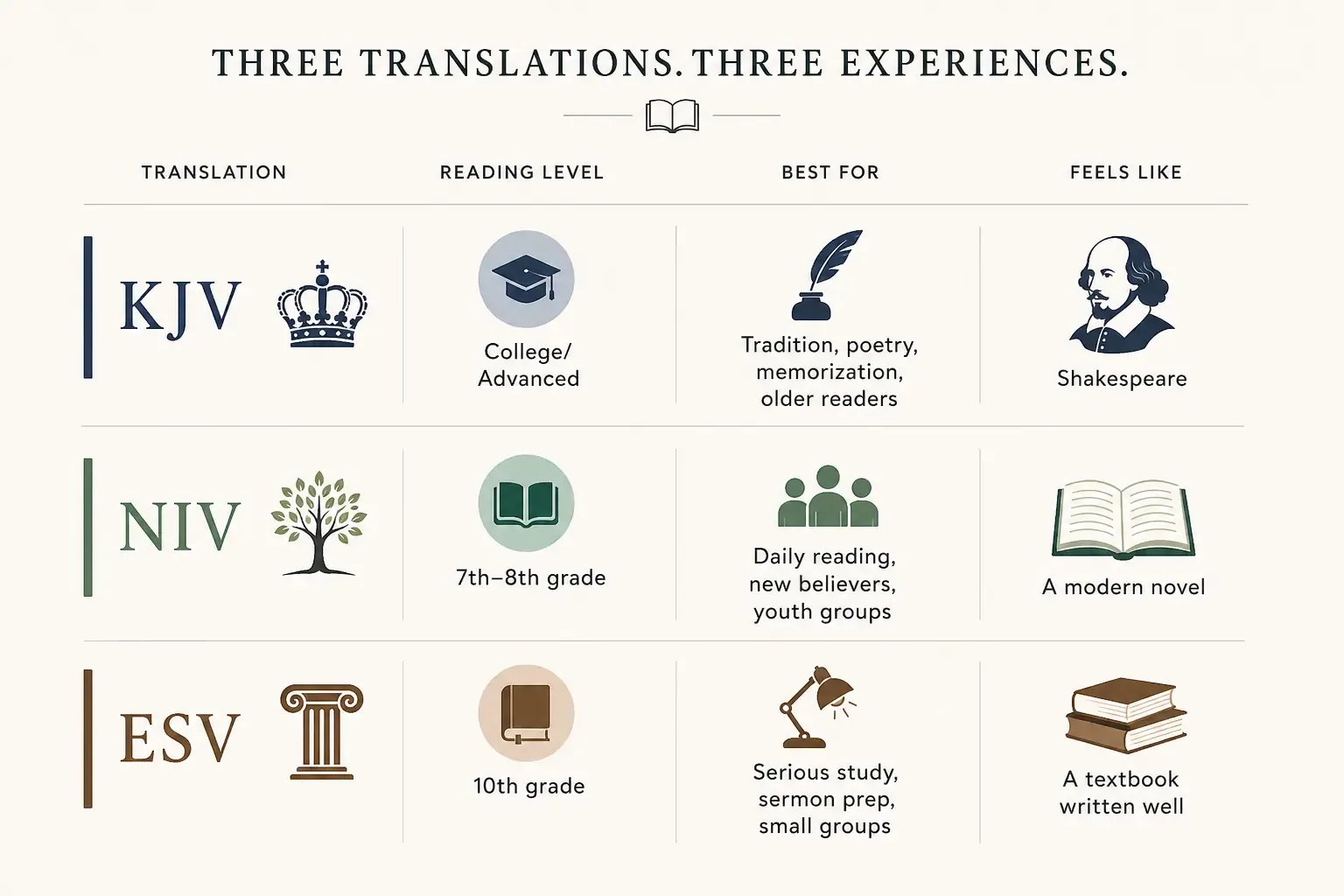
That's the whole decision in one glance. Everything below just backs this up with real examples.
What KJV, NIV, and ESV Actually Mean
Before you pick, it helps to know what you're picking between. These aren't different "versions" of the story — they're different translation philosophies.
KJV: The King James Version (1611)
This is the Bible your grandmother probably has, the one with "thee" and "thou" and "verily I say unto you."
It was commissioned by King James I of England over 400 years ago. It's gorgeous, poetic, and quoted in more songs, movies, and courtroom oaths than any other book in history.
The catch: English has changed a lot since 1611. Words like "suffer" used to mean "allow," and "conversation" used to mean "behavior." You're not just reading old English, you're reading English with hidden traps.
Real example: A guy named Marcus in an online Bible study group told me he spent 20 minutes confused by Matthew 19:14 in KJV — "Suffer the little children to come unto me" — because he genuinely thought Jesus was talking about children suffering. It actually means "let" the children come to him.
NIV: New International Version (1978, updated 2011)
The NIV was built by a team of scholars with one goal: make it read like natural, modern English while staying faithful to the original meaning.
It's the bestselling modern English Bible translation for a reason — it's the one most churches hand out to newcomers because nobody has to stop and decode a sentence.
Real example: My neighbor's teenage son was assigned to read a chapter of the Bible for a comparative religion class. He picked up his family's ESV, got stuck, and switched to an NIV app on his phone. Finished the assignment in one sitting.
ESV: English Standard Version (2001)
The ESV sits in the middle. It aims to be more word-for-word than the NIV, but more readable than the KJV.
It's become the go-to for pastors writing sermons and small groups doing deep study, because it sticks closer to the original sentence structure while still being readable.
Real example: A small group leader named Priya switched her group from NIV to ESV specifically because she wanted people to notice the exact repeated words Paul used in Romans — subtle patterns the NIV smooths over for readability.

The Translation Philosophy Table (Why They Read So Differently)
This is the part most guides skip, and it's the actual reason these three feel so different.
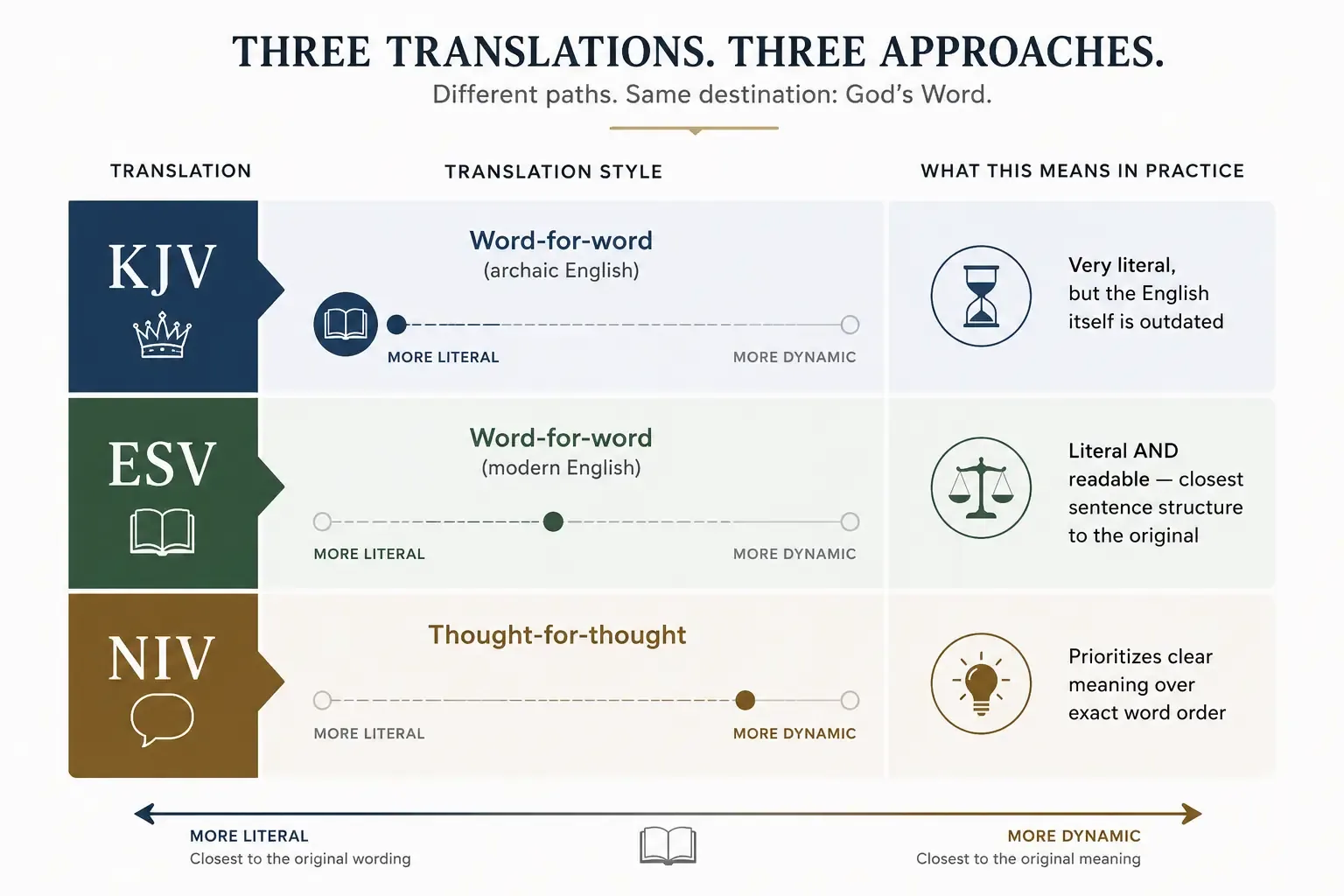
Think of it like translating a joke from French. A word-for-word translation might not be funny anymore. A thought-for-thought translation keeps the joke funny, even if the exact words change.
Neither approach is "cheating." They're just different tools for different readers.
Real-Life Buying Scenarios (And What Actually Works)
Theory is nice, but let's get practical. Here are the situations people actually show up with, and what solved them.
Scenario 1: "I Want to Read the Bible Cover to Cover for the First Time"
The problem: You grab a KJV because it feels "more official," get stuck in Leviticus by week two, and quit.
The fix: Go NIV. It reads at roughly a 7th-8th grade level, which means you spend your energy understanding the story, not decoding sentence structure.
A guy I know named Derek tried the "Bible in a year" challenge three times with a KJV before switching to NIV. He finished on his first NIV attempt.
Scenario 2: "I'm Joining a Bible Study and Everyone Uses a Different Translation"
The problem: Half the group has NIV, half has ESV, and cross-referencing verses out loud gets confusing fast.
The fix: Ask the group leader what the group's "default" is before buying anything. Most study groups standardize on one translation for exactly this reason.
If there's no standard, ESV is the safest pick since it's become the most common translation for structured group study in the last decade.
Scenario 3: "I Inherited My Grandfather's KJV and Feel Guilty Not Using It"
The problem: You want to honor the memory, but you genuinely can't follow the language for daily reading.
The fix: Keep the inherited KJV as a keepsake — display it, read from it on special occasions — and buy a second, everyday-use Bible in NIV or ESV.
There's no rule that says you can only own one. Plenty of serious readers keep two or three translations for different purposes.
Scenario 4: "I Want to Give a Bible as a Gift But Don't Know the Person's Reading Level"
The problem: You don't want to hand someone a Bible they'll never open.
The fix: NIV is the safest gift pick for general audiences, especially teens and new believers, because the barrier to entry is lowest.
If the recipient is already a longtime churchgoer or loves traditional language, KJV works beautifully as a gift edition — especially in a nice leather-bound copy.
You can also look into personalized and giftable Bible editions if you want the gift to feel more meaningful than "generic bookstore purchase."

The Physical Bible Matters More Than You Think
Here's something almost nobody talks about: the translation is only half the decision. The physical edition matters just as much.
Font Size and Page Layout
If you wear reading glasses or just hate squinting, check the font size before buying, not after. Many budget editions cram tiny text into thin paper to save cost.
Tip: Open to a random page in the store and read one full paragraph out loud in your head at normal reading speed. If you're re-reading lines, that font's too small for you.
Study Notes vs. No Notes
Study Bibles pack the page with footnotes, maps, and commentary. Great for depth, but genuinely overwhelming for a first-time reader.
Tip: First Bible? Get a plain text or "reader's edition" with minimal notes. Add a study Bible later once you know what questions you actually have.
If you do want to go deeper later, it's worth learning how to use a study Bible once you've picked one — the notes are only useful if you know what you're looking at.
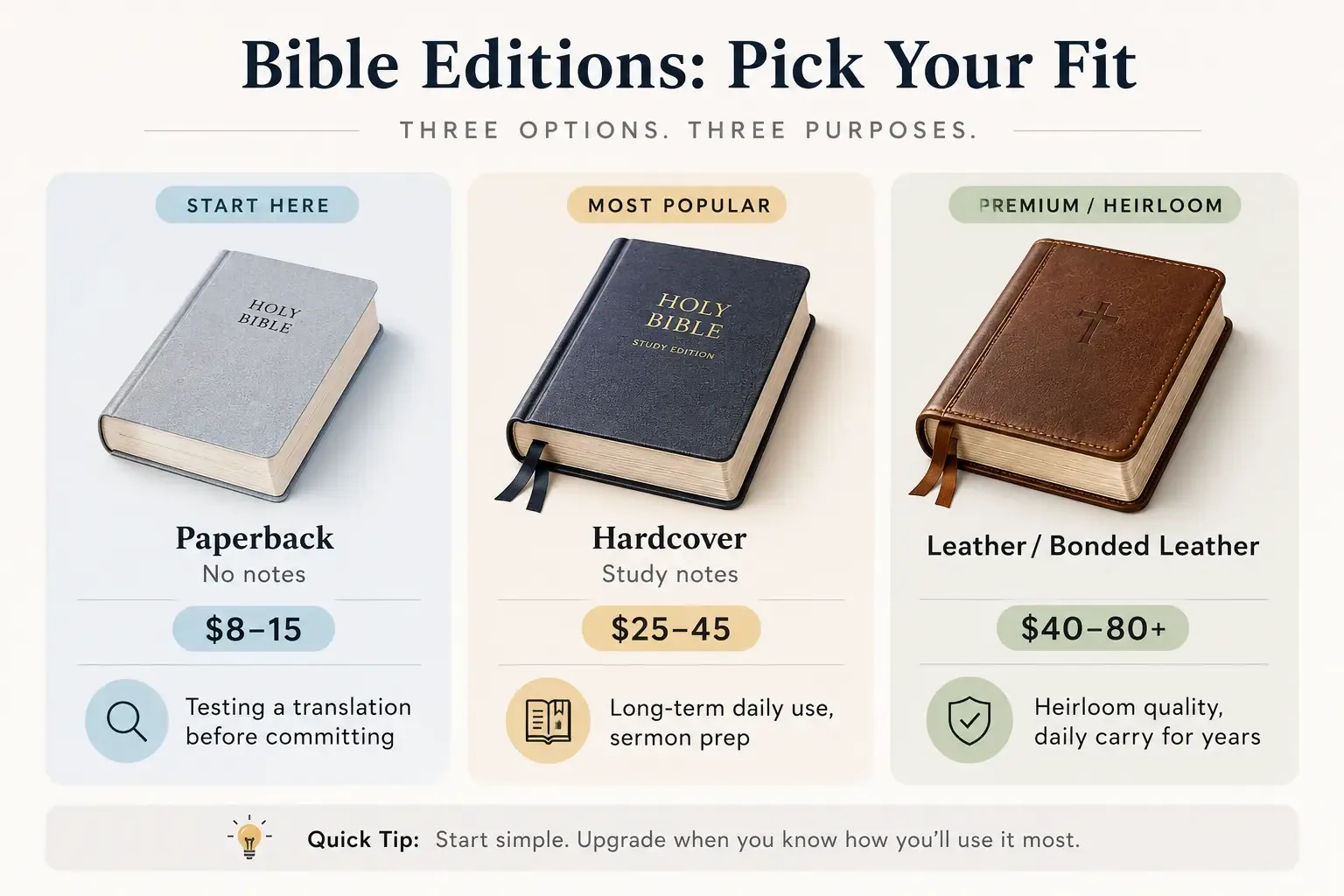
Paper Quality and Binding
Cheap paperback Bibles are fine for a starter copy, but the pages tear and the spine cracks within a year of daily use.
If you plan to carry it, highlight it, and beat it up for a decade, spend the extra $15-20 on a real leather or bonded-leather cover with sewn (not glued) binding.
Common Mistakes First-Time Buyers Make
I asked a few church bookstore staff what they see go wrong most often. Here's the pattern.
Mistake 1: Buying based on cover design alone. A beautiful floral cover doesn't fix a translation you can't understand.
Mistake 2: Assuming "more expensive" means "more accurate." Price reflects paper and binding quality, not translation accuracy.
Mistake 3: Buying the same translation as a friend without checking reading level fit. What worked for your friend might not match how you read.
Mistake 4: Ignoring font size until it's too late to return. Always flip through actual pages before buying, especially online where thumbnails lie.
Mistake 5: Buying a study Bible as a first Bible. Too many notes on the page can make a beginner feel like they're failing a test instead of reading a story.
Which One Should YOU Actually Buy? A Simple Decision Path
Answer these honestly and you'll land on your answer.
Do you want the most natural, easy modern English? → NIV.
Do you want something slightly more literal for serious study, but still readable? → ESV.
Do you love traditional, poetic language and don't mind older wording? → KJV.
Are you buying for a teenager or brand-new reader? → NIV, no contest.
Are you buying for someone leading a Bible study or writing sermons? → ESV is the current standard pick for that role.
Still torn between two? Buy the cheaper paperback version of both, read the same chapter in each, and see which one your brain relaxes into. That five-dollar experiment saves you from a $50 regret.
For a deeper breakdown across even more translations beyond these three, our full Bible translations comparison guide walks through how each one fits different purposes like study, daily reading, or devotion, without crowning a "winner."

Popular Editions Worth Knowing About
If you want a specific recommendation instead of just a translation name, these are the ones that come up constantly in real buying conversations.
For NIV readers who want daily, practical guidance built into the notes, the Life Application Study Bible is a popular NIV pick for daily use — it explains not just what a verse says, but how to apply it that day.
For ESV readers wanting serious depth, it's worth checking why the ESV is favored for serious study thanks to its detailed notes, maps, and theological cross-references.
And if you're brand new to reading the Bible at all and the translation question feels secondary to just building a habit, start here if you're new to Bible reading — consistency matters more than which translation you start with.
Bible Apps: Do You Even Need a Physical Copy?
Quick honest answer: no, but many people still want one.
Apps like YouVersion let you read any of these three translations for free instantly, which is a great way to "test drive" a translation before spending money on a physical copy.
Real example: A woman named Teresa used the YouVersion app to read the same Psalm in all three translations back to back before buying anything. Took her ten minutes and saved her a wasted purchase.
That said, plenty of people still prefer paper because it's easier to flip back and forth, take notes in the margins, and avoid phone notifications derailing a reading session.
FAQ: The Questions People Actually Ask
Is the NIV a "watered down" Bible? No. This is a myth that spread mostly from people who prefer word-for-word translations. The NIV is translated by a large team of scholars using thought-for-thought methodology — it's a different approach, not a lesser one.
Is KJV the "original" Bible? No Bible translation is "the original" — the original texts were written in Hebrew, Aramaic, and Greek thousands of years ago. KJV is simply one 400-year-old English translation among many.
Which translation do most churches use? It varies heavily by denomination and region, but NIV and ESV are currently the two most common in English-speaking churches, with KJV remaining strong in more traditional and some Southern U.S. congregations.
Can I switch translations later? Absolutely. Many longtime readers own two or three translations and switch depending on whether they're doing devotional reading or deep study.
Is it disrespectful to use a modern translation instead of KJV? No. Translation is about clarity, not reverence. Choosing a translation you actually understand shows more respect for the text than owning one you never open.
What translation is easiest for kids? NIV or a dedicated children's Bible edition. Save KJV and deep-note ESV study Bibles for when they're older.
Do I need a study Bible right away? Not at first. Learn the story and build a reading habit before adding footnotes and cross-references into the mix.
Your Next Step
Pick one, actually read a chapter tonight, and pair it with a simple routine so it doesn't end up back on the shelf.
Once you've chosen your translation, pair your new Bible with a reading plan — having a simple daily structure is what actually turns a good purchase into a lasting habit.

Key Statistics
KJV first published
1611
The King James Version has been in continuous use for more than four centuries and remains one of the most influential English Bible translations.
Source: Encyclopaedia Britannica
NIV first published
1978
The New International Version was designed to provide clear, contemporary English while remaining faithful to the original biblical languages.
Source: Biblica
Credible Sources
Biblica · Updated periodically
Official source explaining the NIV's translation philosophy, history, committee, and revisions.
Encyclopaedia Britannica · Updated periodically
Trusted historical overview of the KJV, its origins, influence, and significance.

About the Author
Editorial Team
Editorial Team
Daily Faith Path articles are prepared by the editorial team to help readers find scripture-centered guidance for healing, faith, prayer, and spiritual encouragement.
Expertise: Healing scriptures, Bible study resources, prayer guidance, devotional writing, Christian encouragement
Experience: The team researches scripture references, reviews surrounding biblical context, compares translation wording where useful, and updates articles to improve clarity, usefulness, and trust for readers.
Credentials: Editorial review, devotional writing, scripture study, content updating
This article is published by the Daily Faith Path editorial team to help readers use scripture carefully, prayerfully, and in ways that are practical for real-life seasons of illness, grief, waiting, and spiritual reflection.
Continue Reading
Related articles

October 7, 2026
12 Bible Verses About Hiding Money From Your Spouse
Explore 12 Bible verses about secret spending, hidden debt, financial honesty, confession, forgiveness, boundaries, and rebuilding trust in marriage.

October 6, 2026
15 Bible Verses for Couples Who Keep Fighting About Money
Money fights are rarely just about dollars. These 15 Bible verses help couples address spending, saving, debt, secrecy, unequal income, giving, and financial control with practical next steps and conversation questions.
October 5, 2026
Should You Tithe While in Debt? 11 Bible Passages to Study First
Should you tithe while in debt? Explore 11 Bible passages on tithing, debt, generosity, family responsibility, and giving according to your means—plus a practical plan for deciding what to do.