Perpetual Adolescence: A Bible Study for Men Who Feel Stuck
Many young Christian men feel trapped in a cycle of pornography, gaming, isolation, and delayed adulthood. This practical Bible study explains the psychology behind "perpetual adolescence" and offers a grace-filled, Scripture-based plan to break unhealthy patterns, embrace responsibility, and grow in faith without shame.

You're 27. You're still in your childhood bedroom. Last night ended at 2 a.m. with a controller in one hand and a phone in the other, and you told yourself it was the last time — again. This isn't a willpower problem. It's a wiring problem, and there's a way out that doesn't start with someone telling you to "just pray more."

What "Perpetual Adolescence" Actually Means
Perpetual adolescence isn't a Bible word. It's a real pattern therapists now have a name for: "failure to launch." It means a grown man who looks like an adult on the outside but is still living like a teenager on the inside — no job, no plan, no woman, no responsibility, and no urgency to change any of it.
Here's the part nobody says out loud: this isn't rare anymore. It's the new normal for a huge slice of young men.
Nearly half of American adults under 30 now live with a parent. Men move back home at close to twice the rate of women. And once a man moves back in, he's about 20 percentage points less likely to be in the workforce than a guy his age living on his own. That's not a coincidence — it's a trap that closes slowly.
Two things usually fill the empty hours: porn and gaming. Researchers call them "arousal addictions" because they work the same way — they spike dopamine fast, they cost nothing, and they never reject you. A game always lets you back in. A screen never says no.
That's the hook. And it's why willpower alone rarely breaks it.
The Story of a Guy Named Marcus (And Probably a Guy You Know)
Marcus isn't his real name, but his story is a composite of dozens of men who've written into faith-based recovery forums and men's ministry groups over the past two years. It's worth telling because it's so common it's almost boring — and that's the point.
Marcus graduated college with a business degree in 2023. He applied to 200+ jobs. Got four interviews. Got zero offers. He moved back into his parents' house "just for a few months." Three years later, he was still there.
The days blurred together. Wake up around noon. Scroll. Play ranked matches until 3 a.m. Watch porn most nights because it was the only thing that reliably made the day feel like it had a highlight. He stopped calling old friends because he was embarrassed to say what he'd been doing with his time. He stopped going to church because he figured God was disappointed in him anyway.
The turning point wasn't a lightning-bolt moment. It was his youth pastor from high school texting him out of nowhere: "Thinking about you. No agenda, just wanted you to know." No sermon. No shame. Just a text.
That single message is what got Marcus into a men's group six weeks later — not a "porn addiction group," just a Tuesday night Bible study for guys 20-30. He didn't say a word about porn or gaming for the first two months. He just showed up.
That's the real unlock most content misses: connection comes before confession. Shame-based approaches ask a man to confess before he trusts anyone in the room. Real change usually happens in reverse.
Why Porn and Gaming Hook Men Who Feel Stuck (The Actual Science)
You don't need a psychology degree to understand this, so here's the short version.
Dopamine is the brain chemical behind wanting, not just liking. It's what makes you crave the next hit, not what makes you enjoy the one you just had. Porn and gaming are both built — on purpose, by teams of engineers and producers — to spike dopamine faster and more reliably than almost anything else in daily life.
Here's what that looks like in numbers:
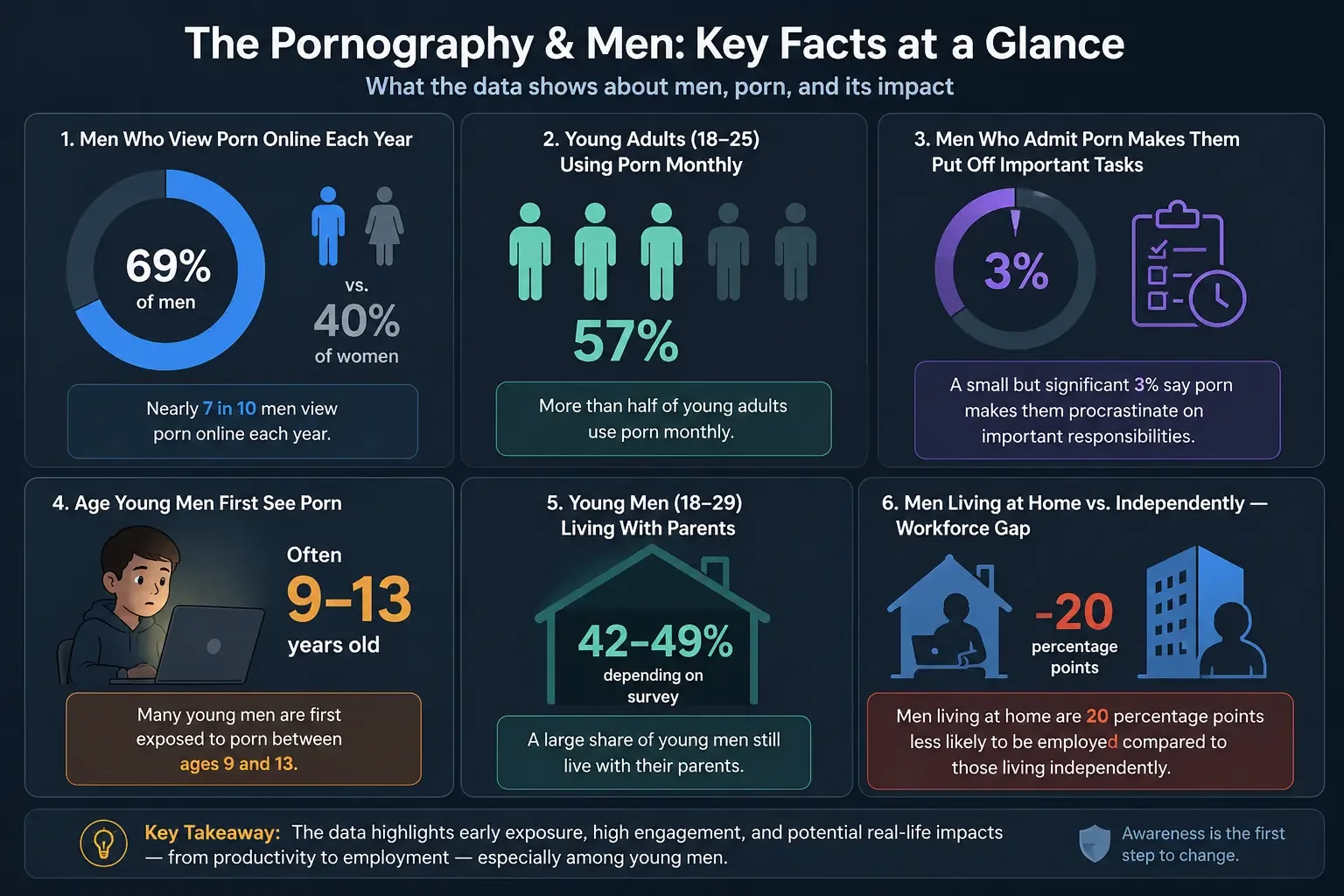
Sources: Addiction Resource, Addiction Help, Pew Research Center, Young Men Research Project (YMRP), and Fortune's 2026 analysis of labor force data.
Here's the mechanism in plain English: the brain's reward system doesn't just respond to porn — it responds hardest to anticipating porn. Brain scans of men in treatment for compulsive use show the reward center lights up most right before anything appears on the screen, not during. That's the same anticipation pattern seen in substance addiction, which is why researchers use the word "addiction" for it at all.
Gaming works on a nearly identical loop. Loot boxes, daily streaks, ranked ladders — none of that is accidental. It's built by people whose job is to make you come back.
Combine both, and you get a man whose brain has been trained for years to expect instant reward for zero real-world effort. Then you put him in front of the actual adult world — job applications, rejection, slow progress, no guaranteed payoff — and his brain treats it like static. Boring. Unrewarding. Skippable.
That's not a moral failure. That's neurology meeting a broken job market and free wifi.

The Shame Trap: Why "Just Read Your Bible More" Doesn't Work
Most Christian content on this topic follows the same script: name the sin, quote a verse about lust, tell the guy to pray harder and get an accountability partner. It's not wrong, exactly. It's just incomplete, and it usually backfires.
Here's why. Shame and guilt feel similar but work completely differently in the brain.
- Guilt says: "I did something wrong." It's fixable. It points to an action.
- Shame says: "I am something wrong." It's identity-level. It points to a person.
Porn and gaming both create shame spirals because they're usually done in secret. Secrecy plus repetition equals identity collapse — a guy stops believing he's a struggling son of God and starts believing he's just "a porn addict" or "a loser who games all day." Once that identity sets in, relapse feels inevitable, because why would a loser act any differently?
This is where a shame-free approach actually out-performs a shame-based one, and it's not soft — it's strategic. Scripture backs this up directly. Grace isn't a loophole for weak men; it's the actual mechanism God uses to change behavior. Guilt that leads to repentance is productive. Shame that leads to hiding is not — and the Bible names that difference explicitly (2 Corinthians 7:10).
If you want a starting point for reframing this, Daily Faith Path's page on forgiveness in the Bible is built around exactly this distinction — grace and mercy, not performance-based approval.
The One Sentence That Changes Everything
Say this out loud: "I am not disqualified. I am in a pattern, and patterns can be interrupted."
That's it. That's the whole reframe. You're not fighting your identity. You're fighting a loop.
A Shame-Free Discipleship Plan (Not Just "Read Your Bible More")
Here's what most articles skip: an actual plan. Not a vague call to "pursue God more," but something you could start tonight.
Step 1: Name the Trigger, Not the Behavior
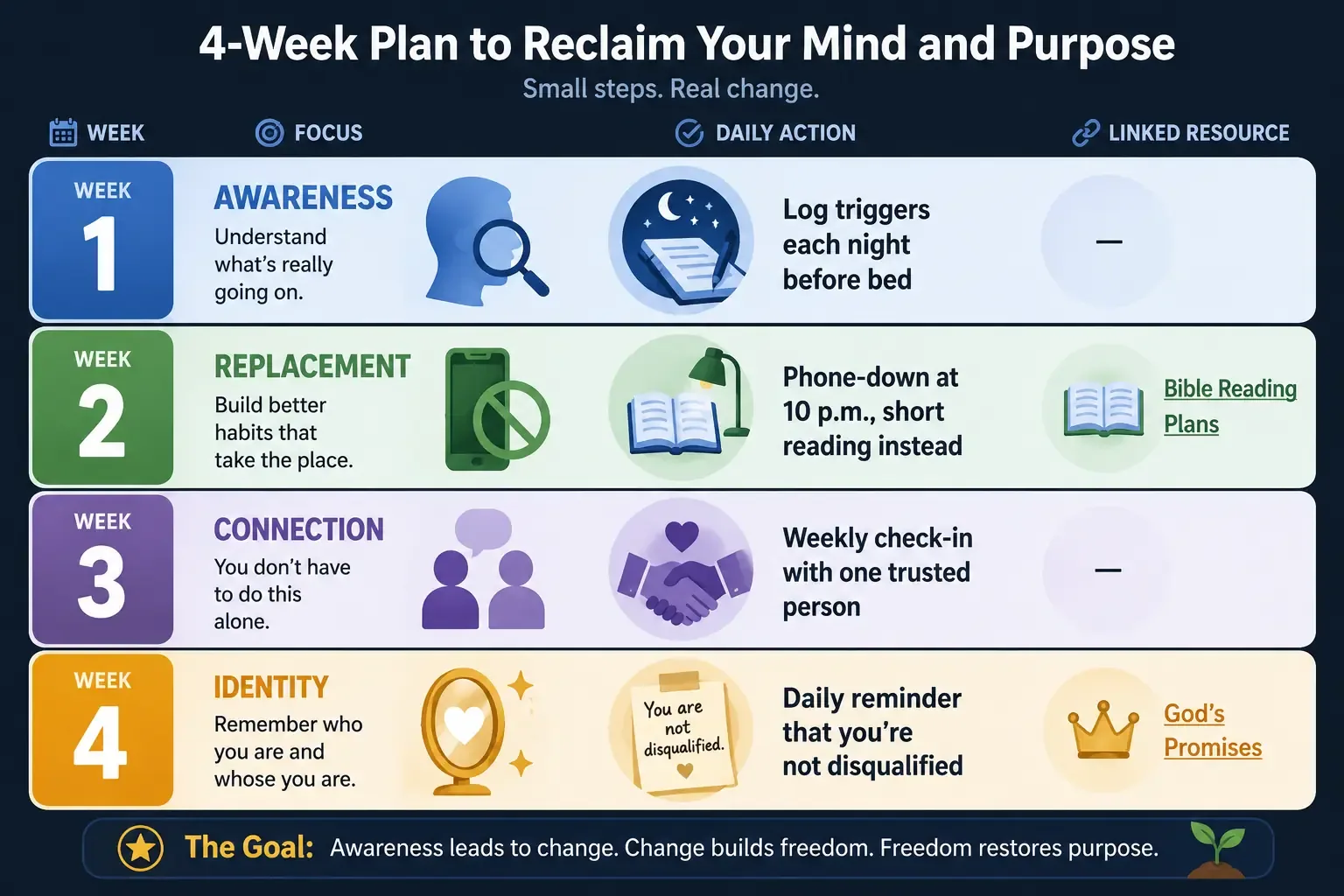
Before you fight porn or gaming directly, figure out what precedes it. For most guys it's one of four things: boredom, loneliness, rejection, or late-night exhaustion. Write down the last five times you relapsed and note the hour and what happened right before.
Most men discover a pattern within a week. Marcus's was almost always 11 p.m. to 1 a.m., after a day with zero human contact.
Step 2: Replace the Time Slot, Not Just the Behavior
Willpower fails when you try to remove a habit and leave a hole. The hole gets filled with the same habit again, guaranteed. Instead, pre-load that exact time slot with something else.
For late-night guys: set a hard phone-down time at 10 p.m., charge the phone in another room, and read one short passage before bed instead. Daily Faith Path's Bible reading plans work well here because they're structured — you're not stuck deciding what to read at 10:47 p.m. when your willpower is already lowest.
Step 3: Get One Person Who Knows Everything
Not a group. Not an app. One person. Research on recovery consistently shows isolation is the single strongest predictor of relapse, and connection is the strongest predictor of sustained change. This doesn't need to be dramatic — a weekly 15-minute check-in text is enough to start.
Step 4: Build a Short, Repeatable Prayer Rhythm
Skip the 45-minute devotional plan. It won't survive week two. Use something short enough to do even on your worst day. Daily Faith Path's prayer for strength page is built as exactly this kind of low-friction tool — something you can actually do at 11 p.m. when you're tempted, not just in the morning when you feel strong.
Step 5: Track Momentum, Not Perfection
Don't track "days clean." That framing makes one slip feel like total failure and often triggers a binge ("I already messed up, might as well keep going"). Instead track weekly wins: did you get outside, talk to someone, apply for a job, go to bed on time three nights? Momentum in real life is what actually breaks the loop — not just abstinence from the trigger.
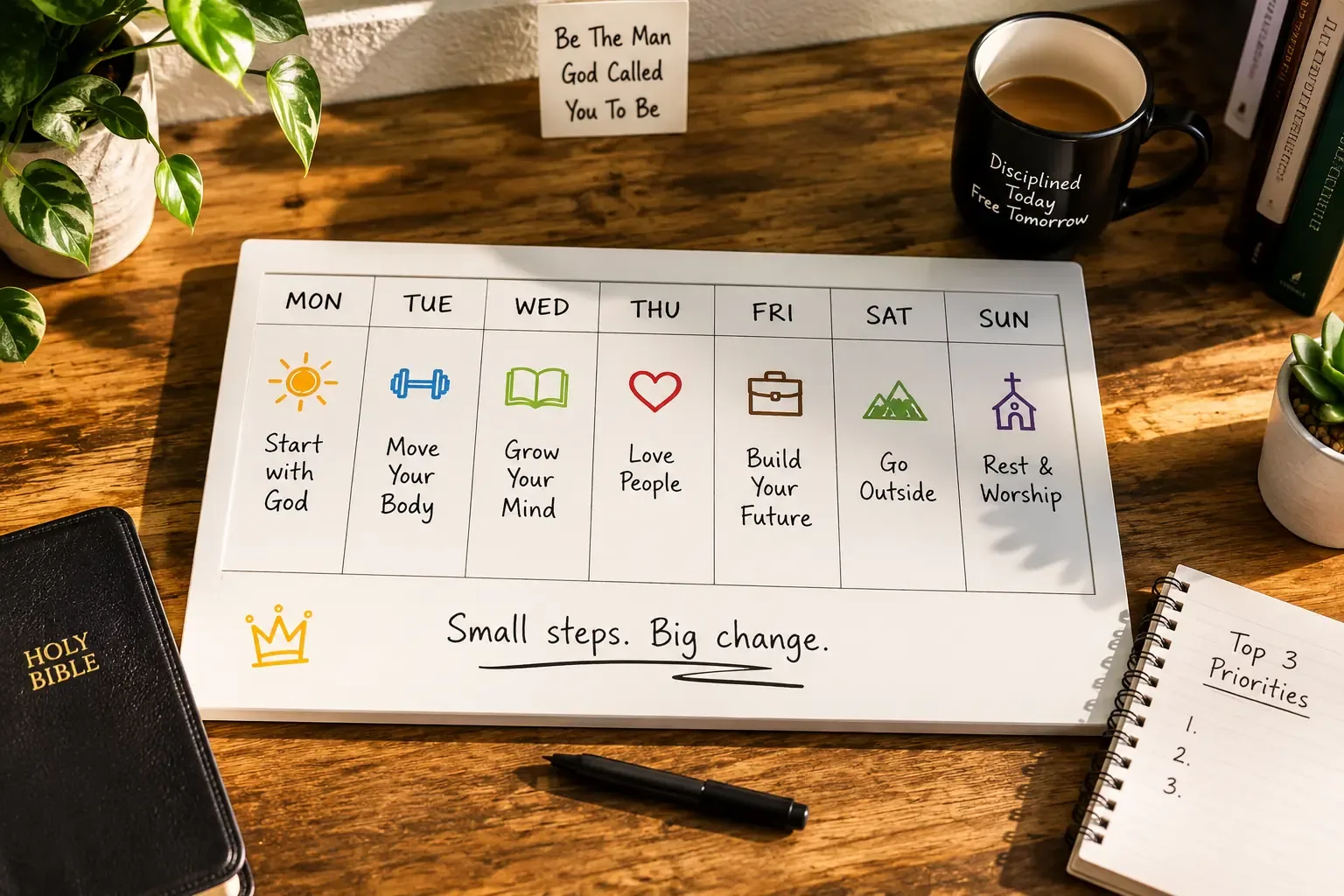
30-Day Starter Framework
What To Do In the Exact Moment You Want to Relapse
Plans are easy to write and hard to remember at 11:45 p.m. when the urge hits. Here's what to actually do in that ten-minute window, because that window is where the whole battle happens.
Move your body first, think second. Urges are physical before they're spiritual. Twenty push-ups, a cold glass of water, or a two-minute walk outside interrupts the loop faster than trying to out-argue your own brain.
Say the trigger out loud. "I'm bored and lonely right now" sounds almost silly said aloud, but naming it breaks the automatic pilot that gaming and porn both rely on.
Text the one person from Step 3. Not a long message. "Struggling right now" is enough. The goal isn't a conversation — it's breaking secrecy in real time, because secrecy is the fuel.
Read one verse, not a chapter. This is where Daily Faith Path's Bible verses about strength page is genuinely useful — short, need-based verses you can read in under a minute when your attention span is at its lowest.
Give yourself permission to be bored. This sounds backward, but boredom tolerance is a trainable skill, and most men in this pattern have almost none left. Sitting in boredom for ten minutes without reaching for a screen is a real workout, not a failure.
When You Relapse Anyway (Because You Will, At Least Once)
Here's the part almost no faith-based article says clearly: you will probably slip. Planning for zero mistakes sets you up to quit the first time you break the plan.
The difference between men who eventually break the cycle and men who stay stuck for years isn't who slips less. It's who recovers faster after slipping.
A slip that gets buried in shame becomes a three-day binge, because the guy figures the streak is already broken. A slip that gets named out loud within 24 hours — to God, and to your one person — usually stays a single bad night instead of a spiral.
This is where grace isn't a nice idea, it's a functional tool. Daily Faith Path's page on God's love is worth returning to specifically after a slip, not just on good days — because the whole point of grace is that it's available on the worst day, not just the best one.
A Real Example of Recovery, Not Perfection
One guy in Marcus's group — call him Tyler — had 40 days clean, relapsed on day 41, and almost quit the whole thing out of shame. His accountability partner's response wasn't a lecture. It was one text: "40 good days still happened. Today doesn't erase them. What time tonight?"
Tyler texted back an hour later. He's now past a year. The recovery, not the relapse, is the actual story.

Why This Matters Beyond the Bedroom
This isn't just about porn or gaming in isolation. It's about a whole posture toward adult life. A man stuck in this loop often isn't just avoiding a screen — he's avoiding responsibility, risk, rejection, and the discomfort that comes with actually building something real.
Faith over fear isn't a slogan here — it's the literal mechanism. Fear of failure keeps a man in his room. Faith is what gets him to send the job application anyway, have the hard conversation anyway, and show up to church even though he feels like a fraud. Daily Faith Path's faith over fear devotional speaks directly to this — not fear of a boogeyman, but the quieter, more common fear of just trying and failing again.
And underneath all of it is a trust question. Can a man actually believe God has something for him beyond the loop he's in? Daily Faith Path's trusting God resource is a good next stop for guys wrestling with that exact question — not "trust God with your eternal salvation" in the abstract, but "trust God enough to put the controller down tonight."
If you've never really studied the Bible and don't know where to start, don't overthink it. Daily Faith Path's beginner Bible study guide is built for exactly this — short passages, no jargon, no assumption you already know your way around Scripture.
FAQ: The Questions Men Actually Search At 2 A.M.
Is porn addiction actually real, or is that just a Christian talking point?
It's a real, researched pattern, not just a religious label. Brain imaging studies on men seeking treatment show measurable differences in reward-system activity tied to anticipation of sexual content — a pattern that mirrors substance addiction. The science is still developing, and not every heavy user meets clinical criteria for addiction, but the compulsive loop is documented outside of any faith context.
How do I know if I'm actually addicted or just a normal guy who games and watches porn sometimes?
Frequency alone isn't the best marker — behavior is. Ask: is it costing you sleep, jobs, relationships, or time you promised yourself to something else? Are you hiding it from people who matter to you? Have you tried to stop and failed more than once? If yes to two or more, it's worth treating seriously, whether or not it fits a clinical label.
Why do I feel worse after watching porn or gaming for hours, not better?
Both activities spike dopamine on anticipation, not satisfaction. The "high" happens before and during, and it's followed by a dopamine dip that can feel like flat emptiness or mild depression. That crash is neurological, not just emotional — which is exactly why it keeps looping. Your brain chases the next spike to escape the dip it just created.
Is it a sin to play video games?
No — gaming itself isn't condemned anywhere in Scripture, obviously, since it didn't exist. The issue is never the activity itself; it's when anything, including a hobby, becomes the thing you run to instead of God, people, or responsibility (this is closer to an idolatry pattern than a "sin list" issue). Moderation and awareness of what it's replacing matter more than the activity itself.
How long does it actually take to break this cycle?
There's no universal number, but most men in structured recovery programs report the first 60-90 days as the hardest, with real momentum building by month four to six if they stay connected to at least one other person. Isolated attempts tend to fail faster and relapse harder than attempts made with even minimal accountability.
What if I've already tried to quit and failed multiple times?
Multiple failed attempts don't mean you're incapable of change — they usually mean the plan needs adjusting, not that you need more willpower. Most men who eventually break the pattern did so on their third, fourth, or later attempt, often after changing their approach from raw willpower to trigger-mapping and accountability, as outlined above.
Where do I even start if I haven't opened a Bible since I was a kid?
Start smaller than you think you need to. One short passage, one honest prayer, one trusted person — that's a real starting point, not a weak one. Daily Faith Path's beginner Bible study guide is designed for exactly this re-entry point.
The Bottom Line
Perpetual adolescence isn't a character flaw you were born with — it's a loop built by engineered dopamine hits, a brutal job market, and years of secrecy that turned guilt into shame. Breaking it doesn't require becoming a spiritual superhero overnight.
It requires naming your triggers, replacing the time slot, telling one person the truth, and getting back up fast when you slip — because you will, and that's not the end of the story. Marcus is still not perfect. He's employed part-time, back in a small apartment with a roommate, and still texts his accountability guy most weeks. That's not a finished transformation. That's a launch.
You don't need to fix everything tonight. You need one honest step — read one verse, send one text, put the phone in another room. Start there.
Key Statistics
Adults ages 18–29 living with parents
49%
Nearly half of U.S. adults under 30 lived with their parents according to the 2025 Federal Reserve SHED survey.
Source: Federal Reserve SHED 2025 / Fortune (2026)
Adults ages 25–34 living in a parent's home
18%
Share of Americans ages 25–34 living with parents in 2023.
Source: Pew Research Center (2025)
Credible Sources
Pew Research Center · January 25, 2024
Excellent source for financial independence, living arrangements, and parent-child relationships among young adults.
Pew Research Center · April 17, 2025
Provides current statistics comparing young men and women living with parents across the United States.

About the Author
Editorial Team
Editorial Team
Daily Faith Path articles are prepared by the editorial team to help readers find scripture-centered guidance for healing, faith, prayer, and spiritual encouragement.
Expertise: Healing scriptures, Bible study resources, prayer guidance, devotional writing, Christian encouragement
Experience: The team researches scripture references, reviews surrounding biblical context, compares translation wording where useful, and updates articles to improve clarity, usefulness, and trust for readers.
Credentials: Editorial review, devotional writing, scripture study, content updating
This article is published by the Daily Faith Path editorial team to help readers use scripture carefully, prayerfully, and in ways that are practical for real-life seasons of illness, grief, waiting, and spiritual reflection.
Continue Reading
Related articles

October 7, 2026
12 Bible Verses About Hiding Money From Your Spouse
Explore 12 Bible verses about secret spending, hidden debt, financial honesty, confession, forgiveness, boundaries, and rebuilding trust in marriage.

October 6, 2026
15 Bible Verses for Couples Who Keep Fighting About Money
Money fights are rarely just about dollars. These 15 Bible verses help couples address spending, saving, debt, secrecy, unequal income, giving, and financial control with practical next steps and conversation questions.

October 5, 2026
Should You Tithe While in Debt? 11 Bible Passages to Study First
Should you tithe while in debt? Explore 11 Bible passages on tithing, debt, generosity, family responsibility, and giving according to your means—plus a practical plan for deciding what to do.