The Bible Verses Everyone Gets Wrong
Many of the Bible's most quoted verses are also its most misunderstood. Discover the real context behind viral Scriptures like Ephesians 5:22, Jeremiah 29:11, Philippians 4:13, Isaiah 60:22, and Proverbs 31—and learn a simple method to fact-check any verse in minutes.
The most quoted marriage verse on the internet — "Wives, submit to your husbands" — isn't even a complete sentence in the original Greek. It borrows its verb from the verse right before it, the one nobody screenshots: "Submit to one another."
That's the pattern with almost every viral Bible quote right now. The verse is real. The meaning is chopped off.
And this isn't a dusty church problem anymore. Bible content is exploding online. YouVersion's Bible app passed 1 billion downloads in 2025, and the American Bible Society found 10 million more Americans reading Scripture in 2025 than the year before. Nearly a quarter of Gen Z digital Bible readers say they learn Scripture on TikTok.
That's the exact place where verses get clipped, captioned, and turned into something they never said.
This guide skips the recycled list you've read ten times ("God helps those who help themselves" — yes, that's Ben Franklin, not the Bible). Instead, we're going after the verses being misused right now — in tradwife videos, manosphere threads, and angel-number TikToks — and showing you what each one actually says.

Why Misquoted Verses Spread Faster Than Ever
A misquote used to travel by word of mouth. Now it travels by algorithm.
Short-form video rewards one thing: a single punchy line. A 15-second clip can't hold a whole chapter. So creators grab the half-verse that fits the caption — and millions of viewers absorb it as "what the Bible says."
Here's the tension in the data. More people are opening the Bible, but many are reading it in fragments. Lifeway Research notes that less-engaged readers tend to read "a few verses at a time," picked by feeling or topic. That's exactly how context dies.
The fix isn't complicated. It's a habit. Before you trust any quoted verse, ask three questions: Who is speaking? Who are they speaking to? What comes right before and after? We'll use those three questions on every verse below.
The Tradwife Misquote: Ephesians 5:22
What the clips say
"Wives, submit to your own husbands, as to the Lord." In tradwife content, this verse gets presented as the entire biblical blueprint for marriage: he leads, she obeys, end of discussion.
The verse is often paired with soft-focus baking footage and captions about "returning to God's design." It performs incredibly well. It's also missing its first half.
What the passage actually says
Ephesians 5:21 — the sentence immediately before — says, "Submit to one another out of reverence for Christ." In many of the oldest Greek manuscripts, verse 22 doesn't even contain the word "submit." It borrows the verb from verse 21. Paul wrote one flowing thought: mutual submission first, then examples of what that looks like.
And look at the word count. Wives get 3 verses of instruction. Husbands get 9 — and their command is heavier: "Love your wives, just as Christ loved the church and gave himself up for her" (Ephesians 5:25). Christ's love for the church meant dying for it. That's the standard set for husbands.
Quoting verse 22 without verses 21 and 25 isn't quoting the Bible. It's quoting a third of a paragraph.
The real-world damage
Marriage counselors and pastors regularly meet women who were told by an online community — not their church, not a pastor who knew them — that voicing disagreement with their husband was sin, because "Ephesians 5:22." Some stayed silent about serious problems, including financial abuse, because a 30-second video framed silence as holiness.
If you want the full picture of what Scripture actually says about marriage and relationships, start with the whole chapter, not the clip.
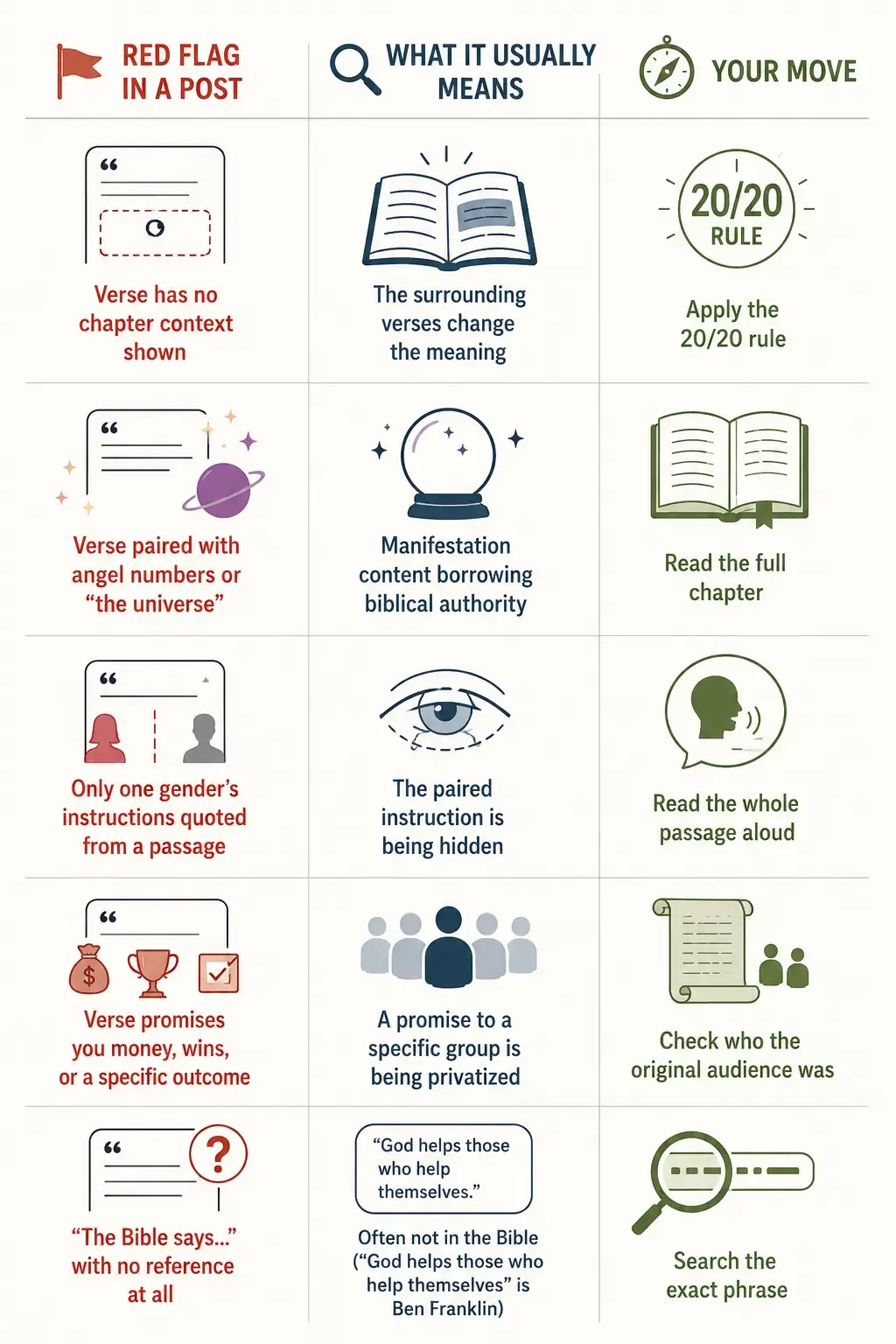
Practical tip: Any time someone quotes a "wives" verse, read the "husbands" verses in the same chapter out loud. The passage was written as a pair. Quoting one side is like reading half a contract.
The Manosphere Misquote: Proverbs 31 (and Friends)
What the threads say
In manosphere spaces, Bible verses get recruited for a different job: proving that a "biblical woman" is quiet, domestic, and economically dependent — and that a "high-value man" is entitled to that arrangement. Proverbs 31 gets waved around as the checklist.
Here's the problem. The people quoting Proverbs 31 clearly haven't read Proverbs 31.
What the chapter actually says
The Proverbs 31 woman is one of the most economically active people in the entire Bible. Read the list yourself:
- "She considers a field and buys it; out of her earnings she plants a vineyard" (v. 16). She evaluates real estate and closes the deal herself.
- "She sees that her trading is profitable" (v. 18). She runs a business and reads her own books.
- "She makes linen garments and sells them, and supplies the merchants with sashes" (v. 24). She manufactures and sells at scale.
- "She speaks with wisdom, and faithful instruction is on her tongue" (v. 26). She teaches. Publicly.
One more detail almost nobody mentions: the chapter opens by saying these are words taught to King Lemuel by his mother. The most famous "ideal woman" passage in Scripture is a woman's teaching, describing a woman who buys land, trades goods, and instructs others.
Practical tip: When a verse is used to build a "checklist" for an entire gender, read the whole chapter and count what the person in the text actually does. The actions usually destroy the checklist.
The Angel-Number Misquote: Isaiah 60:22
What the TikToks say
Search "60:22" or "manifestation verse" and you'll find thousands of videos treating Isaiah 60:22 — "In its time I will do this swiftly" — as a personal cosmic guarantee. See the number, claim the verse, and your breakthrough (money, relationship, glow-up) is scheduled.
It's often blended with angel numbers, scripting, and the law of attraction. The verse becomes a lottery ticket with a reference number.
What the verse actually says
Isaiah 60 is a promise to a devastated nation. Israel had been crushed and exiled. God, through Isaiah, promises that Jerusalem will one day be restored — nations streaming to its light, the smallest clan becoming a thousand. Verse 22 is the closing seal on that promise: when the time comes, God will do it fast.
It's a magnificent verse. It's about God's faithfulness to restore his people — not a manifestation code triggered by seeing 6:02 on your phone.
Does that make the verse useless to you today? Not at all. It teaches something better than manifestation: God's timing is his own, and his promises don't expire. That's sturdier hope than a synchronicity. For a full breakdown, read the real context of Isaiah 60:22.
Practical tip: If a verse is being paired with angel numbers or "the universe," that's your signal to open the actual chapter. Manifestation content almost never survives contact with the surrounding ten verses.

The Classics — Still Wrong, Now Weaponized
These next verses have been misquoted for decades. What's new is how they're being deployed online. Here's the quick-reference table, then the details.
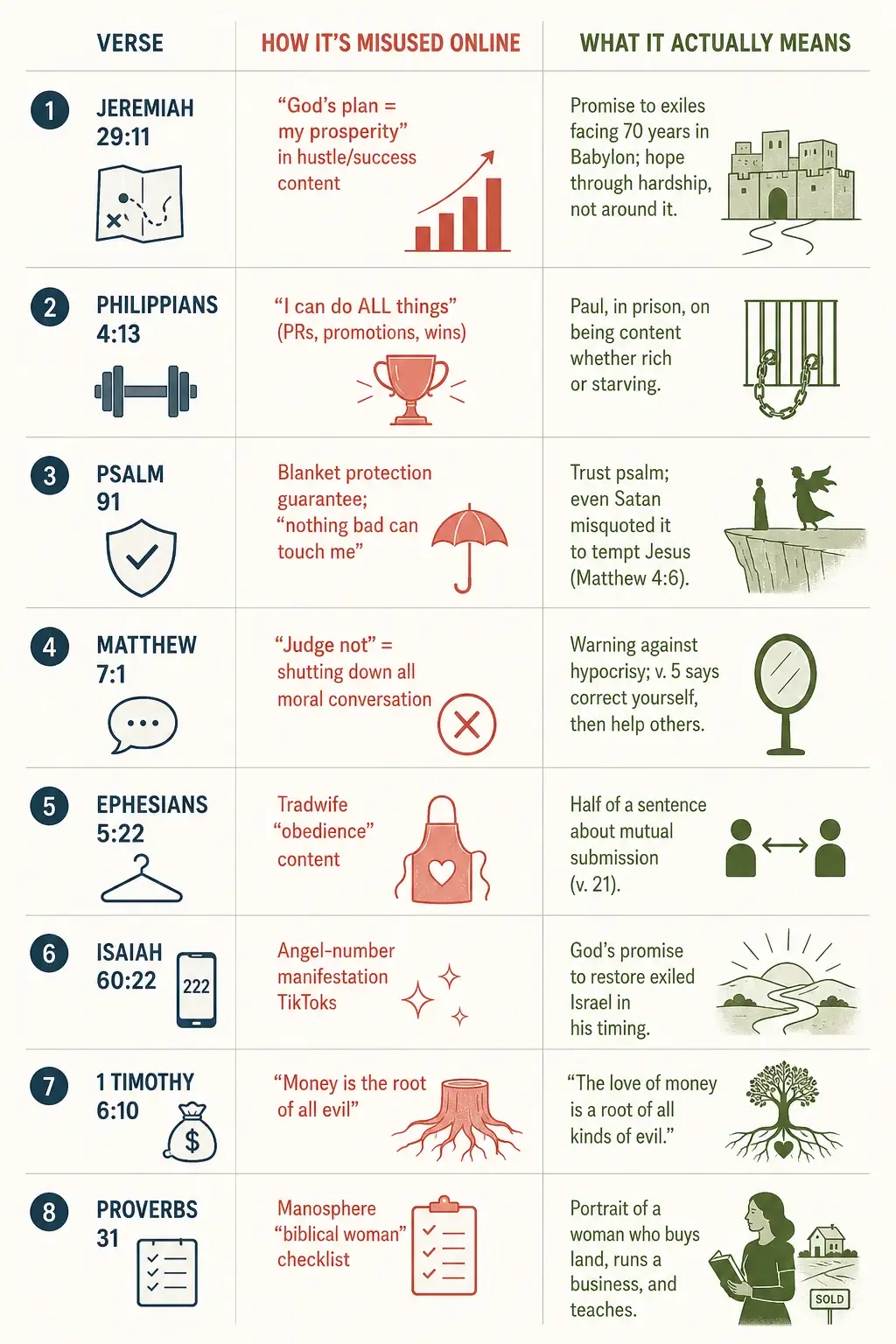
Jeremiah 29:11 — the promise ripped from exile
"'For I know the plans I have for you,' declares the Lord, 'plans to prosper you and not to harm you.'" It was YouVersion's #2 most-engaged verse of 2025, and it lives on graduation cards, vision boards, and hustle-culture reels.
Now read verse 10, one line earlier: "When seventy years are completed for Babylon, I will come to you." God is speaking to a nation dragged into exile. His instruction in the same letter? Build houses. Plant gardens. Settle in. Most of the original hearers would die before the promise landed.
The verse doesn't promise a fast, comfortable life. It promises that God stays faithful through long, hard seasons. That's a deeper comfort — and it's the honest one. If you want to read promises like this responsibly, here's a guide to understanding God's promises in context.
Philippians 4:13 — the gym-bro verse
"I can do all things through Christ who strengthens me" might be the most-inked, most-captioned verse in sports. Athletes write it on cleats. Lifters put it under deadlift videos.
Paul wrote it from prison. And "all things" refers to the sentence before it: "I have learned the secret of being content in any and every situation, whether well fed or hungry, whether living in plenty or in want" (v. 12). The verse is about enduring every circumstance — including losing — not conquering every goal.
That actually makes it a better verse for athletes. It works after the loss, the injury, the cut from the team. A verse about winning can't help you on the worst day of your career. This one can. For what Scripture really teaches about strength, browse these Bible verses about strength.
Psalm 91 — the verse Satan misquoted first
"He will command his angels concerning you... no harm will overtake you." Psalm 91 is shared as an ironclad protection contract — during the pandemic, some circulated it as a reason to refuse basic precautions.
Here's the wild part: the most famous misquote of Psalm 91 is inside the Bible. In Matthew 4:6, Satan quotes it word-for-word to Jesus — "throw yourself down, for it is written, He will command his angels concerning you" — trying to turn a trust psalm into a dare. Jesus answers with another verse: "Do not put the Lord your God to the test."
So Scripture itself shows us that a real verse, accurately quoted, can still be used wrongly. Psalm 91 invites trust in God through danger; it was never a license to create danger. Read Psalm 91 in its full context and the difference is obvious.
Matthew 7:1 — "Judge not," the internet's favorite mute button
"Judge not, that you be not judged" gets deployed in comment sections to end any moral conversation. Meanwhile, "turn the other cheek" gets mocked in other corners of the internet as weakness. Both misuses cut the same corner: they stop reading too early.
Four verses later, Jesus says: "First take the plank out of your own eye, and then you will see clearly to remove the speck from your brother's eye" (Matthew 7:5). The command isn't "never evaluate anything." It's "deal with your own faults first, so you can actually help." Jesus assumes the speck-removal still happens.
And "turn the other cheek" (Matthew 5:39)? In its first-century setting, a backhanded slap to the right cheek was an insult from a superior. Offering the other cheek forced the aggressor to treat you as an equal or back down. It's not passivity — it's dignified, costly non-retaliation. For the fuller picture on both, see forgiveness and judgment in the Bible.
1 Timothy 6:10 — the missing word that changes everything
People say: "Money is the root of all evil." The verse says: "The love of money is a root of all kinds of evil."
Two small words, completely different meaning. Money is a tool. The obsession with it is the danger. Abraham, Job, and Lydia were wealthy and faithful. The verse warns your heart, not your bank account.
How to Fact-Check a Verse in Under 3 Minutes
You don't need seminary. You need a routine. Here's the one Bible teachers actually use, simplified.
Step 1: Use the 20/20 rule
Read 20 verses before and 20 verses after the quote. That's it. This one habit catches the majority of misquotes — Ephesians 5:22, Jeremiah 29:11, and Philippians 4:13 all fall apart (or rather, come alive) within 5 verses.
Step 2: Ask the three context questions
Who is speaking? Who is the audience? What problem is being addressed? A promise to exiled Israel (Jeremiah 29:11) is applied differently than a command to a church (Ephesians 5) or a proverb (general wisdom, not a guarantee).
Step 3: Compare 2–3 translations
Open BibleGateway or the YouVersion app and read the verse in the NIV, ESV, and NLT side by side. Translation differences expose sketchy readings fast — like the missing "love of" in the money verse.
Step 4: Check the genre
The Bible contains history, poetry, law, letters, and prophecy. Psalms are prayers and songs, not contracts. Proverbs are wisdom patterns, not promises. Letters answer specific situations. Genre is the difference between reading Psalm 91 as an invitation to trust versus a legal guarantee.
A Story That Shows Why This Matters
A youth pastor I'll call Marcus shared a story that captures this whole article. A teen in his group had been watching manifestation TikToks for months. She'd claimed Isaiah 60:22 over a relationship, journaled it, watched for the numbers. The relationship ended badly, and she concluded God had personally broken a promise to her.
Marcus didn't lecture her. He opened Isaiah 60 and read the whole chapter with her — the exile, the ruins, the promise of restoration to a crushed people. Her reaction: "So it was never about my situation... but it's kind of about something bigger than my situation."
That's the payoff of context. The clipped verse set her up for disillusionment. The full chapter gave her something that survives disappointment.
The misquote isn't just an intellectual error. It hands people a fragile faith — one bad week away from collapse — when the actual text offers a durable one.
The Bottom Line
Every verse in this article got more powerful when we read the whole passage, not less. Ephesians 5 becomes a picture of mutual, sacrificial love. Jeremiah 29:11 becomes hope that works in a 70-year exile. Philippians 4:13 becomes strength for your worst day, not just your highlight reel.
The internet will keep clipping. Your defense is 3 minutes and 40 verses of context. Read before the quote, read after the quote, and ask who's talking to whom.
The Bible has survived empires, translations, and printing errors. It'll survive TikTok too — as long as readers keep opening the actual book.

FAQ: Misquoted Bible Verses
Is "God helps those who help themselves" in the Bible?
No. The phrase was popularized by Benjamin Franklin in Poor Richard's Almanack, with roots going back to ancient Greek sayings. Surveys have repeatedly found that a large share of Americans believe it's Scripture. If anything, the Bible leans the opposite way — God repeatedly helps those who can't help themselves (Romans 5:6).
Is it a sin to quote a verse out of context?
Sin is a strong word for an honest mistake. But Scripture takes accuracy seriously — 2 Timothy 2:15 talks about "rightly handling the word of truth." Deliberately twisting a verse to control someone is a different matter, and Jesus reserved his sharpest words for religious leaders who did exactly that.
Does Ephesians 5:22 mean wives must obey their husbands in everything?
Read the whole passage. Verse 21 commands mutual submission for everyone. Verses 25–33 command husbands to love sacrificially, the way Christ loved the church. The passage describes a two-way, self-giving relationship — not one-way obedience. Any teaching built on verse 22 alone is built on a fragment.
What's the most misquoted verse of all time?
By volume, probably Philippians 4:13 or Jeremiah 29:11 — both consistently rank among YouVersion's most-shared verses, and both are routinely applied as personal success guarantees. The "most dangerous" misquote is arguably Psalm 91, since even Satan used it that way in Matthew 4.
Are angel numbers biblical?
No. The Bible uses numbers symbolically in places (7, 12, 40), but nowhere does it teach that repeated numbers are personal messages to decode. Deuteronomy 18 and Isaiah 47 actually warn against divination practices. If a verse reference appears in angel-number content, read the actual chapter — the real meaning is usually richer than the manifestation version.
What's the fastest free way to check a verse's context?
Open BibleGateway.com, search the verse, and click "in context" — it shows the full surrounding passage instantly. Then toggle between two translations. Total time: under two minutes, no account needed.
Why do misquoted verses spread so easily on social media?
Three reasons: short-form video rewards single lines over passages, emotionally satisfying quotes get shared without checking, and algorithms amplify whatever gets engagement — accurate or not. With nearly a quarter of Gen Z digital Bible readers learning Scripture on TikTok, clipped verses now reach millions before anyone opens the chapter.
Key Statistics
YouVersion Bible App Downloads
1 billion+
YouVersion surpassed one billion downloads in 2025, demonstrating unprecedented global Bible engagement.
Source: YouVersion
Increase in Americans Reading the Bible
10 million
The American Bible Society reported approximately 10 million more Americans engaged with Scripture in 2025 compared to the previous year.
Source: American Bible Society – State of the Bible 2025
Credible Sources
American Bible Society · January 1, 2025
Provides authoritative research on Bible engagement in America, including readership growth and Gen Z digital Bible habits cited in the article.
YouVersion · January 1, 2025
Confirms Bible app download milestones and identifies the year's most-engaged Bible verses, including Jeremiah 29:11.

About the Author
Editorial Team
Editorial Team
Daily Faith Path articles are prepared by the editorial team to help readers find scripture-centered guidance for healing, faith, prayer, and spiritual encouragement.
Expertise: Healing scriptures, Bible study resources, prayer guidance, devotional writing, Christian encouragement
Experience: The team researches scripture references, reviews surrounding biblical context, compares translation wording where useful, and updates articles to improve clarity, usefulness, and trust for readers.
Credentials: Editorial review, devotional writing, scripture study, content updating
This article is published by the Daily Faith Path editorial team to help readers use scripture carefully, prayerfully, and in ways that are practical for real-life seasons of illness, grief, waiting, and spiritual reflection.
Continue Reading
Related articles

October 7, 2026
12 Bible Verses About Hiding Money From Your Spouse
Explore 12 Bible verses about secret spending, hidden debt, financial honesty, confession, forgiveness, boundaries, and rebuilding trust in marriage.

October 6, 2026
15 Bible Verses for Couples Who Keep Fighting About Money
Money fights are rarely just about dollars. These 15 Bible verses help couples address spending, saving, debt, secrecy, unequal income, giving, and financial control with practical next steps and conversation questions.
October 5, 2026
Should You Tithe While in Debt? 11 Bible Passages to Study First
Should you tithe while in debt? Explore 11 Bible passages on tithing, debt, generosity, family responsibility, and giving according to your means—plus a practical plan for deciding what to do.