The "Biblically Accurate Angels" Meme Is Back — What Ezekiel Actually Says
The viral "biblically accurate angels" meme is based on real Bible passages—but it leaves out the bigger story. Discover what Ezekiel, Isaiah, and Daniel actually describe, why the famous eye-covered wheels exist, and what most biblical angels really looked like.
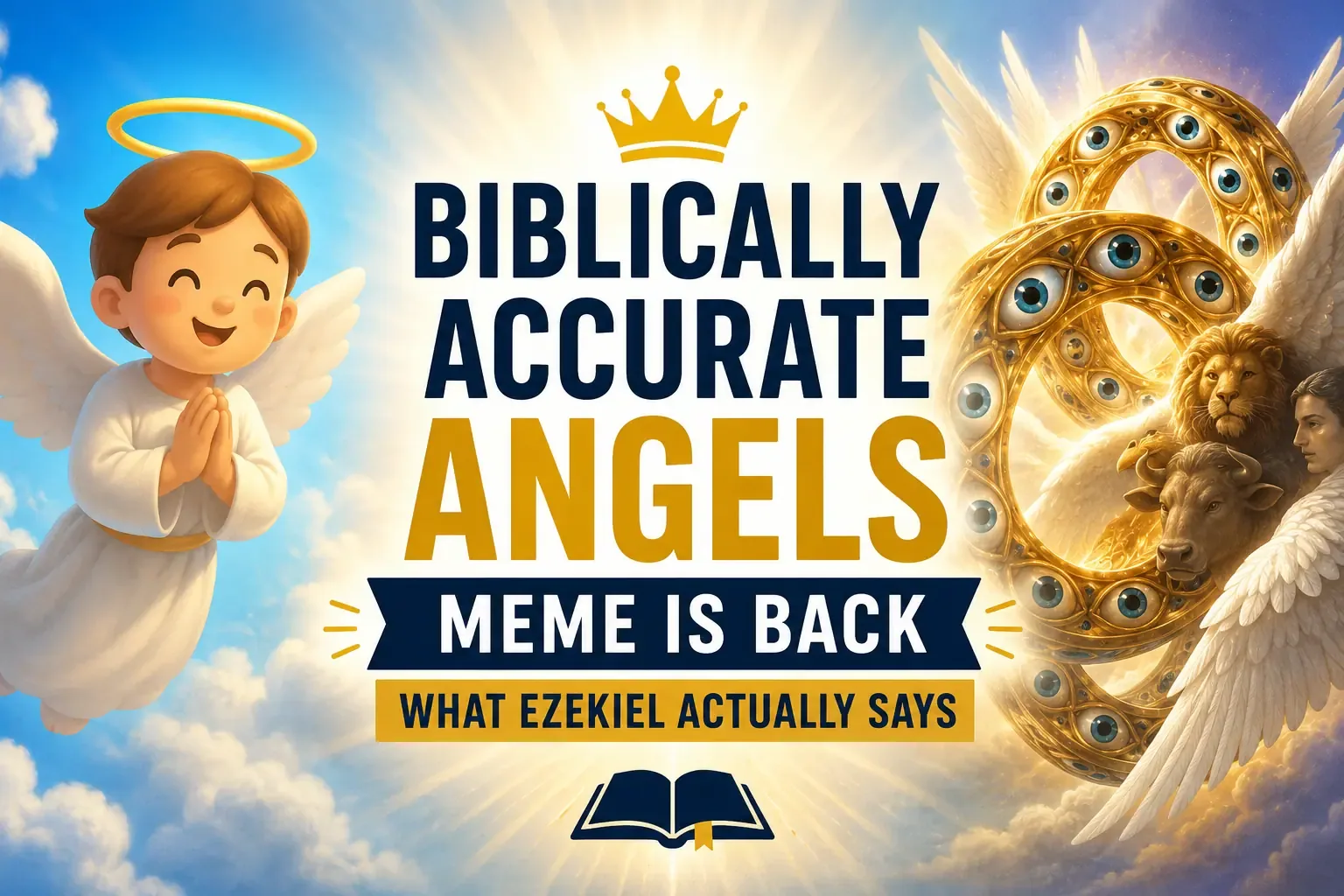
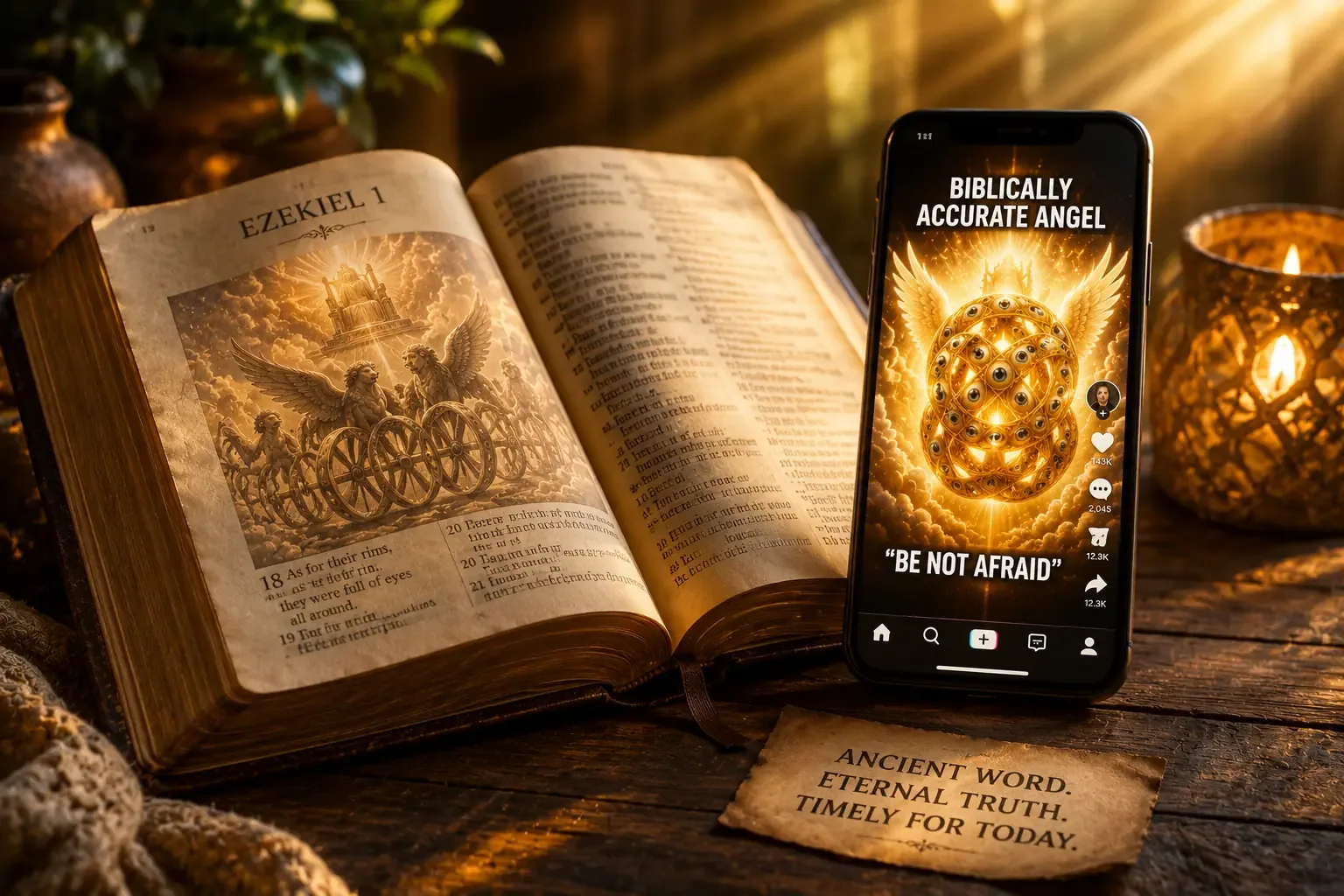
Yes, the wheel covered in eyes is really in the Bible — Ezekiel 1:18 says the rims were "full of eyes all around." But here's what the memes never tell you: that creature isn't what most angels in the Bible look like, and the reason it looks so strange is more interesting than the joke.
If you've been scrolling TikTok or Instagram in 2026, you've seen it. A glowing ring of interlocking wheels, dozens of eyes, six wings, maybe four faces — with a caption like "Be not afraid."
The videos rack up hundreds of thousands of views. The comments are full of the same two questions: "Is this actually in the Bible?" and "Why would God make angels look like that?"
Most articles online only answer the first question, and only halfway. They trace the meme's history — Tumblr posts, the 2020 Swole Doge edit — and stop there.
This post goes further. We'll open the actual passages — Ezekiel 1, Ezekiel 10, Isaiah 6, and Daniel 10 — and walk through what they say, what they mean, and why the "biblically accurate angel" label is both kind of right and kind of wrong.
What the Meme Actually Is (60-Second History)
The joke is simple. Western art shows angels as gentle winged people or chubby babies. The Bible's strangest visions show something wildly different — wheels, eyes, faces, fire.
The meme puts those two pictures side by side. The punchline is almost always the angel's opening line: "Be not afraid." As in — of course you'd be afraid of a flaming eye-wheel.
The idea floated around Tumblr and Reddit in the late 2010s. It fully took off as a meme in 2020, boosted by a popular Swole Doge edit on Reddit's r/me_irl that contrasted intimidating biblical angels with their serene artistic counterparts.
Since then, it's never really died. In 2025–2026 the format has surged again on TikTok, with Bible scholars like Dan McClellan making explainer videos debunking myths about it, and apologists like Wesley Huff pushing back with videos arguing the meme angels are "not really" accurate.
Individual meme videos regularly pull massive numbers — one popular TikTok reaction video on the topic sits at over 143,000 likes. That's the reach. Now let's get to the substance.
Quick Answer: Is the Meme Real Scripture or Exaggeration?
Both. Here's the honest scorecard before we dig in.
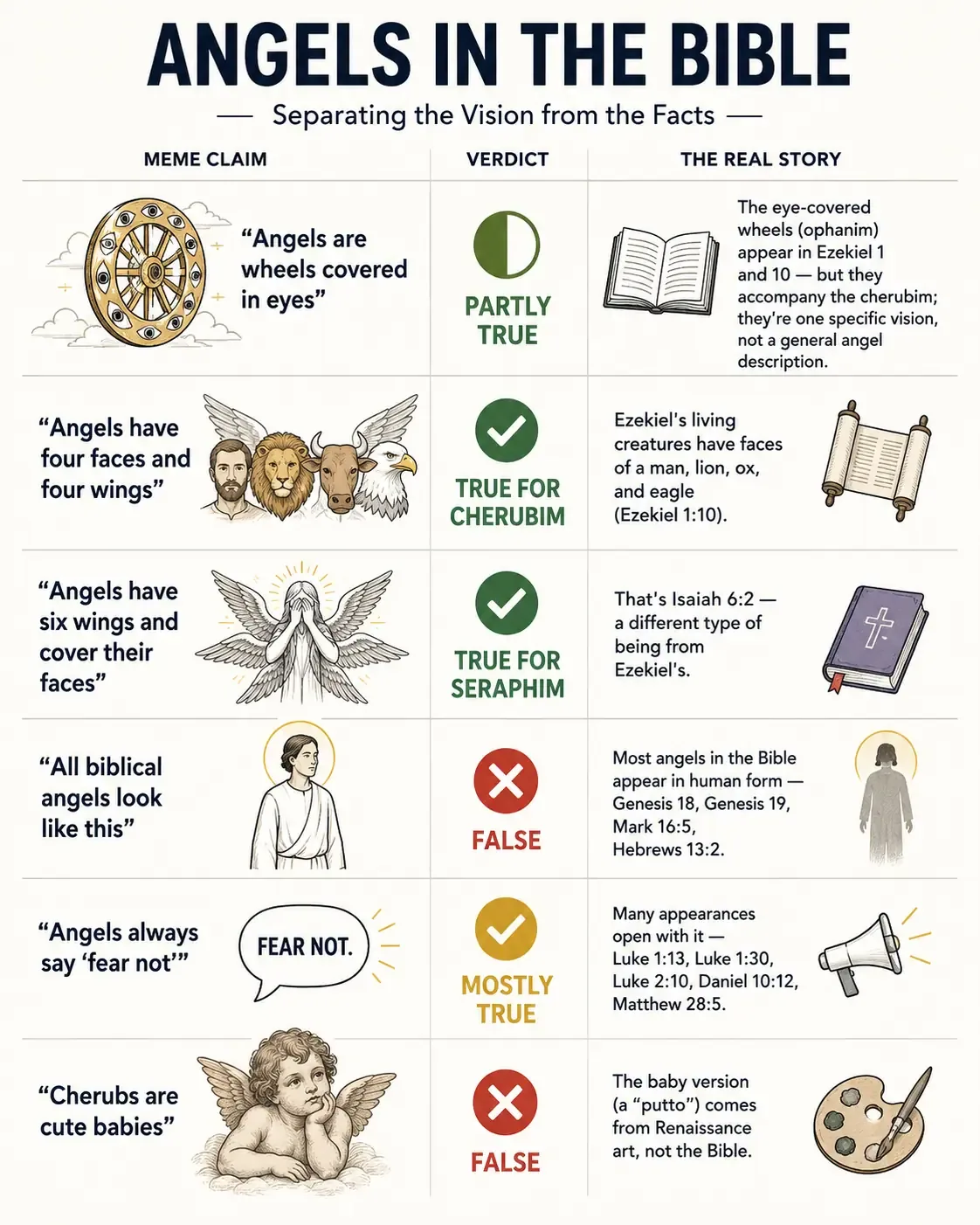
So the meme isn't lying — it's just cropping the photo. It takes the Bible's most extreme throne visions and labels them "what all angels look like."
Let's open the four key passages one by one.
Ezekiel 1: The Four Living Creatures
Ezekiel was a priest living as a captive in Babylon around 593 BC. Chapter 1 records his opening vision by the Kebar River — and it's the source text for most of the meme.
What Ezekiel Actually Saw
First comes a storm cloud flashing with fire (Ezekiel 1:4). Out of it step four living creatures.
Each one has a human-like form but four faces — a man, a lion, an ox, and an eagle (Ezekiel 1:10). Each has four wings, legs that gleam like polished bronze, and they move like flashes of lightning (Ezekiel 1:14).
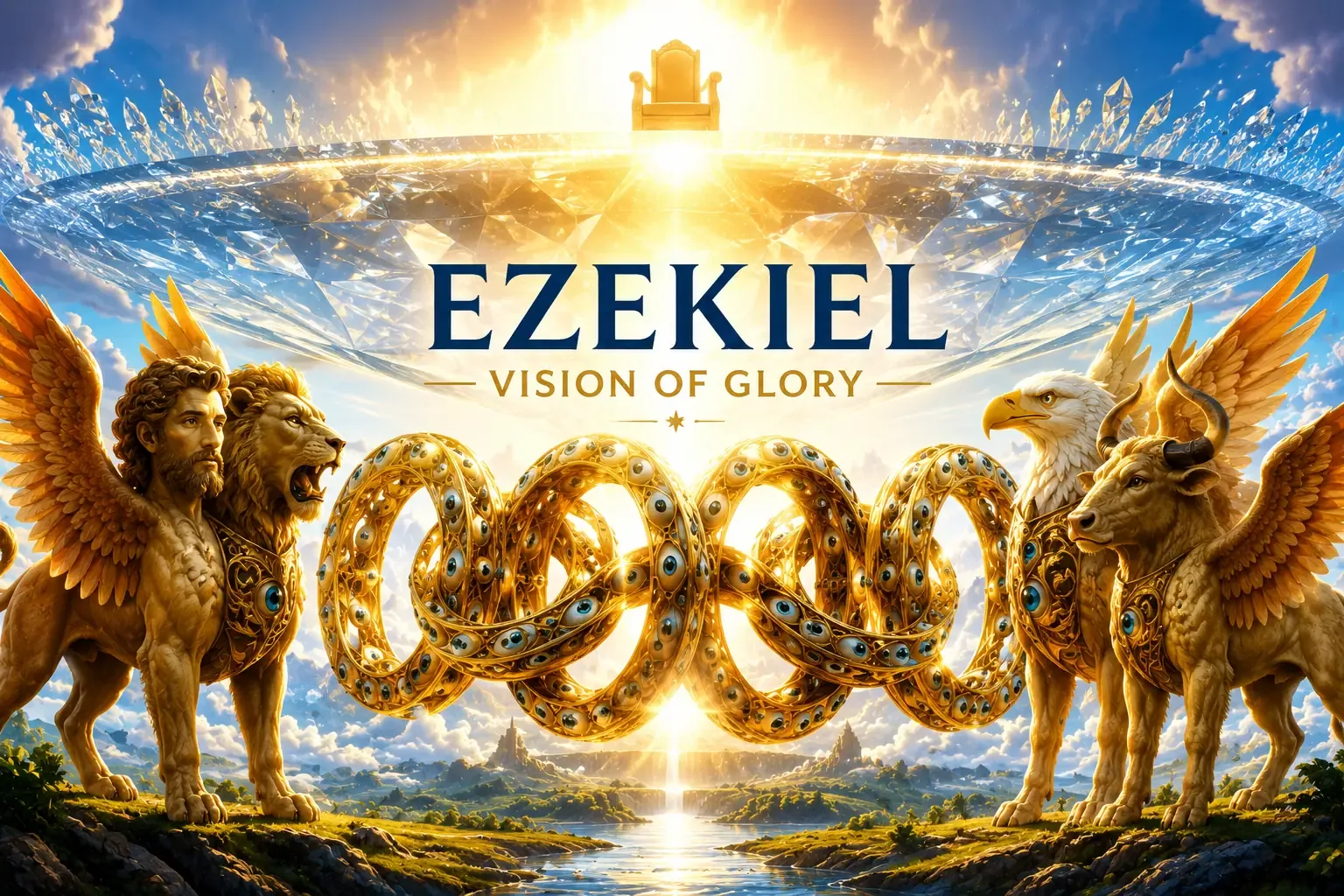
Then come the famous wheels. Beside each creature is a wheel that looks like "a wheel intersecting a wheel" — a wheel inside a wheel — and "their rims were full of eyes all around" (Ezekiel 1:16–18).
Above the creatures stretches a sparkling crystal expanse. Above that is a throne, and on the throne, a figure glowing like fire — the glory of the LORD (Ezekiel 1:26–28).
Ezekiel's response? He falls on his face. No jokes, no captions — just a man flat on the ground.
What It Means (In Plain English)
Here's the key most meme explainers miss: this is a vision, and every strange detail is doing a job. Ancient visions communicated through symbols the way we communicate through emojis — the picture is the message.
The four faces represent the peak of creation: humans (wisest), lions (strongest wild animal), oxen (strongest tame animal), eagles (greatest bird). Together they say these beings carry the full power of the created world.
The eyes everywhere mean nothing escapes their sight. God's servants see all directions at once — you cannot sneak past heaven.
The wheels within wheels mean movement in any direction without turning. God's throne isn't stuck in the Jerusalem temple — it can travel anywhere, even to exiles in Babylon.
That last point was the whole message for Ezekiel's original audience. Judean captives thought God was left behind in Jerusalem. The vision says: God's throne has wheels. He came with you.
Ezekiel 10: The Wheels Get a Name
Nine chapters later, the same beings return — and Ezekiel finally identifies them. "These were the living creatures I had seen by the Kebar River... and I realized that they were cherubim" (Ezekiel 10:15, 20).
That's a bombshell for the meme discussion. The terrifying four-faced beings are cherubim — the same category of angel that Renaissance painters turned into chubby flying babies.
The Ophanim: The Wheels Themselves
Ezekiel 10:12 goes further than chapter 1: "Their entire bodies, including their backs, hands and wings, were completely full of eyes, as were their four wheels." The wheels are even called "the whirling wheels" (Ezekiel 10:13).
Later Jewish tradition gave these wheels their own name — the ophanim, from the Hebrew word for "wheel." Some traditions treat them as their own class of heavenly being.
So when a TikTok video shows a floating eye-covered wheel, that's the ophanim of Ezekiel 10. It's genuinely biblical imagery — the meme just presents a throne-vision detail as a standalone monster.
Why Chapter 10 Matters More Than Chapter 1
Chapter 10 isn't a rerun. It's one of the saddest scenes in the Old Testament: God's glory leaving the temple because of Israel's sin.
The cherubim and wheels are the moving vehicle of that departure. The imagery that makes people laugh online was, in context, a funeral procession for a nation's relationship with God.
That's a good reality check for meme culture. The pictures are real — but they were never meant to be funny.
Isaiah 6: The Seraphim (The Six-Winged Ones)
About 150 years before Ezekiel, the prophet Isaiah had his own throne vision — and met a completely different kind of being.
What Isaiah Saw
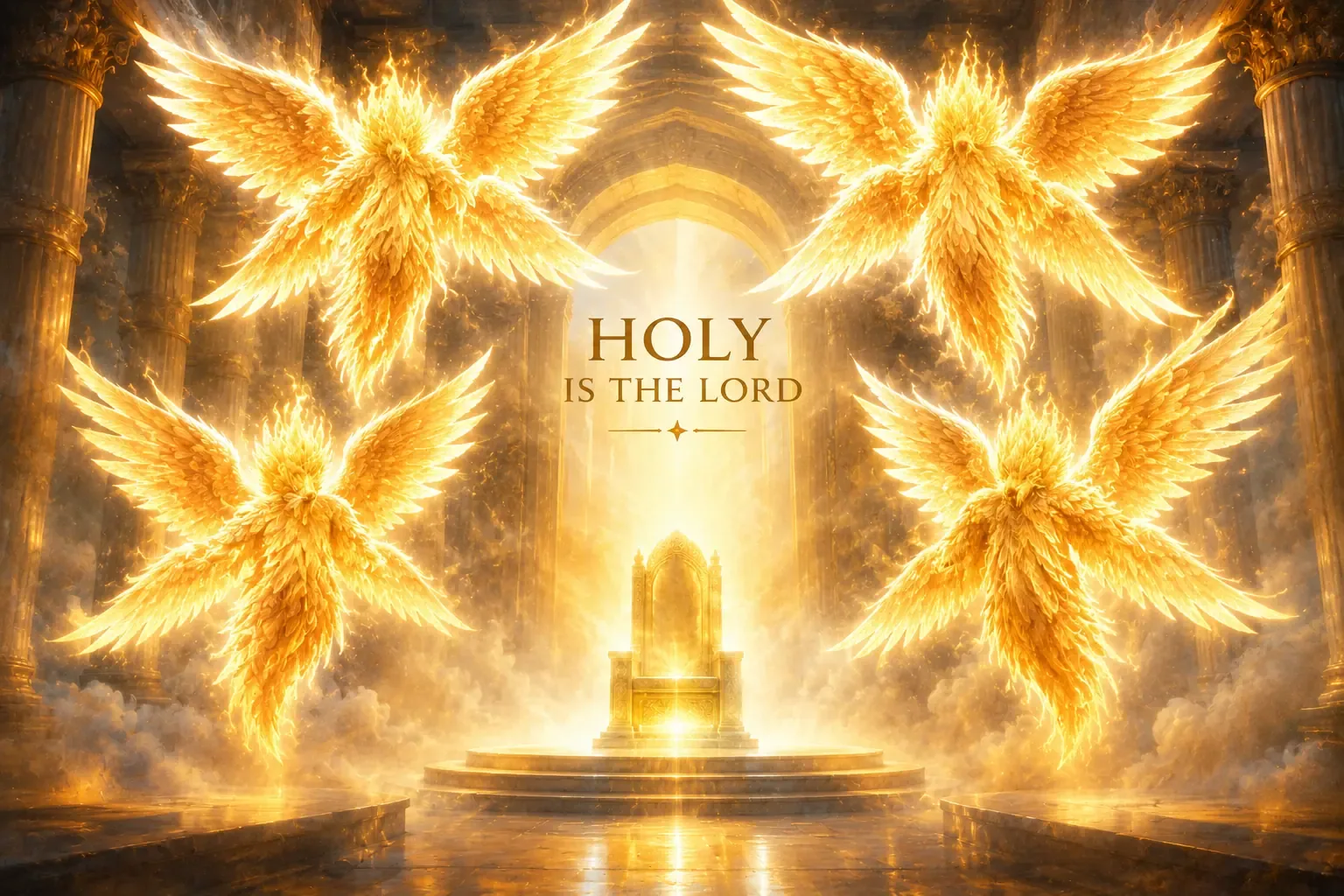
"I saw the Lord, high and exalted, seated on a throne... Above him were seraphim, each with six wings: With two wings they covered their faces, with two they covered their feet, and with two they were flying" (Isaiah 6:1–2).
They call to each other "Holy, holy, holy is the LORD Almighty" — so loudly the doorposts shake and the temple fills with smoke (Isaiah 6:3–4).
The word seraphim literally means "burning ones." These are creatures of fire, and one of them carries a live coal from the altar to touch Isaiah's lips (Isaiah 6:6–7).
The Detail Everyone Misses
Notice what the seraphim do with four of their six wings: they cover themselves. Even beings made of fire shield their faces before God.
That's the actual point of the passage — not "angels look weird," but "God is so holy that even the burning ones can't look straight at Him." The strangeness of the seraphim is a measuring stick for the holiness of God.
Isaiah's reaction matches Ezekiel's: "Woe to me! I am ruined!" (Isaiah 6:5). If you want more from this book, we've written about God's promises elsewhere in Isaiah, where the same holy God speaks in surprisingly tender terms.
Daniel 10: The Angel That Terrified a Prophet
Daniel 10 is the passage that best explains the meme's punchline — the "be not afraid" part.
What Daniel Saw
Daniel sees "a man dressed in linen, with a belt of fine gold... his body was like topaz, his face like lightning, his eyes like flaming torches, his arms and legs like the gleam of burnished bronze, and his voice like the sound of a multitude" (Daniel 10:5–6).
Note: this being is human-shaped. No wheels, no extra faces. And yet the effect is devastating.
The men with Daniel don't even see the vision — they feel it and run (Daniel 10:7). Daniel's strength drains, his face turns deathly pale, and he collapses face-down (Daniel 10:8–9).
Then Comes the Famous Line
The being touches Daniel, sets him trembling on his hands and knees, and says: "Do not be afraid, Daniel" (Daniel 10:12).
This is the pattern the meme is riffing on, and it's real. Gabriel says it to Zechariah (Luke 1:13) and Mary (Luke 1:30). An angel says it to shepherds (Luke 2:10) and to the women at the empty tomb (Matthew 28:5).
But here's the correction to the meme: Daniel wasn't scared because the angel was ugly. The being looked like a glorious man — and Daniel still collapsed. The fear comes from raw heavenly presence, not from tentacles and eyeballs.
So What Do Most Biblical Angels Actually Look Like?
This is the biggest thing the meme gets wrong, and almost no viral video mentions it.
The Hebrew word malak and the Greek word angelos both simply mean "messenger." When these messengers show up in Scripture, they overwhelmingly appear in human form.
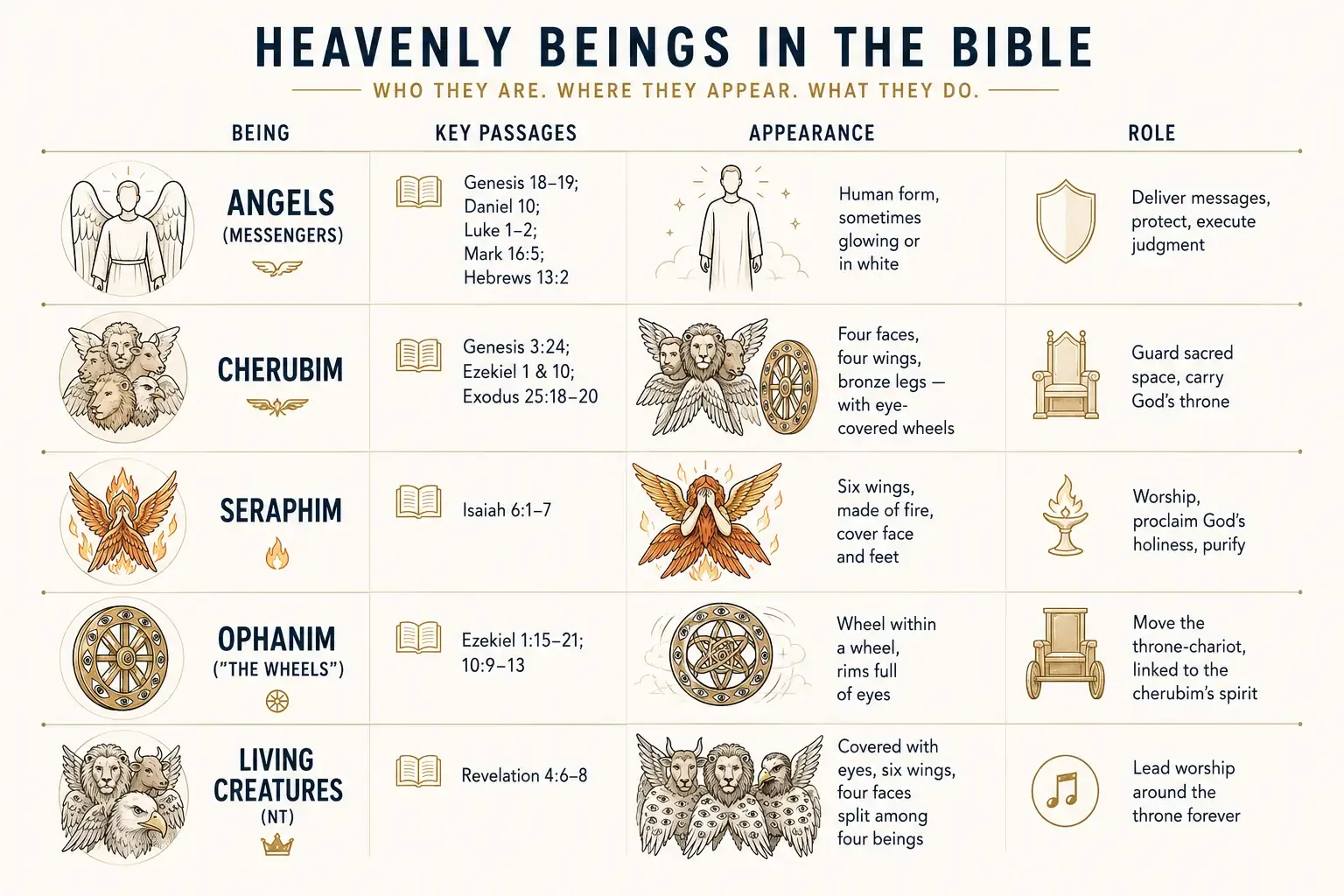
Read that table closely and you'll notice something. The "weird" beings — cherubim, seraphim, ophanim — are throne-room creatures. They appear when a prophet gets a rare glimpse of heaven itself.
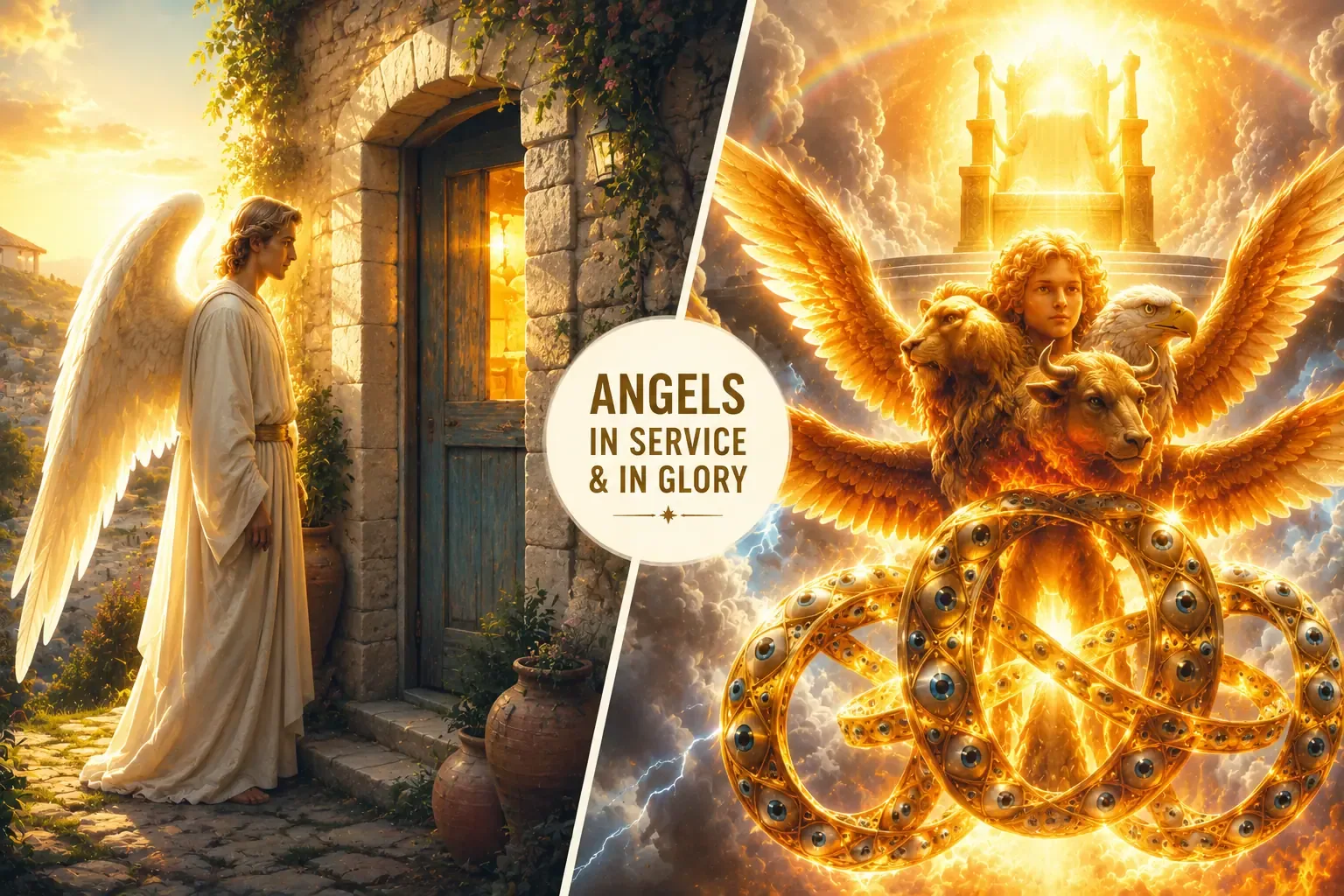
The beings sent to people — to Abraham, Lot, Gideon, Mary, the shepherds — look like men. Hebrews 13:2 even says some people "have shown hospitality to angels without knowing it." You can't accidentally host an eye-covered wheel for dinner.
So the most technically accurate statement is this: the meme shows biblically accurate cherubim and seraphim, but biblically inaccurate angels. The scholars going viral debunking the trend are making exactly this point.
Why Does Scripture Describe Them This Way? (The Part Memes Skip)
Here's the deeper answer curious viewers are actually looking for. Three reasons.
1. The Visions Use Symbols on Purpose
Prophets describe the indescribable using stacked comparisons. Count the hedge words in Ezekiel 1: "the appearance of," "the likeness of," "something like." Ezekiel uses this kind of language over a dozen times in one chapter.
He's not drawing a biology diagram. He's saying: the closest thing I can compare it to is... Eyes = total awareness. Wheels = unlimited movement. Fire = purity and danger. Four faces = all of creation serving God.
A 5th grader version: the vision is written in picture-language, like a dream. You don't measure a dream with a ruler — you ask what it means.
2. Ancient Audiences Recognized the Imagery
Ezekiel's neighbors in Babylon carved giant guardian statues called lamassu — winged beings with the body of an ox or lion, eagle wings, and a human head. Sound familiar? Those are the same four creatures in Ezekiel's vision.
Babylonians put lamassu at palace gates to guard the king. Ezekiel's vision takes that familiar picture and says: the real King's guardians are alive, on fire, and mobile — and they answer to the God of Israel, not to Babylon.
That's not copying; that's confronting. The vision spoke the visual language of its day to make a point about who's really in charge.
3. The Strangeness Protects Us From a Small God
Comforting angel art has a hidden cost: it can shrink God to greeting-card size. The throne visions do the opposite.
If God's servants make prophets collapse, what is God like? Every strange detail pushes the reader toward the same conclusion Isaiah reached: "Holy, holy, holy."
Scripture actually warns against making the servants the focus. In Revelation 19:10, John falls at an angel's feet and the angel snaps: "Don't do that! ... Worship God!" The beings are signposts, not the destination.
Real-World Moments This Meme Creates (And How to Handle Them)
The meme isn't just entertainment — it's creating real conversations in real places. Here are common situations, based on what's actually happening in comment sections, youth groups, and classrooms, with practical ways to respond.
When Your Kid Shows You a Terrifying Angel Video
This happens constantly. A 10-year-old sees an AI-generated eye-wheel with horror-movie music and asks, "Is this in the Bible? Will I see one?"
Don't dismiss it and don't lecture. Say something like: "That picture comes from a special vision one prophet had of God's throne room. Most angels in the Bible look like regular people — and every time one showed up, their first words were 'don't be afraid.'"
Then flip fear into comfort. Read Psalm 91's promise of angelic protection together — "He shall give his angels charge over thee, to keep thee in all thy ways" (Psalm 91:11). Same beings, totally different job: guarding you.
When Someone in the Comments Says "Christians Don't Even Know Their Own Book"
The meme is often used as a gotcha — "your cute angels are fake, the Bible's angels are cosmic horrors." Here's a calm, accurate reply that wins the exchange:
"Partly right! The cherubim and seraphim in Ezekiel and Isaiah really are that strange — the baby-angel look came from Renaissance art. But most angels in Scripture appear as men (Genesis 18, Mark 16:5, Hebrews 13:2). The wild imagery belongs to throne visions, and the symbols have meanings: eyes = nothing escapes God's sight, wheels = God's presence isn't stuck in one place."
That answer concedes what's true, corrects what's false, and adds something the other person didn't know. That's how you turn a dunk into a discussion.
When the Meme Actually Scares You
Some viewers aren't laughing. Search data and comment threads show a steady stream of people who find these images genuinely disturbing, especially at night.
Two anchors help. First, throne visions were rare — a handful of prophets across 1,500 years of biblical history. Scripture gives zero examples of an ophanim appearing to an ordinary person.
Second, notice what every heavenly messenger does when a human is afraid: they close the distance and calm the person. The angel touches Daniel before speaking (Daniel 10:10). Fear is never the goal — it's the thing heaven immediately works to remove. For a fuller treatment, see what the Bible says about overcoming fear, or browse these faith over fear scriptures.
When You Want to Use the Meme for Good
Youth leaders and Bible teachers: this trend is a gift. You have a generation asking to study Ezekiel 1 — a chapter most adults have never read.
A simple 30-minute study plan that works:
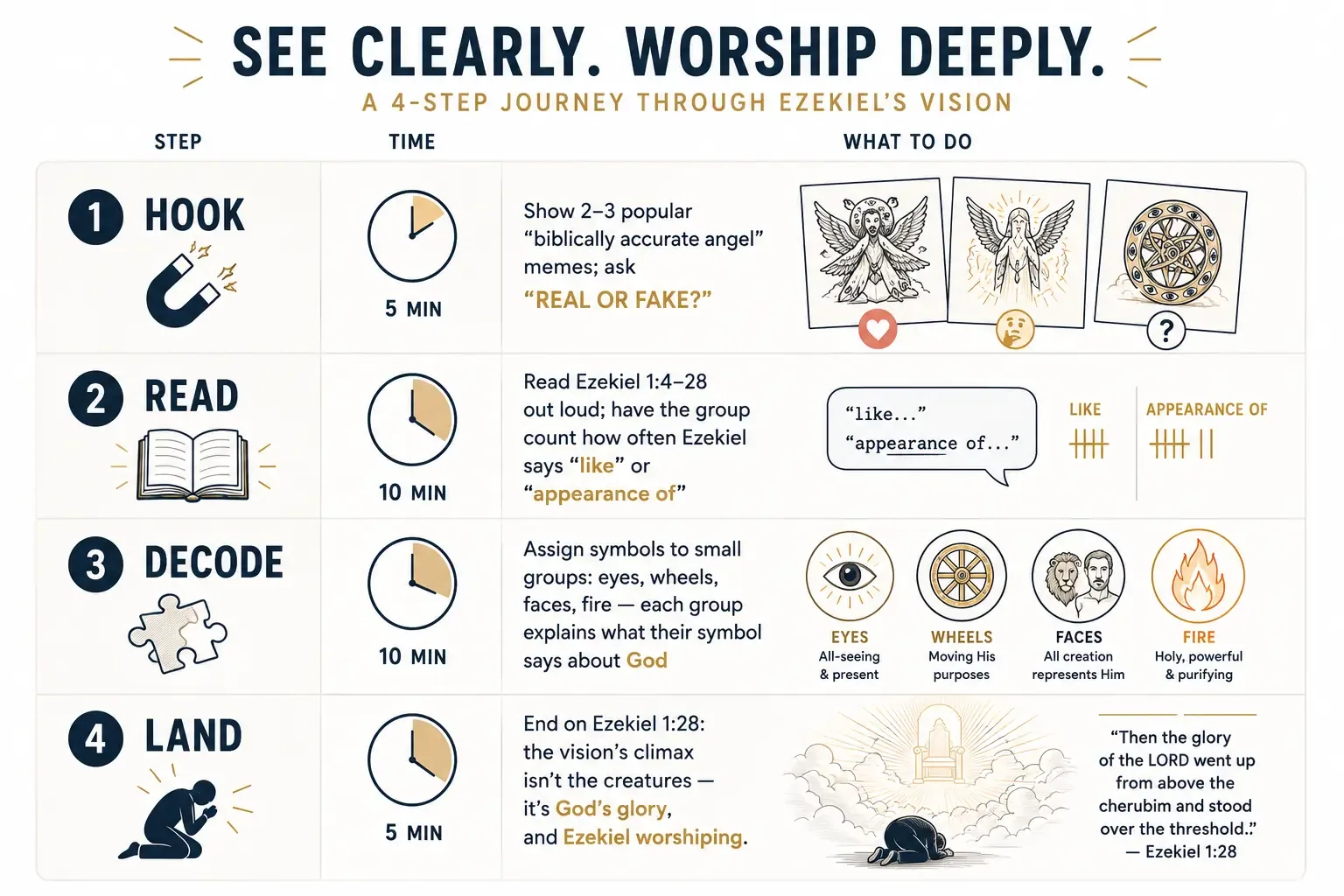
The counting exercise is the secret weapon. Once students see the simile language for themselves, they understand vision-literature better than most meme creators do.
What Angels Actually Do (Beyond Looking Strange)
The meme fixates on appearance. Scripture fixates on function. A quick tour of what these beings are actually for:
They deliver messages. Gabriel announces the births of John the Baptist and Jesus (Luke 1). That's the core meaning of the word "angel."
They protect. Psalm 91:11–12 promises angelic guardianship for those who dwell in God's shelter. An angel shuts lions' mouths for Daniel (Daniel 6:22) and breaks Peter out of prison (Acts 12:7–10).
They execute judgment. This side gets forgotten. Psalm 35 asks for the angel of the LORD to pursue and drive away the psalmist's enemies (Psalm 35:5–6). Angels aren't greeting-card decorations — they're soldiers.
They worship. The seraphim of Isaiah 6 and the living creatures of Revelation 4 do this "day and night without ceasing." Whatever else heaven's beings are, they are worshipers first.
They accompany God's communication. Ezekiel 1 and Daniel 10 are both visions — one of the ways God spoke to prophets. If that topic grabs you, here's a full guide on how God speaks to people and how to test what you think you're hearing.
FAQ: Biblically Accurate Angels Meme Meaning
Are biblically accurate angels real, or is the meme exaggerating?
The imagery is real Scripture — eye-covered wheels (Ezekiel 1:18; 10:12), four-faced cherubim (Ezekiel 1:10), and six-winged seraphim (Isaiah 6:2) are all in the Bible. The exaggeration is the label: these are specific throne-room beings from prophetic visions, not what "angels" generally look like. Most angels in the Bible appear in human form.
Where does the wheel covered in eyes come from?
Ezekiel 1:15–21 and Ezekiel 10:9–13. Each cherub has a "wheel intersecting a wheel" beside it, with rims "full of eyes all around." Later Jewish tradition calls these wheels the ophanim, Hebrew for "wheels."
Do angels really say "be not afraid"?
Yes, frequently. Examples: Daniel 10:12, Luke 1:13, Luke 1:30, Luke 2:10, and Matthew 28:5. But they say it because heavenly presence overwhelms people — Daniel collapsed before a human-shaped angel — not because they're monsters.
What's the difference between cherubim, seraphim, and ophanim?
Cherubim guard sacred space and carry God's throne (four faces, four wings — Ezekiel 1 and 10). Seraphim are "burning ones" who worship around the throne (six wings — Isaiah 6). Ophanim are the eye-covered wheels that move with the cherubim (Ezekiel 1 and 10). They're different beings with different jobs.
Why does art show angels as babies then?
The chubby winged baby is a putto — a figure borrowed from Greek and Roman art (think Cupid) that Renaissance painters attached to religious scenes. It has no biblical source. Real cherubim guarded Eden with a flaming sword (Genesis 3:24).
Should Christians be bothered by the meme?
Most pastors and scholars engaging the trend treat it as an opportunity, not an attack. It sends millions of people to Ezekiel 1 — a passage they'd otherwise never open. The only real correction needed is the overreach: throne beings aren't the template for all angels.
Will I ever see a biblically accurate angel?
Scripture records throne visions for only a handful of prophets across roughly 1,500 years. Meanwhile, Hebrews 13:2 suggests angelic encounters can be so ordinary you'd miss them. Statistically and biblically, the eye-wheel is the last form you'd expect.
Is the meme disrespectful to the Bible?
The meme itself is usually affectionate — it's laughing at Renaissance art's softness, not at Scripture. Where it goes wrong is context: Ezekiel 10's imagery describes God's glory departing the temple, one of the most sorrowful moments in the Old Testament. Knowing that adds weight the meme can't carry.
The Bottom Line
The "biblically accurate angels" meme is that rare internet joke that's more interesting when you fact-check it. Yes, the eye-covered wheels are real. Yes, the four faces and six wings are real. Yes, "be not afraid" is practically an angelic catchphrase.
But the full picture is better than the punchline. The strange beings are throne-room guardians whose every feature — eyes, wheels, fire, faces — is a symbol saying the same thing: God sees everything, goes everywhere, and is holier than we can imagine.
And the beings God actually sends to people? They look like us, they meet us in our fear, and their first move is always the same: Do not be afraid.
So next time the meme crosses your feed, you'll know something the caption doesn't say. The joke is that angels are terrifying. The truth is that the terrifying ones never leave the throne room — and the ones sent to you come in peace.
Key Statistics
Ezekiel's Wheel Description
Rims "full of eyes all around"
The famous eye-covered wheels originate from Ezekiel's throne vision.
Source: Ezekiel 1:18
Living Creatures
4
Ezekiel's vision includes four living creatures surrounding God's throne.
Source: Ezekiel 1:5
TikTok Reaction Video Likes
143,000+
Example of the meme's popularity on social media.
Source: TikTok (referenced in article)
Credible Sources
BibleGateway · Bible text
Primary source describing the living creatures, wheels, and eyes central to the meme.
Oxford University Press · January 1, 2001
Academic reference widely cited for historical and literary interpretation of prophetic visions.

About the Author
Editorial Team
Editorial Team
Daily Faith Path articles are prepared by the editorial team to help readers find scripture-centered guidance for healing, faith, prayer, and spiritual encouragement.
Expertise: Healing scriptures, Bible study resources, prayer guidance, devotional writing, Christian encouragement
Experience: The team researches scripture references, reviews surrounding biblical context, compares translation wording where useful, and updates articles to improve clarity, usefulness, and trust for readers.
Credentials: Editorial review, devotional writing, scripture study, content updating
This article is published by the Daily Faith Path editorial team to help readers use scripture carefully, prayerfully, and in ways that are practical for real-life seasons of illness, grief, waiting, and spiritual reflection.
Continue Reading
Related articles

October 7, 2026
12 Bible Verses About Hiding Money From Your Spouse
Explore 12 Bible verses about secret spending, hidden debt, financial honesty, confession, forgiveness, boundaries, and rebuilding trust in marriage.

October 6, 2026
15 Bible Verses for Couples Who Keep Fighting About Money
Money fights are rarely just about dollars. These 15 Bible verses help couples address spending, saving, debt, secrecy, unequal income, giving, and financial control with practical next steps and conversation questions.

October 5, 2026
Should You Tithe While in Debt? 11 Bible Passages to Study First
Should you tithe while in debt? Explore 11 Bible passages on tithing, debt, generosity, family responsibility, and giving according to your means—plus a practical plan for deciding what to do.