The Red Heifer Prophecy, Explained Without the Hype
The red heifer prophecy has generated enormous attention online, but how much of it is actually true? Learn what Numbers 19 really teaches, the current status of the red heifer ceremony, why the 2025 practice burn wasn't the biblical ritual, and how the Third Temple discussion fits into biblical prophecy without the hype.
Here's the short version nobody puts in a headline: no qualified red heifer has been sacrificed, no Third Temple is being built, and every viral "it happened" video so far has been officially corrected by the very groups running the project. That's the whole story in one sentence — and this article will show you the receipts.
If you've seen "Third Temple in 2026" flash across your feed and felt a jolt of curiosity (or anxiety), you're in the right place. No countdown clocks here. Just the actual Bible text, the real status of the ceremony, the history, and honest answers.
Why Is Everyone Suddenly Talking About a Red Cow?
In September 2022, five red heifers were flown from a ranch in Texas to Israel. Jewish tradition says the animal should be around three years old before it can be used in the biblical ceremony. Do the math, and the "maturity window" landed between late 2025 and 2026.
That's it. That's why your feed exploded. A shipping date plus a birthday created a deadline that prophecy channels could count down to.
Then real events kept feeding the cycle. On July 1, 2025, a red heifer that had been housed at Shiloh was burned on a pyre at an undisclosed location in Samaria. Videos went viral within hours. "The prophecy is fulfilled!" Except it wasn't — and the organizers themselves said so.
Both the Temple Institute and the Sanhedrin issued official statements clarifying that the animal burned was not a qualified red heifer according to biblical standards. It was a practice run. A rehearsal. The Temple Institute explained that the process includes practical experiments and exercises because the ritual involves thousands of details.
Almost nobody shared the correction. The rumor got millions of views. The clarification got a fraction. That gap — between viral claim and quiet correction — is the single most important thing to understand about this whole topic.
What Numbers 19 Actually Says (In Plain English)
Before forming an opinion on any prophecy claim, read the source text. The red heifer law sits in Numbers chapter 19, part of the law given through Moses. It's not in Revelation. It's not in Daniel. It's a purity law from roughly 3,400 years ago.
Here's what the chapter requires, simplified:
The animal. A red cow (some translations say "heifer," others "cow" — how Bible translations differ matters here). It must be without defect or blemish. And it must never have worn a yoke — meaning it never did farm work.
The ceremony. The cow is taken outside the camp and slaughtered. Then the entire animal is burned — hide, flesh, blood, everything. Cedar wood, hyssop, and scarlet wool are thrown into the fire.
The purpose. The ashes are collected and mixed with fresh water. This mixture is called the "water of purification." It's sprinkled on people who became ritually impure by touching a dead body. On day three and day seven, they're sprinkled. Then they're clean.
That's the whole function. Think of it like a spiritual decontamination shower for one specific type of impurity: contact with death.
What Numbers 19 Does NOT Say
Read the chapter yourself and notice what's missing. There is no mention of a Third Temple. No end-times timeline. No "when the heifer is burned, the countdown begins."
The connection to a future temple is indirect, and it works like this: Jewish law says priests must be ritually pure to serve in a temple. Since everyone today is presumed impure from contact with death (even indirectly), you'd need red heifer ashes to purify priests before temple service could restart. So the heifer is a prerequisite for temple worship — not a trigger for temple construction.
That's a huge difference. A driver's license is a prerequisite for driving. Getting one doesn't mean you own a car, have gas money, or that the roads exist.

The Rules Are Stricter Than You Think
Here's the part hype videos skip: qualifying a red heifer is astonishingly hard. Jewish tradition (recorded in the Mishnah, tractate Parah) built a wall of requirements around this animal.
Two hairs can end it. Just two non-red hairs, by the strictest standard, disqualify the animal. Inspectors examine the cow hair by hair. Some candidates have been disqualified by a few white or black hairs appearing as they aged.
No yoke, ever. The animal can never have carried a burden or done work. Even leaning on the cow, by some opinions, could be a problem. That's why candidate heifers live pampered, carefully guarded lives.
No blemishes. Injuries, scratches from a fence, an eye issue — any physical defect disqualifies.
Age matters. Tradition holds the heifer should be in her third or fourth year. Too young doesn't count. And every extra month alive is another month for a stray white hair to grow.
Jewish tradition itself calls the red heifer the most enigmatic and difficult law in the Torah, and says few scholars are true experts in it. Even King Solomon, according to rabbinic legend, said he couldn't fully understand this one.
This is why the ceremony hasn't happened in nearly 2,000 years. According to Maimonides, only nine red heifers were ever prepared in all of Israelite history — from Moses to the destruction of the Second Temple in 70 AD. Nine. In roughly 1,400 years.
That stat alone should reset your expectations about anyone promising a date.
The Real Status in Mid-2026: A Timeline Without Spin
Let's lay out what has actually happened, sourced from the organizations involved — not from reaction videos.
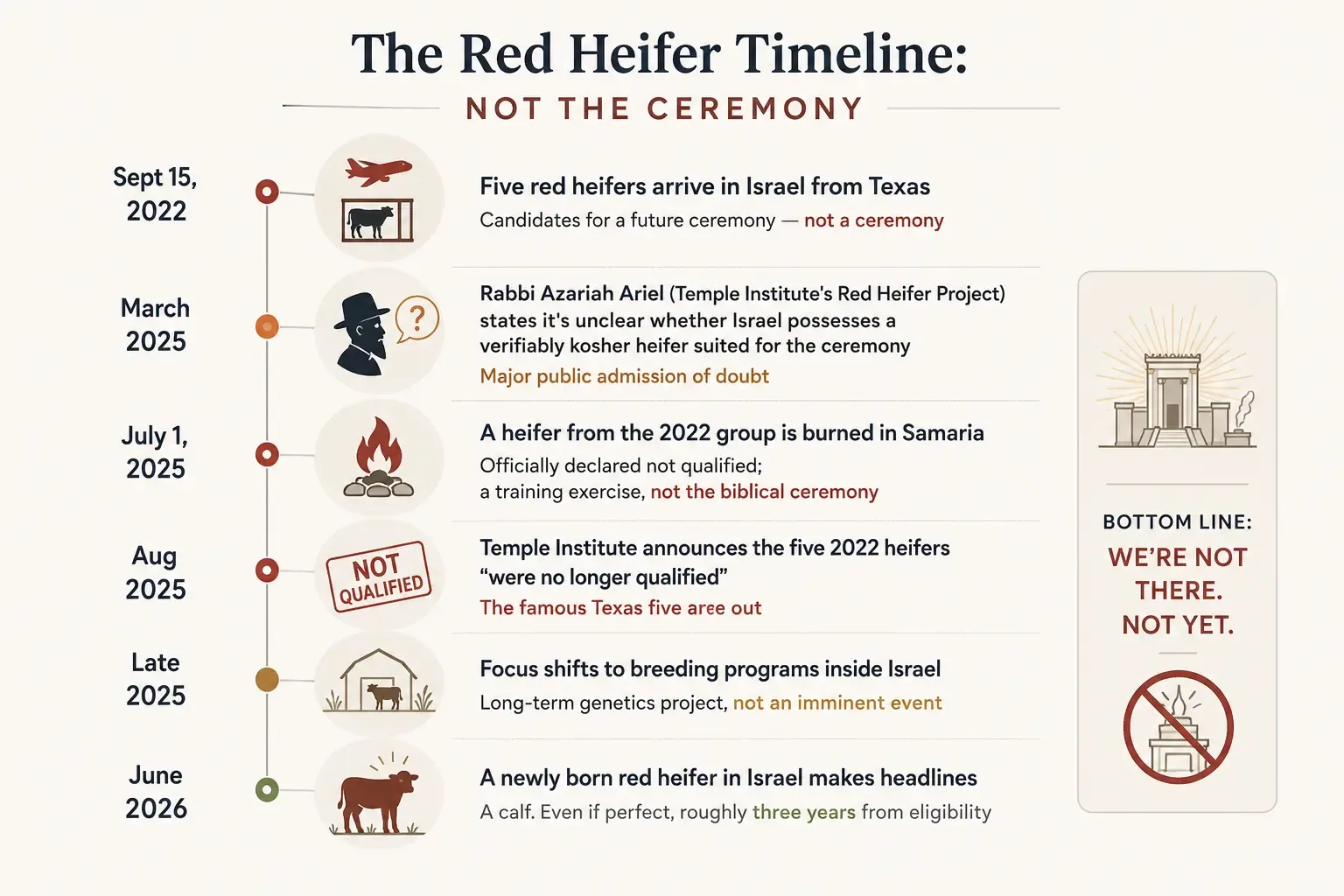
Notice the pattern? Every "it's happening" moment resolved into "not yet, still preparing." As of mid-2026, there is no verified biblical red heifer sacrifice and no Third Temple construction underway.
Meanwhile, one genuinely notable trend is real: Temple Mount interest is surging. About 65,000 Jewish ascents to the Temple Mount were recorded in the Hebrew year 5785, compared to roughly 54,000 the year before. On Tisha B'Av 2025, a record 3,527 Jewish visitors ascended in a single day — a jump of over 32% above the previous record.
Those numbers are worth watching. They reflect a real religious and political shift in Israel. But visits to a site are not blueprints for a building.
This Has Happened Before: A Short History of Heifer Hype
Here's the unique angle almost no 2026 coverage gives you: we've run this exact news cycle multiple times. Knowing the pattern is the best inoculation against panic.
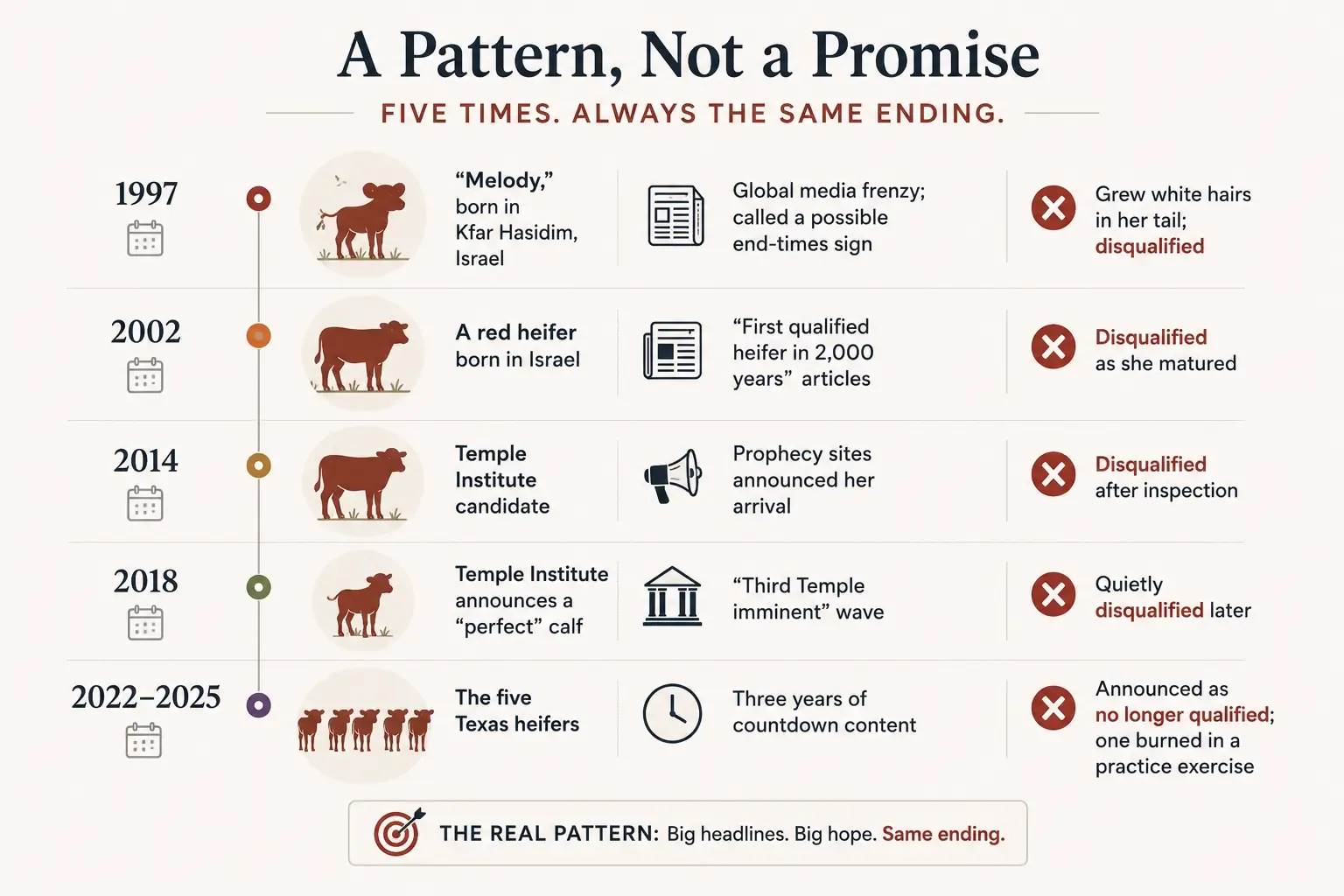
Five hype cycles in under 30 years. Each one produced viral certainty. Each one ended with a disqualification or a clarification. The 2026 cycle — new calf, new countdown — is following the identical script.
This doesn't mean a qualified heifer can never emerge. It means the base rate for "this specific animal will make it" is, historically, very low. Real-world expertise here means thinking like an actuary, not a headline writer.

The Obstacles the Countdown Videos Never Mention
Even if a flawless heifer were certified tomorrow, a Third Temple would still face barriers that dwarf the cow question. Any honest explainer has to name them.
The Site Itself
The Temple Mount is home to the Al-Aqsa Mosque and the Dome of the Rock — among the holiest sites in Islam, standing there for over 1,300 years. A status quo agreement governing the site goes back to 1967, and Israel's Prime Minister's Office reaffirmed in 2025 that the policy "has not changed and will not change."
Any construction attempt would risk regional war. This isn't a footnote. It's the elephant on the Mount.
Rabbinic Disagreement
For centuries, the mainstream rabbinic consensus held that ritual purity laws still apply to the site, restricting Jews from even visiting — let alone building. Many leading Orthodox authorities teach that the Third Temple arrives in the messianic era, by divine action, not by construction crews. The temple-activist movement, while growing, represents one stream within Judaism, not the whole.
Location Uncertainty
Scholars still debate the exact original spot of the Holy of Holies. Building even slightly in the wrong place would, by Jewish law, invalidate everything. There's no consensus blueprint.
The Covenant Context
Biblically, the temple was never a standalone construction project. It sat inside a covenant relationship — the blessings-and-consequences framework laid out in chapters like Deuteronomy 28. The prophets tied temple worship to national faithfulness, justice, and repentance, not just to correct rituals. Reducing all of that to "find cow, build temple, start clock" flattens the Bible's own storyline.
"But What About the Timing?" — What Scripture Actually Says
Here's where a calm reading of Scripture directly contradicts the countdown-clock genre.
Jesus said plainly that no one knows the day or hour of the end — not the angels, not even the Son, only the Father (Matthew 24:36). That's not a loophole. It's a stated design feature.
And on God's side of the ledger, there's Isaiah 60:22: "in its time, I will do it swiftly." The verse teaches two things at once. God's plans can accelerate suddenly — and the schedule is His, not ours. Every failed prediction in church history (and there have been hundreds, from 1844 to 1988 to 2011) broke on this same rock.
So the intellectually honest position is a both/and: these developments are genuinely interesting to watch, and nobody — no rabbi, no pastor, no YouTuber, no author of this article — knows the timing. Anyone who claims otherwise is selling something, usually urgency.
A Real-World Story: The July 1 Weekend
Let me make this concrete, because this exact scenario played out in thousands of homes.
A grandmother in the American South — call her Linda, a composite of real accounts pastors described that summer — saw a nine-second video on Facebook the weekend of July 1, 2025. Red flames, Hebrew chanting, a caption reading "IT HAS BEGUN." She barely slept. She called her daughter, urged her to get right with God that week, and forwarded the clip to her Sunday school group.
By Monday, the Temple Institute had issued its first official statement addressing the claims circulating on platforms like YouTube, confirming the event was a preparatory exercise. The Sanhedrin echoed that no purification for Temple service was achieved.
Linda never saw the correction. Her feed's algorithm had already moved her to three more "prophecy fulfilled" channels. Her pastor spent two counseling sessions that month walking anxious members back from panic — using, of all things, the Temple Institute's own clarification as the receipt.
The lesson isn't that Linda was foolish. She cared deeply and got played by an information environment built to reward alarm. The lesson is that the primary sources were calmer than the coverage — which brings us to the practical part.

How to Read Prophecy Headlines Without Losing Your Peace: 7 Practical Tips
These are field-tested habits — the same ones media-literacy educators and pastors actually recommend — adapted for prophecy news specifically.
1. Apply the 72-Hour Rule
Never share or emotionally invest in a prophecy headline for three days. In this niche, corrections reliably arrive within 24–72 hours. The July 2025 event, the 2018 calf, the 1997 Melody frenzy — all corrected within days. If it's real, it'll still be real on Thursday.
2. Go to the Primary Source
For red heifer news, that means the Temple Institute's own statements and Israeli press — not reaction videos about reaction videos. Ironically, the groups most eager for the ceremony are often the most careful about claims, because they issue corrections specifically to stop misinformation spreading on social media.
3. Ask the Disqualification Question
Before believing "a qualified heifer exists," ask: has it passed final inspection at age three-plus, by recognized authorities, publicly? Historically, the answer at the hype stage has been no, every single time. One question filters out 90% of clickbait.
4. Watch the Verbs
"Could," "may signal," "paves the way," "experts suggest" — these verbs mean nothing has happened. Train your eye to spot conditional language dressed up as breaking news.
5. Separate Interesting from Imminent
You can find these developments fascinating — a majority of Israeli Jews now supporting temple rebuilding is a real sociological shift — without concluding the world ends next year. Curiosity and calm can share a brain.
6. Read the Actual Chapter
Sit down with Numbers 19 and a good study Bible. Check the cross-references to Hebrews 9, where the New Testament directly discusses the heifer's ashes. Twenty minutes with the text gives you more grounding than twenty hours of videos. If Old Testament law feels intimidating, a beginner Bible study guide can get you oriented first.
7. Audit Your Feed
If a channel has predicted imminent fulfillment more than twice and been wrong, unfollow. That's not cynicism; it's the biblical standard. Deuteronomy 18:22 says a prediction that doesn't come to pass tells you everything you need to know about the predictor.
What This Means for Christians (Without the Panic)
For Christian readers, there's a theological anchor that changes the whole emotional temperature of this topic.
The New Testament book of Hebrews mentions the red heifer by name. Hebrews 9:13–14 argues that if the ashes of a heifer could cleanse the body outwardly, the sacrifice of Christ cleanses the conscience completely. In Christian teaching, the heifer was a signpost — and Christ remains the ultimate and final sacrifice for believers.
Practically, that means a Christian can watch Jerusalem news with genuine interest and zero existential dread. Your standing doesn't hinge on a cow's hair color in Shiloh. Whatever unfolds on the Temple Mount, the instruction from Jesus wasn't "monitor livestock" — it was stay ready, love people, and don't be deceived by those shouting "here it is!" (Matthew 24:23).
For Jewish readers and observers, the developments carry different weight — a centuries-old longing for restored worship, expressed today in study, training, and yes, cattle breeding. You can respect that longing as real and historically profound while still noting, factually, that the ceremony hasn't happened.
Both things are true. That's what hype-free looks like.
FAQ: Your Real Questions, Answered Straight
Has a red heifer been sacrificed in Israel?
Not a qualified one. A heifer was burned in Samaria on July 1, 2025, but the Temple Institute and Sanhedrin both confirmed it did not meet biblical standards and achieved no purification for Temple service. It was a practice exercise.
What happened to the five Texas heifers from 2022?
The Temple Institute announced in 2025 that they were no longer qualified. Some organizers dispute parts of that and say breeding programs will preserve the animals' genetics, but no ceremony occurred with them.
Does the red heifer ceremony mean the Third Temple gets built?
No. The ashes would solve one problem: ritual purification of priests. They do nothing about the site (occupied by Al-Aqsa and the Dome of the Rock), the political status quo, rabbinic disagreement, or location uncertainty. Prerequisite, not trigger.
Is the red heifer mentioned in end-times prophecy?
Not directly. Numbers 19 is a purity law, not a prophecy. The end-times connection is an inference: some readings of Daniel 9, 2 Thessalonians 2, and Revelation 11 assume a functioning future temple, and a temple would require purification, which would require ashes. Every link in that chain is interpretation.
Could the ceremony happen in 2026 or 2027?
The program remains active but fluid, and organizers keep working. But with the 2022 cohort out and the newest candidate born in June 2026, even a flawless calf sits roughly three years from eligibility — and history says most candidates get disqualified before then. Anyone giving you a date is guessing.
Why were only nine red heifers ever prepared?
Because the standard is brutal: completely red (two stray hairs can disqualify), never worked, physically perfect, correct age. Maimonides counted nine from Moses to 70 AD — about one per 150 years. Rarity is the norm, not a sign.
Should Christians be worried or excited?
Neither panicked nor dismissive. Watch with interest, hold timelines loosely, and remember Matthew 24:36 — no one knows the day or hour. Hebrews 9 teaches that for believers, the heifer's purpose is already fulfilled in Christ.
Where can I verify future red heifer claims myself?
Check the Temple Institute's official channels and established Israeli news outlets, wait 72 hours, and ask whether recognized authorities publicly certified the animal at the proper age. If those boxes aren't checked, you're looking at speculation.
The Bottom Line
Strip away the soundtrack and the countdown graphics, and here's the honest state of the red heifer third temple prophecy in mid-2026: real preparations, real religious longing, real record-breaking interest in the Temple Mount — and zero fulfilled ceremonies, zero qualified heifers, zero construction.
Every viral "it happened" moment since 1997 has ended the same way: with the primary sources quietly saying not yet. That's not a conspiracy. It's just what happens when a genuinely difficult ancient ritual meets an attention economy that pays for urgency.
The best response isn't to doomscroll harder. It's to read the texts these headlines are built on — slowly, in context, for yourself. Start with Numbers 19, then Hebrews 9, then the prophets. A Bible reading plan that walks through the Torah and the prophets will give you something no algorithm can: the actual story, at a pace that builds peace instead of panic.
The heifer may come one day. The timing was never ours to know. And you can live wisely, calmly, and faithfully either way.
Word count: ~3,050
Key Statistics
Red heifers transported to Israel
5
Five red heifers were brought from Texas to Israel in September 2022 as candidates for future qualification.
Source: Temple Institute
Traditional maturity age
Around 3 years
Jewish tradition generally considers a red heifer eligible during its third year.
Source: Temple Institute
Credible Sources
Temple Institute · Ongoing
Primary source for official updates regarding red heifer candidates, qualification status, and project announcements.
Sefaria · Continuously maintained
Primary rabbinic source explaining qualification standards for the red heifer.

About the Author
Editorial Team
Editorial Team
Daily Faith Path articles are prepared by the editorial team to help readers find scripture-centered guidance for healing, faith, prayer, and spiritual encouragement.
Expertise: Healing scriptures, Bible study resources, prayer guidance, devotional writing, Christian encouragement
Experience: The team researches scripture references, reviews surrounding biblical context, compares translation wording where useful, and updates articles to improve clarity, usefulness, and trust for readers.
Credentials: Editorial review, devotional writing, scripture study, content updating
This article is published by the Daily Faith Path editorial team to help readers use scripture carefully, prayerfully, and in ways that are practical for real-life seasons of illness, grief, waiting, and spiritual reflection.
Continue Reading
Related articles

October 7, 2026
12 Bible Verses About Hiding Money From Your Spouse
Explore 12 Bible verses about secret spending, hidden debt, financial honesty, confession, forgiveness, boundaries, and rebuilding trust in marriage.

October 6, 2026
15 Bible Verses for Couples Who Keep Fighting About Money
Money fights are rarely just about dollars. These 15 Bible verses help couples address spending, saving, debt, secrecy, unequal income, giving, and financial control with practical next steps and conversation questions.

October 5, 2026
Should You Tithe While in Debt? 11 Bible Passages to Study First
Should you tithe while in debt? Explore 11 Bible passages on tithing, debt, generosity, family responsibility, and giving according to your means—plus a practical plan for deciding what to do.