Tradwife Isn't Biblical Womanhood — Here's the Actual Difference
Discover the difference between the tradwife trend and biblical womanhood. Learn what Scripture actually teaches about submission, identity, marriage, and faith versus social media aesthetics.
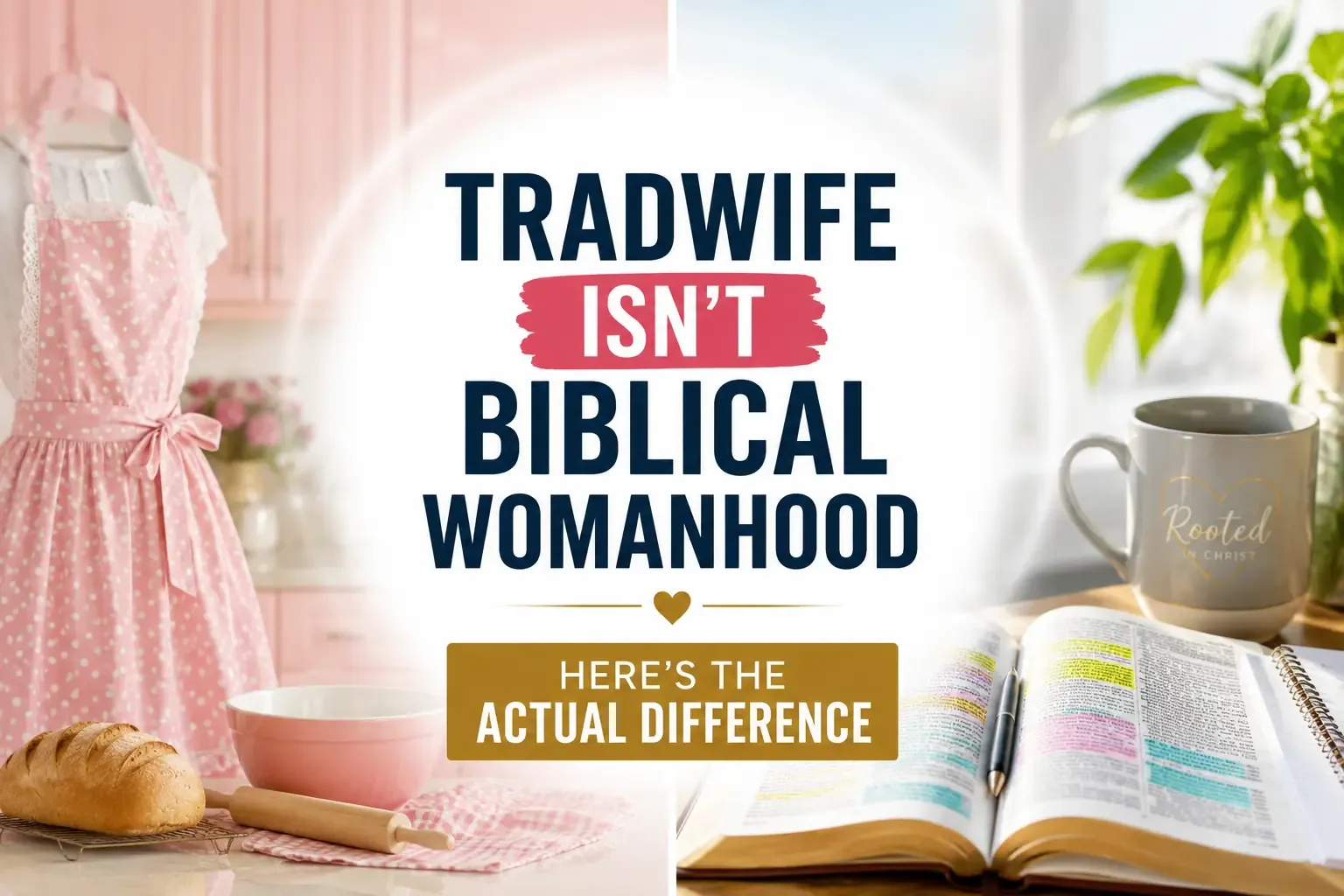
Your floral dress and sourdough starter are not a theology. That's the blunt truth a growing number of Christian women are waking up to, and it's why even outspoken conservative voices are now pumping the brakes on a trend they used to cheer for.

The Confusion That's Splitting Christian Women Online
Here's what's happening. Millions of women scroll past videos of homesteading, hand-sewn dresses, and "submissive wife" lifestyle content every week. Somewhere along the way, that aesthetic got labeled "biblical womanhood," and a lot of Christian women started believing the two things were the same thing.
They're not.
In June 2026, BlazeTV host and Christian commentator Allie Beth Stuckey said publicly what a lot of pastors have been saying quietly for years: one of the biggest myths in Christian womanhood is treating "tradwife" and "biblical womanhood" as interchangeable terms. That distinction matters more than it sounds like it should, because women are building entire identities, marriages, and self-worth on a mix-up.
This article untangles it. No academic jargon, no culture-war shouting. Just a clear, honest look at what's trend and what's actually in Scripture — with real examples of women who got burned by the confusion and what they did about it.
What Is "Tradwife" Culture, Really?
"Tradwife" is short for traditional wife. It's a social media aesthetic, mostly built on TikTok and Instagram, that shows women who stay home, cook from scratch, dress modestly (often in vintage-style clothing), and defer to their husbands in an idealized, camera-ready way.
It exploded because it's genuinely beautiful to watch. Homemade bread. Clean kitchens. Calm mornings. In a world that feels chaotic, that content is soothing.
The Aesthetic Checklist
Tradwife content usually hits most of these notes:
- Homemaking as the entire identity, filmed and styled for an audience
- A husband who is provided for by, and provides for, the wife in a very specific 1950s-style script
- Modest, often retro fashion (think prairie dresses, victory rolls)
- A tone of total, cheerful submission with little friction ever shown
- Monetization — many tradwife accounts sell courses, cookbooks, or brand deals
Where It Comes From
Tradwife culture didn't start in a church. It grew out of a reaction to burnout, hustle culture, and disillusionment with modern feminism's promises. A lot of women are exhausted by "having it all," and the tradwife aesthetic offers a fantasy escape hatch.
That reaction is understandable. The problem is that it borrows biblical language — submission, homemaking, godly femininity — without being rooted in the actual text or theology behind those words. It's a lifestyle brand wearing Scripture's vocabulary.
What Is Biblical Womanhood, Actually?
Biblical womanhood isn't a look. It's a set of convictions about who God made women to be, drawn from Scripture, that plays out differently depending on a woman's season of life, calling, and circumstances.
It Starts With Identity, Not Roles
The first thing Genesis says about women isn't about homemaking. It's that women are made in the image of God, same as men (Genesis 1:27). That's the foundation everything else sits on.
Biblical womanhood is about being conformed to Christ's character — patience, wisdom, courage, faithfulness — regardless of your job title, marital status, or Pinterest board. A single working attorney and a stay-at-home mother of five can both be living out biblical womanhood fully, at the same time, doing completely different things with their days.
You can dig into how identity and love shape this in Scripture directly through this collection of what the Bible says about love — it's the engine behind biblical femininity, not aesthetics.
Submission Isn't What Instagram Thinks It Is
This is the word that gets twisted the most. Tradwife content often shows submission as total obedience with a smile, no questions asked, husband-as-authority-figure.
Biblical submission (Ephesians 5:22-24) is paired, in the very same passage, with a command to husbands to love their wives as Christ loved the church — meaning, sacrificially, to the point of laying down his life. It's a mutual, self-giving structure, not a hierarchy where one person just gets to be served.
Submission in Scripture is about trust, not servitude. It's choosing to trust God's design for marriage the way you'd trust a good father's wisdom, not performing obedience for an audience. This idea of trusting God's design instead of a cultural script is worth sitting with — you can read more through this resource on trusting God's design.

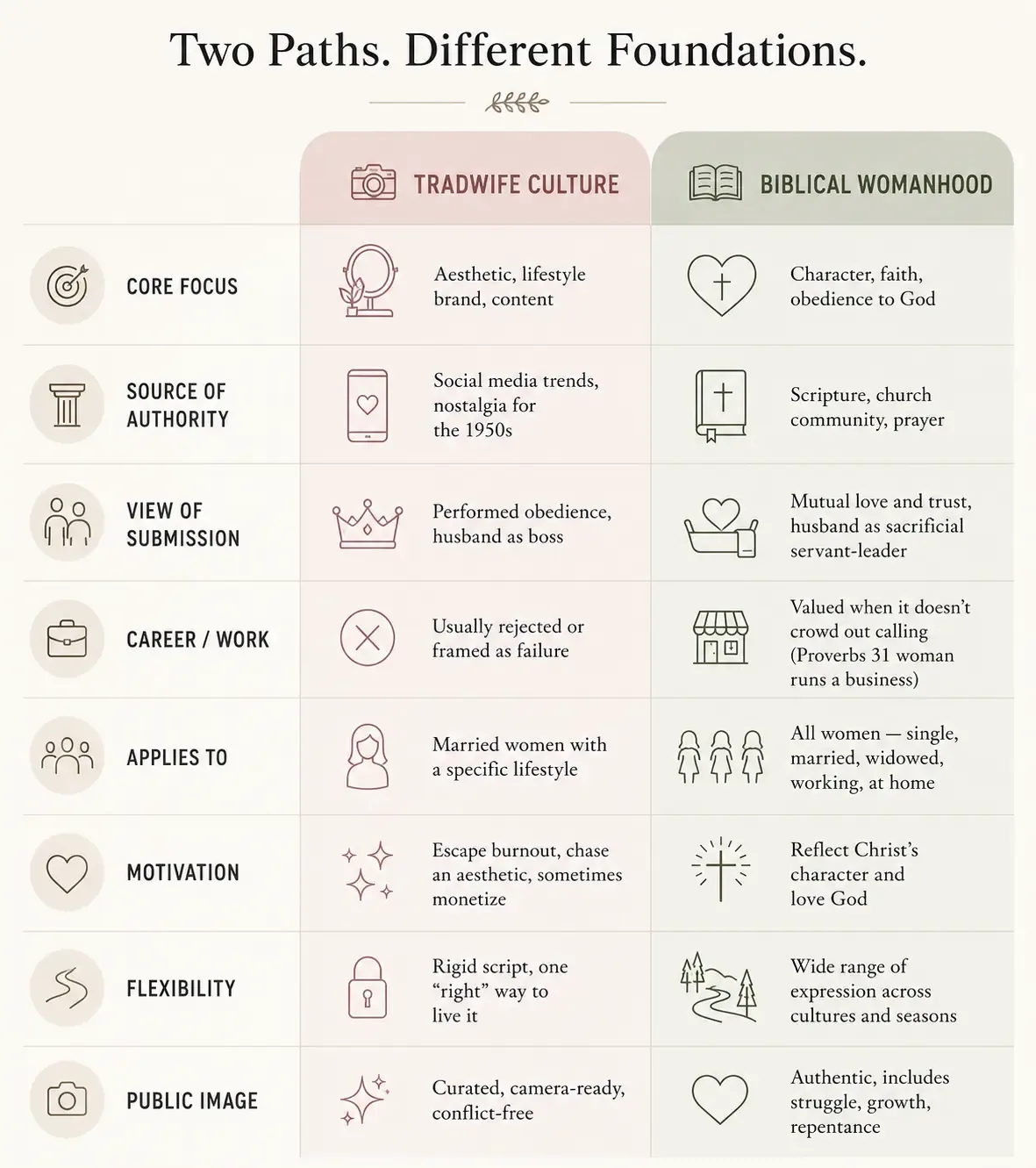
Tradwife vs. Biblical Womanhood: Side-by-Side
This is the comparison most articles skip. Here it is, plain and simple.
Real Stories: Three Women Who Learned The Difference The Hard Way
Story 1: The Influencer Who Burned Out On The Brand
A woman named Rachel (name changed for privacy) built a following of 40,000 people posting tradwife-style content — sourdough, hand-washing dishes, "wife duties" captions. She told her small group at church that the hardest part wasn't the housework. It was the pressure to perform contentment for an audience even on days she felt resentful or exhausted.
She eventually stepped back from the account entirely. Her words to her pastor: the lifestyle had become a job she couldn't quit, and it had replaced her actual relationship with God with a relationship with her follower count.
Story 2: The Marriage That Confused Control With Headship
A couple in a Bible study — call them Mark and Dana — nearly divorced because Mark used "biblical submission" to justify controlling Dana's finances, friendships, and even her phone. Their pastor sat them down and walked through Ephesians 5 in full, not just the submission verse pulled out of context.
Once Mark saw that his role required sacrificial love, not control, the entire marriage dynamic shifted. Dana said the moment that mattered most was realizing submission was never supposed to mean fear.
Story 3: The Single Woman Who Thought She Didn't Qualify
A college student, Priya, felt like she was failing at "biblical womanhood" because she wasn't married, didn't cook, and had a demanding career in engineering. She'd absorbed tradwife content as the standard for godly femininity and felt like a failure by comparison.
A mentor pointed her to Proverbs 31 — the woman there runs a household and a business, invests in real estate, and is praised for her strength, not her aesthetic. Priya realized the standard was never "housewife." It was faithfulness with whatever's in front of you.

The Allie Beth Stuckey Moment, Explained
In mid-2026, Stuckey publicly named the conflation between "tradwife" and "biblical womanhood" as one of the most damaging myths circulating among Christian women online. Her point was straightforward: plenty of tradwife content actually contradicts Scripture — some of it centers around pleasing a husband sexually or materially in ways that have nothing to do with holiness, and some of it turns modesty into a costume rather than a heart posture.
That moment mattered because it came from inside the same Christian media ecosystem that helped popularize the aesthetic in the first place. It wasn't outside critics attacking the trend — it was an insider saying "we need to be more careful with our language."
This is also why a side-by-side, plain-language breakdown (like the table above) is overdue. Most existing coverage is either academic critique that dismisses biblical womanhood altogether, or apologetic defense that assumes everyone already agrees on definitions. Neither one actually helps a woman sitting at her kitchen table wondering if she's doing this right.
5 Signs You've Drifted From Faith Into Aesthetic
Use this quick gut-check if you're not sure which side of the line you're on.
-
You feel worse about yourself after scrolling tradwife content than after reading Scripture. Conviction from God's Word leads to hope and growth. Comparison from Instagram leads to shame.
-
Your "submission" has never once involved disagreement, conversation, or pushback. Real biblical marriages have friction. If everything looks flawless online, it's a highlight reel, not a template.
-
You've started measuring your worth by how "traditional" your home looks. A messy kitchen doesn't make you less faithful. God cares about your heart, not your aesthetic.
-
You feel guilty for working, studying, or having ambition outside the home. Scripture never says every woman must stay home — it says be faithful with your calling, whatever that looks like.
-
You can't explain your convictions from the Bible itself — only from a trend you follow. If you can't point to Scripture behind a belief about womanhood, it's worth re-examining where that belief actually came from.
How To Build a Faith-Rooted Home (Not an Instagram-Rooted One)
Here's the practical part — real steps, not just theory.
Start With The Text, Not The Trend
Before adopting any "biblical womanhood" practice you saw online, open the Bible and check it yourself. Read the full passage, not just the verse someone screenshotted. A good starting point is this collection of marriage and family verses, which gives you the full context instead of a single quote ripped out of a chapter.
Talk To Your Husband About What Headship Actually Means To Him
Don't assume. Sit down and have an actual conversation about what "leading the home" looks like in your specific marriage — his job, your job, your finances, your calendar. Write down what you both agree on.
Separate Your Identity From Your Output
Journal one line each night: "Today I was faithful in ___." Not "today my kitchen looked good" or "today I posted content." This retrains your brain to measure the right thing.
Find A Church Community, Not Just An Online One
Algorithms show you the most extreme, most polished version of any lifestyle. A real church small group will show you the mess, the disagreements, and the actual growth — which is far more useful than a feed.
Give Yourself Grace When You Don't Match The Aesthetic
Legalism kills more marriages and more faith than laziness does. If you're chasing a perfect performance of femininity instead of resting in grace, you've swapped the gospel for a checklist. Reconnect with what grace actually means through this resource on forgiveness in the Bible — it's the antidote to performance-based faith.

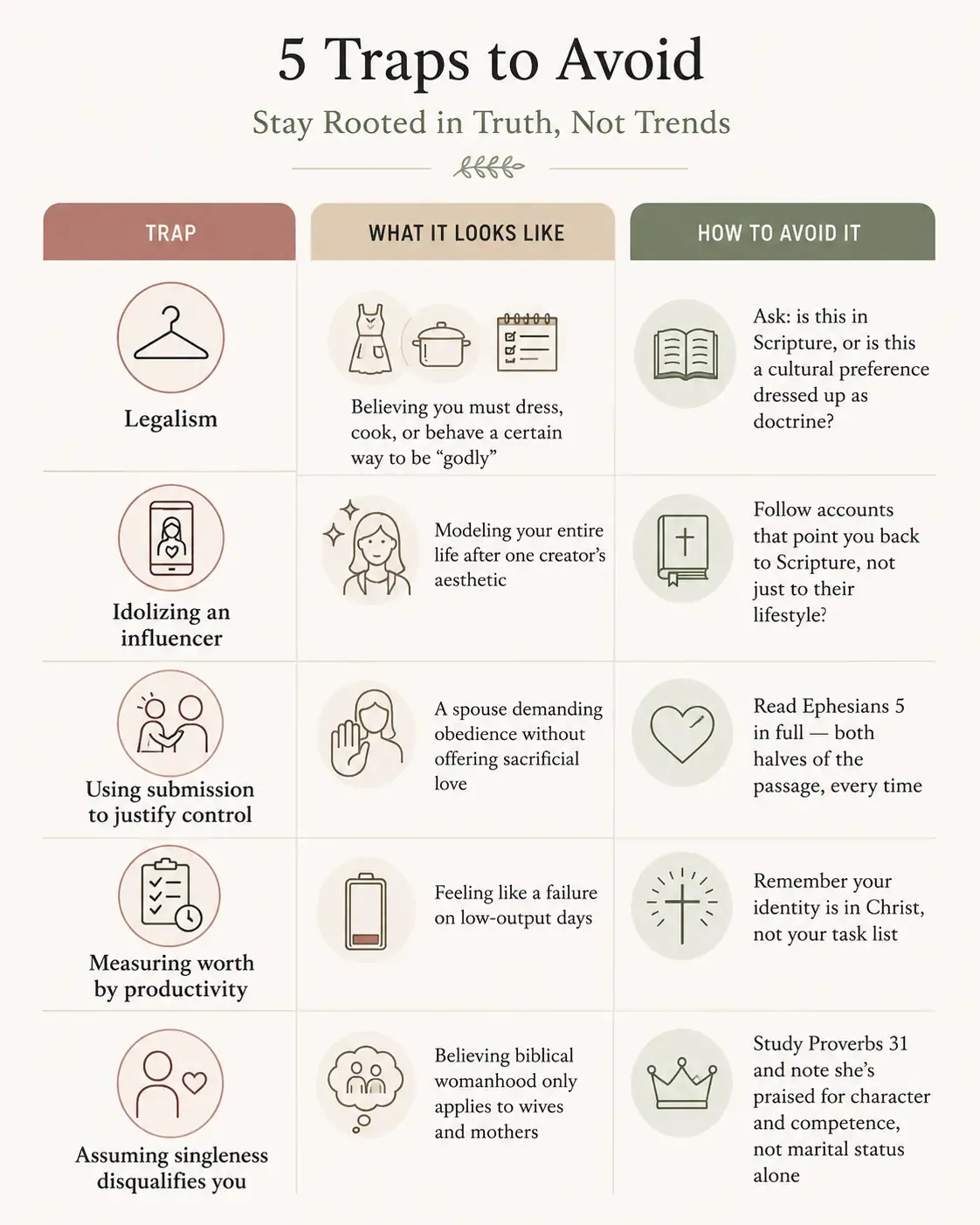
Common Traps and How To Avoid Them
What A Woman Actually Gains From Scripture (vs. What The Trend Promises)
The tradwife trend promises peace through control — control your kitchen, your look, your role, and life feels calm. Scripture promises something sturdier: peace through trust in God, even when your circumstances are messy or your home doesn't look pinned-and-polished.
That's a real difference women notice once they've tried both. The aesthetic requires constant maintenance. Faith requires daily surrender, which is harder some days and lighter on others — but it doesn't collapse the moment your bread doesn't rise or your husband has a bad week. If you want a deeper look at what's actually promised in Scripture instead of on a feed, this list of God's promises is a solid place to start.
Reclaiming "Strength" From the Stereotype
One more myth worth busting: the idea that biblical womanhood is soft, passive, and quiet by default. The Proverbs 31 woman is described using a Hebrew word, "chayil," that's the same word used for mighty warriors elsewhere in the Old Testament. She's strong, capable, and business-savvy — not a doormat in an apron.
If the tradwife aesthetic has convinced you that biblical femininity means being small, timid, or endlessly agreeable, it's worth revisiting what real biblical strength actually looks like in Scripture. It's a lot more Proverbs 31 warrior than 1950s sitcom wife.

FAQ: Tradwife vs. Biblical Womanhood
Is being a tradwife a sin? No. Choosing to stay home, cook, and dress modestly isn't sinful on its own. The issue is when the aesthetic itself becomes the goal, or when it's used to justify control, adultery, or replacing Scripture with a trend.
Can a working woman still be biblically feminine? Yes. The Proverbs 31 woman ran a business, bought property, and managed employees. Career and biblical womanhood aren't opposites — the question is always whether your priorities reflect faithfulness to God and your family, not whether you clock in somewhere.
What does the Bible actually say about wifely submission? Ephesians 5:22-24 calls wives to submit to their husbands, and in the very same passage, husbands are called to love their wives sacrificially, the way Christ loved the church. It's a mutual structure built on love and trust, not a one-way command for obedience.
Why did the tradwife trend become so popular with Christian women? Burnout. A lot of women are exhausted by modern career and hustle-culture pressure, and the tradwife aesthetic offers a calming, nostalgic escape. The appeal is real — the theology behind it just isn't automatically biblical.
Is submission the same as being controlled? No, and this is the most common distortion. Biblical submission is a voluntary posture of trust within a relationship where the husband is called to sacrificial love. Control, fear, or restriction of basic freedoms is not what Scripture describes.
How do I know if I'm following a trend instead of my faith? Ask if you can back up your belief with an actual Bible passage, in context, rather than a screenshot or an influencer's caption. If the answer is no, it's worth studying the topic for yourself before adopting it as conviction.
Does biblical womanhood look the same in every culture and era? No. The core character — faithfulness, love, wisdom, courage — stays the same, but how it's expressed varies by culture, calling, and season of life. There's no single approved outfit or job description.
The Bottom Line
Tradwife culture is a trend. Biblical womanhood is a conviction. One is built for an audience and a camera; the other is built for God and lived out in ordinary, unfilmed moments — including the messy ones.
If you've felt pressure to match an aesthetic instead of grow in faith, that pressure isn't coming from Scripture. Go back to the text, talk honestly with the people in your life, and let your identity rest in something sturdier than a trend that will eventually be replaced by the next one. Living by faith, not by feed, is the whole difference — and you can dig deeper into what that looks like daily through this resource on living by faith.
Key Statistics
Weekly TikTok users in the U.S.
Over 170 million
Demonstrates the enormous reach of social media platforms where tradwife content spreads.
Source: TikTok Newsroom
Instagram monthly active users
2+ billion
Shows the scale of the platform that popularizes tradwife aesthetics.
Source: Meta
Credible Sources
Pew Research Center · January 1, 2023
Provides authoritative demographic data about Christianity in the United States and the audience engaging with biblical womanhood discussions.
Pew Research Center · January 1, 2023
Offers high-quality religious demographic research supporting broader discussions about Christian beliefs and practices.

About the Author
Editorial Team
Editorial Team
Daily Faith Path articles are prepared by the editorial team to help readers find scripture-centered guidance for healing, faith, prayer, and spiritual encouragement.
Expertise: Healing scriptures, Bible study resources, prayer guidance, devotional writing, Christian encouragement
Experience: The team researches scripture references, reviews surrounding biblical context, compares translation wording where useful, and updates articles to improve clarity, usefulness, and trust for readers.
Credentials: Editorial review, devotional writing, scripture study, content updating
This article is published by the Daily Faith Path editorial team to help readers use scripture carefully, prayerfully, and in ways that are practical for real-life seasons of illness, grief, waiting, and spiritual reflection.
Continue Reading
Related articles

October 7, 2026
12 Bible Verses About Hiding Money From Your Spouse
Explore 12 Bible verses about secret spending, hidden debt, financial honesty, confession, forgiveness, boundaries, and rebuilding trust in marriage.

October 6, 2026
15 Bible Verses for Couples Who Keep Fighting About Money
Money fights are rarely just about dollars. These 15 Bible verses help couples address spending, saving, debt, secrecy, unequal income, giving, and financial control with practical next steps and conversation questions.

October 5, 2026
Should You Tithe While in Debt? 11 Bible Passages to Study First
Should you tithe while in debt? Explore 11 Bible passages on tithing, debt, generosity, family responsibility, and giving according to your means—plus a practical plan for deciding what to do.