What the Bible Actually Says About Submission
Most discussions of Ephesians 5 focus on "wives, submit to your husbands" while ignoring the verse that comes first. This guide explores Ephesians 5:21–33 in context, explaining mutual submission, the meaning of the Greek words hypotasso and kephale, common misconceptions, and practical ways couples can apply the passage in healthy, Christ-centered marriages.

Everyone quoting "wives submit to your husbands" online skips the verse right before it — and that missing verse changes the whole meaning. Ephesians 5:21 says submit to one another, and once you see that, the tradwife version of this passage falls apart.

Why This One Word Is Blowing Up Right Now
"Submission" is having a moment. Tradwife content on social media has turned it into a lifestyle brand — aprons, obedience, and a husband who "leads."
Search interest in terms like "biblical submission" and "Ephesians 5 wives" has spiked alongside this trend. But most of the content people are finding gives them half a verse and zero context.
Here's the problem. Ephesians 5:22 is almost always quoted alone. Ephesians 5:21, the verse right before it, never makes the cut.
That's not an accident. It's a lot easier to build a hierarchy when you delete the sentence that says submission goes both ways.
The Verse Everyone Skips
Ephesians 5:21 reads: "Submit to one another out of reverence for Christ."
That's the topic sentence for the whole passage. Everything after it — wives, husbands, even the later verses about children and parents, slaves and masters — is an example of that one command playing out in different relationships.
Paul doesn't say "husbands, here's your authority." He says "everyone, here's how you treat each other." Wives get an example. Husbands get one too, and honestly, theirs is harder.
Breaking Down Ephesians 5:21-33, Verse by Verse
Let's slow down and actually read this thing in order, instead of jumping straight to the "wives" part.
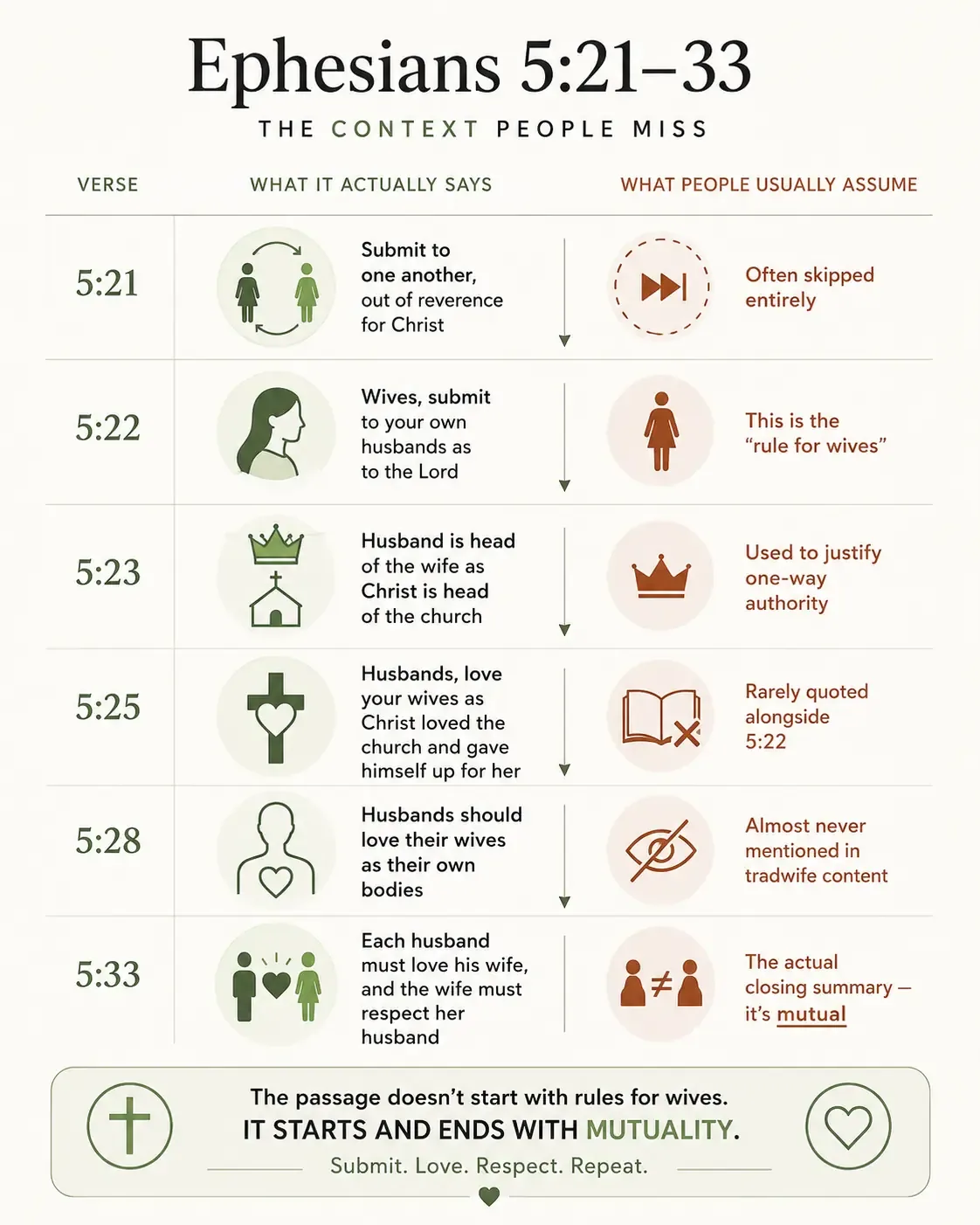
Look at that last row. The chapter doesn't end with "wives obey." It ends with a two-way instruction: husbands love, wives respect. That's the summary Paul himself chose to give.
What "Head" Actually Meant in Greek
The Greek word translated "head" in verse 23 is kephale. In modern English, "head" means boss, the one in charge.
But in the culture Paul was writing to, the word carried a strong sense of "source" or "origin," similar to how we'd say "the head of a river" — the place something flows from, not a rank in a chain of command.
Biblical scholars have debated this for decades, and reasonable people land on different sides. What's not up for debate is that verse 25 immediately redefines whatever "head" means through the example of Christ — who led by giving himself up, not by giving orders.
If "head" means "the one who sacrifices first and most," that's a completely different picture than "the one who gives commands."
The Real Meaning of "Submission" (Not What You Think)
The Greek word for submission here is hypotasso. It's a military-sounding word — it literally means "to arrange under" or "to order oneself under."
But here's the detail almost every quick internet summary misses. In verse 22, the actual word "submit" isn't even there in the original Greek text. It's borrowed from verse 21.
Translators added it back into English because English sentences need a verb. In Greek, verse 22 basically reads "wives, to your own husbands, as to the Lord" — grammatically leaning on the "submit to one another" from the sentence before it.
That's a huge deal. It means verse 22 isn't a separate command aimed only at wives. It's one example of the mutual submission Paul just described.
Submission vs. Obedience: They're Not the Same Word
This trips people up constantly, so let's clear it up.
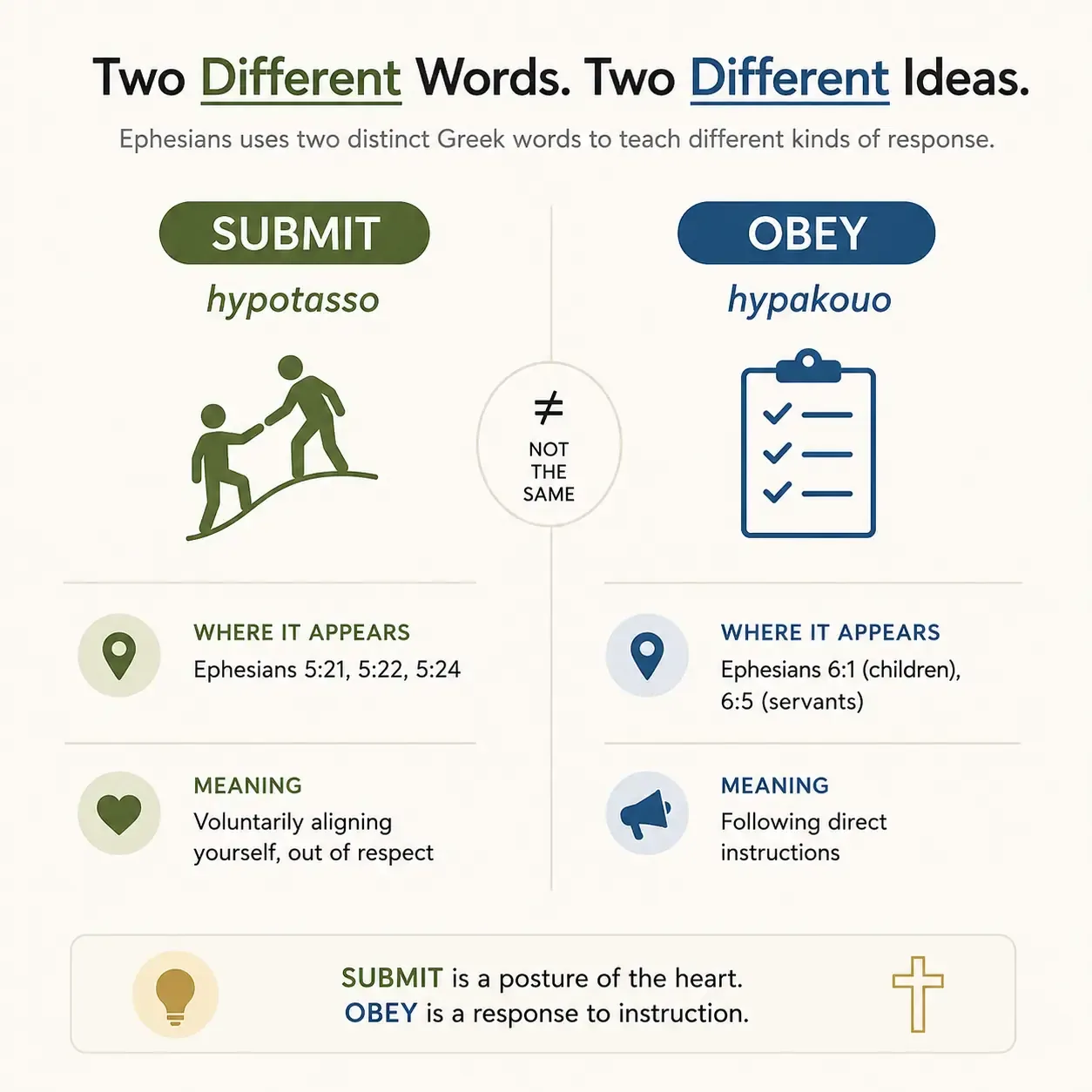
Paul uses a different, stronger word — "obey" — for children and servants. He deliberately does not use that word for wives. He uses "submit," the same word he just used for everyone toward everyone.
That word choice was intentional. If Paul wanted a chain-of-command marriage, he had the vocabulary for it. He chose different words on purpose.
Real Stories: How This Verse Plays Out in Actual Marriages
Word studies are great, but people live real lives. Here's how this actually shows up.
Story 1: The Couple Who Fought Over "Who Decides"
A couple I'll call Mara and Jon (names changed) hit a wall early in their marriage. Jon had grown up hearing "husband is the head" meant he got the final say, full stop.
Every disagreement became a standoff: Jon felt like giving in made him weak, and Mara felt unheard no matter what she said. They weren't submitting to each other. They were negotiating for power, with Bible verses as ammunition.
What changed things was a marriage counselor pointing out Ephesians 5:21 — the "one another" part. Once Jon saw that his job wasn't to win, but to sacrifice like Christ did in verse 25, the whole dynamic shifted from a contest to a partnership.
Story 2: The Career Decision That Tested Both of Them
Another couple faced a real practical crunch: the wife got a job offer in another city, and it was the better opportunity for the family financially.
Under the "wife obeys husband" model, that's simple — he decides, she follows. But under mutual submission, both partners had to actually lay down their own preferences.
He gave up his hometown and his job to move. She gave up staying close to her aging parents. Neither one "won." Both submitted something real. That's what Ephesians 5 mutual submission looks like outside of theory — actual costs, shared by both people.
Story 3: When Submission Got Weaponized
Not every story is a happy resolution, and it's important to say that clearly. Some people in unhealthy or abusive marriages have had this exact verse used against them to justify control, silence, or staying in dangerous situations.
That is a misuse of the text, not a correct reading of it. A passage that opens with "submit to one another" and defines the husband's role as "give yourself up for her" cannot honestly be used to justify one person controlling or harming another. If you're in that kind of situation, the Bible's own logic here does not support staying silent or staying in danger.
Practical Tips for Applying Ephesians 5 in a Real Marriage
Here's where this stops being a word study and starts being something you can actually use this week.
Start every disagreement by asking "what am I willing to give up here?" instead of "what am I owed here?" That single question reframes the whole conversation from a power struggle into a partnership.
Read verse 21 out loud before you read verse 22, every single time. If you're doing a couple's devotional or Bible study on this passage, never let anyone quote 22 without 21 first. Context isn't optional here — it's the whole point.
Notice who's doing the giving-up in your marriage. If it's always one person, that's not mutual submission, no matter what verse gets quoted. Ephesians 5 asks both people to sacrifice, just in different ways.
Separate "respect" from "agreement." Verse 33 asks wives to respect husbands — that doesn't mean agreeing with everything he says. Respect is about how you treat someone, not whether you always defer to them.
Use love as the test for leadership, not the other way around. Verse 25 says husbands love like Christ — sacrificially, first, without keeping score. If "leadership" in your home doesn't look like that kind of love, it's worth a hard conversation.
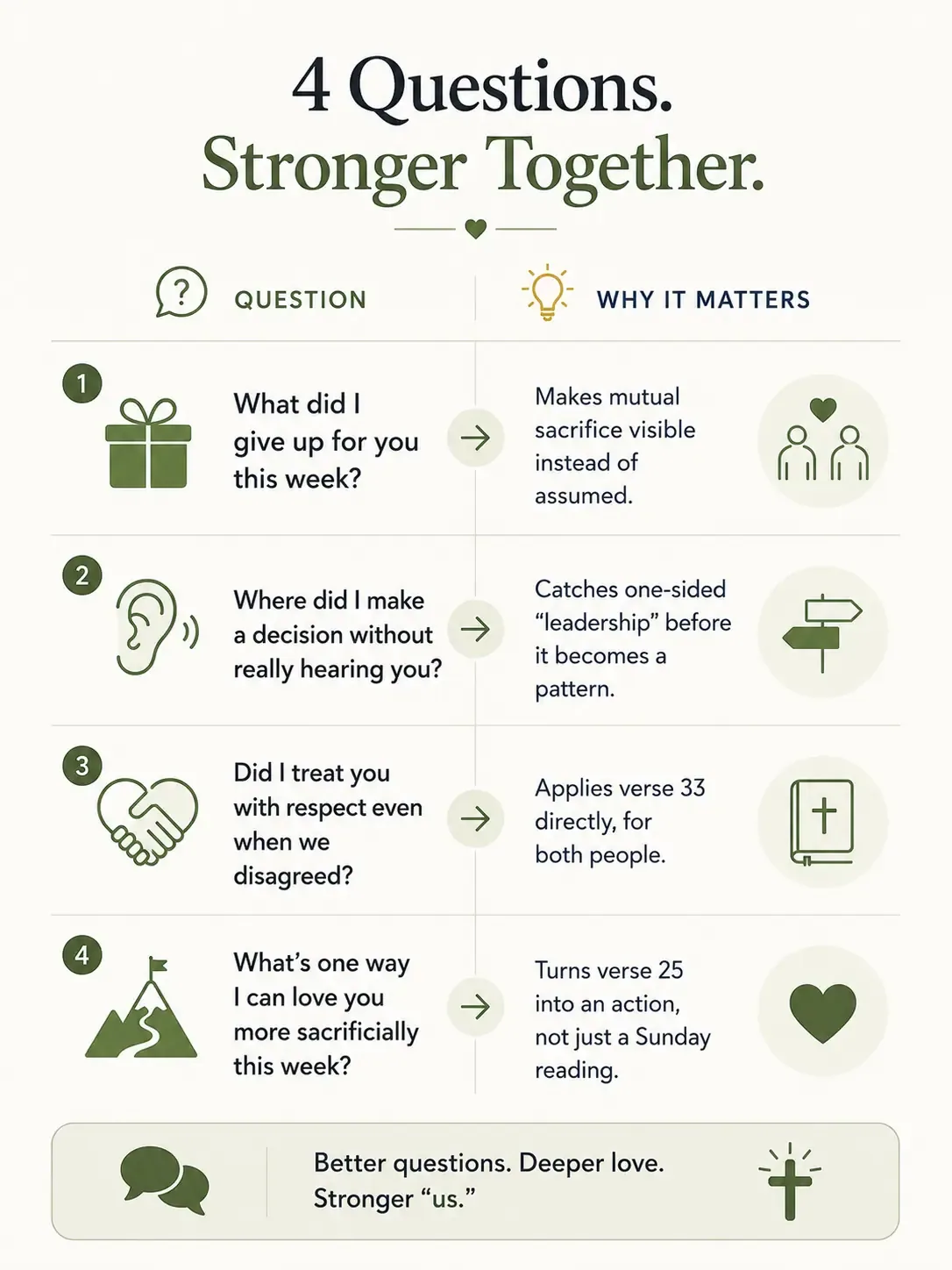
A Simple Weekly Check-In Script
Try this with your partner once a week. It takes ten minutes.
Common Misreadings — And Why They Happen
Misreading #1: "Submission Means Silence"
Nowhere in this passage does Paul say wives shouldn't speak up, disagree, or have opinions. Submission in the biblical sense is about posture and respect, not about staying quiet. Plenty of respected women throughout scripture — like Abigail in 1 Samuel 25 — spoke up directly and were praised for it.
Misreading #2: "It's a One-Way Command for Wives"
We covered this above, but it's worth repeating because it's the single biggest misunderstanding. The passage opens with mutual submission and only then gives specific examples. Skipping verse 21 to get to verse 22 is like reading a movie's twist ending without watching the setup.
Misreading #3: "Submission Equals Inferiority"
Submission in the Bible is never framed as a statement about someone's worth or intelligence. Jesus himself is described elsewhere in scripture as submitting to God the Father, and nobody reads that as Jesus being "less than." Submission describes a role in a relationship, not a ranking of value.
How to Study This Passage the Right Way (Not Just Skim It)
If this whole breakdown makes you want to actually dig into scripture properly instead of relying on a social media caption, that's a great instinct. The biggest mistake people make is reading one verse in isolation. Learning how to study a Bible passage in context will save you from about ninety percent of the misreadings floating around online.
A good starting habit: always read the paragraph before and the paragraph after any verse someone sends you. If you're newer to this, working through some Bible study basics first will make passages like Ephesians 5 click a lot faster.
This idea of context also connects to bigger biblical themes worth exploring — like what the Bible says about love, since Ephesians 5 is really a love passage wearing a "submission" label. It's also worth reading alongside other marriage scriptures if you're trying to build a fuller picture of what a biblical marriage is actually supposed to look like, not just this one chapter in isolation.
When Submission Gets Hard: Grace, Trust, and Letting Go of Control
Real talk — mutual submission is hard even when both people are trying. You will mess it up. Your partner will mess it up.
That's where forgiveness in marriage becomes non-negotiable, not optional. A marriage built on mutual submission needs a matching amount of mutual grace, or every failure turns into ammunition.
It also requires trusting God's design for relationships even when it doesn't match what culture is telling you a marriage should look like right now. Tradwife content sells certainty — clear roles, clear hierarchy, no ambiguity. Mutual submission is messier because it asks both people to keep choosing sacrifice, not just one person to comply.
That messiness is actually the point. A relationship where only one person ever submits isn't a biblical marriage — it's just a hierarchy with a Bible verse taped to it.

FAQ: The Questions People Actually Ask About This Verse
Does the Bible say wives have to obey their husbands?
No. The Bible uses the word "obey" for children and servants elsewhere in Ephesians, but a different word — "submit" — for wives. That word choice was deliberate and points to voluntary respect, not required obedience.
What does Ephesians 5:21 mean?
It means everyone in a Christian community, including both spouses in a marriage, is called to submit to one another out of respect for Christ. It's the topic sentence for the whole passage that follows, including the verses about wives and husbands.
Why do most articles skip Ephesians 5:21?
Because it complicates the simpler, more shareable version of the passage that frames marriage as a strict hierarchy. Quoting only verse 22 lets people present a one-directional command instead of the mutual relationship Paul actually describes.
Is submission the same as being weak or having no voice?
No. Submission describes how you treat someone, not whether you can disagree with them or speak your mind. Biblical submission is compatible with having strong opinions, pushing back respectfully, and being an equal partner in decisions.
What does it mean that the husband is the "head" of the wife?
The Greek word used, kephale, can carry the sense of "source" as much as "authority," and Paul immediately defines whatever authority it implies through Christ's example of sacrificial love in verse 25 — not through command or control.
Can this verse be used to justify staying in an abusive relationship?
No. A passage built on mutual submission and sacrificial love cannot honestly justify one person controlling, harming, or endangering another. If you're in a dangerous situation, seek help immediately — the Bible's own framework here does not support silence or staying in harm's way.
How is this different from what tradwife content usually teaches?
Tradwife content typically starts at verse 22 and frames submission as a wife's one-directional duty. The full passage starts at verse 21 with mutual submission and spends more verses telling husbands to sacrificially love their wives than it spends telling wives anything at all.
The Bottom Line
Read the whole passage, not just the clip that fits on a slide. Ephesians 5 opens with everyone submitting to everyone, and closes with husbands loving and wives respecting — a two-way relationship, not a one-way command.
If you take one thing from this: never let anyone quote verse 22 to you without also reading verse 21 out loud first. That single habit will keep you from about every major misreading of this passage floating around right now.
Key Statistics
Christians who say religion is very important in marriage
44%
Among married U.S. Christians, nearly half consider shared religious beliefs very important for a successful marriage.
Source: Pew Research Center (Marriage & Religion Survey)
Average monthly Google searches for "wives submit to your husbands"
~5,000+
Demonstrates ongoing search demand surrounding Ephesians 5.
Source: Google Keyword Planner
Credible Sources
BibleGateway · Updated continuously
Allows readers to compare Bible translations and read the entire passage in context rather than isolated verses.
Blue Letter Bible · Updated continuously
Includes Greek interlinear tools, Strong's numbers, and lexical resources useful for understanding hypotasso and kephale.

About the Author
Editorial Team
Editorial Team
Daily Faith Path articles are prepared by the editorial team to help readers find scripture-centered guidance for healing, faith, prayer, and spiritual encouragement.
Expertise: Healing scriptures, Bible study resources, prayer guidance, devotional writing, Christian encouragement
Experience: The team researches scripture references, reviews surrounding biblical context, compares translation wording where useful, and updates articles to improve clarity, usefulness, and trust for readers.
Credentials: Editorial review, devotional writing, scripture study, content updating
This article is published by the Daily Faith Path editorial team to help readers use scripture carefully, prayerfully, and in ways that are practical for real-life seasons of illness, grief, waiting, and spiritual reflection.
Continue Reading
Related articles

October 7, 2026
12 Bible Verses About Hiding Money From Your Spouse
Explore 12 Bible verses about secret spending, hidden debt, financial honesty, confession, forgiveness, boundaries, and rebuilding trust in marriage.

October 6, 2026
15 Bible Verses for Couples Who Keep Fighting About Money
Money fights are rarely just about dollars. These 15 Bible verses help couples address spending, saving, debt, secrecy, unequal income, giving, and financial control with practical next steps and conversation questions.

October 5, 2026
Should You Tithe While in Debt? 11 Bible Passages to Study First
Should you tithe while in debt? Explore 11 Bible passages on tithing, debt, generosity, family responsibility, and giving according to your means—plus a practical plan for deciding what to do.