What the Bible Says About the "Signs of the End Times" Everyone's Sharing
Are viral end-times posts about blood moons, earthquakes, AI, and 2026 actually biblical? Discover what Scripture really says about the signs of the end times, common prophecy myths, and how to respond with faith instead of fear.
That viral post claiming a blood moon, an earthquake, and a "prophetic alignment" all prove 2026 is the year? Most of it isn't in the Bible at all — and in this guide, we'll test each viral claim against actual Scripture so you can stop panicking and start reading.
Here's the wild part. About 39% of American adults say we're living in the end times, yet most viral "signs" being shared right now would fail a basic Bible check.
So let's do that check. Claim by claim.
Why End-Times Posts Go Viral Every Single Year
Every war, earthquake, or election produces a fresh wave of "THIS IS IT" posts. It's a pattern that repeats like clockwork.
There's a reason. Fear spreads faster than facts, and end-times content mixes fear with something that feels like insider knowledge. That combo is social media rocket fuel.
But here's what most people miss. Jesus predicted this exact behavior — and told His followers not to fall for it.
Matthew 24:6 (KJV): "And ye shall hear of wars and rumours of wars: see that ye be not troubled: for all these things must come to pass, but the end is not yet."
Read that slowly. Jesus said wars and rumors would happen, and His command was "be not troubled." The viral posts say the opposite: "Be very troubled, and share this."
If a post makes you panic, it's already contradicting the verse it's quoting. If your heart needs somewhere calmer to land after doomscrolling, these Bible verses about peace are a better next click than another prophecy video.
The Numbers Behind the Panic
End-times belief isn't fringe. It's mainstream, and it's been stable for decades.
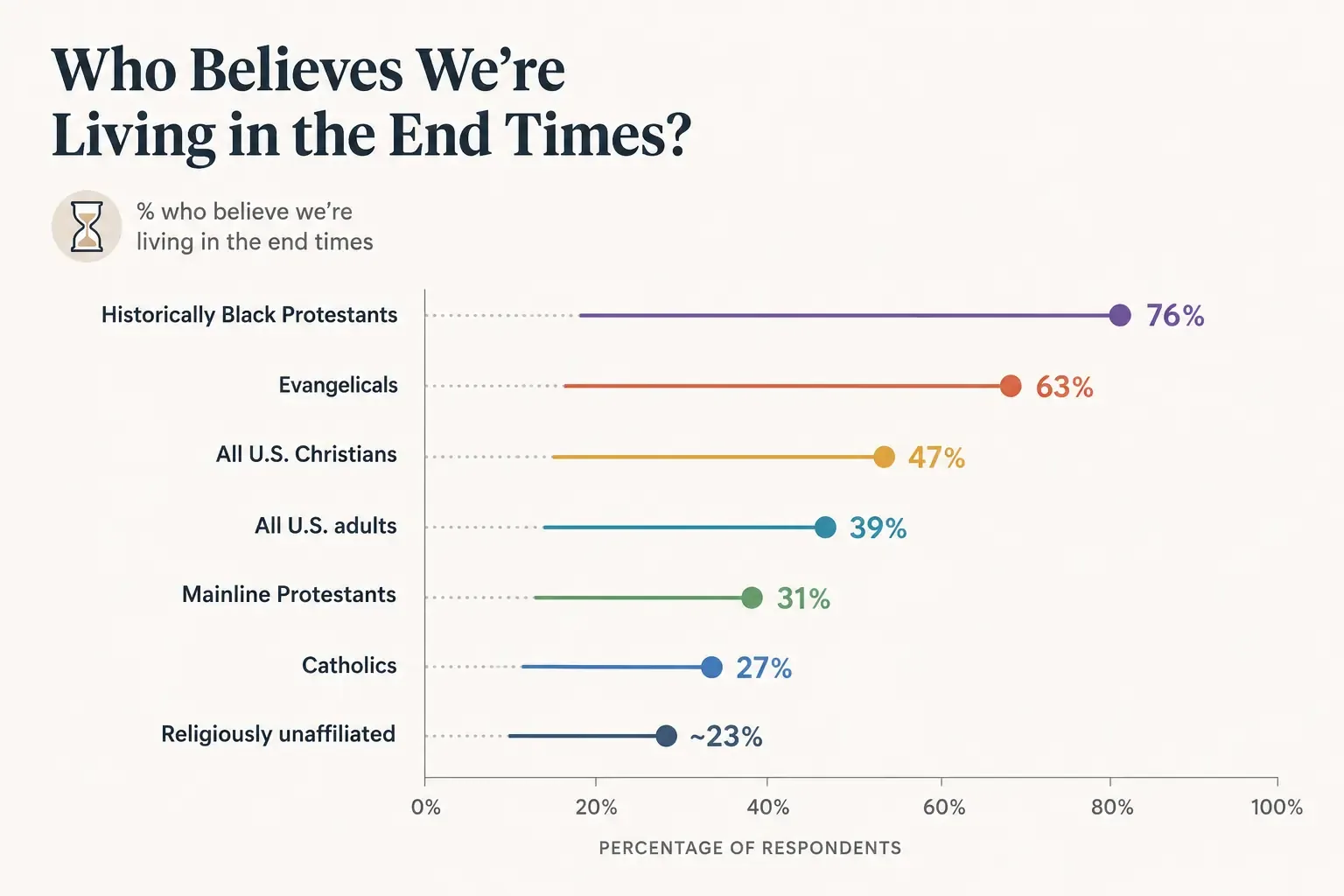
Historically Black Protestants (76%) and evangelicals (63%) are the groups most likely to say we're in the end times, while Catholics (27%) and atheists (9%) are the least likely.
And this isn't new. A 2013 report found 41% of U.S. adults believed the same thing back then — nearly identical to today. People felt "it's happening now" in 2013, in the 1970s, in 1999, and in the year 1000. Keep that in mind as we go.
The Myth-Busting Test: 7 Viral "Signs" vs. Actual Scripture
Let's run the most-shared claims through a simple filter: Is this actually in the Bible, or is it internet folklore?
Myth #1: "The Bible Predicts a Specific Year (Like 2026)"
Verdict: Not in the Bible. The Bible says the opposite.
This is the big one, and Jesus could not have been clearer.
Matthew 24:36 (KJV): "But of that day and hour knoweth no man, no, not the angels of heaven, but my Father only."
No man knows. Not the angels. According to Jesus's own words here, even He didn't know during His earthly ministry — only the Father.
So when someone claims they've decoded the date from calendars, comets, or numerology, they're claiming to know something Jesus said no one knows. That's not prophecy. That's a red flag.
Real-world example: Radio broadcaster Harold Camping famously predicted the end for May 21, 2011. Followers spent life savings on billboards. Some quit jobs. The date passed like any other Saturday. Camping later admitted the attempt to predict a date was wrong — but the damage to real families was done.
The takeaway isn't cynicism. It's trusting God's timing instead of a stranger's countdown clock.
Myth #2: "Blood Moons Are a Direct End-Times Countdown"
Verdict: Half folklore. The Bible mentions signs in the heavens, but not lunar eclipse schedules.
Joel 2:31 does say the moon will turn "into blood" before the day of the Lord. That's real Scripture.
But here's what the viral posts skip: lunar eclipses (which make the moon look red) happen regularly — usually a couple of times per year somewhere on Earth. They're predictable astronomy, published decades in advance by NASA.
A sign you can print on a calendar 50 years early isn't a surprise. Scripture describes the day of the Lord coming "as a thief in the night" (1 Thessalonians 5:2) — unexpected, not pre-scheduled.
Practical tip: When you see a "blood moon prophecy" post, search the eclipse date on NASA's public eclipse tables. If it was predicted by astronomers in the 1990s, it's an eclipse, not a countdown.
Myth #3: "There Are More Earthquakes and Wars Than Ever — Proof We're at the End"
Verdict: The verse is real. The "more than ever" claim usually isn't.
Matthew 24:7 mentions "famines, and pestilences, and earthquakes, in divers places." Jesus really said this.
But the claim that earthquakes are dramatically increasing doesn't hold up. Seismologists at the USGS have long noted that the number of large earthquakes per year stays fairly consistent — what changed is that we now have sensors everywhere and a phone in every pocket. We detect and see more, instantly.
Same with wars. We're not necessarily living in the most violent era of history — we're living in the most televised one. A conflict on the other side of the planet lands in your feed within minutes.
Real-world story: After the 2023 Turkey-Syria earthquake, posts exploded claiming quake frequency had "tripled." Fact-checkers traced the stat to nowhere — it was invented, then shared millions of times. The tragedy was real. The trend line was not.
And notice what Jesus actually calls these events in Matthew 24:8: "the beginning of sorrows" — literally "birth pains." Not the end. The beginning of a long process, with no timeline attached. If the suffering behind those headlines troubles you deeply (and it should), here's a thoughtful look at why God allows suffering.
Myth #4: "Modern Technology (Chips, IDs, AI) Is the Mark of the Beast"
Verdict: The mark is in Revelation 13. Your specific gadget is not.
Revelation 13:16-17 describes a mark on the right hand or forehead, required for buying and selling. That's the actual text.
What the text doesn't do is name a technology. And history proves how flexible this myth is. Over the past century, people have confidently declared the mark to be: Social Security numbers, barcodes, credit cards, RFID chips, and now AI and digital IDs.
Every generation picks its newest scary tech. Every previous generation's pick quietly gets forgotten.
Here's the detail the viral posts always skip: in Revelation, taking the mark involves worship of the beast (Revelation 14:9-11). It's a spiritual allegiance, described in the context of a choice — not something that sneaks onto you through a software update or a vaccine card.
Practical tip: If a post says a product "IS the mark," ask one question: "Where does receiving this involve worshiping anyone?" That single question deflates 99% of these claims.
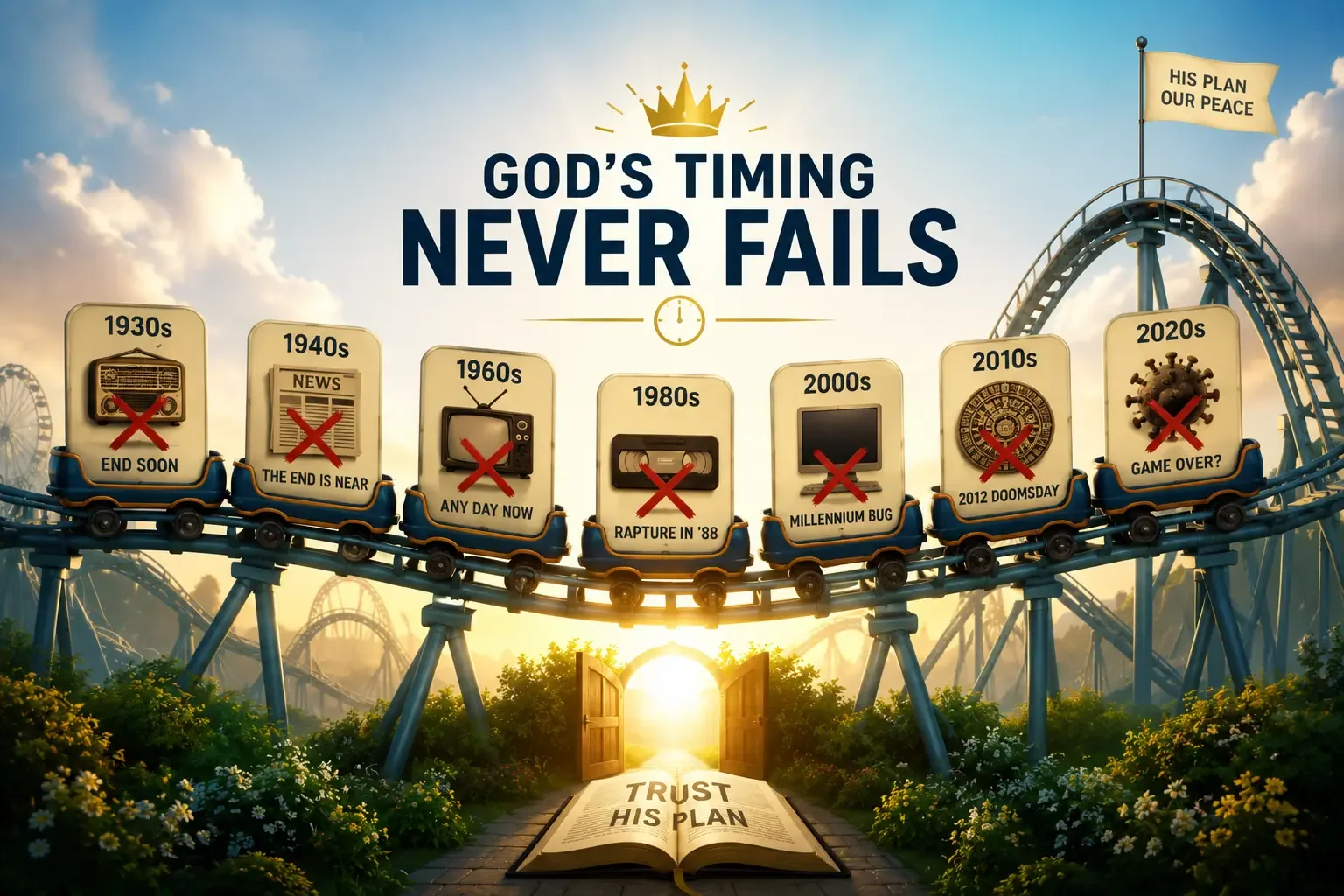
Myth #5: "A Famous Preacher Had a Dream About the Exact Date"
Verdict: Scripture tells you exactly how to handle this one.
The Bible doesn't say dreams are fake. It says test them.
1 Thessalonians 5:20-21 (KJV): "Despise not prophesyings. Prove all things; hold fast that which is good."
Deuteronomy 18:22 gives the test: if a predicted thing doesn't happen, the prophet spoke presumptuously. Simple scoreboard. And date-setters are batting .000 across two thousand years.
Real-world example: The "88 Reasons Why the Rapture Will Be in 1988" booklet sold millions of copies. Believers were genuinely shaken when the date passed. The author released a revised prediction for 1989. That failed too. The pattern never changes — only the dates do.
Learning to weigh claims like this is a skill Scripture calls discernment, and it's worth building on purpose. This guide to biblical discernment walks through how to tell God's voice from hype, anxiety, and your own imagination.
Myth #6: "Israel-Related Events Mean the Clock Has X Years Left"
Verdict: Israel matters hugely in prophecy. The math formulas attached to it don't come from the Bible.
Many Christians see the modern regathering of Israel as prophetically significant, often pointing to passages like Ezekiel 36-37. That's a legitimate, widely held interpretation.
The folklore starts when people bolt a countdown onto it. The most famous version: "A generation is 40 years, Israel became a nation in 1948, so the end must come by 1988." When 1988 passed, the formula quietly updated — new start dates, new generation lengths, new deadlines.
Notice the move. The verse stays the same; the math keeps changing to avoid being wrong. Scripture doesn't work that way. Any system that requires constant recalculating after failed deadlines is human arithmetic, not divine revelation.
Myth #7: "Things Are So Bad, God Must Be About to End It All"
Verdict: Understandable feeling. But it's vibes, not verses.
This one is less a claim and more a mood — and it's the engine behind all the others. When the news feels unbearable, "it must be the end" feels almost comforting. At least it would mean the chaos has a deadline.
But 2 Peter 3:9 flips the perspective: the Lord "is longsuffering... not willing that any should perish." From the Bible's viewpoint, the delay isn't neglect. It's patience — more time, more mercy, more chances.
And Peter wrote that verse because people in the first century were already asking "where is the promise of his coming?" (2 Peter 3:4). Feeling like the world can't go on much longer is a 2,000-year-old feeling. Every generation has felt it. Every generation was told to respond with faithfulness, not panic.
What Jesus Actually Told People to DO About the End Times
Here's the part almost no viral post covers, because it doesn't get clicks. Jesus attached instructions to His end-times teaching, and none of them involve panicking or sharing charts.

Instruction #1: "See That Ye Be Not Troubled"
Matthew 24:6 again. It's a command, not a suggestion. Anxiety about the end is treated as something to actively resist.
That doesn't mean pretending the news isn't scary. It means refusing to let fear drive the bus. If fear keeps grabbing the wheel anyway, here's a practical walkthrough on how to overcome fear with God using Scripture instead of willpower.
Instruction #2: "Watch" — Which Means Live Ready, Not Live Scared
Matthew 24:42 says "Watch therefore." People read this as "monitor the news obsessively."
But look at the parables Jesus tells immediately after. The faithful servant (Matthew 24:45-46) is praised for one thing: being found doing his job when the master returns. Feeding the household. Handling his responsibilities.
Watching, biblically, looks like showing up to work, loving your family, and serving your neighbor. The person Jesus commends isn't holding a prophecy chart. He's holding a serving tray.
Instruction #3: Keep Doing Good, Right Where You Are
Paul had to correct people who quit their jobs because they thought the end was imminent (2 Thessalonians 3:10-12). His response was blunt: get back to work, quietly, and earn your own bread.
That's remarkably practical. The biblical posture toward the end times is planting trees, not selling everything.
A Practical 5-Step Filter for the Next Viral "Sign" Post
Save this. Use it every time a scary prophecy post crosses your feed.
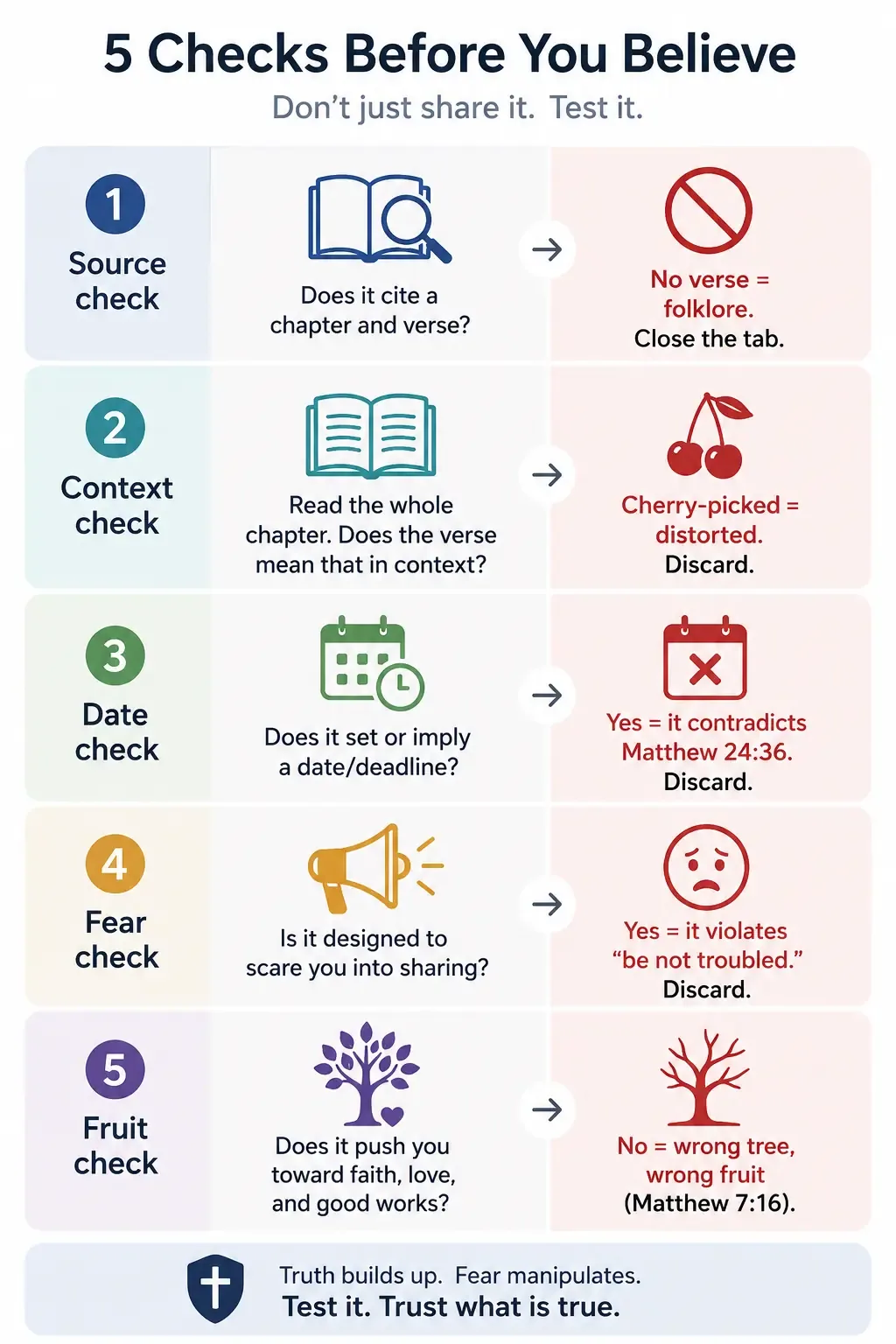
Real-world example of the filter working: A church small group in Ohio made this their rule after a member nearly drained a retirement account over a "prophecy" video in 2020. Now, any end-times claim shared in their group chat has to arrive with a chapter and verse, read in full context, before it's discussed. The panic posts dried up within a month — and their actual Bible study attendance went up.
How to Handle End-Times Anxiety (The Doomscrolling Problem)
Let's get honest about the real issue. For most people, the problem isn't theology. It's the 11 p.m. scroll session that ends with a racing heart.
Set a News Cutoff Time
Give the news a bedtime. A hard cutoff 60-90 minutes before sleep changes everything, because frightening content hits differently when you're tired and alone in the dark.
If your mind still races after lights out, keep Scripture within reach instead of your phone. These verses for anxiety at night were gathered for exactly that moment.
Replace the Scroll With a Psalm
Psalm 91 has been the go-to "scary times" psalm for thousands of years — soldiers, plague survivors, and worried parents have all leaned on it. Its images are the exact opposite of doom content: shelter, refuge, a fortress, wings you can hide under.
Try a simple swap: one read-through of Psalm 91's promises of protection for every ten minutes of news. You'll feel the difference in your body, not just your head.
Talk to a Real Person
End-times fear grows in isolation and shrinks in community. A pastor, a small group, or even one honest friend can pressure-test a scary claim in five minutes.
And if the anxiety is constant, physical, or stealing your sleep for weeks — talking to a doctor or counselor is wisdom, not weak faith. Elijah needed food and rest before he needed a sermon (1 Kings 19).
What You Can Actually Hold Onto
Strip away the folklore, and here's what the Bible genuinely teaches about the end.
Jesus promised He will return (John 14:3). No one knows when (Matthew 24:36). Hard times will come, and He told us in advance so we wouldn't be blindsided (John 16:33). And the ending He describes isn't destruction for its own sake — it's God wiping away every tear (Revelation 21:4).
That last verse is the actual headline of biblical prophecy. Not the beast. Not the blood moons. A God who ends the story by ending the crying.
So the biblical response to 2026 — and 2027, and every year after — isn't decoding. It's choosing faith over fear daily, doing your work, loving your people, and standing on God's promises instead of a stranger's predictions.
Two thousand years of failed date-setters. Zero failed promises. That's the ratio worth remembering.
FAQ: Biblical End Times Signs
Does the Bible say the world will end in 2026?
No. The Bible names no year, ever. Matthew 24:36 says no one knows the day or hour — so any post naming 2026 (or any year) contradicts Jesus directly.
Are wars and earthquakes signs of the end times?
Jesus mentioned them (Matthew 24:6-8), but He called them "the beginning of sorrows," not the end — and specifically said "the end is not yet." They tell us to stay faithful, not to start a countdown.
Is AI or digital ID the mark of the beast?
The Bible never names a technology. Revelation ties the mark to knowingly worshiping the beast (Revelation 14:9-11) — a spiritual choice, not a gadget. Barcodes, credit cards, and chips have all been wrongly accused before.
What percentage of people believe we're in the end times?
About 39% of U.S. adults say we're living in the end times, including 47% of Christians — with the highest agreement among historically Black Protestants (76%) and evangelicals (63%).
Should Christians stop making long-term plans?
No. Paul rebuked believers who quit working over end-times excitement (2 Thessalonians 3:10-12). The biblical model is living ready and living responsibly — save, plant, build, serve.
How do I stop being scared of end-times content?
Test every claim against Scripture in context, limit late-night news, replace doomscrolling with passages like Psalm 91, and talk to your faith community. Jesus's own command about scary world events was "see that ye be not troubled" (Matthew 24:6) — and He doesn't command the impossible.
What's the difference between biblical prophecy and internet folklore?
Biblical prophecy has chapter-and-verse sources, fits its context, sets no dates, and produces faith and good works. Folklore cherry-picks verses, adds human math, sets deadlines that keep failing, and produces fear and shares. Run the 5-step filter above and the difference becomes obvious fast.
Word to the wise: bookmark this article. The next time a major headline hits and your feed fills with prophecy posts, come back, run the filter, and read Psalm 91 before you share anything.
Key Statistics
U.S. adults who believe we're living in the end times
39%
Share of American adults who believe current events indicate the end times.
Source: Pew Research Center
U.S. Christians who believe we're living in the end times
47%
Percentage of Christians who say we're living in the end times.
Source: Pew Research Center
Credible Sources
NASA · Continuously maintained
Demonstrates that lunar eclipses ("blood moons") are predictable astronomical events, providing scientific context for biblical discussions.
Bible Gateway · N/A
Primary source for all Scripture quoted throughout the article, including Matthew 24, Revelation 13–14, Joel 2, 2 Peter 3, and other cited passages.

About the Author
Editorial Team
Editorial Team
Daily Faith Path articles are prepared by the editorial team to help readers find scripture-centered guidance for healing, faith, prayer, and spiritual encouragement.
Expertise: Healing scriptures, Bible study resources, prayer guidance, devotional writing, Christian encouragement
Experience: The team researches scripture references, reviews surrounding biblical context, compares translation wording where useful, and updates articles to improve clarity, usefulness, and trust for readers.
Credentials: Editorial review, devotional writing, scripture study, content updating
This article is published by the Daily Faith Path editorial team to help readers use scripture carefully, prayerfully, and in ways that are practical for real-life seasons of illness, grief, waiting, and spiritual reflection.
Continue Reading
Related articles
October 7, 2026
12 Bible Verses About Hiding Money From Your Spouse
Explore 12 Bible verses about secret spending, hidden debt, financial honesty, confession, forgiveness, boundaries, and rebuilding trust in marriage.
October 6, 2026
15 Bible Verses for Couples Who Keep Fighting About Money
Money fights are rarely just about dollars. These 15 Bible verses help couples address spending, saving, debt, secrecy, unequal income, giving, and financial control with practical next steps and conversation questions.
October 5, 2026
Should You Tithe While in Debt? 11 Bible Passages to Study First
Should you tithe while in debt? Explore 11 Bible passages on tithing, debt, generosity, family responsibility, and giving according to your means—plus a practical plan for deciding what to do.