Why Are Young Men Suddenly Reading Their Bibles Again?
Young men are returning to church and reading the Bible at rates not seen in years. Behind the headlines lies a deeper story about loneliness, purpose, friendship, and why faith communities are becoming attractive again to a generation searching for meaning.

They're not doing it for God, first. Most of them are doing it because they're drowning, and somebody finally handed them a rope.
That's the part almost every headline about this trend skips. In April 2026, Gallup dropped a number that made pastors, pollsters, and journalists sit up straight: young men's religious attendance jumped seven points in two years, and the share who call religion "very important" to them shot up 14 points — from 28% to 42%. That's one of the biggest two-year swings Gallup has ever recorded on a religion question. Most coverage stopped at the stat. This piece is about the "why."

The Numbers That Started This Conversation
Let's get the data on the table first, because it's genuinely wild.
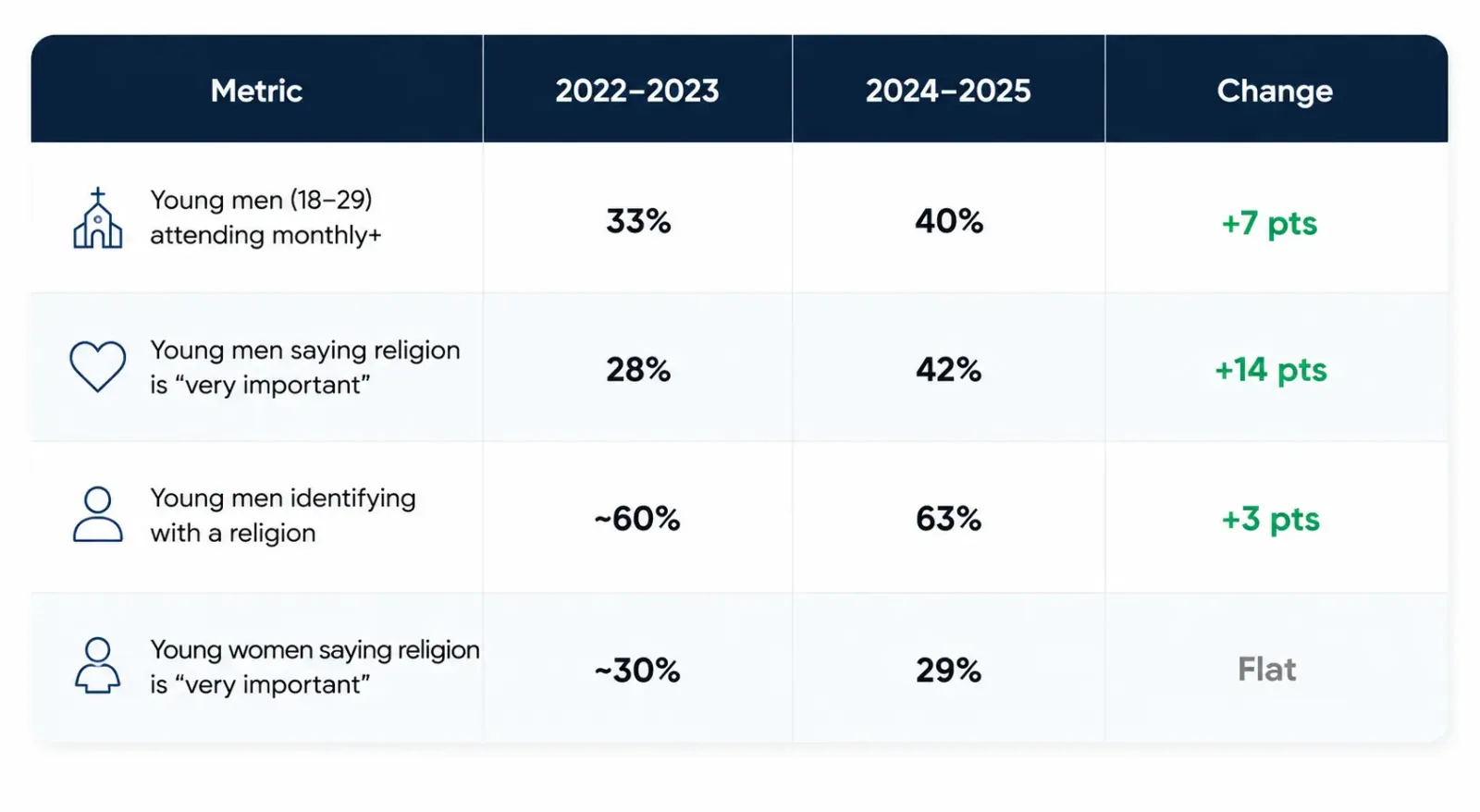
The percentage of young men reporting monthly or more frequent attendance at religious services rose seven points between 2022-2023 and 2024-2025, reaching 40% — its highest level since 2012-2013. For context, that's the highest it's been since Barack Obama's first term. Gallup surveyed 26,601 American adults on this, including 1,905 men younger than 30, so this isn't a fluke from 200 people in one zip code.
It's not just church pews, either. Christian music streams are up 50% since 2019, Bible sales have risen 41.6% since 2022, and spiritual app downloads climbed 79.5% since 2019. Something is moving well beyond Sunday mornings.
Gallup's own scientist put it plainly: "We're sensing, based on the data, a change in the religious environment in this country", said Frank Newport. He also noted something that's been true for two decades: "Headline after headline for a decade or two now has been: 'America is becoming less religious.' And now I think we're seeing the consensus across organizations is that's leveled off."
It's Not a Culture War Story. It's a Loneliness Story.
Here's where most articles get it wrong. They frame this as young men turning right politically and church being a side effect. Flip that around. The politics is downstream of something rawer: young men are some of the loneliest people in America, and church is one of the last places left that fixes loneliness on purpose.
Look at the friendship numbers. 15% of men now report having zero close friends, up 3 points since 1990, while the number of men with six or more close friends dropped from 55% to 27%. That's not a small dip. That's half a generation of male friendship groups disappearing.
Gallup's own world poll found one in four young American men under 35 report feeling lonely "a lot of the day" — and the U.S. gap is unusually wide. In the U.S., 25% of young men are lonely compared with 17% of all other adults, a much bigger gap than in Iceland or Denmark. Something specific to American life is hitting young men harder here than almost anywhere else on earth.
A psychotherapist who works with men, Justin Yong, put his finger on the mechanism: "digital disconnection" through toxic-male social media, gaming, and porn all "give this short term dopamine hit and relief that replaces real intimacy and acts as a barrier to being vulnerable". He also flagged something almost nobody talks about: "There's this erosion of male friendships... the depth of friendships with other men become more and more shallow, and they don't connect on things beyond sports, work, stocks".
Now hold that next to what church, at its best, actually is: a room full of people who show up every week, know your name, ask how you're doing, and expect you to show up for them too. That's not a coincidence. That's a direct answer to a direct problem.
A Real Story: Why "David" Started Going Back
Charisma Magazine profiled several men navigating this exact path. David Szabo, a 30-year-old Hungarian immigrant, gave his life to Jesus 10 years ago and has been involved in his church in New Jersey ever since. Javier Diaz, 25 and living in Florida, rededicated his life to Christ at 19 and was baptized in 2020. Joseph Chaparro, 35, recommitted to Christ at 25 and has served in a leadership role at his Chicago-area church for six years.
None of these are dramatic Hollywood conversion stories. They're guys who were quietly unmoored, found a room where people actually noticed them, and stayed. A Southern Baptist pastor in Waco, Texas, Phil Barnes, said it best after watching his own congregation fill up with young men: "What's the Lord doing? Why is he sending us all of these young men?"
What Church Gives Them That Nothing Else Is Offering
Strip away the theology for a second and look at church as a piece of social infrastructure. It's one of the only remaining institutions that gives young men all four of these things in one place, for free, every single week.
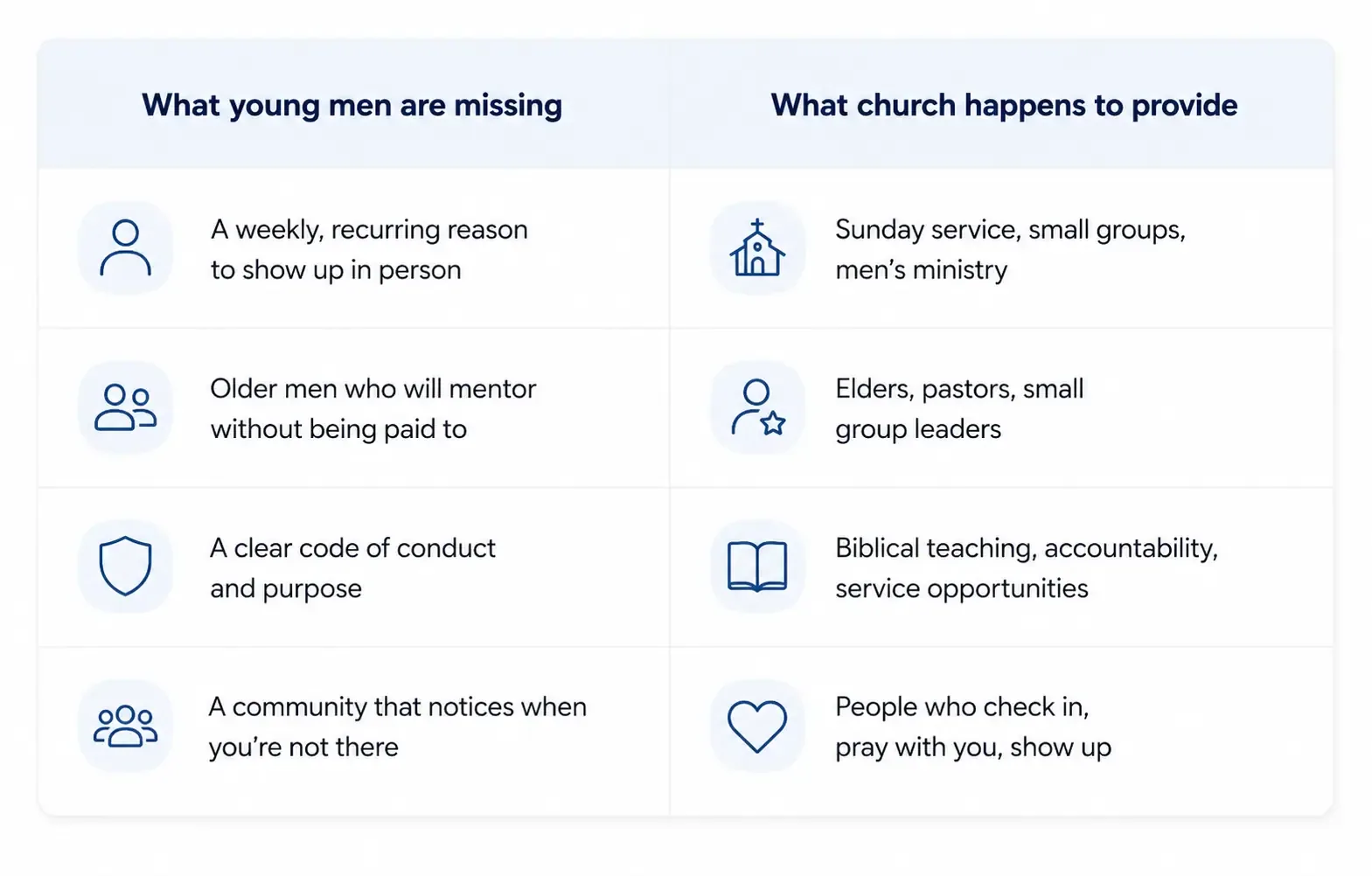
Compare that to a gym membership, a gaming Discord, or a podcast subscription — all of which are things young men already have in abundance, and none of which call you when you disappear for three weeks.
A UK church leader working with young adults, Phil Knox, has watched this up close: "In my local church, the majority of our recent baptisms have been young men... A lot of these young men's journeys in faith started with big questions about life and masculinity. They would go on YouTube rabbit trails where they would stumble on some Christian content that sparked their curiosity".
That YouTube-to-pew pipeline is worth sitting with, because it's the most under-reported part of this whole story.

The Podcast-to-Pew Pipeline
Nobody plans to become religious by watching three-hour interview podcasts. But that's genuinely what's happening for a chunk of this generation.
Jordan Peterson isn't a professing Christian, but he teaches on the Bible, speaks about Jesus, and interviews followers of Christ, and his audience skews heavily young and male. Joe Rogan's interview with Christian apologist Wesley Huff has been described as "one of the most widespread proclamations of the Gospel ever, with over 7 million views on YouTube". Both Peterson's and Rogan's audiences are predominantly male, with Rogan's at 71% male and Peterson's median listener age under 40.
Here's the practical takeaway for anyone trying to understand this trend: young men aren't walking into a church building first anymore. They're finding faith content in the same feed as gym videos and finance advice, getting curious, and then walking through a church door months later already half-convinced. If you're a pastor, this means your website and your first sermon online might matter more than your Sunday bulletin.
Real Problems This Trend Is Creating (And How People Are Solving Them)
This shift isn't clean or simple. Pastors, families, and the young men themselves are running into real friction points. Here's what's actually showing up, and what's working.
Problem 1: "He's only here for the vibe, not the faith"
Pastors keep noticing that some young men arrive treating church like a masculinity club rather than a faith community. One theologian at The Gospel Coalition flagged this directly: churches risk becoming "a social club where young men are encouraged to be rebellious, angry, 'macho' culture-warriors" instead of places of real discipleship.
What's working: Churches that are handling this well pair new male attendees with an older mentor within the first month, not the first year. They give the guy a job — ushering, setup, tech booth, anything — within weeks of his second visit. Purpose plus responsibility turns a spectator into a participant fast.
Problem 2: He won't actually talk about why he's there
This is the quietest problem and the hardest one. Men, culturally, are trained to not name what's going on inside them. Research following boys from age four found they shift from being "authentic, direct, and expressive" to "pretense," learning to perform what the world wanted from them as boys.
What's working: Small men's groups that start with something practical — a workout, a project, a meal — before any deep conversation happens. Trying to go straight to feelings talk with a 22-year-old guy you just met usually backfires. Give the activity first; let the honesty follow naturally, usually around month three or four of consistent contact.
Problem 3: Family members think it's a political phase
If your son, brother, or nephew suddenly started going to church weekly, and you're not sure if this is faith or a MAGA hat with extra steps, you're not alone in wondering. Researchers themselves are still debating whether the shift reflects genuine spiritual belief or a reaction to gender politics, and a political science professor at Notre Dame, David Campbell, points out that surveys measuring weekly attendance haven't shown the same spike, calling some of the shift "just an expression of an identity... not necessarily, are you actually active in a congregation".
What's working for families: Ask questions instead of accusations. "What do you like about it?" opens a door. "Are you turning into one of those guys?" slams it shut. Most families report the faith holds up over time when it started from genuine searching — and fades fast when it was only ever about belonging to a tribe.
Problem 4: Toxic influencers are competing for the same lonely guys
This is the ugliest wrinkle. The same loneliness and identity confusion driving men toward church is also driving some toward figures like Andrew Tate. A cultural commentator addressed this head-on: "Andrew Tate does not offer what young men need. He offers the way of Samson – exaggerated, cartoonish manhood... We need Christ-shaped men".
What's working: Naming the difference out loud, in plain language, rather than pretending the overlap doesn't exist. Good youth pastors are directly addressing manosphere content in sermons and small groups instead of ignoring it — because the guys in the room have already seen it.

Practical Advice: What Actually Helps
If you're a pastor, a parent, or a guy in this exact situation yourself, here's what real-world practice is showing works.
If you're a pastor or ministry leader:
- Give new young men a task within the first month — chairs, sound, coffee, anything with a physical output.
- Start small groups with a shared activity (hike, gym, project) before deep conversation. Trust builds through doing things side by side, not face to face.
- Talk about manosphere content directly. Don't pretend your 19-year-old hasn't seen Andrew Tate clips. Address it by name.
- Track attendance and follow up personally when someone disappears for two weeks. A text beats a form email every time.
If you're a parent or family member:
- Ask curious questions, not suspicious ones. "What's your favorite part of going?" works. "Is this a phase?" doesn't.
- Watch behavior over months, not the first sermon he quotes at dinner. Real change shows up in patience, follow-through, and how he treats people — not in vocabulary.
- Don't panic if the politics come with it at first. For many guys, the theology outlasts the politics once they're actually reading the text themselves.
If you're the guy figuring this out yourself:
- Start with a men's group, not a huge Sunday crowd. Smaller rooms build faster trust.
- Give it three months minimum before deciding if it's for you. The first visit rarely feels like anything. Month three usually does.
- Separate the message from the messenger. A pastor, a YouTuber, or a friend can point you somewhere useful even if you don't agree with everything else they say.
The Skeptics Have a Point Too — Here's Their Side
Good journalism includes the pushback, so here it is. Not everyone buys the "revival" framing, and their reasoning is solid.
PRRI's own data shows church attendance rates are generally flat among young Republican men — 41% attending monthly in 2021 versus 43% in 2025, which is barely a blip. Ryan Burge, a former pastor now at Washington University in St. Louis, expresses skepticism about the Gallup poll's findings, and PRRI's CEO wrote plainly: "A 14-point increase is highly unusual; however, if confirmed by future data, it could signal a meaningful shift" — the key word being "if."
The honest read: something real is moving in how young men feel about religion and how important they say it is to them. Whether that translates into decades of weekly pews being full is still an open question, and anyone telling you it's already settled is overselling the data.
FAQ
Is this actually happening, or is it just one poll? It's more than one poll. Barna's separate tracking found Gen Z men's commitment to Jesus jumped 15 percentage points and Millennial men's jumped 19 points between 2019 and 2025. Multiple organizations are seeing pieces of the same pattern, even if they disagree on the size.
Why is this happening to men specifically, and not women? Young women's religiosity actually dropped sharply over the same period — from 51% in 2012-2013 saying religion was very important to just 29% in 2024-2025. Researchers point to different pressures: women report frustration with patriarchal structures in some faith traditions, while men report a hunger for structure and belonging that's missing elsewhere in their lives.
Is this just about politics and Trump? Partly, but not entirely. Attendance rose most among young Republican men and women — up 7 points and 8 points respectively since 2022-2023 — while young Democratic men's attendance rose only 3 points. Politics is clearly a factor, but plenty of apolitical young men are showing up too, often through podcasts and personal loneliness rather than partisanship.
Should I be worried this is connected to toxic "manosphere" influencers? It's connected, but not identical. The same identity vacuum that draws men to Andrew Tate-style content draws others to church — sometimes the same guy flirts with both before landing somewhere. The healthiest churches are addressing this overlap directly instead of ignoring it.
What if he stops going after a few months? That's common and not necessarily a failure. For a lot of young men, this is exploration, not a lifelong commitment on day one. What predicts staying long-term is usually a specific relationship — a mentor, a small group, a friend — more than the content of any single sermon.
Is this trend showing up outside the U.S. too? Yes. In Finland, belief in God among confirmation-age boys rose from 36% in 2019 to 67% in 2025, and Church of England attendance grew for four straight years through 2024, with teen and adult baptisms up more than 10%. This isn't only an American story.
The Bottom Line
Young men aren't reading their Bibles because a pastor got better at marketing. They're reading them because they're lonelier than almost any generation of American men on record, and church is one of the only places left offering a weekly seat, a mentor's phone number, and a reason to show up that has nothing to do with a screen.
That doesn't mean every guy in the pew is there for pure, uncomplicated faith. Some are working through politics, some through loneliness, some through curiosity sparked by a podcast at 1 a.m. But the honest story here isn't a culture war. It's a bunch of guys looking for a room that notices when they're missing — and finding out church still does that better than almost anything else around.
Related reading:
- Gallup: Rise in Young Men's Religiosity Realigns Gender Gaps
- Pew Research: Men, Women and Social Connections
- Barna Group: Belief in Jesus Rises, Fueled by Younger Adults
- Fortune: Young American Men Are Experiencing a Crisis of Loneliness
- TIME: Religion's Longstanding Gender Gap Is Narrowing Among Gen Z
Key Statistics
Young men attending religious services monthly or more
40%
Share of U.S. men ages 18–29 attending religious services at least monthly in 2024–2025, up from 33% in 2022–2023.
Source: Gallup (2026)
Increase in young men's monthly attendance
+7 percentage points
Two-year increase in monthly religious attendance among young men.
Source: Gallup (2026)
Credible Sources
Gallup · April 1, 2026
Primary source for the article's central statistics on religious attendance and importance among young men.
Pew Research Center · January 16, 2025
Documents the long-term decline in male friendships and social connectedness.

About the Author
Editorial Team
Editorial Team
Daily Faith Path articles are prepared by the editorial team to help readers find scripture-centered guidance for healing, faith, prayer, and spiritual encouragement.
Expertise: Healing scriptures, Bible study resources, prayer guidance, devotional writing, Christian encouragement
Experience: The team researches scripture references, reviews surrounding biblical context, compares translation wording where useful, and updates articles to improve clarity, usefulness, and trust for readers.
Credentials: Editorial review, devotional writing, scripture study, content updating
This article is published by the Daily Faith Path editorial team to help readers use scripture carefully, prayerfully, and in ways that are practical for real-life seasons of illness, grief, waiting, and spiritual reflection.
Continue Reading
Related articles

October 7, 2026
12 Bible Verses About Hiding Money From Your Spouse
Explore 12 Bible verses about secret spending, hidden debt, financial honesty, confession, forgiveness, boundaries, and rebuilding trust in marriage.

October 6, 2026
15 Bible Verses for Couples Who Keep Fighting About Money
Money fights are rarely just about dollars. These 15 Bible verses help couples address spending, saving, debt, secrecy, unequal income, giving, and financial control with practical next steps and conversation questions.

October 5, 2026
Should You Tithe While in Debt? 11 Bible Passages to Study First
Should you tithe while in debt? Explore 11 Bible passages on tithing, debt, generosity, family responsibility, and giving according to your means—plus a practical plan for deciding what to do.