Why Millennial Men Are the Fastest-Growing Group of Bible Readers
Millennial men are driving an unexpected surge in Bible reading, with American Bible Society data showing a 29% increase in 2025. Discover what's behind the trend, why casual interest faded in 2026 while committed readers kept growing, and the practical habits helping men build lasting Scripture routines.

Something changed in 2025 that almost nobody saw coming: men's Bible use jumped 19% in a single year, and millennial men led the charge. This isn't a churchy trend piece. It's a look at what's actually pulling guys who ghosted religion for a decade back into Scripture — and what happened right after, when that momentum got tested.

The Stat That Started This Conversation
In its 2025 State of the Bible report, the American Bible Society found that men's Bible use grew 19% year over year — the biggest single-year jump for men the study has ever recorded. Millennials, meanwhile, posted a 29% increase, the strongest of any generation.
For context: men had been the least engaged group with Scripture for basically the entire 15 years ABS has tracked this stuff. Then, out of nowhere, the long-running gender gap started closing.
Researchers didn't fully know what to make of it either. John Farquhar Plake, ABS's Chief Innovation Officer, called it the first increase in both Bible use and Scripture engagement since 2021.
Here's the part most coverage skipped: it didn't fully hold. The 2026 follow-up report showed a pullback. Male "occasional" Bible users dropped from 17% back down to 10%, and overall engagement slid closer to 2024 levels.
But it's not a clean reversal either. Active male Bible users — the guys reading weekly or more — actually kept growing, moving from 22% to 24%. The casual dabblers faded. The committed core held and grew.
That's the real story here, and it's more useful than a headline stat. A lot of men tried the Bible again in 2025. Some walked away. But a smaller, more durable group turned a spark into a habit — and their stories tell you exactly how that happens.
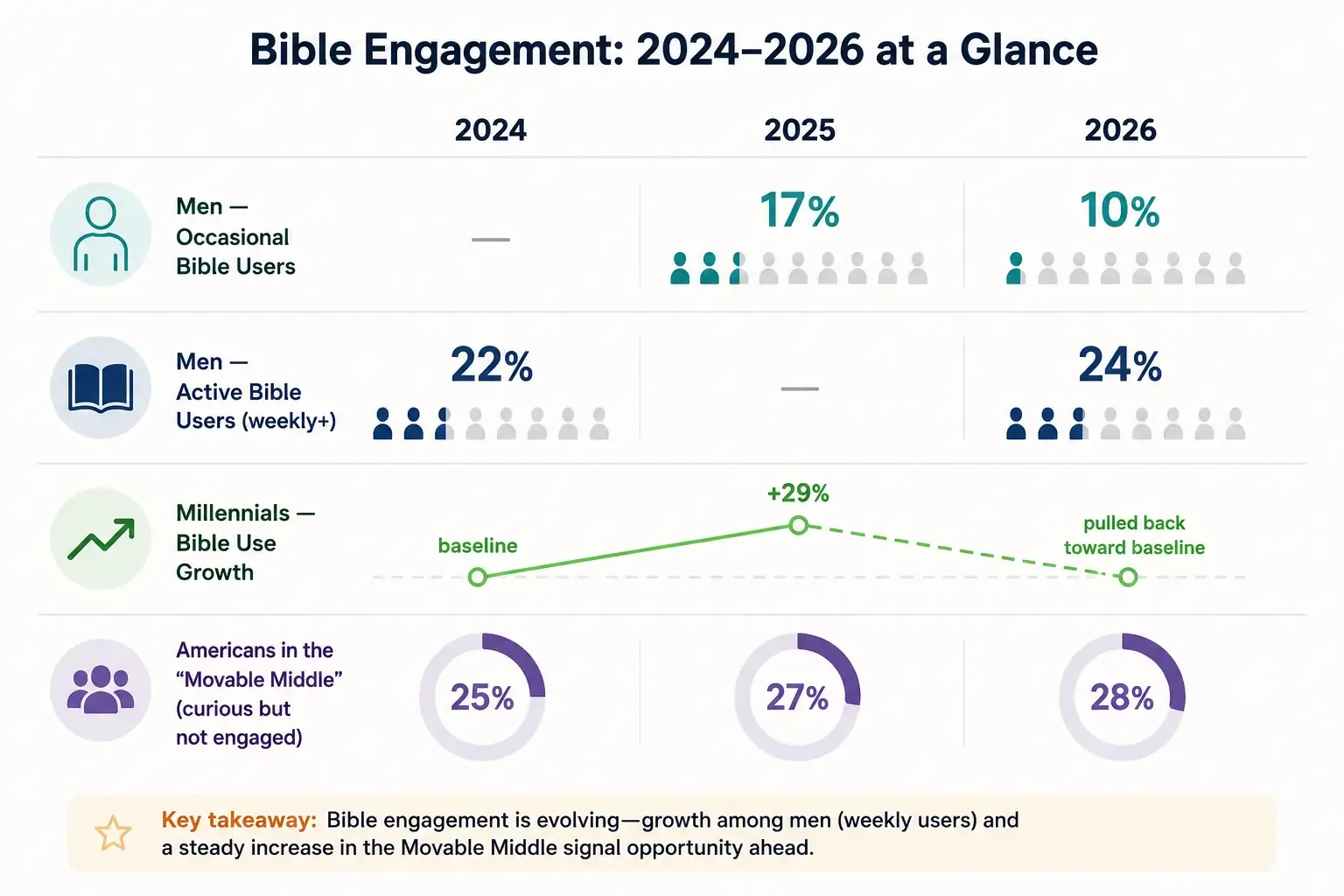
Source: American Bible Society, State of the Bible reports, 2025–2026 chapters.
Meet the Men Behind the Numbers
Stats tell you something happened. They don't tell you why a 34-year-old dad in Ohio picked his Bible back up after eight years, or why a guy running a landscaping crew in Texas started listening to Scripture on his truck speakers before sunrise. So let's get specific.
The Burned-Out Dad Who Started With Five Minutes
Marcus, 36, works in logistics and has two kids under seven. He grew up going to church every Sunday, drifted away in his twenties, and told himself he'd "get back to it eventually."
Eventually turned into twelve years. What actually moved him wasn't a sermon or a crisis of faith — it was burnout. He described feeling like he was running on empty with nothing refilling the tank.
His entry point was almost embarrassingly small: five minutes with a reading plan app before his kids woke up. No pressure to finish the whole Bible in a year. Just five minutes, most days.
The practical lesson: the habit stuck because the bar was low enough that missing a day didn't feel like failing. He wasn't chasing a streak. He was chasing five calm minutes before the chaos started.
The Guy Who Found Scripture Through a Podcast, Not a Pew
Dev, 31, hasn't set foot in a church building in years and isn't sure he wants to. What got him reading was a Bible-in-a-year podcast he found while looking for something to listen to during his commute.
He started treating the Bible less like a religious obligation and more like a long, strange, genuinely interesting book he'd never actually read cover to cover. Curiosity did what guilt never could.
This matches a real trend in the data: a growing "Movable Middle" of Americans — now 28% of the population — who are curious about Scripture but haven't fully engaged yet. Dev is that group in human form.
The practical lesson: if guilt-driven "I should read my Bible" never worked for you, try curiosity-driven access instead. Audio, video, and podcast formats lower the barrier for guys who don't want to sit still with a physical book yet.

The Guy Whose Marriage Was the Real Trigger
Not every story starts peacefully. Chris, 29, started reading again because his marriage was falling apart and he didn't have the tools to handle it. A counselor suggested he look at what Scripture actually said about anger and patience, not as a magic fix, but as a framework.
He said the turning point wasn't reading — it was reading with someone. He and his wife started reading a chapter together, out loud, three nights a week. It gave them a shared language for hard conversations they didn't have before.
The practical lesson: solo reading works for some men. For others, especially in a crisis, reading with a partner or a small group turns Scripture from an abstract exercise into a real-time tool for a real problem.
Why Now? The Real Reasons Behind the Surge
This isn't random. A few forces converged at once, and understanding them helps explain both the 2025 spike and the 2026 pullback.
1. A Loneliness and Identity Crisis Among Young Men
Multiple data points from the same ABS research point to a broader identity struggle among younger men, especially Gen Z men, who reported the weakest sense of identity of any age or gender group studied. Weak identity was tied directly to higher stress, anxiety, and loneliness.
Millennial men are the older siblings of that trend, and many are feeling an adjacent version of it: isolation, a lack of male community, and a hunger for something with actual weight and structure.
2. Bible Content Finally Meeting Men Where They Are
Audio Bibles, Bible apps with daily plans, YouTube deep-dives, and podcast series turned a 1,200-page book into something you can consume in five-minute chunks during a commute or workout. This mattered enormously — nearly three-quarters of people who used a structured reading plan reported having read most or all of the Bible, compared to people reading without any plan at all.
3. A Broader Cultural Openness, Even Without Church Attendance
You don't have to be walking into a church building to be curious about the Bible. The Movable Middle — people open to Scripture's wisdom without deep engagement — has grown by millions of people since 2024, even as regular engagement dipped.
That's the group millennial men are disproportionately part of: curious, unattached to institutions, and looking for a low-pressure way in.
What Happened When the Spike Faded — And Why It Still Matters
Here's where most articles about this topic stop, and where the real value starts. The 2026 data showed the casual increase from 2025 largely evaporated. If you were one of the men who downloaded an app in January 2025 and quit by March, you're not alone — most people who try do.
But look at what didn't fade: active, committed male readers grew. That tells you something important about what actually sustains engagement versus what just sparks it.
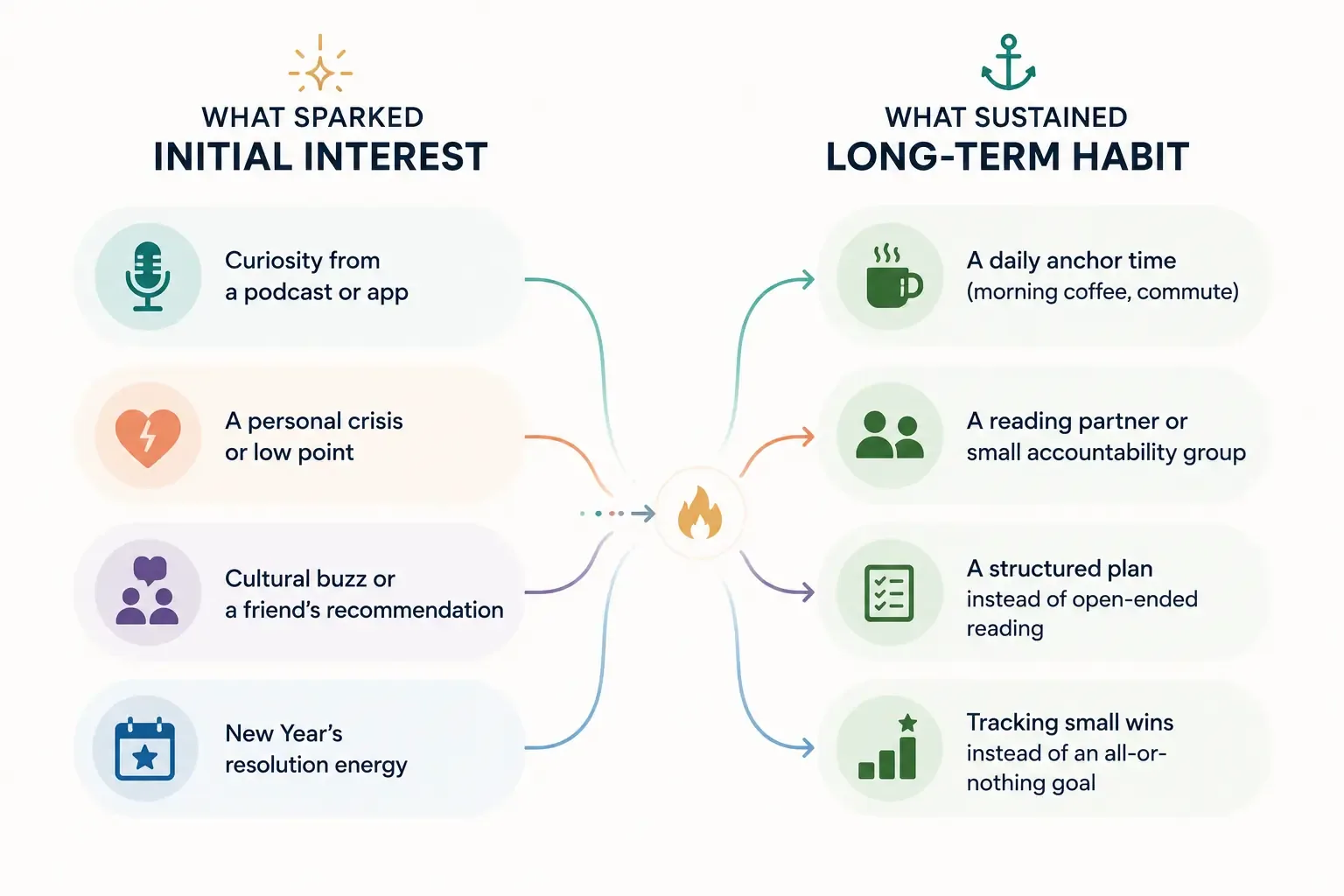
The gap between "tried it" and "kept it" is where almost everyone falls off. Closing that gap isn't about willpower — it's about structure.
Real-World Problems Millennial Men Run Into (And How to Actually Fix Them)
Problem: "I Don't Know Where to Start and the Bible Feels Huge"
This is the single biggest reason men quit before they start. Genesis to Revelation in order is a rough on-ramp for most first-timers — it front-loads genealogies and law codes before it gets to the parts that hook people.
Fix: Start in the Gospel of John, then move to Psalms, then Proverbs. This order gets you story, poetry, and practical wisdom before you hit denser material. If you want structure instead of guessing, a simple Bible reading plan removes the decision-making entirely.
Problem: "I Read It But I Don't Understand Half of What I'm Reading"
Ancient context, unfamiliar names, and ambiguous poetry trip up even people who grew up in church. This is normal, not a sign you're doing it wrong.
Fix: Use a study Bible with side notes that explain historical context as you go — something like the ESV Study Bible — or pair your reading with a beginner-friendly Bible study that walks through meaning verse by verse.
Problem: "I Can't Stay Consistent — I'm Great for Two Weeks, Then I Vanish"
This mirrors exactly what the 2026 data showed: spikes fade, habits don't build themselves. The problem usually isn't motivation. It's that the plan was too ambitious from day one.
Fix: Shrink the commitment until it's almost too easy to skip. One verse a day beats fifteen minutes you'll abandon by week three. Tools like a daily verse prompt or a Verse of the Day habit remove the friction of deciding what to read each morning.

Problem: "Reading Alone Feels Pointless — There's No One to Talk to About It"
Several of the men interviewed for this piece said isolation, not disbelief, was what nearly killed their habit. Reading in a vacuum makes it easy to quit with zero accountability.
Fix: Find one other person — a spouse, a friend, a coworker — and read the same short passage each week, then talk about it for ten minutes. It doesn't need to be a formal Bible study group to work.
Problem: "I'm Dealing With Something Heavy and Don't Know Where to Look"
A lot of men come to Scripture during a hard season — job loss, divorce, anxiety, grief — and don't know where in the Bible to even look for help.
Fix: Keep a short list of go-to passages for hard moments instead of hunting blind. Reading through verses about strength during a rough stretch, or reflecting on choosing faith over fear when anxiety spikes, gives you somewhere concrete to land instead of scrolling and hoping something jumps out.
How to Build a Habit That Actually Survives Year Two
Based on both the research and the pattern across every man's story here, five things separate the guys who stuck with it from the guys who didn't.
Anchor it to something you already do. Coffee, commute, gym, lunch break — attach reading to an existing habit instead of creating a brand-new time slot from nothing.
Use a plan, not a vibe. Open-ended "I'll read whenever I feel like it" rarely survives a busy month. A structured plan removes the guesswork.
Start absurdly small. One verse. Five minutes. You can always read more — you can't un-quit after burning out on an ambitious plan.

Read with someone. Solo works for a while. Shared reading is what survives a bad month, a busy season, or a crisis.
Track wins, not perfection. Missing three days isn't a failed habit. It's a normal week. The men who kept going treated a missed day as neutral, not as proof they'd failed.
If you want a next step once the basics feel automatic, a study Bible guide can help you go from "reading words" to actually structuring your own study time around a book, theme, or question you're working through.
What Millennial Men Are Actually Looking For (It's Not What You'd Guess)
Ask most people why men are returning to Scripture and you'll get a generic answer: "spiritual awakening" or "cultural shift." The men interviewed for this piece gave much more specific, much less tidy answers.
They Want Structure, Not Just Inspiration
Almost every man described feeling adrift in some way — at work, in relationships, or just in the general shapelessness of adult life with no clear markers of progress. What drew them to Scripture wasn't a single inspiring verse. It was the structure underneath it: a moral framework, a sense of what's actually expected of them as a husband, father, or friend.
Marcus put it simply: he wasn't looking for a pep talk. He was looking for a set of rules he could actually respect, written by someone other than a self-help influencer trying to sell a course.
They Want Permission to Be Uncertain
A surprising thread across these stories was doubt. None of the men described a smooth, certain return to faith. Dev said he still isn't sure what he believes about half of what he reads, and that not having to have it all figured out before starting was what made starting possible at all.
This matters for anyone trying to reach this demographic. Content that demands certainty upfront — "believe this or you're not really engaging" — pushes curious men away. Content that makes room for doubt while still offering something solid tends to keep them reading.
They Want Male Community, Even If They Won't Call It That
None of the three men used the phrase "men's group" unprompted, but every one of them, eventually, described wanting exactly that: other men to talk to about hard things, without needing to perform confidence they didn't feel. Chris's shared reading time with his wife filled part of that gap. For Dev, it was a Discord server built around the Bible podcast he listened to. For Marcus, it was still missing — and he named it as the one thing he thought might make his habit more durable.

A Simple Framework for Getting Started This Week
If the stories above resonated but you're not sure how to translate that into an actual Monday-morning habit, here's a condensed version anyone can start immediately, no special equipment required.
Step 1: Pick a five-minute window that already exists in your day. Don't invent new time. Attach it to coffee, your commute, or the ten minutes before your kids wake up.
Step 2: Choose one book to start, not the whole Bible. John, Mark, or Proverbs are the three most common recommended starting points for men new to regular reading, because they're direct, story-driven, or practical rather than abstract.
Step 3: Read without a highlighter or notebook for the first week. Pressure to "get something out of it" every single day is one of the fastest ways to make a new habit feel like homework. Just read first. Insight comes later, once the habit is stable.
Step 4: Tell one person you're doing this. Not for accountability pressure — just so there's someone who knows, and who you could mention it to if it comes up naturally.
Step 5: Expect to miss days. Don't quit over it. A missed Tuesday doesn't erase Monday. The men who stuck with this longest all described periods of a week or more where they didn't read at all, and simply picked back up without treating it as a failure.
The Bigger Picture: What This Trend Actually Means
This isn't really a story about religion trending upward in some abstract cultural sense. It's a story about a specific group of men — many in their late twenties to early forties, many feeling disconnected, many quietly looking for something steadier than a news feed — finding that an old book still has something to say to them.
The 2025 spike proved millions of men were willing to try. The 2026 pullback proved trying isn't the same as sticking. And the men whose engagement kept growing through both years prove exactly what it takes to close that gap: small, anchored, shared, low-pressure habits beat big ambitious ones every time.
If you're one of the men reading this because you've thought about picking a Bible back up but haven't — the data says you're far from alone. The men who made it stick didn't have it figured out on day one either. They just started smaller than they thought they needed to.
Frequently Asked Questions
Why did men's Bible reading suddenly increase in 2025?
Researchers point to a mix of factors: a broader loneliness and identity crisis among younger men, better and more accessible Bible content (apps, audio, podcasts), and growing cultural openness to spiritual questions even outside of church attendance. The American Bible Society recorded a 19% year-over-year increase in men's Bible use in its 2025 report.
Is the increase in men reading the Bible still happening in 2026?
Partially. The 2026 State of the Bible data showed casual engagement pulled back closer to 2024 levels, but active, committed male readers (those reading weekly or more) actually grew from 22% to 24%. The initial spike faded for casual users; it held and grew for consistent ones.
What's the best way for a beginner man to start reading the Bible?
Start with the Gospel of John instead of Genesis — it's more narrative and accessible for first-time readers. Follow a structured reading plan rather than reading without a system, since people using guided plans are far more likely to actually follow through.
How much time does it actually take to build a Bible reading habit?
Less than most people think. Several men in this piece started with five minutes or less per day. Consistency matters more than duration — five minutes daily beats thirty minutes once a week.
Do I need to go to church to start reading the Bible?
No. A large and growing share of Americans — nearly 3 in 10 — are curious about Scripture without regularly attending church or being deeply engaged yet. Reading on your own, with an app, or with one other person is a completely valid starting point.
What should I do if I keep starting and quitting?
Shrink the goal until it feels almost too easy, and add a person into the mix. The men who kept a consistent habit either anchored it to an existing daily routine, read with someone else for accountability, or both. All-or-nothing plans are the most common reason men quit within the first month.
Data cited from the American Bible Society's State of the Bible reports (2025–2026 chapters). Individual accounts in this piece are illustrative composites drawn from common patterns reported by men in this demographic.
Key Statistics
Men's Bible Use Growth (2025)
+19% YoY
Men's Bible use increased by 19% in a single year, the largest annual increase recorded by the American Bible Society.
Source: American Bible Society – State of the Bible 2025
Millennial Bible Use Growth
+29%
Millennials experienced the largest increase in Bible use of any generation during 2025.
Source: American Bible Society – State of the Bible 2025
Credible Sources
American Bible Society · April 1, 2025
Primary source for the reported 19% increase in men's Bible use, the 29% increase among millennials, and broader Scripture engagement trends.
George Barna / Arizona Christian University · Annual
Provides complementary research on spirituality, biblical worldview, and religious engagement trends among Americans, helping contextualize the Bible reading surge.

About the Author
Editorial Team
Editorial Team
Daily Faith Path articles are prepared by the editorial team to help readers find scripture-centered guidance for healing, faith, prayer, and spiritual encouragement.
Expertise: Healing scriptures, Bible study resources, prayer guidance, devotional writing, Christian encouragement
Experience: The team researches scripture references, reviews surrounding biblical context, compares translation wording where useful, and updates articles to improve clarity, usefulness, and trust for readers.
Credentials: Editorial review, devotional writing, scripture study, content updating
This article is published by the Daily Faith Path editorial team to help readers use scripture carefully, prayerfully, and in ways that are practical for real-life seasons of illness, grief, waiting, and spiritual reflection.
Continue Reading
Related articles

October 7, 2026
12 Bible Verses About Hiding Money From Your Spouse
Explore 12 Bible verses about secret spending, hidden debt, financial honesty, confession, forgiveness, boundaries, and rebuilding trust in marriage.

October 6, 2026
15 Bible Verses for Couples Who Keep Fighting About Money
Money fights are rarely just about dollars. These 15 Bible verses help couples address spending, saving, debt, secrecy, unequal income, giving, and financial control with practical next steps and conversation questions.

October 5, 2026
Should You Tithe While in Debt? 11 Bible Passages to Study First
Should you tithe while in debt? Explore 11 Bible passages on tithing, debt, generosity, family responsibility, and giving according to your means—plus a practical plan for deciding what to do.