19 Bible Verses to Read While Paying Off Debt
Paying off debt takes more than a budget—it takes endurance. These 19 Bible verses offer biblical encouragement and practical steps for every stage of debt payoff, from facing your balances and handling setbacks to staying motivated and making the final payment.
If paying off debt feels less like a money plan and more like a test of endurance, read the Bible verse that matches the stage you are actually in. These 19 Bible verses about money and debt payoff will take you from the first uncomfortable look at your balances to the day you make the final payment.
You will also find practical debt-payoff steps, real stories from people who have done it, ways to handle setbacks, and a plan for the dangerous middle months when motivation starts disappearing.
Debt is not a small issue for many families. U.S. household debt stood at about $18.77 trillion in Q2 2026, including roughly $1.263 trillion in credit-card balances, according to the Federal Reserve Bank of New York.
The Federal Reserve also found that 16% of U.S. adults did not pay all their bills in full during the previous month in its 2025 household survey.
So if paying off debt is hard, you are not dealing with an imaginary problem.
But you still need a plan.
And you need something strong enough to keep you following that plan after the excitement of Month 1 is gone.

The 19 Bible Verses for Each Stage of Your Debt Payoff
Do not try to use all 19 verses at once.
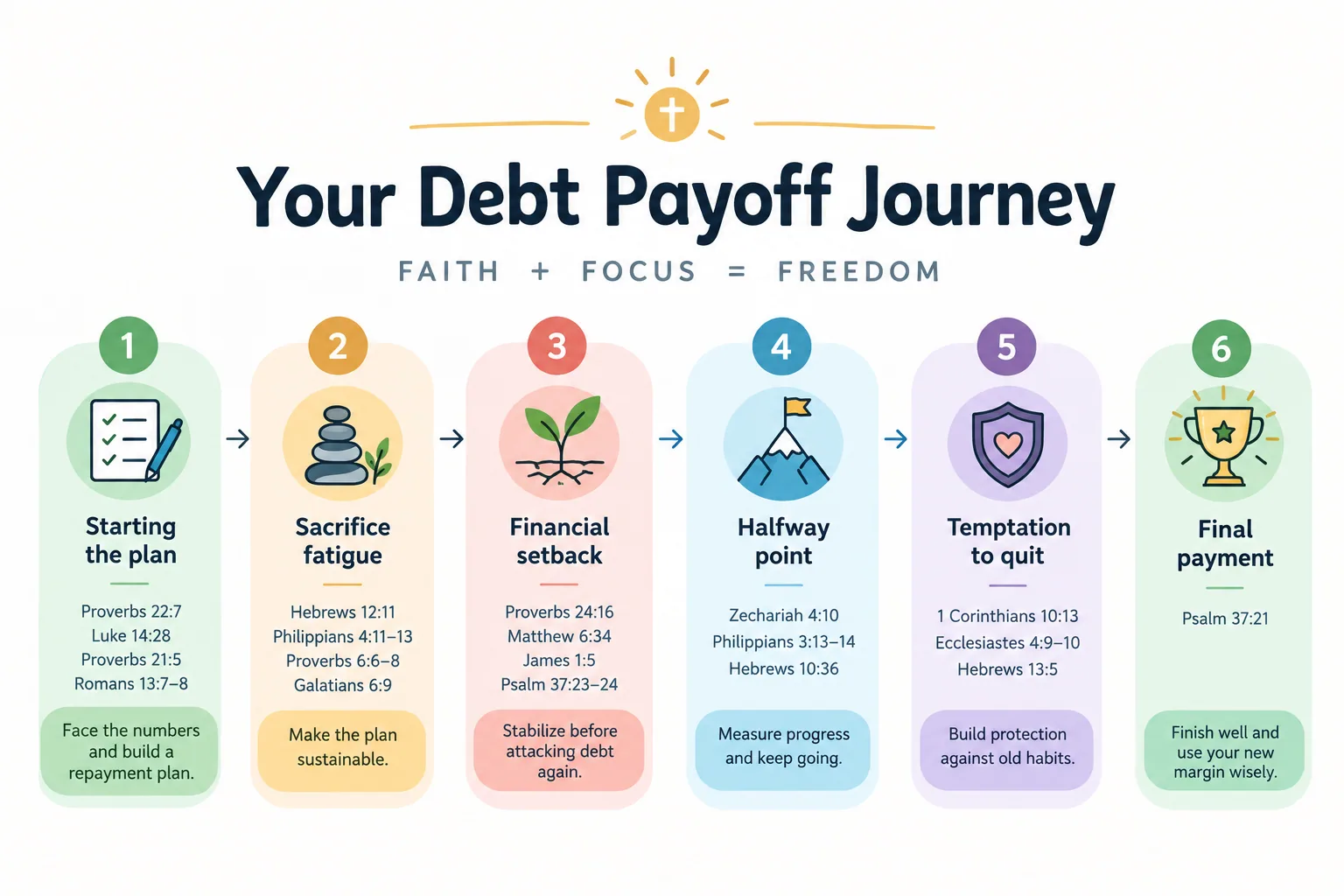
Find your current stage. Read those verses. Then take the practical action beside them.
Before You Start: What Does the Bible Actually Say About Debt?
The Bible gives strong warnings about debt, but it does not give a simple verse saying that every form of borrowing is automatically sinful.
Proverbs 22:7 warns about the power debt can give a lender over a borrower. Psalm 37:21 stresses paying back what is owed. Romans 13 speaks about fulfilling obligations.
Those ideas give us a useful biblical framework:
Borrow carefully. Count the cost. Keep your commitments. Avoid becoming controlled by money. Pay what you owe. Practice contentment.
That is much more useful than feeling ashamed every time you open your banking app.
If your immediate problem is that you cannot cover this month's bills, debt payoff may not be your first job. Start with this guide for when bills are piling up and stabilize your basic expenses first.
Stage 1: Bible Verses for Starting Your Debt-Payoff Plan
Starting sounds simple until you have to write every balance on one page.
That page may show $4,700 on one card, $11,000 on another, a car loan, medical debt, student loans, or years of purchases you regret.
Do not hide from the number.
A number is information. It is not your identity.
1. Proverbs 22:7 — Understand What Debt Is Costing You
“The borrower is servant to the lender.”
Proverbs 22:7 is not telling you to panic.
It is showing you why paying off debt matters. Every required payment claims part of next month's income before you get to decide what to do with it.
That reduces your options.
Practical move: Write down every debt with five pieces of information:
-
Current balance
-
Interest rate
-
Minimum payment
-
Due date
-
Type of debt
Do not estimate.
Log in and get the real numbers.
2. Luke 14:28 — Count the Cost Before You Build the Plan
Jesus uses the example of someone sitting down and calculating the cost before building a tower.
Debt repayment needs the same honesty.
You need to know what your household actually earns, what essentials cost, what minimum payments require, and how much is truly available for extra payments.
Practical move: Calculate this:
Monthly take-home income − essential expenses − minimum debt payments = possible extra debt payment
If the answer is $180, start with $180.
A realistic $180 plan that lasts is better than a $900 plan you abandon in six weeks.
3. Proverbs 21:5 — Slow Planning Beats Financial Panic
Proverbs 21:5 connects diligent planning with abundance and haste with lack.
That principle matters when debt makes you desperate for a quick fix.
Do not sign up for a consolidation loan, balance transfer, settlement company, refinance, or other product just because the monthly payment looks smaller. Check the interest rate, fees, repayment period, protections you may lose, and total cost.
Practical move: Give major debt decisions a 24-hour waiting period whenever possible.
Urgency is not the same thing as wisdom.
4. Romans 13:7–8 — Treat Repayment as a Commitment
Romans 13 emphasizes giving people what is due to them.
That turns your debt plan from a vague wish into a commitment.
You do not need to hate yourself for having debt. You need to deal honestly with what you owe.
Which Debt Should You Pay First?
Two common approaches are the debt avalanche and debt snowball.
The Consumer Financial Protection Bureau explains that focusing on the highest interest rate first can reduce total interest costs, while paying the smallest balance first can create faster visible wins that help some people stay motivated.

The best system is not the one that sounds smartest online.
It is the sensible system you will actually follow.
Real-Life Lesson: When $24,000 Barely Touched the Principal
Attorney Cindy Zuniga-Sanchez accumulated nearly $215,000 in student loans and credit-card debt. CNBC Select reported that after paying about $24,000 during one early year, she discovered around $20,000 had gone toward interest and only about $4,000 toward principal.
She eventually paid off the debt over several years.
The lesson is simple: do not track only how much you pay. Track what happens to the balance.
Interest rate matters.
Stage 2: Bible Verses for Sacrifice Fatigue
Month 1 can feel exciting.
Month 9 can feel like eating leftovers while watching someone else post vacation pictures from Italy.
This is where debt plans often break.
5. Hebrews 12:11 — Discipline Does Not Always Feel Good
Hebrews says discipline can feel painful in the moment while producing good fruit later.
That describes debt payoff surprisingly well.
Skipping an upgrade, keeping an older car, cooking more meals at home, or saying no to another expensive weekend may not feel rewarding tonight.
The reward comes later.
6. Philippians 4:11–13 — Learn Contentment While the Plan Is Running
Paul talks about learning to live with both plenty and little.
Notice the word learned.
Contentment is a skill.
You can practice it without pretending you never want anything.
Practical move: Instead of saying, “I can't buy anything until I am debt-free,” say:
“My goal matters more than this purchase today.”
That feels different because you are making a choice rather than serving a punishment.
7. Proverbs 6:6–8 — Small Repeated Work Matters
Proverbs points to the ant storing resources through steady work.
Debt freedom usually looks less dramatic than social media suggests.
It is often:
$75.
Then $75.
Then $75 again.
Then a tax refund.
Then another $75.
Months of ordinary decisions can eventually produce a very unordinary result.
8. Galatians 6:9 — Do Not Get Tired of Doing Good
Galatians 6:9 tells believers not to become weary in doing good.
Debt payoff creates a strange problem: you can be succeeding while feeling like nothing is happening.
That is because progress becomes normal.
The first $1,000 feels huge. The next $1,000 may barely register.
Do not confuse less excitement with less progress.
If the long middle is exhausting you, these Bible verses about strength and endurance can help when the hard season lasts longer than expected.

Make Your Debt Plan Hard, Not Miserable
There is a difference.
A hard plan requires sacrifice.
A miserable plan removes everything enjoyable until you finally rebel against it.
Try a small guilt-free spending amount if your budget allows it. Maybe that is $20, $40, or $75 each month.
Then spend it without turning a $12 lunch into a moral crisis.
Sustainable discipline usually beats financial perfectionism.
Stage 3: Bible Verses for a Debt-Payoff Setback
The transmission breaks.
Your child needs dental work.
Work cuts your hours.
A medical bill arrives.
You planned to send $700 extra to debt, and now that money has somewhere else to go.
A setback does not erase the payments you already made.
9. Proverbs 24:16 — Getting Back Up Is Part of the Plan
Proverbs says a righteous person may fall seven times and rise again.
The important word is not fall.
It is rise.
Your debt plan should assume that real life will happen.
If one bad month destroys the plan forever, the plan was too fragile.
10. Matthew 6:34 — Solve Today's Problem First
Jesus warns against carrying tomorrow's trouble into today.
That does not mean you stop planning.
It means you deal with the actual problem instead of creating twenty imaginary ones.
Your $1,200 car repair does not automatically mean:
“We will never become debt-free.”
It means:
“We have a $1,200 problem to solve.”
Those are very different statements.
11. James 1:5 — Ask for Wisdom Before Making a Panic Decision
James tells believers who lack wisdom to ask God.
Use that pause when a setback hits.
Pray.
Then get the facts.
Can the bill be negotiated? Is a payment plan available? Can you temporarily reduce extra debt payments? Is there an expense you can pause? Is there reliable temporary income available?
Wisdom usually needs accurate information.
12. Psalm 37:23–24 — A Setback Is Not the End of the Road
Psalm 37 describes someone stumbling without being completely cast down.
That is a useful picture for debt repayment.
You can lose a month without losing the mission.
Use the Setback Order
When a real financial emergency happens:
-
Protect food, housing, utilities, essential medicine, necessary transportation, insurance, and other critical needs.
-
Keep required minimum debt payments current when possible.
-
Use appropriate emergency savings.
-
Reduce or pause extra debt payments temporarily if needed.
-
Avoid turning one emergency into expensive new debt if there is a reasonable alternative.
-
Restart extra payments once the emergency is stable.
If income disappeared because of unemployment, use this guide to Bible verses for money fear after losing a job.
Do not keep making aggressive extra payments while your rent, electricity, or groceries fall apart just so you can say you never changed the debt plan.
The plan serves the household.
The household does not serve the spreadsheet.
Stage 4: Bible Verses for the Halfway Point
Halfway should feel amazing.
Sometimes it does not.
You have already made the easiest cuts. The novelty is gone. You may still owe a number that looks huge.
This is where you need to stop staring only at what remains.
13. Zechariah 4:10 — Do Not Despise Small Beginnings
Small progress deserves respect.
Suppose you began with $42,000 and still owe $21,000.
Your brain may say:
“I still owe twenty-one thousand dollars.”
Write another sentence underneath it:
“I have already eliminated twenty-one thousand dollars.”
Both statements are true.
Only one remembers what you have done.
14. Philippians 3:13–14 — Keep Moving Forward
Paul describes reaching forward rather than remaining trapped in what lies behind.
For debt repayment, that means you do not need to keep punishing yourself for the purchases, loans, mistakes, emergencies, or decisions that created yesterday's balance.
Learn from them.
Then make today's payment.
Shame looks backward without solving anything.
Responsibility looks forward.
15. Hebrews 10:36 — You Need Endurance
Hebrews says, “ye have need of patience.”
That may be the perfect halfway-point verse.
Many debt plans fail not because the math was wrong but because the timeline was longer than the person's motivation.
You need a system that can keep running after motivation leaves.
If your progress feels painfully slow, read these scriptures about trusting God while you wait.
Your Halfway Audit
When you cross 50%, do not just celebrate.
Audit.
Write down:
-
Starting debt
-
Current debt
-
Total principal eliminated
-
Current monthly extra payment
-
Current interest rates
-
Estimated payoff date
-
One expense that can stay cut
-
One sacrifice you need to loosen because it is becoming unsustainable
Then compare yourself with Day 1, not with someone else's Day 900.
Real-Life Lesson: Five Years Is Still Success
CNBC Select has documented Alaina Curry's journey from more than $80,000 in student loans and growing credit-card debt to paying off roughly six figures over about five years. Her journey included unexpected difficulties rather than one perfect upward line.
That matters.
A debt-payoff story does not become less successful because it took years.
Your goal is not to produce the most impressive before-and-after post.
Your goal is to change your financial life.

Stage 5: Bible Verses for When You Want to Quit
The dangerous moment is often not an emergency.
It is a normal Friday night.
You are tired.
You think, “I have been responsible for a year. One big purchase won't matter.”
Sometimes it will not.
But old habits rarely return wearing a sign that says I am about to rebuild your debt.
16. 1 Corinthians 10:13 — Build an Exit Before Temptation Arrives
First Corinthians 10:13 speaks about temptation and a way of escape.
Do not wait until you want something badly to invent your escape route.
Build it now.
If online shopping is your weakness, remove saved card numbers.
If social plans destroy the budget, decide your monthly entertainment number before invitations arrive.
If stress makes you spend, build a different stress routine.
Make the right choice easier before you need to make it.
17. Ecclesiastes 4:9–10 — Stop Doing This Completely Alone
Ecclesiastes says two are better than one and describes one person helping another when they fall.
Debt secrecy is exhausting.
Choose someone trustworthy who can ask:
“Did you make the payment?”
“Did the emergency change the plan?”
“Are you about to buy that because you need it or because this week was awful?”
That might be your spouse, a close friend, mentor, financial counselor, or accountability partner.
18. Hebrews 13:5 — Practice Enough
Hebrews 13:5 warns against loving money and calls believers toward contentment.
Contentment does not mean never upgrading your life.
It means possessions stop controlling the definition of enough.
One of the strongest debt-prevention questions is:
What problem will this purchase actually solve?
If you cannot answer that clearly, wait.
If you are seriously tempted to abandon the plan, these Scriptures for when you feel like giving up go deeper into taking the next small step instead of quitting.
Real-Life Lesson: Debt Can Be a Lifestyle Problem, Not Just a Math Problem
Personal-finance educator Lynnette Khalfani-Cox has described paying off about $100,000 in credit-card debt over roughly three years. She told CNBC Select that credit had become both a “crutch” and a lifestyle tool.
That distinction matters.
Sometimes the solution is not another spreadsheet.
It is changing what you believe you must buy to feel successful, comforted, normal, included, or rewarded.
Stage 6: The Bible Verse for Your Final Debt Payment
Eventually, a strange day arrives.
The balance says $483.71 instead of $48,371.
You press the payment button.
Now what?
19. Psalm 37:21 — Finish What You Owe
Psalm 37:21 contrasts borrowing without repayment with righteousness and generosity.
The final payment represents more than a zero.
It represents a commitment completed.
Celebrate it.
Just do not destroy the result by immediately filling the new monthly margin with new payments.
What to Do With the Money After the Debt Is Gone
Suppose you were paying $850 each month toward debt.
That $850 has already learned how to leave your checking account.
Give it a new job before lifestyle inflation finds it.
Depending on your situation, that may include:
-
Building or rebuilding emergency savings
-
Catching up on retirement contributions
-
Saving for predictable car and home repairs
-
Building medical or insurance deductibles into savings
-
Saving cash for future purchases
-
Increasing generosity
-
Paying down other debt included in your longer-term plan
-
Funding goals that debt payments forced you to delay
You do not need to live like you are in debt forever.
But give yourself time before upgrading everything.
Financial freedom becomes much more useful when you keep some of the habits that created it.
The Emergency Fund Question: Save or Pay Debt?
There is no universal dollar amount that fits every household.
But sending every spare dollar to debt while keeping no buffer can create a cycle:
Pay credit card.
Emergency happens.
Use credit card.
Pay credit card again.
A small cash buffer can protect your debt plan from normal life.
The right amount depends on things such as income stability, insurance, family size, health needs, transportation, housing, and how easily you could replace lost income.
Think of emergency savings as a shock absorber.
It does not make the road smooth.
It stops every pothole from destroying the car.
When You Should Get Outside Help
Some debt problems are bigger than budgeting.
If you cannot cover minimum payments, are repeatedly missing essential bills, are facing collections or lawsuits, or simply cannot see a workable path, consider reputable professional help.
The Federal Trade Commission says legitimate credit counseling organizations should review your individual finances rather than immediately pushing one product. Some may help create debt-management plans in which creditors agree to certain concessions and payments are made through the counseling organization.
The FTC also warns consumers to understand fees and promises before signing up.
Do not let embarrassment make an expensive problem more expensive.
Asking for qualified help can be responsible stewardship.
A Simple Christian Debt-Payoff Routine
You do not need to think about debt all day.
Use a short routine.
Every Payday
Check the account.
Cover essentials.
Make required payments.
Send the planned extra payment.
Stop staring at the balance.
Once a Week
Spend ten minutes reviewing transactions.
Look for mistakes, overspending, upcoming bills, and anything unusual.
Then close the app.
Once a Month
Update your total debt.
Record how much disappeared.
Read the Bible verse for your current stage.
Review the next month's likely expenses.
Every Three Months
Ask:
“Is this plan still realistic?”
“Can I increase the payment?”
“Do I need to reduce it temporarily?”
“Is the same spending problem showing up repeatedly?”
“What has become easier?”
A good financial plan changes when reality changes.
That is not failure.
That is planning.
Frequently Asked Questions About Bible Verses, Money and Debt Payoff
What is the best Bible verse to read while paying off debt?
Start with Proverbs 22:7 if you need motivation to begin because it shows how borrowing can limit freedom.
If you are already tired of the process, Galatians 6:9 may be more useful because it speaks directly to becoming weary while doing good.
The best verse depends on the problem you are facing today.
Does the Bible say debt is a sin?
The Bible strongly warns about the risks and obligations connected with debt, but Scripture does not simply state that every act of borrowing is automatically a sin.
Its clearest themes are caution, planning, honesty, repayment, avoiding exploitation, contentment, and responsible stewardship.
Is the debt snowball biblical?
The Bible does not command a debt snowball, avalanche, or any modern repayment method.
Those are financial tools.
The CFPB notes that targeting the highest interest rate can reduce costs, while targeting the smallest balance can provide motivating early wins. Choose a reasonable approach and follow it consistently.
Should I pause debt payoff when an emergency happens?
Sometimes pausing extra debt payments can be reasonable if essential needs or a genuine emergency require the money.
Keep required obligations in mind, protect necessities, understand the consequences of missed payments, and restart your extra payments once the immediate problem is stable.
Do not confuse pausing with quitting.
What if my debt balance is barely going down?
Check the interest rate, fees, new charges, minimum payment, and how much of each payment is reaching principal.
If you continue using the account while paying it down, you may also be replacing much of what you repay.
Get the actual statements instead of guessing.
Should Christians tithe while paying off debt?
Christian churches and traditions differ on how tithing and giving should be practiced.
Talk honestly with your spouse, church leadership, or trusted pastor if this is creating tension. Avoid pretending your finances have not changed or using expensive borrowing merely to maintain an appearance.
Generosity also includes time, service, hospitality, encouragement, and helping others in ways that fit your current means.
What if I feel ashamed about my debt?
Separate responsibility from shame.
Responsibility says:
“I owe this money, so I am going to make a plan.”
Shame says:
“I owe this money, so something is fundamentally wrong with me.”
Only the first statement helps you make Tuesday's payment.
Can I trust God and still use a strict budget?
Yes.
Prayer and planning are not enemies.
Luke 14:28 points directly toward counting the cost. Proverbs repeatedly praises wisdom, diligence, and planning.
You can pray for provision while checking your bank balance.
You can trust God while calling a creditor.
You can read Scripture and use a spreadsheet.
How do I stay motivated when debt payoff is taking years?
Stop depending entirely on motivation.
Automate what you can.
Track milestones.
Keep a small amount of breathing room in the budget when possible.
Review how far you have already come.
And measure progress in quarters, not every morning.
A long plan can still be a successful plan.
Your Next Payment Does Not Have to Be Dramatic
Debt freedom is usually built through ordinary decisions that nobody else sees.
You open the statement.
You tell the truth about the number.
You make the budget.
You skip something.
You survive a setback.
You restart.
You make another payment.
And eventually the payment you make is the last one.
So do not try to carry the entire remaining balance in your head tonight.
Find your stage.
Read the verse for that stage.
Then make the next faithful financial move.
That is how a debt-payoff plan becomes more than a burst of motivation.
It becomes a practice of wisdom, discipline, patience, and freedom.
Key Statistics
Total U.S. household debt
$18.771 trillion
Total household debt outstanding at the end of Q2 2026. It declined $13 billion from Q1 but was $383 billion higher than a year earlier.
Source: Federal Reserve Bank of New York — Q2 2026 Household Debt & Credit
U.S. credit-card debt
$1.263 trillion
Credit-card balances at the end of Q2 2026, up $21 billion during the quarter and $54 billion year over year.
Source: Federal Reserve Bank of New York — Q2 2026 Household Debt & Credit
Credible Sources
Federal Reserve Bank of New York · August 11, 2026
Primary, authoritative source for the article’s $18.771T total household-debt and $1.263T credit-card-balance figures. It is based on the New York Fed’s nationally representative Consumer Credit Panel.
Board of Governors of the Federal Reserve System · May 19, 2026
Supports the 16% bill-payment statistic and provides useful supporting evidence about financial hardship, unexpected expenses, and emergency savings.

About the Author
Editorial Team
Editorial Team
Daily Faith Path articles are prepared by the editorial team to help readers find scripture-centered guidance for healing, faith, prayer, and spiritual encouragement.
Expertise: Healing scriptures, Bible study resources, prayer guidance, devotional writing, Christian encouragement
Experience: The team researches scripture references, reviews surrounding biblical context, compares translation wording where useful, and updates articles to improve clarity, usefulness, and trust for readers.
Credentials: Editorial review, devotional writing, scripture study, content updating
This article is published by the Daily Faith Path editorial team to help readers use scripture carefully, prayerfully, and in ways that are practical for real-life seasons of illness, grief, waiting, and spiritual reflection.
Continue Reading
Related articles

October 7, 2026
12 Bible Verses About Hiding Money From Your Spouse
Explore 12 Bible verses about secret spending, hidden debt, financial honesty, confession, forgiveness, boundaries, and rebuilding trust in marriage.

October 6, 2026
15 Bible Verses for Couples Who Keep Fighting About Money
Money fights are rarely just about dollars. These 15 Bible verses help couples address spending, saving, debt, secrecy, unequal income, giving, and financial control with practical next steps and conversation questions.
October 5, 2026
Should You Tithe While in Debt? 11 Bible Passages to Study First
Should you tithe while in debt? Explore 11 Bible passages on tithing, debt, generosity, family responsibility, and giving according to your means—plus a practical plan for deciding what to do.