Deconstructing vs. Deconverting: The Difference Nobody Explains
Faith deconstruction and deconversion are often treated as the same thing, but they're fundamentally different. Learn what separates questioning your beliefs from leaving your faith, why many Christians remain believers after deconstruction, and how to recognize where you are in your own spiritual journey.
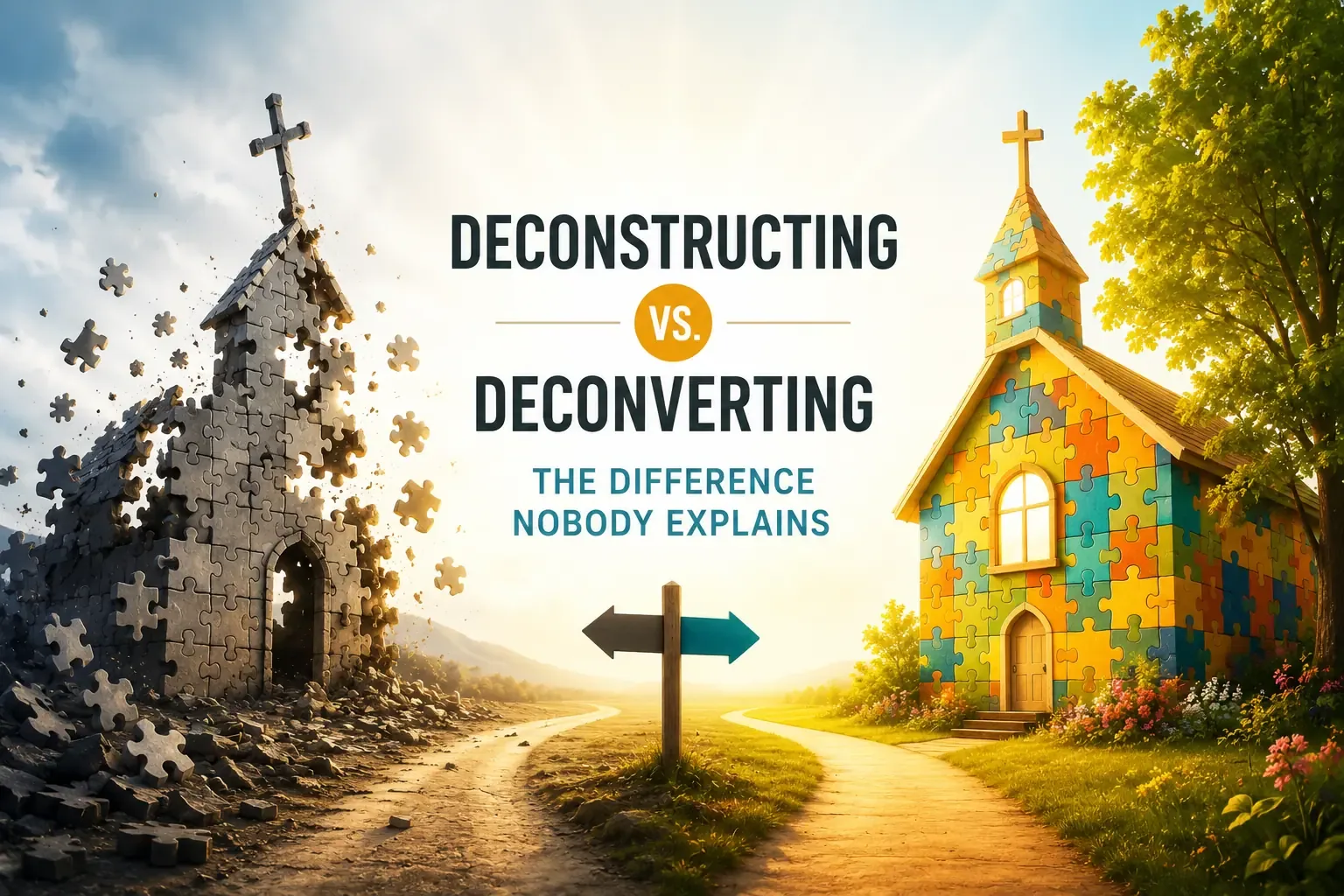
You can question everything you believe on Tuesday and still take communion on Sunday. Nobody tells you that. Most articles online treat "faith deconstruction" as a polite word for leaving the church, but Barna Group's own research found that 37% of people who have deconstructed their faith are still practicing Christians today. That single stat blows up the whole "deconstruction equals exit" story — and this article is for the people living in that gap.

What Deconstruction Actually Means (And What It Doesn't)
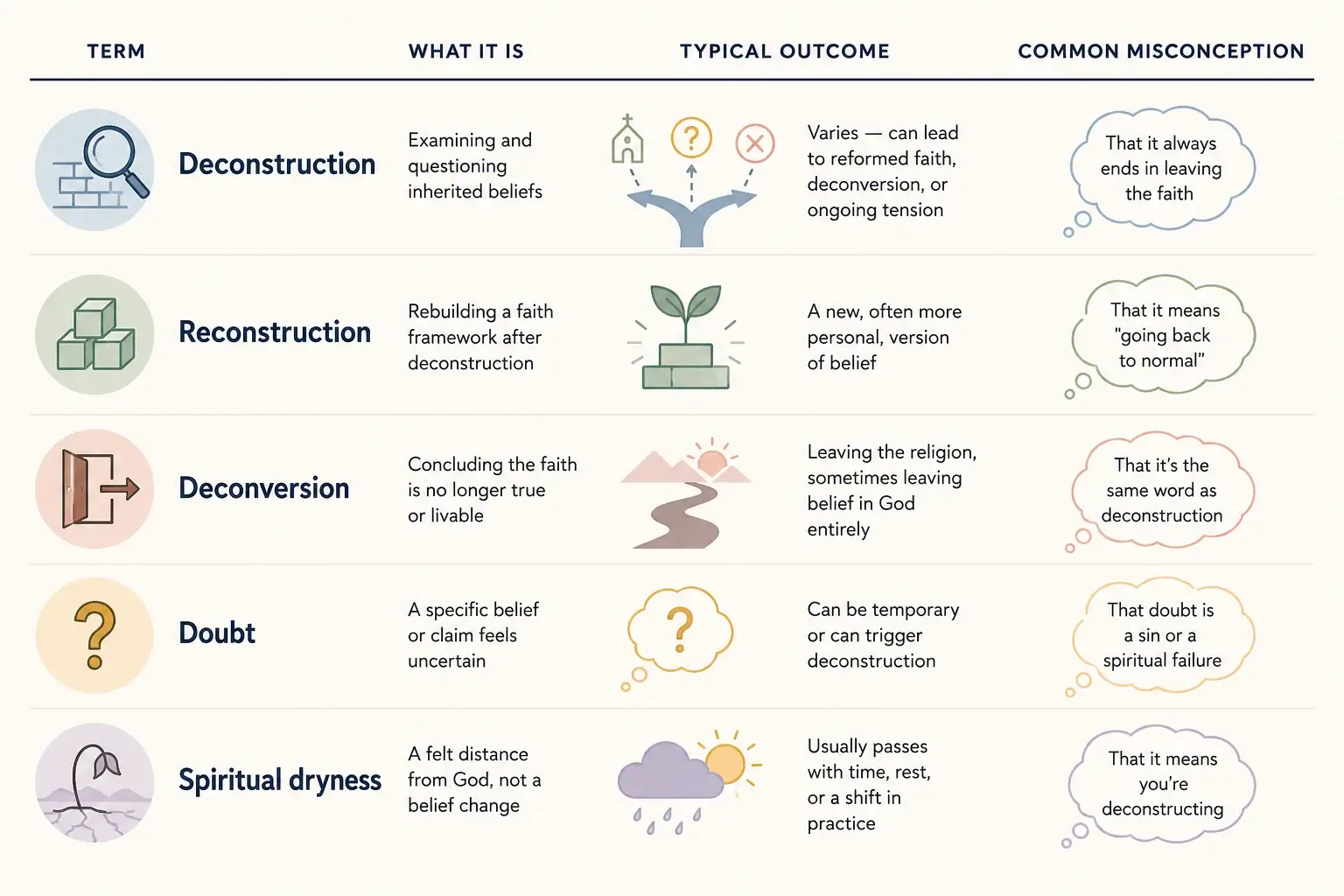
Faith deconstruction is the process of taking apart your beliefs, one at a time, to see which ones are actually yours and which ones you just inherited. It's not an event. It's a slow, sometimes years-long process of asking "wait, why do I believe this?"
Deconversion is different. Deconversion is the outcome where someone examines their beliefs and lands outside the faith entirely. They're related, but one is a process and the other is a destination — and not everyone who starts the process ends up at that destination.
Here's the easiest way to picture it: deconstruction is remodeling a house room by room. Deconversion is tearing the house down and moving somewhere else. Some people remodel the kitchen and keep living there. Other people realize the whole foundation is cracked and walk away. Both start with a hammer. They don't end in the same place.
Why This Distinction Gets Erased Online
Search "faith deconstruction" and most results assume you're already halfway out the door. Ex-vangelical forums, exit-story podcasts, and "why I left the church" essays dominate page one. If you're not trying to leave, none of that content speaks to you — it just makes you feel like your quiet questioning is a phase before an inevitable exit.
That's not what the data says. A 2023 Barna study on the "post-Christian" landscape found that a majority of self-identified deconstructors remained Christian, just with a reshaped set of beliefs. The loud voices online are the exception being treated like the rule.
The Reader Nobody Is Writing For
Picture Maria. She's 34, sings on the worship team, and hasn't missed a Sunday in three years. She also can't stop thinking about the sermon on hell she heard as a kid, or why her pastor gets defensive every time someone asks about women in leadership. She's not planning to leave. She just has questions she's scared to say out loud.
Maria is the underserved reader. Most deconstruction content assumes she's an "ex-Christian in progress." She isn't. She's a currently-active, currently-serving, currently-believing person who is doing theological homework in private because she doesn't know if it's safe to do it out loud.
This matters because the shame Maria feels isn't really about her doubts — it's about not having a name for what she's going through. Naming something correctly is often the first relief a person gets.

Real Story: The Youth Pastor Who Stayed
A youth pastor in Texas — we'll call him Dan, since he asked not to use his name in interviews about this topic — spent 18 months quietly deconstructing his views on biblical inerrancy after a college class exposed him to how the biblical canon was actually assembled. He kept preaching every week. He kept leading worship nights. He didn't tell his elder board for over a year because he assumed doubt meant disqualification.
When he finally told one trusted mentor, the response surprised him: "I've been in ministry 30 years and rebuilt my theology of Scripture twice." Dan didn't leave the faith. He left behind a version of it that couldn't survive contact with real questions, and built one that could. That's deconstruction without deconversion, happening inside the very institution some assume it destroys.
The Symptoms People Mistake for Losing Their Faith
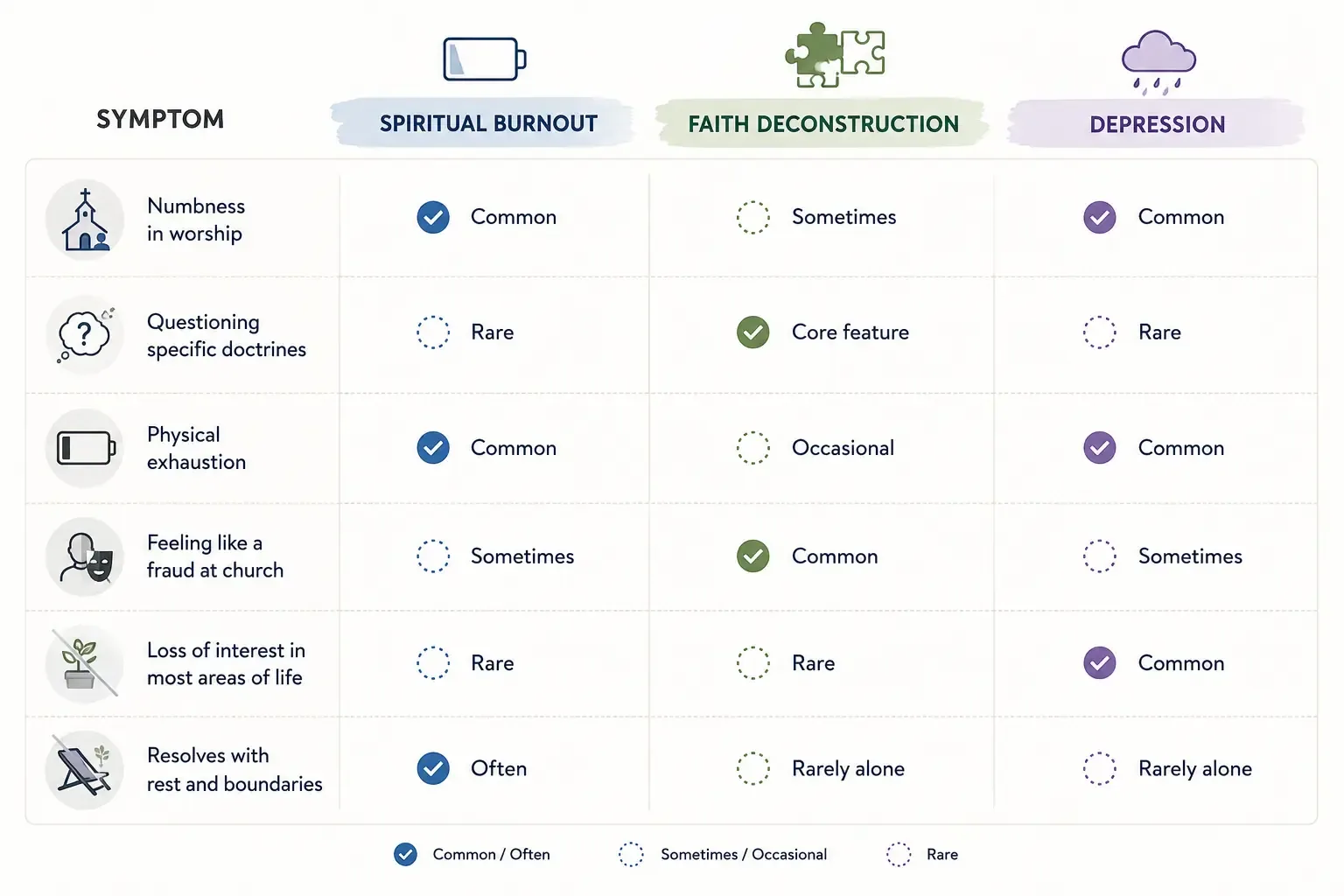
A lot of what feels like "losing my faith" is actually something else entirely — spiritual exhaustion, burnout, or a normal dry season that every long-term believer experiences. Confusing these categories is one of the most common and most avoidable sources of panic.
Spiritual burnout shows up as numbness toward things that used to move you: worship music does nothing, prayer feels like a chore, and church starts to feel like a performance you're watching from behind glass. This piece on 10 signs of spiritual exhaustion breaks down exactly what that numbness looks like and why it's often a body-and-mind problem before it's a belief problem.
Christian burnout specifically can also mimic depression, which is why it's worth learning to tell the two apart before assuming your faith itself is collapsing — this breakdown of Christian burnout symptoms is a useful gut-check.
And sometimes it's simpler than burnout — it's just a dry season. Feeling like God has gone quiet doesn't mean He left, and it definitely doesn't mean you're deconstructing. This guide on what to do when God feels silent walks through the difference between a quiet season and a real crisis of belief.
The 37% Nobody Talks About
Barna's research on the post-Christian shift in America found that people who describe themselves as having "deconstructed" their faith are far more likely to still identify as Christian than most media coverage suggests. That number — 37% staying Christian post-deconstruction — deserves way more attention than it gets, because it means deconstruction is not a one-way exit ramp. It's a fork in the road.
Why doesn't this show up in the content you find when you search? Partly because leaving makes a better story. "I deconstructed and I'm still here, just different" doesn't get the same shares as "Why I Left Christianity Forever." The algorithm rewards the dramatic outcome, not the common one.
A Second Data Point Worth Knowing
Pew Research's religious landscape studies have consistently shown that religious switching in the U.S. is common in both directions — people leave, but people also return, and people also stay while significantly revising what they believe. Deconstruction-without-departure isn't a fringe case. It might be the majority case among people who use the word "deconstructing" about themselves at all.

How to Tell Which One You're In
You can't always predict where deconstruction will lead while you're in the middle of it, but there are a few honest questions that tend to clarify things.
Are you questioning a belief, or questioning the existence of God entirely? Deconstruction usually starts specific — a view on hell, a stance on sexuality, a doctrine of Scripture. Deconversion tends to widen out to the foundational claim itself: does God exist at all.
Do you still want this to be true? Many people mid-deconstruction will tell you they're desperately hoping their faith survives the process. That desire is a meaningful signal. Deconversion often comes with relief, not grief, once someone has fully arrived there.
Are you angry at the church, or angry at God? Anger at specific leaders, institutions, or teachings is compatible with deconstruction. A settled conviction that there's no God to be angry at is closer to deconversion.
Can you picture yourself back in a pew in five years? If the honest answer is "yes, just a different kind of church," you're likely deconstructing. If the honest answer is "no, and I don't want to," that's a different journey.
None of these questions are a test you pass or fail. They're just a mirror.
Practical Steps for the Person Still in the Pew
Give Yourself Permission to Ask the Question Out Loud
The single most damaging thing people do during deconstruction is keep it entirely silent. Silence turns a normal process into a hidden shame spiral. Find one person — a therapist, a trusted friend, a mentor who has been through their own version of this — and say the actual sentence: "I'm not sure what I believe anymore."
Separate the Institution From the Belief
A lot of deconstruction starts with disappointment in a specific church or leader, not with theology itself. Ask yourself plainly: is this church's failure a reason to question this doctrine, or are you letting a hurt person's behavior stand in for God's character? Those are two very different problems needing two very different responses.
Read Outside Your Usual Voices — On Purpose
If everything you've ever read on a topic came from one theological tribe, you're not actually testing your beliefs, you're just repeating them. Read a serious defense of the view you doubt from its best available source, not its worst representative. Weak arguments against a straw man convince nobody who's paying attention.
Rebuild Trust in Small, Concrete Steps
If your trust in God feels shaky, don't try to solve the whole thing in one theological essay. Trust rebuilds through small, repeated evidence, the same way trust rebuilds in any relationship. This guide on trusting God when life is falling apart offers a step-by-step approach that treats trust as something you practice, not something you either have or don't.
Get Curious About What "Faith" Actually Means
A huge amount of deconstruction pain comes from conflating "faith in God" with "certainty about every doctrine my church taught me." Those aren't the same thing. Exploring what the Bible actually says about faith can be a useful reset, because biblical faith was never framed as the absence of doubt — Thomas doubted, and he's still in the book.

Watch the Timeline, Not Just the Moment
Deconstruction rarely resolves in a weekend. Give yourself an actual runway — months, sometimes years — instead of demanding a verdict on your entire worldview by Friday. People who rush the process tend to either force themselves back into beliefs they don't actually hold, or slam the door on a faith they never fully examined.
Real-World Example: Two People, Same Starting Point
Consider two people who both grew up in the same strict, fear-based church tradition and both started questioning it in their late twenties over the same issue — how their church talked about hell.
The first person spent two years reading theologians across the spectrum, found a version of Christian belief about judgment and afterlife that felt honest to both Scripture and conscience, and now attends a different, less fear-driven congregation. She deconstructed a specific doctrine and reconstructed a faith that fits.
The second person went through the same reading process, concluded the entire framework of divine judgment didn't hold up under scrutiny, and over time stopped believing in God altogether. He deconstructed the same starting belief and ended up deconverted.
Same trigger. Same amount of intellectual honesty. Different destinations. That's the whole point — the process doesn't predetermine the outcome, and neither path proves the other person did it wrong.
What Church Leaders Get Wrong (And Right)
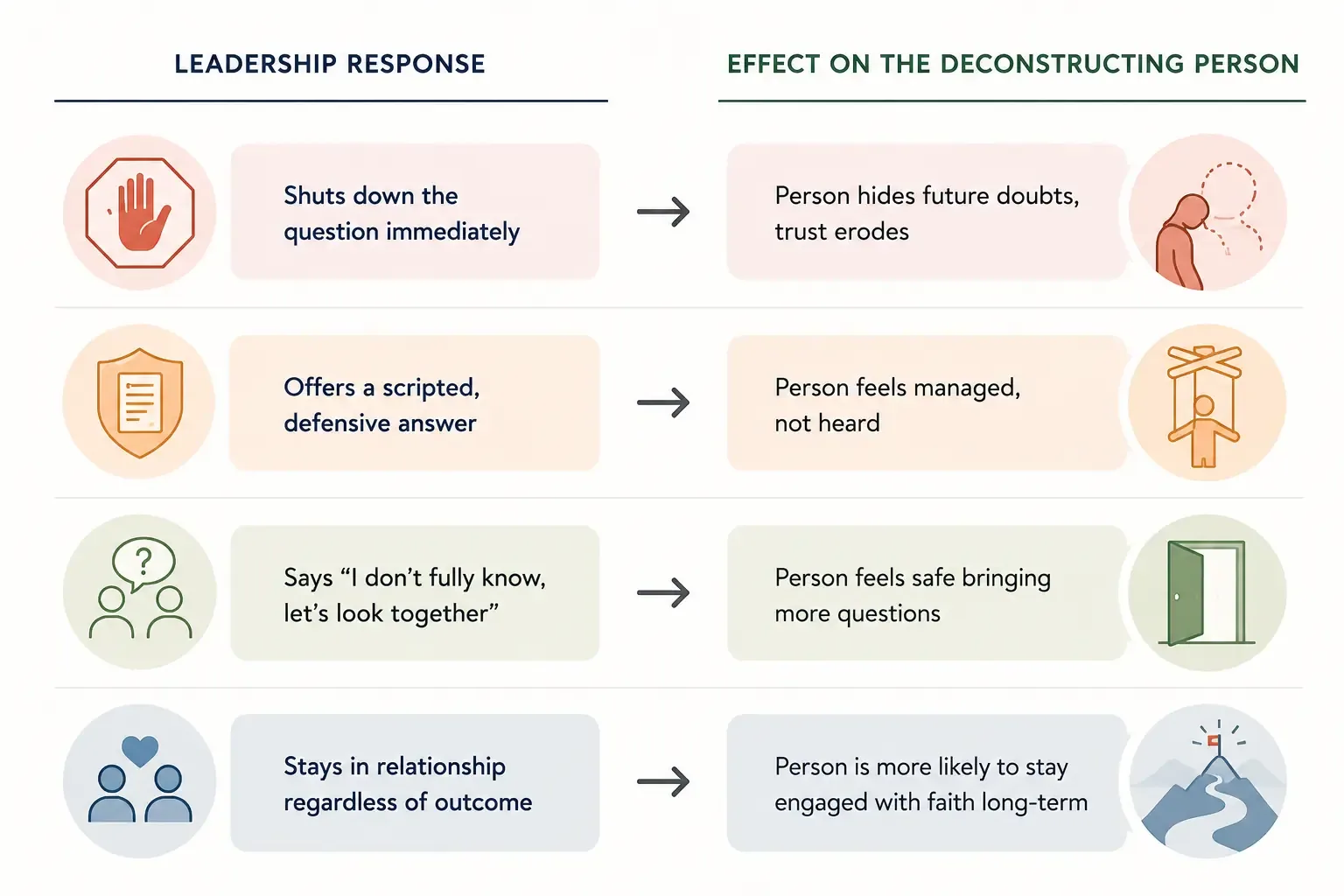
Many pastors respond to any mention of "deconstruction" as if it's a fire alarm — something to shut down immediately with reassurance and proof-texts. That instinct, while understandable, often pushes people toward secrecy rather than resolution.
The leaders who handle this well tend to do three things: they don't panic when someone brings them a hard question, they admit when they don't have a tidy answer, and they treat the questioning person as someone worth keeping in relationship regardless of where they land. Fear of losing someone to deconversion is exactly what makes some churches lose people faster — nobody stays somewhere they have to lie to survive.
FAQ: Faith Deconstruction vs. Deconversion
Is deconstruction a sin? No. Examining what you believe and why is not the same as rejecting God. Many respected theologians throughout history have gone through seasons of intense doubt and questioning without it being treated as spiritual failure.
Can you deconstruct and come back stronger in your faith? Yes, and it's common. Barna's research shows a significant share of people who deconstruct remain in the Christian faith, often with a more resilient, personally-owned belief system than before.
How long does deconstruction usually take? There's no fixed timeline. For some it's a matter of months tied to one specific doubt; for others it's a multi-year process touching several beliefs. Rushing it tends to backfire in both directions.
What's the difference between doubt and deconstruction? Doubt is usually about one specific claim or belief. Deconstruction is a broader process of examining the whole framework those beliefs sit inside. Doubt can trigger deconstruction, but not every doubt turns into one.
Is it normal to keep attending church while deconstructing? Very normal. Many people continue attending, serving, and even leading while quietly working through hard questions, precisely because they're not trying to leave — they're trying to figure out what they actually believe.
Should I tell my pastor or small group I'm deconstructing? That depends on whether your community has shown it can handle hard questions without panic or judgment. Start with one trusted person rather than a public announcement, and gauge the response before opening up further.
What if I deconstruct and realize I don't believe anymore? That's a real and valid outcome for some people, and it deserves the same compassion as any other outcome. If you land there, resources for people in that season — including grief support and community — matter just as much as resources for people who stay.
The Bottom Line
Deconstruction is not a euphemism for leaving. It's a process, and Barna's own numbers say more than a third of people who go through it are still sitting in a pew somewhere, just with a faith that's actually theirs now instead of one they inherited without asking a single question. If you're the person quietly wrestling with doubt on a Sunday morning, you're not a statistic waiting to happen — you're doing exactly what faith that can survive scrutiny requires.
For continued reading on rebuilding trust in this season, the hub on trusting God offers a broader set of paths for wherever you land next.

Key Statistics
Christians Remaining After Deconstruction
37%
Barna research found that 37% of people who deconstructed their faith still identify as practicing Christians, demonstrating that deconstruction does not necessarily lead to leaving Christianity.
Source: Barna Group – The Deconstruction of Christianity / Post-Christian America Research
Religious Switching in the U.S.
High prevalence (no single percentage cited in article)
Pew Research consistently finds that Americans change religious affiliation throughout life, including leaving, returning to, or changing traditions within Christianity.
Source: Pew Research Center – Religious Landscape Studies
Credible Sources
Pew Research Center · January 1, 2014
Provides authoritative data on religious affiliation, switching, and long-term trends in American Christianity.
Pew Research Center · September 13, 2022
Offers projections and analysis of religious change, helping contextualize faith transitions and deconversion trends.

About the Author
Editorial Team
Editorial Team
Daily Faith Path articles are prepared by the editorial team to help readers find scripture-centered guidance for healing, faith, prayer, and spiritual encouragement.
Expertise: Healing scriptures, Bible study resources, prayer guidance, devotional writing, Christian encouragement
Experience: The team researches scripture references, reviews surrounding biblical context, compares translation wording where useful, and updates articles to improve clarity, usefulness, and trust for readers.
Credentials: Editorial review, devotional writing, scripture study, content updating
This article is published by the Daily Faith Path editorial team to help readers use scripture carefully, prayerfully, and in ways that are practical for real-life seasons of illness, grief, waiting, and spiritual reflection.
Continue Reading
Related articles

October 7, 2026
12 Bible Verses About Hiding Money From Your Spouse
Explore 12 Bible verses about secret spending, hidden debt, financial honesty, confession, forgiveness, boundaries, and rebuilding trust in marriage.

October 6, 2026
15 Bible Verses for Couples Who Keep Fighting About Money
Money fights are rarely just about dollars. These 15 Bible verses help couples address spending, saving, debt, secrecy, unequal income, giving, and financial control with practical next steps and conversation questions.

October 5, 2026
Should You Tithe While in Debt? 11 Bible Passages to Study First
Should you tithe while in debt? Explore 11 Bible passages on tithing, debt, generosity, family responsibility, and giving according to your means—plus a practical plan for deciding what to do.