Random Bible Quote for Overthinking: 1 Peter 5:7 + 5-Minute Method
When your mind won’t stop overthinking, more information may not be the answer. Start with 1 Peter 5:7 and use this simple five-minute Read → Breathe → Question → Pray → Act method to separate facts from fears, take one responsible next step, and release what you cannot control.
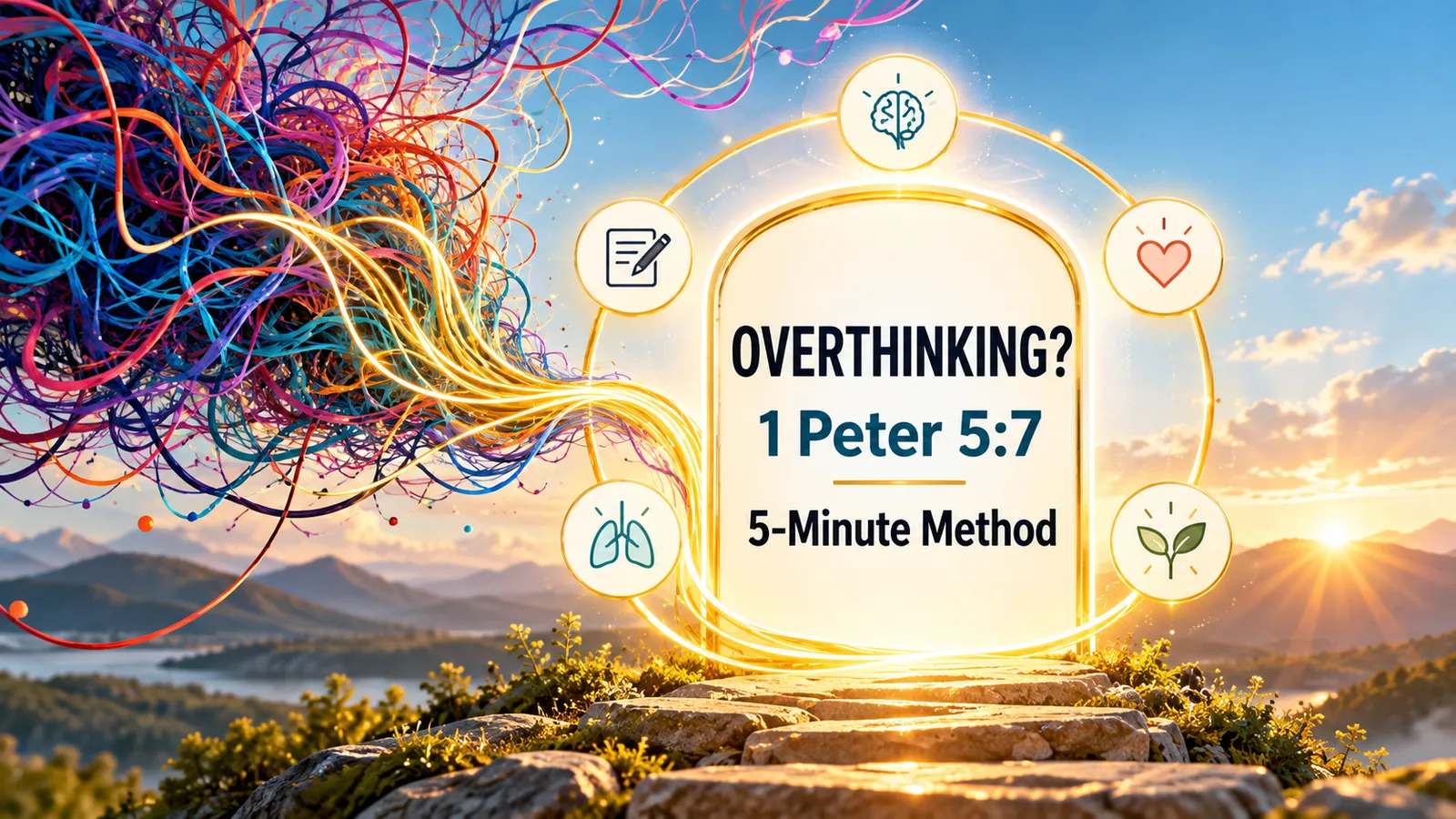
Your mind does not need 37 more Bible verses right now. It may need one verse, five quiet minutes, and one clear next step.
Here is your random Bible quote for overthinking:
“Casting all your care upon him; for he careth for you.” — 1 Peter 5:7, KJV
Do not refresh the page yet.
Stay with this verse for five minutes.
Because when you are overthinking, searching for another verse can sometimes become part of the problem. You keep looking for the perfect sentence that will remove all uncertainty.
This guide takes a different approach.
You will use one Scripture through a simple process:
Read → Breathe → Question → Pray → Act.
By the end, you will have something more useful than a comforting quote. You will have a practical way to respond when your mind starts circling the same problem again.

Your Random Bible Quote for Overthinking: 1 Peter 5:7
1 Peter 5:7 says:
“Casting all your care upon him; for he careth for you.”
This verse is short enough to remember when your brain feels crowded.
But its message is bigger than “stop worrying.”
What 1 Peter 5:7 actually means
Peter was writing to Christians dealing with pressure, suffering, and uncertainty.
The surrounding passage calls believers to humility, trust, alertness, and steadfast faith.
That matters.
Peter is not saying:
“Nothing bad will happen.”
He is not saying:
“If you trust God enough, you will immediately feel calm.”
He is saying you do not have to carry every concern as if the final outcome depends completely on you.
You can bring the weight to God.
Then you can keep living faithfully.
That is especially useful for an overthinking mind.
Overthinking often whispers:
“Keep thinking. If you analyze this long enough, you can finally guarantee the right outcome.”
But there are many situations where certainty is impossible.
You can make a wise decision without knowing everything that happens next.
You can take responsibility without carrying the entire future.
If you want another Scripture after working through this one, use the Daily Verse Generator. It gives you a fresh passage for prayer and reflection instead of an endless stream of verses to skim.
Overthinking Is Not the Same as Careful Thinking
Thinking carefully is useful.
Rumination is different.
Researchers often describe rumination and worry as forms of repetitive negative thinking. The thoughts repeat, feel hard to control, focus heavily on negative possibilities, and may continue even when they are no longer helping you solve the problem. Research has linked this pattern with both anxiety and depression.
Here is an easy test.
Healthy thinking moves you toward information, a decision, or an action.
Overthinking keeps moving around the same circle.
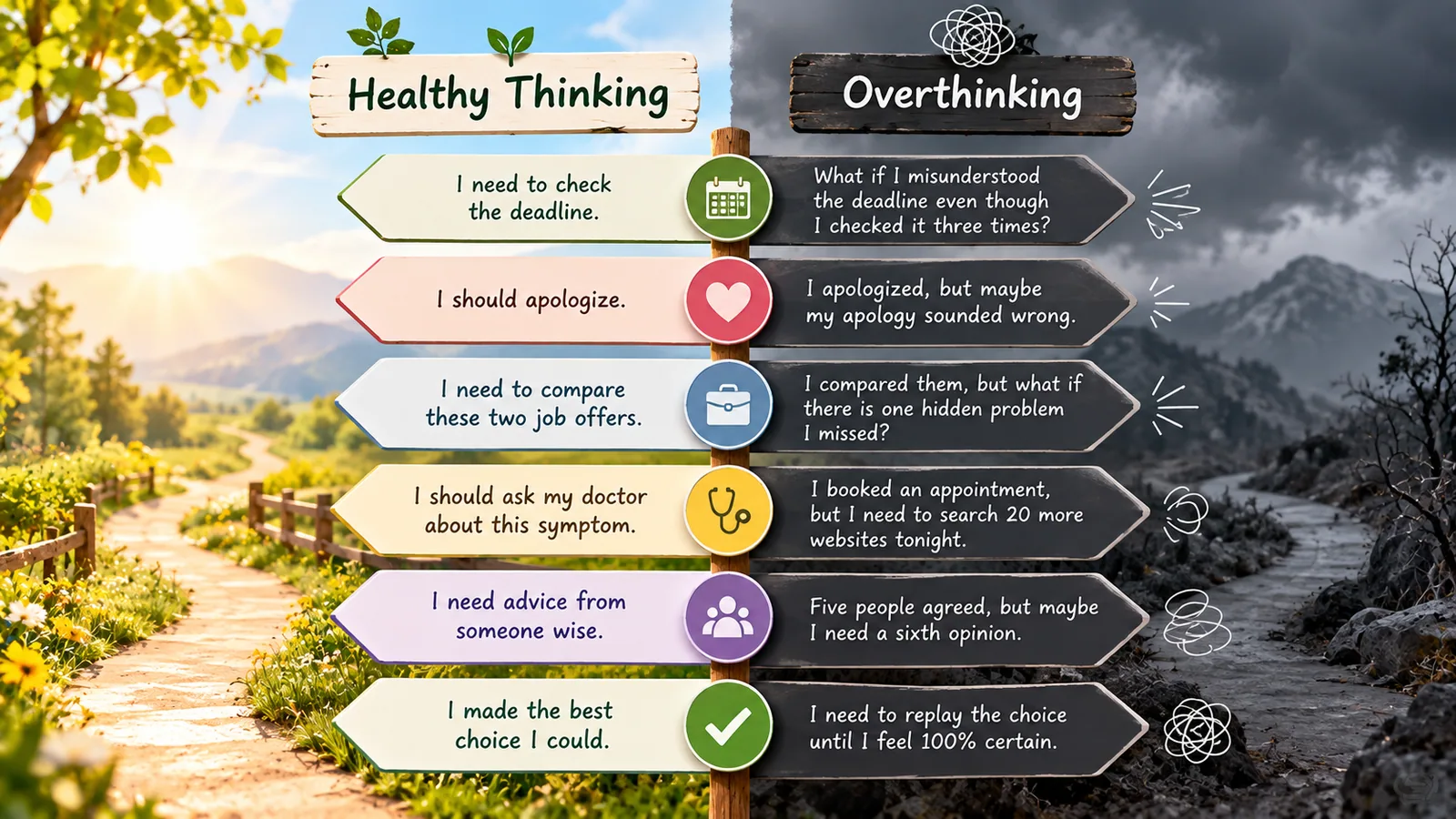
That last line is important.
Overthinking often stops being a search for wisdom.
It becomes a search for certainty.
And certainty is something life rarely gives us.
Why Your Brain Keeps Replaying the Same Problem
People overthink for different reasons.
Sometimes you are trying to prevent a mistake.
Sometimes you are scared of disappointing someone.
Sometimes you are trying to understand why something painful happened.
Sometimes your brain thinks another five minutes of analysis will finally make you feel safe.
The problem is that repeated thinking can feel productive even when nothing new is happening.
A useful question is:
“What new information am I getting from this thought?”
If the answer is “none,” you may no longer be problem-solving.
You may be looping.
A 2025 meta-analysis examined 55 studies involving 4,970 participants and found that cognitive behavioral therapy interventions reduced repetitive negative thinking such as worry and rumination. The researchers also found stronger results for treatments specifically focused on repetitive negative thinking, although study quality varied.
That does not mean every person who overthinks has a mental health disorder.
It means the process matters.
Trying to answer every worrying thought is not always the best response.
Sometimes you need to change what you do with the thought.
The 5-Minute Read → Breathe → Question → Pray → Act Method
Do this before opening another tab.
Do it before asking another person for reassurance.
Do it before generating another Bible verse.
Set a five-minute timer if that helps.
Minute 1: READ — Stay with one passage
Read 1 Peter 5:7 slowly.
“Casting all your care upon him; for he careth for you.”
Read it again.
Now notice one phrase.
Maybe it is:
“all your care.”
Maybe it is:
“casting.”
Maybe it is:
“he careth for you.”
Do not try to understand every theological detail right now.
Choose the phrase that speaks most directly to what you are carrying.
For more passages designed for slower reflection, you can also explore these Bible verses about peace.
Minute 2: BREATHE — Stop trying to solve while your body is rushing
Slow your breathing.
This is not a trick to guarantee that anxiety disappears.
It is simply a way to create a little space between the thought and your next reaction.
Try this:
Breathe in gently.
Pause.
Breathe out slowly.
Then read the verse again.
Do that several times.
You are not trying to achieve some perfect spiritual feeling.
You are trying to slow down enough to notice what is happening.
Say:
“My mind is racing. I do not have to race with it.”
That small distinction matters.
A thought can feel urgent without being urgent.
Minute 3: QUESTION — Ask what problem actually needs solving
Now ask:
“Is there a real problem I can act on, or am I trying to solve uncertainty itself?”
Write one sentence.
For example:
“My boss has not answered my message, and I am imagining that I am about to be fired.”
Now separate the facts from the story.
Fact: My boss has not answered my message.
Story: My boss is angry, my job is in danger, I will lose my income, and everything will fall apart.
The story could be true.
It could also be completely wrong.
You do not know yet.
That means your next job is not to solve your entire imagined future.
Your next job may simply be to wait for the reply.
Minute 4: PRAY — Pray about the actual fear
Do not pray vaguely if your fear is specific.
Instead of:
“God, please help me stop worrying.”
Try:
“God, I am afraid I will lose this job. I want certainty that I do not have. Help me deal with what is real today and trust You with what I cannot know yet.”
Short prayers are fine.
Messy prayers are fine.
You do not need to create beautiful language.
Prayer is not another task you have to perform perfectly.
Minute 5: ACT — Choose one responsible next step
This is where many verse lists stop.
They help you feel encouraged but do not help you decide what to do next.
Ask:
“What is one useful action available to me today?”
Not ten actions.
One.
Send the email.
Book the appointment.
Apologize.
Go to sleep.
Check the contract once.
Talk to your spouse.
Write down the decision.
Turn off the search results.
Then act.
Your mind may continue producing questions afterward.
You do not have to answer every one.

Real-Life Story #1: The Job Offer That Never Felt Certain
Consider this realistic composite example.
Marcus receives a job offer.
It pays more and offers better hours, but he would need to leave a team he likes.
So Marcus does what a responsible person should do.
He compares salaries.
He checks health benefits.
He talks with his wife.
He prays.
He asks a trusted friend for advice.
After several days, he has enough information.
But he does not feel certain.
So he creates another spreadsheet.
Then he searches Reddit.
Then he watches videos about changing careers.
Then he asks two more friends.
Then he starts wondering if God is warning him because he still feels nervous.
Nothing new is being learned.
Marcus has moved from decision-making into reassurance-seeking.
What could Marcus do instead?
He can create a decision deadline.
For example:
“Friday at 6 p.m., I will decide using the information I already have unless something important changes.”
Then he can write:
Reasons to accept: better schedule, higher pay, career growth.
Reasons to stay: familiar team, shorter commute, lower risk.
He can pray.
He can decide.
Then he can stop reopening the question every time anxiety returns.
This is one of the most important lessons for Christian overthinkers:
Feeling uncertain after a decision does not automatically mean the decision was wrong.
For a deeper guide to this kind of decision loop, read how to trust God when you overthink.
The Three-Loop Test: Why Are You Still Thinking?
When you notice yourself returning to the same concern, identify the loop.
Loop 1: The Information Loop
You are missing a fact that genuinely matters.
Example:
You are considering renting an apartment but do not know whether pets are allowed.
The solution is simple.
Get the information.
Ask the landlord.
Then stop guessing.
Loop 2: The Decision Loop
You have enough information, but choosing feels scary.
Example:
Two colleges have both accepted you.
Both are affordable.
Both offer your program.
You have researched them for weeks, yet you continue comparing tiny details because you want one choice to become completely risk-free.
It will not.
The solution is to set reasonable criteria and make a decision.
Loop 3: The Reassurance Loop
You already have an answer, but you keep checking because the answer does not feel certain enough.
Example:
Your doctor says your test result is normal.
Then you search the result online.
Then you ask a friend.
Then you search again.
Then you wonder if the doctor overlooked something.
Another round of checking may produce only temporary relief.
Soon the question returns.
The goal here is often not more information.
It is learning to tolerate some uncertainty.
Real-Life Story #2: “Did I Say Something Wrong?”
Sofia sends a text to a close friend.
The friend normally responds quickly.
Three hours pass.
Sofia rereads her message.
“Was that rude?”
She changes her mind.
“No, it was normal.”
Ten minutes later:
“But maybe the joke sounded sarcastic.”
She reads the old messages.
She asks another friend what they think.
She starts writing an apology even though nobody has said anything is wrong.
What has happened?
A simple unanswered message has turned into a full relationship crisis inside her mind.
A better response
Sofia can separate the facts from the predictions.
Fact: My friend has not replied for three hours.
Unknown: Why.
Action needed right now: Probably none.
Her prayer might be:
“God, help me not invent an answer where I do not have one.”
Then she returns to her day.
Later, she discovers her friend was driving and then eating dinner with family.
Her three hours of analysis solved nothing because there was no problem available to solve.
This is why overthinking can be exhausting.
You are doing emotional work for events that have not actually happened.
When “What If?” Takes Over Your Mind
Overthinking loves the future.
What if I choose wrong?
What if my child fails?
What if I lose my job?
What if they leave?
What if my health gets worse?
What if God does not answer?
Notice the pattern.
A real possibility becomes an imagined certainty.
Try adding four words to the thought:
“I do not know yet.”
“What if the interview goes badly?”
“I do not know yet.”
“What if she says no?”
“I do not know yet.”
“What if I regret moving?”
“I do not know yet.”
Those words are not denial.
They are honesty.
You can prepare for realistic problems without mentally living through every possible disaster.
A Simple “Control / Influence / Release” Exercise
Take a piece of paper and make three sections.
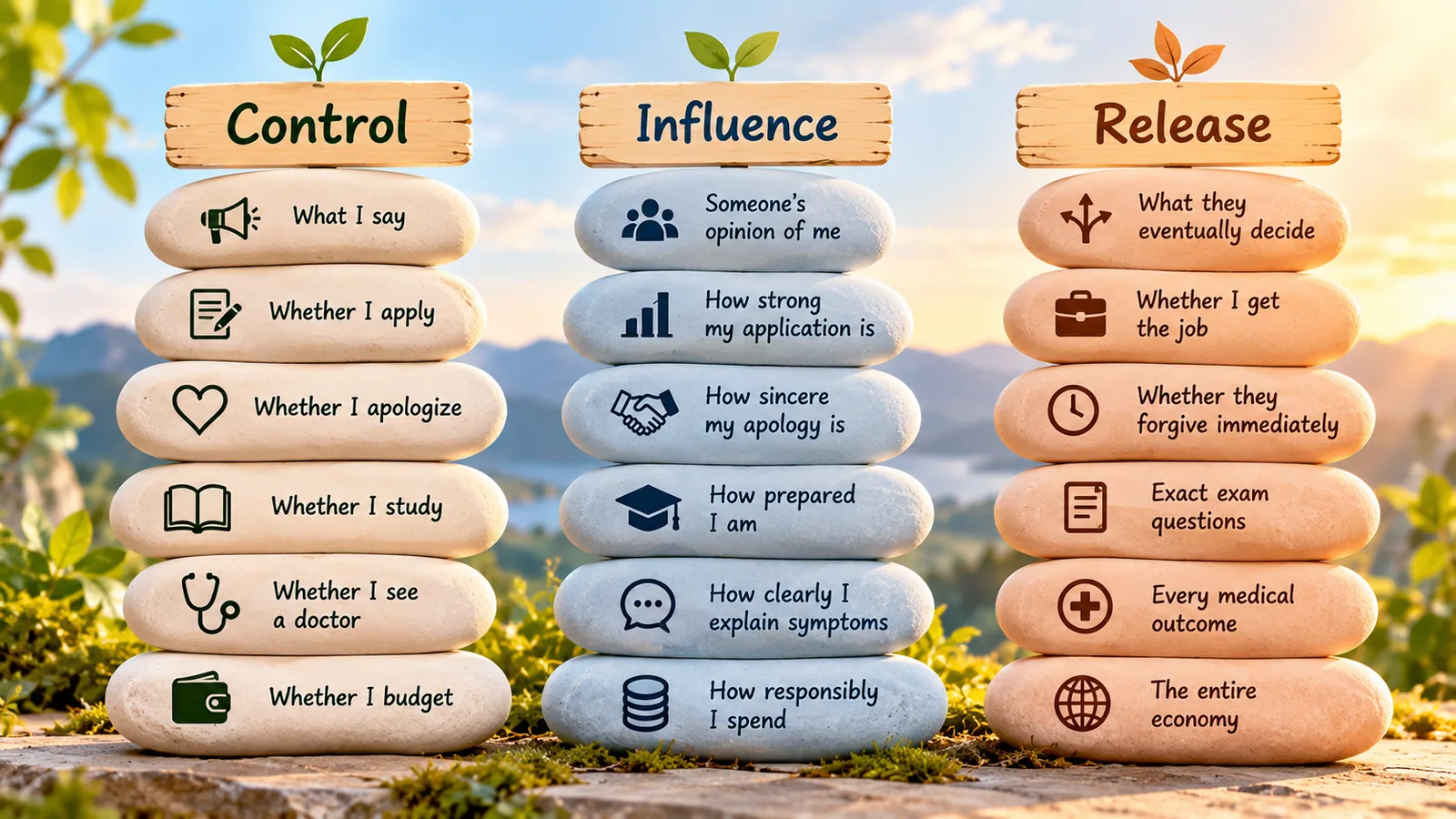
Most overthinking happens in the third column.
You are trying to mentally control something that cannot be controlled mentally.
That is exactly where 1 Peter 5:7 becomes practical.
Cast what you cannot carry.
Then deal responsibly with what you can.
For more Scripture around surrender and uncertainty, see these scriptures for trusting God.

Real-Life Story #3: Replaying a Mistake After You Already Apologized
Imagine Daniel said something cruel during an argument with his brother.
Later, Daniel realizes it was wrong.
He apologizes clearly.
He does not make excuses.
His brother accepts the apology but still seems hurt.
Daniel goes home and begins replaying the conversation.
“I should have explained myself differently.”
“Maybe my apology was selfish.”
“What if he secretly hates me?”
“What kind of Christian says something like that?”
There may be a useful question here:
Is there anything responsible left for Daniel to do?
If the answer is yes, he should do it.
Maybe he needs to repair damage he caused.
Maybe he needs to change a repeated behavior.
But if he has confessed, apologized, and taken responsibility, endlessly punishing himself in his mind is not the same thing as repentance.
Rumination feels active.
But replaying yesterday 100 times does not rewrite yesterday.
The better question becomes:
“What would changed behavior look like today?”
That turns guilt into responsible action.
What If You Are Overthinking God's Will?
This is one of the hardest forms of Christian overthinking.
You may wonder:
“What if I miss God's plan?”
“What if I choose the wrong career?”
“What if this person is not the person God wants me to marry?”
“What if this opportunity is a test?”
“What if this anxious feeling is a warning from God?”
Be careful about turning every emotion into divine guidance.
Strong feelings can be meaningful.
They are not automatically instructions.
Use the Clear / Wise / Free test
Ask three questions.
1. Is Scripture clear about this?
If an action clearly conflicts with biblical teaching, that matters.
2. What is the wise choice based on the facts?
Consider responsibilities, consequences, trusted advice, finances, health, commitments, and other real information.
3. If multiple options are morally acceptable, might I be free to choose?
Not every decision has a hidden answer you must decode.
You may sometimes have two reasonable choices.
Faith does not require supernatural certainty before every ordinary decision.
Do Not Turn Bible Verses Into Another Checking Habit
This deserves special attention.
Suppose you ask for a random Bible verse.
You receive:
1 Peter 5:7.
But you hoped for something about relationships.
So you generate another verse.
Then another.
Then another.
Eventually you find one that seems to support the decision you already wanted.
That is not necessarily discernment.
It can become reassurance-seeking dressed in spiritual language.
Try this rule:
The One-Verse Rule
When you intentionally ask for a random verse for reflection:
Stay with the first suitable passage for five minutes before generating another.
Ask what it teaches.
Read its context.
Pray through it.
Choose an action.
Then, if you want broader study, explore a focused collection such as these Bible verses for anxious thoughts.
Do not make randomness responsible for major decisions.
A random verse can start reflection.
It should not replace Scripture study, wisdom, facts, prayer, professional advice, or mature counsel.
When Overthinking Happens at Night
Everything can feel more serious at 1:17 a.m.
The house is quiet.
There are fewer distractions.
Tomorrow's problems suddenly demand immediate answers.
This is usually a terrible time to make major decisions.
Create a “not tonight” list
Keep a notebook near your bed.
When a worry appears, write:
Problem: I am worried about the meeting.
Tomorrow's action: Review my notes at 8:30 a.m.
Then tell yourself:
“This problem has an appointment. I do not need to solve it in bed.”
If there is no useful action available tonight, write:
“Nothing to do tonight.”
That may sound simple.
Simple is the point.
You are giving your brain permission to stop treating every thought as an emergency.
If nighttime is your main struggle, use these Bible verses for anxiety at night as part of a slower bedtime routine.

“But What If I Really Do Make the Wrong Choice?”
You might.
That is part of being human.
Christian faith does not promise that believers will never make imperfect decisions.
You may take the wrong job.
Trust the wrong person.
Spend money badly.
Say something foolish.
Choose an option that does not work.
Wisdom matters because choices have consequences.
But fear adds another claim:
“If I cannot guarantee the outcome, I cannot move.”
That is where fear becomes paralysis.
A healthier approach is:
Gather enough information.
Seek wise counsel.
Pray honestly.
Make the best decision available.
Stay teachable.
Correct course when needed.
Trust God with what remains outside your control.
A Practical Decision Journal for Chronic Overthinkers
Use this template when you notice yourself reopening the same decision repeatedly.
Decision
What am I actually deciding?
Write it in one sentence.
Facts
What do I know?
Only include information you can reasonably support.
Fears
What am I predicting?
Separate possible events from established facts.
Missing information
What information would genuinely change the decision?
This keeps research focused.
Values
What matters most here?
Faithfulness?
Safety?
Family?
Financial responsibility?
Health?
Honesty?
Rest?
Advice
Who is qualified to help?
Different decisions need different people.
A pastor may help with spiritual questions.
A doctor helps with medical questions.
A financial professional may help with complex financial questions.
A licensed therapist can help when rumination, anxiety, or compulsive reassurance-seeking becomes persistent or disruptive.
Next action
What is the smallest responsible next step?
Decision deadline
When will I stop researching and decide?
Reopen only if...
Write the conditions that would justify revisiting the decision.
For example:
“I will reconsider the job offer only if the salary changes, my spouse raises a new concern, or I receive new information about the role.”
This creates a boundary around the decision.
An anxious feeling alone does not automatically reopen the case.
What If Prayer Does Not Make the Overthinking Stop?
Then your prayer did not necessarily fail.
Prayer is not a button that forces your nervous system to become calm immediately.
You can trust God while still feeling unsettled.
You can pray while needing counseling.
You can read Scripture and still need sleep.
You can have strong faith and still need medical care.
Those ideas do not have to compete.
The World Health Organization reported in September 2026 that about 470 million people worldwide were living with an anxiety disorder in 2023, around 5.8% of the global population. WHO also notes that anxiety disorders involve more than normal occasional worry and can significantly interfere with daily life.
Overthinking alone does not mean you have an anxiety disorder.
But persistent worry deserves attention when it begins controlling your life.
When to Get Extra Help
Consider talking with a qualified mental health professional if repetitive thoughts regularly:
-
Keep you from sleeping.
-
Stop you from completing normal responsibilities.
-
Make ordinary decisions feel impossible.
-
Lead to hours of repeated checking.
-
Push you to seek the same reassurance again and again.
-
Seriously affect your relationships.
-
Make it difficult to work or study.
-
Cause significant distress.
-
Feel intrusive or impossible to disengage from.
Professional mental health care and Christian faith are not opposites.
Good care can help you understand what your mind is doing and develop healthier responses.
Current research is especially useful here because it focuses not only on what people think about, but on the repetitive process itself. A large 2025 meta-analysis found that CBT approaches can reduce repetitive negative thinking, with treatments directly focused on that process showing promising results.
Prayer can be part of your support.
So can community.
So can therapy.
So can medicine when appropriately prescribed.
A 30-Second Version for the Next Thought Spiral
You will not always have five minutes.
Use this shorter version.
READ:
“Casting all your care upon him; for he careth for you.” — 1 Peter 5:7
NAME:
“What am I afraid will happen?”
CHECK:
“Is this a fact, possibility, or prediction?”
PRAY:
“God, help me handle what is mine and give You what is not.”
ACT:
“What is one useful thing I can do now?”
If there is no useful action available:
Release it for now.
You can come back when new information exists.
A Better Goal Than “Stop Overthinking”
Trying to force yourself to stop thinking can become another battle inside your head.
Instead, use a different goal:
Notice sooner. Circle less. Act sooner. Release sooner.
You may still experience anxious thoughts.
Success does not mean your mind never asks “what if?”
Success can look like this:
You notice the thought.
You recognize that you have already answered it.
You refuse another hour of checking.
You pray.
You return to your life.
That is progress.
Frequently Asked Questions About Bible Verses and Overthinking
What is a good random Bible quote for overthinking?
A useful passage is 1 Peter 5:7: “Casting all your care upon him; for he careth for you.”
It is especially helpful because it addresses the burden behind many overthinking loops: the belief that you must keep carrying every possible outcome yourself.
What Bible verse should I read when my mind will not stop?
Start with 1 Peter 5:7.
Philippians 4:6–7, Matthew 6:34, Proverbs 3:5–6, Psalm 56:3, and Isaiah 26:3 are also commonly used when dealing with worry, uncertainty, trust, and fear.
Do not rush through all of them.
Choose one and read it slowly.
What does the Bible say about overthinking?
The Bible does not use the modern psychological term “overthinking.”
It does address worry, fear, anxious care, wisdom, trust, prayer, attention, and dependence on God.
Those themes can help Christians respond to repetitive worry without pretending uncertainty does not exist.
Is overthinking a sin?
Overthinking is not automatically a sin.
People can become stuck in repetitive thinking because of stress, fear, personality patterns, difficult circumstances, anxiety, depression, OCD, trauma, or other factors.
Instead of immediately condemning yourself, ask what the thought needs.
Does it need action?
Repentance?
Information?
Prayer?
Rest?
Professional support?
Or does it simply need to be released?
How do I stop overthinking according to the Bible?
Do not make “never having another anxious thought” the goal.
Try this instead:
Read one passage.
Name the real fear.
Separate facts from predictions.
Bring the specific concern to God.
Take the next responsible action.
Release what you cannot control.
Repeat when needed.
What Bible verse helps with decision paralysis?
Proverbs 3:5–6 is commonly used when decisions feel uncertain because it points believers toward trusting God rather than depending completely on their own limited understanding.
The passage should not be treated as permission to ignore facts.
Biblical wisdom includes planning, counsel, responsibility, and humility.
Why do I keep overthinking after I pray?
Because prayer does not necessarily switch off thoughts or emotions instantly.
Your brain may still be trying to protect you from uncertainty.
You may need to stop repeated checking, get more rest, take practical action, talk with someone trustworthy, or seek professional help if the pattern is persistent and disruptive.
Your remaining anxiety is not proof that God did not hear you.
Can a random Bible verse tell me what decision to make?
It can prompt reflection.
It should not be treated as a fortune-telling tool.
For important decisions, read Scripture in context, pray, gather reliable facts, seek wise counsel, consider your responsibilities, and make a thoughtful choice.
What should I pray when I cannot stop overthinking?
Try this:
“God, You know what I am afraid of. Show me what is true and what is only a prediction. Give me wisdom for what I can do, courage to take the next step, and trust to release what I cannot control. Amen.”
What if I keep needing reassurance?
Notice whether reassurance actually solves the problem.
If somebody answers your question and you feel better for ten minutes before needing to ask again, you may be caught in a reassurance loop.
Instead of immediately checking again, practice allowing the uncertainty to remain.
If repeated reassurance-seeking becomes severe or interferes with daily life, a qualified mental health professional can help you understand the pattern.
Before You Generate Another Verse, Do This
Read 1 Peter 5:7 one last time:
“Casting all your care upon him; for he careth for you.”
Now name the thing you are carrying.
Not every possible problem.
The one that is actually in front of you.
Ask:
What is true?
What is still unknown?
What can I responsibly do?
What do I need to release?
Then take one step.
That is the difference between using Scripture as another reassurance button and allowing Scripture to change how you respond to uncertainty.
Your mind may not become completely quiet.
You do not need complete quiet before you can move forward.
Read. Breathe. Question. Pray. Act.
And when you are ready for another passage—not because you are escaping this one, but because you have reflected on it—you can generate another Bible verse and begin again.
Key Statistics
People living with anxiety disorders worldwide
470 million
WHO estimates that 470 million people worldwide were living with an anxiety disorder in 2023. This supports the article’s broader discussion of when persistent worry may warrant additional support.
Source: WHO Anxiety Disorders
Studies included in CBT meta-analysis
55 studies
A 2025 transdiagnostic meta-analysis evaluated randomized controlled trials of cognitive behavioral therapy for repetitive negative thinking, worry, and rumination.
Source: Stenzel et al. 2025
Credible Sources
Psychological Medicine / Cambridge University Press · February 7, 2025
Strongest research source for the article’s discussion of repetitive negative thinking. It supplies the 55-study, 4,970-participant figures and the reported CBT effect sizes.

About the Author
Editorial Team
Editorial Team
Daily Faith Path articles are prepared by the editorial team to help readers find scripture-centered guidance for healing, faith, prayer, and spiritual encouragement.
Expertise: Healing scriptures, Bible study resources, prayer guidance, devotional writing, Christian encouragement
Experience: The team researches scripture references, reviews surrounding biblical context, compares translation wording where useful, and updates articles to improve clarity, usefulness, and trust for readers.
Credentials: Editorial review, devotional writing, scripture study, content updating
This article is published by the Daily Faith Path editorial team to help readers use scripture carefully, prayerfully, and in ways that are practical for real-life seasons of illness, grief, waiting, and spiritual reflection.
Continue Reading
Related articles

October 7, 2026
12 Bible Verses About Hiding Money From Your Spouse
Explore 12 Bible verses about secret spending, hidden debt, financial honesty, confession, forgiveness, boundaries, and rebuilding trust in marriage.

October 6, 2026
15 Bible Verses for Couples Who Keep Fighting About Money
Money fights are rarely just about dollars. These 15 Bible verses help couples address spending, saving, debt, secrecy, unequal income, giving, and financial control with practical next steps and conversation questions.

October 5, 2026
Should You Tithe While in Debt? 11 Bible Passages to Study First
Should you tithe while in debt? Explore 11 Bible passages on tithing, debt, generosity, family responsibility, and giving according to your means—plus a practical plan for deciding what to do.