How to Trust God When Your Mind Won't Stop
Learn how to trust God when you overthink with biblical wisdom, practical steps, and a simple decision journal to help you manage worry and move forward in faith.

Your mind has replayed the same problem 20 times, you've prayed about it, and you still can't stop wondering what might go wrong. If you're trying to learn how to trust God when you overthink, the answer isn't to force yourself to stop thinking. It's to learn which thoughts deserve your attention, which worries need to be released, and how to take your next step without knowing every outcome.
You can trust God and still have questions. You can feel anxious and still act in faith. You can make a wise decision without being 100% certain it's the right one.
This guide will show you how to do that using Scripture, everyday examples, a four-step method called Pause, Pray, Verify, Act, and a simple decision journal you can start using today.
You don't need to figure out your entire future. You need a faithful way to handle what's in front of you.

Why Is It So Hard to Trust God When You Overthink?
Overthinking often starts with a good goal. You want to protect your family, avoid mistakes, honor God, or make a wise choice.
But somewhere along the way, careful thinking turns into an endless search for certainty.
You research one more option. Replay one more conversation. Ask one more person for advice. Then you wonder whether you've missed a sign from God.
The problem isn't always a lack of faith. Sometimes, it's the belief that you must eliminate every possible risk before you can move forward.
Your brain wants certainty. Faith requires trust.
Imagine you're offered a new job. It pays more, but you'd need to move away from your church and friends.
You pray, compare salaries, check housing costs, and talk to your spouse. That's responsible thinking.
But three weeks later, you're still running the same arguments through your mind. You're no longer learning anything new. You're trying to find a guarantee that doesn't exist.
Healthy thinking helps you make a decision. Overthinking keeps you from making one.
This is especially hard when you care about God's will. You may fear that one wrong choice could ruin His plan for your life.
Yet Scripture repeatedly calls believers to seek wisdom, act faithfully, and depend on God through uncertainty.
You're not the only one struggling with worry
The World Health Organization reported that 359 million people worldwide were living with an anxiety disorder in 2021. Anxiety disorders are medical conditions, not simply everyday overthinking. Still, the figure shows why persistent fear and worry deserve serious attention.
The U.S. National Institute of Mental Health also reports that 19.1% of American adults experienced an anxiety disorder in a 12-month period, based on its 2001–2003 national survey. That is a historical estimate, not a current measurement.
These numbers don't mean every person who overthinks has an anxiety disorder. They do remind us that severe worry isn't something we should dismiss with a quick instruction to pray harder.
If your thoughts are disrupting sleep, work, or relationships, spiritual support and mental health care can work together.
What Does Proverbs 3:5–6 Really Mean for an Overthinker?
Proverbs 3:5–6 calls believers to trust God wholeheartedly, avoid relying only on their own understanding, and acknowledge Him in their ways.
The passage concludes with the promise that God will direct or straighten their paths.
It's one of the most familiar Bible passages about trust. It's also easy to misunderstand when you're afraid of making the wrong decision.
"Lean not on your own understanding" doesn't mean stop thinking
The book of Proverbs repeatedly encourages wisdom, knowledge, good counsel, and careful planning.
Proverbs 15:22, for example, teaches the value of advice. Proverbs 21:5 connects diligent planning with good results.
So Proverbs 3 isn't telling you to ignore facts or avoid making plans.
It's warning against treating your own limited understanding as the final source of truth.
You can check the numbers, ask questions, and think through the risks. But you can't see everything God sees.
Trust means remembering that your view is limited, even when you've done your homework.
"He will make your paths straight" isn't a promise of an easy life
God's guidance doesn't mean every faithful choice leads to quick success.
Joseph was betrayed and imprisoned. Paul faced hardship during his ministry. Jesus prayed in Gethsemane before facing the cross.
These stories challenge the idea that a hard outcome always means you made the wrong choice.
A straight path is not necessarily a painless path. Proverbs teaches reliance on God's direction, not a guarantee that you will never face loss, delay, or disappointment.
The practical takeaway: Make the wisest decision you can with the information you have. Then leave room for God to guide, correct, and sustain you as life unfolds.
Biblical Discernment vs. Overthinking: How to Tell the Difference
Discernment is the process of judging something carefully. Biblical discernment includes Scripture, wise counsel, honest motives, and attention to real-world facts.
Overthinking can look similar from the outside. The difference often lies in what your thinking is doing.
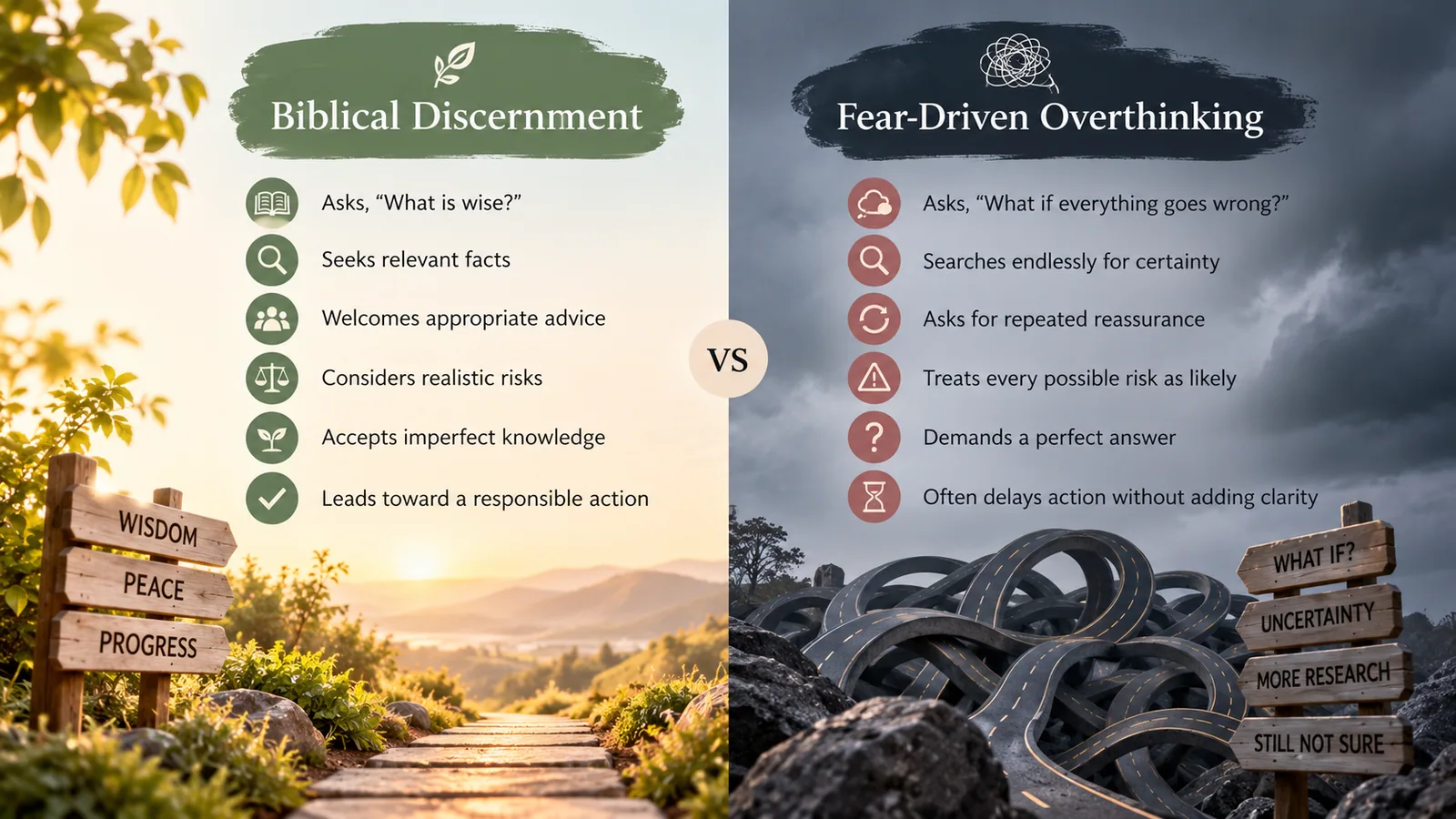
Here's a question worth writing down:
"Am I looking for information I need, or reassurance that nothing bad can happen?"
That one question can change the direction of your thinking.
The three-loop test: Are you solving or circling?
When your mind won't stop, identify which loop you're in.
-
The information loop: You genuinely need a missing fact, such as a contract detail or medical result.
-
The decision loop: You have enough information, but you're afraid to choose.
-
The reassurance loop: You've made or nearly made a decision, but you keep seeking confirmation that it is safe.
Each loop needs a different response.
If information is missing, find it. If a decision is due, identify the next responsible action. If you're seeking repeated reassurance, more checking may keep the cycle going.
For a deeper look at future-focused worry, read these Bible verses for anxiety about the future , which connect common fears with practical exercises.

How to Trust God When You Overthink: The Pause, Pray, Verify, Act Method
This four-step framework gives you something concrete to do when your thoughts start racing.
It's not a formula for discovering God's hidden plans. It's a way to make responsible decisions without letting fear control the process.
Step 1: PAUSE — Interrupt the worry cycle
Before you make another search, send another message, or replay the problem again, stop for a moment.
Name what is happening.
Try saying: "I'm having the thought that this decision could go badly. That thought is not the same as a fact."
Next, take a few gentle breaths and notice your surroundings. You can place your feet on the floor, look out the window, or take a short walk.
Then write down the problem in one sentence.
For example: "I'm afraid I'll disappoint my parents if I change careers."
Now separate the facts from your predictions.
A fact might be that your parents prefer your current job. A prediction might be that they'll never respect you again.
You don't have to solve every prediction.
Step 2: PRAY — Give God the actual worry
Philippians 4:6–7 encourages believers to bring their requests to God with thanksgiving.
Notice that Paul invites people to present their needs. He doesn't tell them to pretend those needs aren't real.
Keep your prayer specific.
"God, I'm afraid this choice will hurt my family. Please give me wisdom, help me act with love, and teach me to trust You with what I cannot control."
You can also pray through Proverbs 3:5–6 one phrase at a time.
When your mind wanders, gently return to the passage. Prayer doesn't need to become another task you must perform perfectly.
And don't use your level of calm as a test of whether God heard you.
You may still feel anxious after praying. That doesn't automatically mean your faith is weak or your prayer failed.
The article on Isaiah 41:10 and anxiety explores God's promise of presence and why fear may remain even after prayer.
Step 3: VERIFY — Check what is true and wise
This is where faith and careful thinking work together.
Ask yourself four questions:
-
Does this choice fit clear biblical teaching?
-
What reliable facts do I have?
-
Have I sought appropriate advice?
-
What would I recommend to a friend in this situation?
Suppose you feel strongly that God wants you to quit your job tomorrow.
Before acting, consider whether you can meet your family's needs. Speak with your spouse if you're married. Review your finances and employment agreement.
A strong feeling alone isn't proof of divine direction.
For help evaluating spiritual impressions, see this guide on how to discern God's voice from your own thoughts .
If you're making a medical, legal, or financial decision, qualified professional advice is also part of gathering reliable information.
Step 4: ACT — Take the next responsible step
After you've prayed and checked the facts, identify the smallest useful action.
You may not need to decide everything today.
If you're considering a career change, your next step might be arranging an interview. If you're concerned about your health, it might be booking an appointment.
Set a reasonable decision deadline when appropriate.
For a routine purchase, that might mean 20 minutes. For a major move, it could mean several weeks of research and discussion.
These aren't universal rules. Choose a timeframe that fits the risk and importance of the decision.
Then stop reopening the same question unless genuinely new information appears.
Trust grows when you practice making wise choices without demanding perfect certainty.
The Decision Journal: A Practical Tool for Trusting God
An overactive mind often treats every possible outcome as equally urgent. A decision journal helps you put your thoughts somewhere other than your head.
Use one page for each important decision.
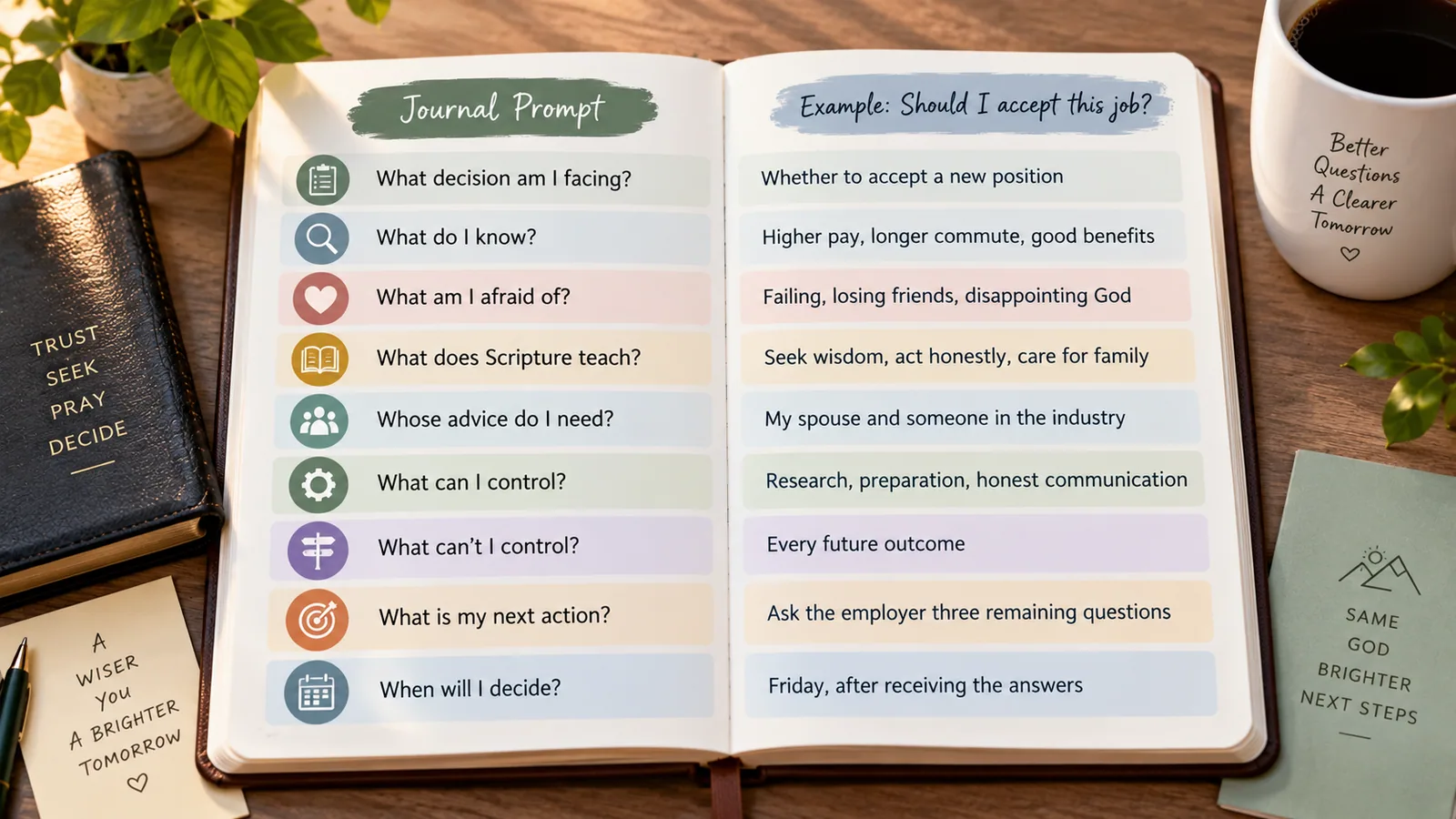
Add a "return only if" rule
At the bottom of the page, write the conditions that would justify reopening the decision.
For instance: "I'll reconsider if the salary changes, my spouse raises a new concern, or the employer provides important new information."
This keeps you open to wisdom without restarting the entire process every time anxiety returns.
You can also review your journal after 30 days.
Ask: "What actually happened? Which fears were predictions? What did I learn?"
The goal isn't to prove that all your fears were wrong. It's to learn that you can respond to life, including its surprises, without having every answer in advance.

5 Real-Life Problems That Make Trusting God Difficult
The following everyday scenarios are illustrative, not interviews or verified personal testimonies. Each shows how the framework works when you have a real problem to solve.
1. You can't decide whether to leave a relationship
Imagine a woman named Rachel. She's dating someone who shares her faith, but they disagree about marriage, money, and their future.
She keeps praying for a sign. Every good date feels like confirmation. Every argument makes her question everything.
Rachel can start by writing down the actual concerns. She can discuss them directly with her partner and seek advice from someone she trusts.
If the relationship involves abuse, threats, or coercive control, safety takes priority. She should seek appropriate help rather than treating the situation as a test of how much she can endure.
The lesson: Trusting God doesn't require ignoring warning signs or waiting indefinitely for a supernatural answer.
2. You keep worrying about your child's future
Imagine a father named Daniel whose teenage son is struggling at school.
Daniel checks grades repeatedly, searches for worst-case outcomes, and imagines his son's entire future falling apart.
His care is real. But constant worry doesn't give him more control.
He can speak with his son, arrange a meeting with a teacher, and agree on one practical plan for the next month.
After that, he can pray for his son without trying to solve every possible future problem.
If your life feels increasingly out of control, this guide on how to trust God when life is falling apart offers further steps for navigating hardship.
3. You can't stop replaying a mistake
You said something hurtful during an argument. You apologized, but now you're replaying every word.
You wonder whether God has forgiven you. You imagine that the other person secretly hates you.
Ask whether there is a real action left to take.
If you owe someone an apology or need to repair harm, do that. If you've already taken responsibility, repeated mental punishment won't change the past.
1 John 1:9 speaks of God's forgiveness when believers confess their sins.
You can accept responsibility without treating endless guilt as proof of repentance.
4. You're afraid of making a financial mistake
Your family needs a new car, but every option comes with risks.
You spend hours reading reviews. One negative comment makes you restart your search.
Choose a realistic budget, identify your must-have features, and compare a small number of suitable options.
Arrange an independent inspection for a used car. Check the full costs, including insurance and repairs.
Then make the decision based on the evidence available.
Faith doesn't replace a budget or an inspection. It helps you act responsibly without expecting a guarantee.
5. Your mind races when you try to sleep
It's midnight. You suddenly remember an awkward conversation from three years ago.
Then you think about tomorrow's meeting, your bills, and something you read online.
Keep a notebook beside your bed. Write down anything that genuinely needs attention tomorrow.
If there is no useful action you can take tonight, give yourself permission to return to it during the day.
Psalm 4:8 offers a short prayerful reminder about resting in God's care.
A more detailed bedtime routine is available in these Bible verses for anxiety at night .

What If Your Thoughts Are Intrusive, Scary, or Blasphemous?
Some worries feel different from ordinary overthinking.
You may experience an unwanted thought about hurting someone, insulting God, or doing something that conflicts with your values.
The thought can feel so disturbing that you start analyzing what it means about you.
An intrusive thought is an unwanted mental event. Having a disturbing thought does not, by itself, mean you want to act on it.
The UK's National Health Service explains that intrusive thoughts can occur in obsessive-compulsive disorder (OCD). Repeated checking, mental rituals, and requests for reassurance may provide brief relief while keeping the cycle going.
Don't turn prayer into another checking ritual
Suppose you're afraid you prayed incorrectly.
You repeat the prayer until it feels right. Then you wonder whether your intentions were sincere, so you start again.
In this situation, repeating prayers to reach perfect certainty may become part of the problem.
If this pattern is frequent or distressing, speak with a mental health professional who understands OCD.
Evidence-based treatment, including exposure and response prevention (ERP), can help people manage obsessive thoughts and compulsive behaviors.
A pastor may provide spiritual support, but an OCD specialist can address the clinical cycle. You don't have to choose between faith and treatment.
What to Do When God Feels Silent
Sometimes, the hardest part of trusting God is that you don't feel guided.
You've prayed about a decision, read Scripture, and sought advice. But no clear answer has appeared.
Start with what Scripture already makes clear: practice honesty, love your neighbor, seek wisdom, and take responsibility for your actions.
Not every choice has one hidden answer that you must discover.
If two options are both morally acceptable, you may have room to choose based on your responsibilities, opportunities, and informed judgment.
God's silence is not proof that you've been abandoned.
Consider Paul in 2 Corinthians 12:7–10. He repeatedly asked for relief from a painful struggle, yet the passage describes him receiving grace to endure rather than the exact outcome he requested.
Prayer is a relationship with God, not a system for obtaining complete information about the future.
A Simple 7-Day Practice for an Overthinking Mind
Try this plan for one week. Each activity takes about five to ten minutes, unless a real-life decision needs more attention.
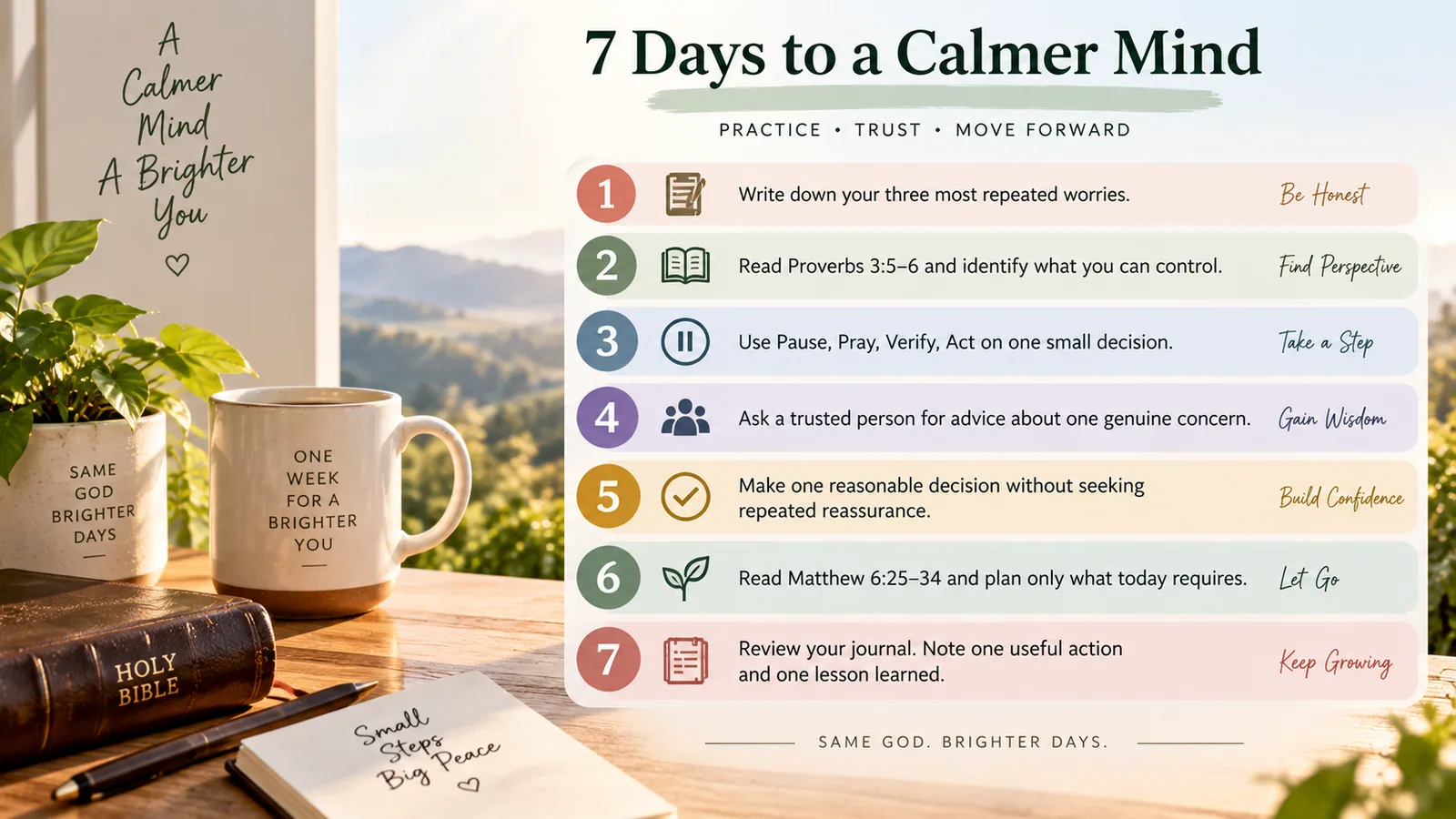
Don't judge the week by whether every anxious thought disappeared.
Look for changes in your response. Did you recognize a worry loop earlier? Did you take action despite uncertainty? Did you seek appropriate help?
Those are meaningful signs of progress.
Frequently Asked Questions About Trusting God and Overthinking
Is overthinking a sin?
Overthinking isn't automatically a sin. It may reflect fear, stress, a habit of seeking certainty, or a mental health condition.
Scripture encourages believers to bring worries to God. It doesn't require you to achieve a perfectly quiet mind before you can have faith.
How can I trust God when I'm afraid of making the wrong decision?
Identify what Scripture clearly teaches, gather the facts you need, seek suitable advice, and make a responsible choice.
Remember that an unwanted outcome doesn't automatically prove you disobeyed God. You can learn, adjust, and seek His guidance as circumstances change.
How do I know whether a thought is from God or my anxiety?
Don't treat the strength or urgency of a feeling as proof that it came from God.
Compare it with Scripture, reliable facts, and wise counsel. Be especially careful with thoughts that demand immediate action, promise guaranteed outcomes, or push you toward harmful behavior.
Can I trust God and still go to therapy?
Yes. Therapy can help you understand thought patterns, manage anxiety, and develop practical coping skills.
Prayer, Christian community, and appropriate medical care can work together.
What should I do when I can't stop worrying about the future?
Write down the specific concern and identify one action you can take today.
If there's nothing useful to do now, set it aside until an appropriate time. Matthew 6:34 encourages attention to today's responsibilities rather than carrying tomorrow's troubles in advance.
Why do I still feel anxious after praying?
Prayer doesn't guarantee an immediate change in your emotions or nervous system.
You may need time, practical support, rest, or professional care. Continuing anxiety isn't a reliable measure of how much God loves you.
Does trusting God mean I should stop making plans?
No. Proverbs values wisdom and diligent planning.
Make reasonable plans, prepare for realistic risks, and remain open to changing course. Trusting God means you don't have to depend on your plans as though they could guarantee the future.
What's a short prayer for someone who overthinks?
"Lord, You know what I'm afraid of. Help me see what is true, make a wise choice, and accept what I cannot control. Give me strength for the next step. Amen."
The Next Time Your Mind Won't Stop, Start Here
You don't need to solve every possible outcome before you can trust God.
When you catch yourself circling the same fear, return to four simple actions: Pause. Pray. Verify. Act.
Name the worry. Bring it to God. Check what is true. Then take the next responsible step.
Your mind may still have questions afterward. That's okay. You can continue living faithfully while some answers remain unknown.
Trust isn't the ability to predict what happens next. It's choosing to depend on God while doing what is yours to do today.
Key Statistics
Global anxiety disorder prevalence (2021)
359 million
Estimated number of people worldwide living with an anxiety disorder in 2021. This is not a measure of everyday overthinking.
Source: WHO
U.S. adult anxiety disorder prevalence
19.1%
Estimated proportion of U.S. adults who experienced an anxiety disorder within a 12-month period, based on 2001–2003 survey data. This is a historical estimate.
Source: NIMH
Credible Sources
World Health Organization (WHO) · September 11, 2026
Provides updated global anxiety disorder estimates, including 470 million people in 2023, and distinguishes clinical disorders from ordinary emotional experiences.
World Health Organization (WHO) · January 1, 2025
Supports the article's original figure of 359 million people living with anxiety disorders in 2021. Also provides context about symptoms and treatment.

About the Author
Editorial Team
Editorial Team
Daily Faith Path articles are prepared by the editorial team to help readers find scripture-centered guidance for healing, faith, prayer, and spiritual encouragement.
Expertise: Healing scriptures, Bible study resources, prayer guidance, devotional writing, Christian encouragement
Experience: The team researches scripture references, reviews surrounding biblical context, compares translation wording where useful, and updates articles to improve clarity, usefulness, and trust for readers.
Credentials: Editorial review, devotional writing, scripture study, content updating
This article is published by the Daily Faith Path editorial team to help readers use scripture carefully, prayerfully, and in ways that are practical for real-life seasons of illness, grief, waiting, and spiritual reflection.
Continue Reading
Related articles

October 7, 2026
12 Bible Verses About Hiding Money From Your Spouse
Explore 12 Bible verses about secret spending, hidden debt, financial honesty, confession, forgiveness, boundaries, and rebuilding trust in marriage.

October 6, 2026
15 Bible Verses for Couples Who Keep Fighting About Money
Money fights are rarely just about dollars. These 15 Bible verses help couples address spending, saving, debt, secrecy, unequal income, giving, and financial control with practical next steps and conversation questions.

October 5, 2026
Should You Tithe While in Debt? 11 Bible Passages to Study First
Should you tithe while in debt? Explore 11 Bible passages on tithing, debt, generosity, family responsibility, and giving according to your means—plus a practical plan for deciding what to do.