What to Say When Someone You Love Is Deconstructing Their Faith
When someone you love begins questioning their faith, it's easy to panic or argue. This guide explains how to respond with empathy, protect your relationship, avoid common mistakes, and support them through faith deconstruction without compromising your own beliefs.

Your daughter just told you she doesn't believe in God the way she used to, and you have no idea what to say back. Here's the short answer: stop trying to win the conversation, and start trying to keep the relationship. Everything else in this guide builds from that one shift.

Why Almost Nobody Talks About This Side of Deconstruction
Type "faith deconstruction" into any search bar and you'll get thousands of articles. Nearly all of them are written for the person doing the deconstructing. They explain doubt, they validate questions, they map out stages.
Almost none of them are written for the mom who just found out her son stopped praying. Or the husband whose wife quietly skipped church for the fifth Sunday in a row. Or the friend who got a 2 a.m. text that said "I don't think I believe any of this anymore."
That gap is the whole reason this guide exists. You are not the villain of this story, and you're not powerless either. You just need different tools than the ones aimed at the person who's questioning.
Barna Group research found that 42% of American adults say they've deconstructed the faith of their youth at some point, and that number climbs to 37% even among people who still call themselves Christian. This isn't a fringe experience. It's happening in an enormous number of households, quietly, usually without anyone giving the family member a script for how to respond.
What Deconstruction Actually Means (In Plain Words)
Deconstruction is when someone takes apart their faith piece by piece to see what's actually true, instead of just believing what they were taught. Think of it like a kid taking apart a clock to see how it works. Sometimes the clock goes back together. Sometimes it doesn't. Sometimes it becomes a different kind of clock.
It is not the same thing as rebellion. It's rarely about wanting to sin more or punish the family. Most people who deconstruct are doing it because something stopped making sense to them, and pretending it still made sense felt dishonest.
Deconstruction vs. Losing Faith Completely
These get treated as the same thing, but they're not. Deconstruction is a process. Losing faith is one possible outcome of that process, but plenty of people who deconstruct end up with a faith that's smaller, weirder, less certain, but still there. Some end up with no faith at all. Some end up back where they started, just for better reasons this time.
Signs Someone You Love Might Be in It
- They ask hard questions and get frustrated with easy answers
- Church attendance drops or stops without a clear reason
- They start reading books or watching content that challenges their upbringing
- Conversations about faith feel guarded, defensive, or exhausting for them
- They mention feeling "burned out" or "done performing" more than "I don't believe"
The First 48 Hours: What Not to Say
The first conversation sets the tone for every one after it. Most people blow it not because they're bad parents or spouses, but because panic makes us reach for control.
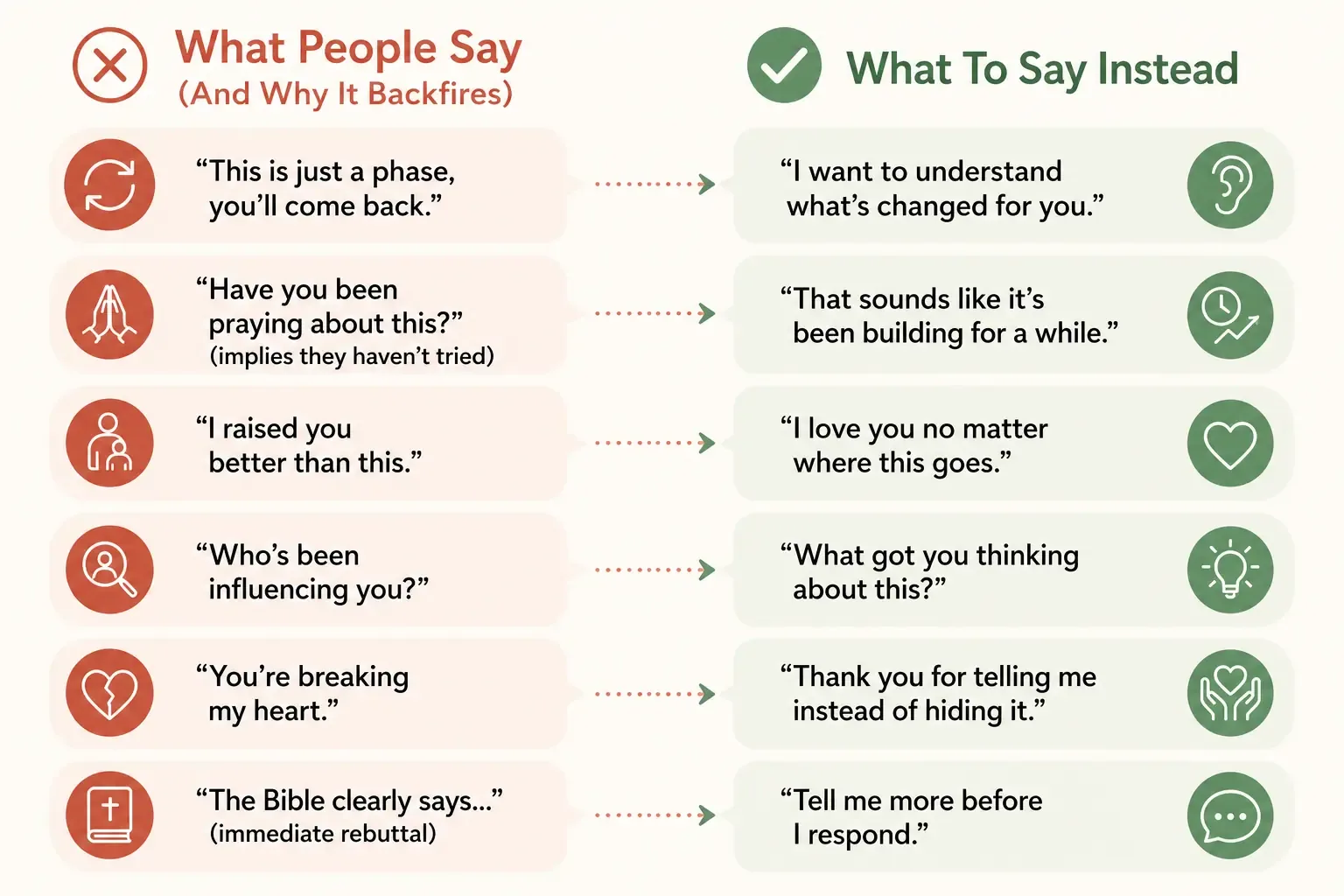
Notice the pattern. The backfiring phrases all center the parent's or spouse's feelings, or they treat the person like a problem to be corrected. The better versions center curiosity and safety instead.
The Non-Defensive Language Toolkit
This is the part most articles skip entirely: actual words you can use, in the actual moment, when you don't know what to say.
When They Drop the Bomb
Someone says, "I don't think I believe this anymore." Your instinct might be to argue, cry, or go silent. Try this instead:
"Okay. That's a big thing to carry. Do you want to talk about it, or do you just need me to know?"
This does two things. It doesn't confirm or fight the statement, and it hands control back to them about how deep the conversation goes right now.
When They Criticize the Church or Your Beliefs
"The church is full of hypocrites" or "Christianity has hurt a lot of people" can feel like a personal attack, especially if you've built your life around your faith. A non-defensive response sounds like:
"You're not wrong that churches have hurt people. Has that happened to you, or to someone you care about?"
You're not agreeing that the whole thing is fake. You're acknowledging a true, specific thing, which almost always lowers the temperature.
When They Ask a Question You Can't Answer
Nobody has airtight answers for suffering, contradictions in scripture, or why prayers go unanswered. It's fine to say:
"I don't have a good answer for that. I've wrestled with it too. Can we sit with the question together instead of me pretending I've solved it?"
Pretending to have certainty you don't have is one of the fastest ways to lose credibility with someone who's already questioning certainty.
When Family Gatherings Get Tense
Thanksgiving, Christmas, and Sunday dinners can turn into landmines. A short script for the table:
"We don't all see this the same way right now, and that's okay. Let's eat."
Said once, calmly, it gives everyone permission to stop debating and start passing the potatoes.

Three Real Families, Three Different Paths
Sarah's story. Sarah's 24-year-old son stopped coming to church during his second year of college. Her first instinct was to send him articles defending the faith. It backfired every time, and he stopped answering her calls for two weeks. She switched tactics: she started asking about his life first, faith only if he brought it up. Eight months later, he told her the space she gave him was the reason he still called her every Sunday, even though he still didn't believe.
Mike's story. Mike's wife told him over dinner that she'd been listening to podcasts that challenged everything she grew up believing. Mike felt like his marriage was collapsing. A counselor gave him one piece of advice that changed things: stop treating her doubt like a threat to defeat, and start treating it like weather to walk through together. He started asking what she was learning instead of correcting it. Their marriage is still intact three years later, and their faith conversations are more honest than they've ever been.
Pastor Dan's story. Dan had a longtime friend from his men's group quietly stop showing up. Instead of a Bible verse text, Dan sent one line: "Missed you Tuesday. No agenda, just miss you." That single low-pressure message reopened a friendship that a theological argument would have closed for good.
The common thread in all three: the relationship survived because the person on the receiving end stopped trying to fix the faith and started protecting the connection.
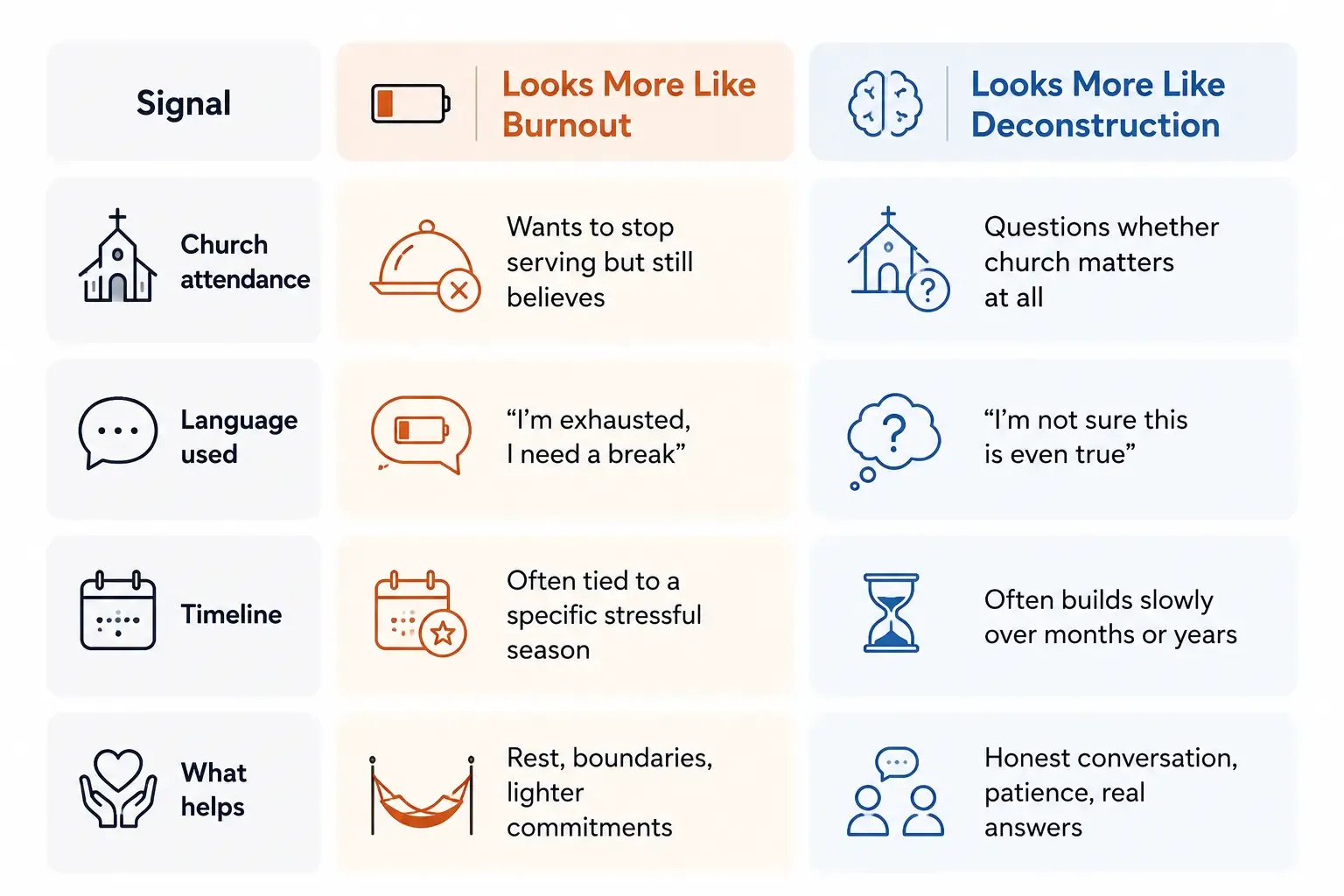
Distinguishing Deconstruction From Burnout
Sometimes what looks like deconstruction is actually plain exhaustion. Someone who's been serving, performing, and showing up for years without rest can start to look like they're losing faith when really they're just running on empty. Daily Faith Path has a helpful breakdown of the signs of spiritual exhaustion that's worth reading if your loved one seems more tired than doubtful. There's also a companion piece on Christian burnout symptoms that lays out the difference between spiritual weariness and an actual crisis of belief.
Ask yourself: is this person questioning what's true, or are they just depleted from carrying too much for too long? The response is different in each case. Burnout usually calls for rest and lighter obligations. Genuine deconstruction calls for space and honest conversation.
A Quick Comparison
Protecting the Relationship Without Losing Yourself
Here's the part nobody warns you about: watching someone you love question their faith can shake your own. That's normal, and it doesn't make you weak.
If their questions are stirring up your own doubts, that's worth sitting with honestly rather than pushing down. Daily Faith Path's piece on what to do when God feels silent is written for exactly this kind of season, when someone else's doubt starts to echo in your own chest.
It also helps to remember that this relationship existed before the disagreement and can outlast it. Scripture built around relationships and love can be a steadying anchor here, not as ammunition to win an argument, but as a reminder of what you're actually trying to protect.
When Hurtful Things Get Said
Deconstruction conversations can get sharp. Someone might say something about your parenting, your church, or your beliefs that stings. This is where what the Bible says about forgiveness becomes less of a theological talking point and more of a practical tool you actually need, so resentment doesn't quietly build up between you.

A 30-Day Plan for Staying Connected
You don't need a grand gesture. You need consistency.
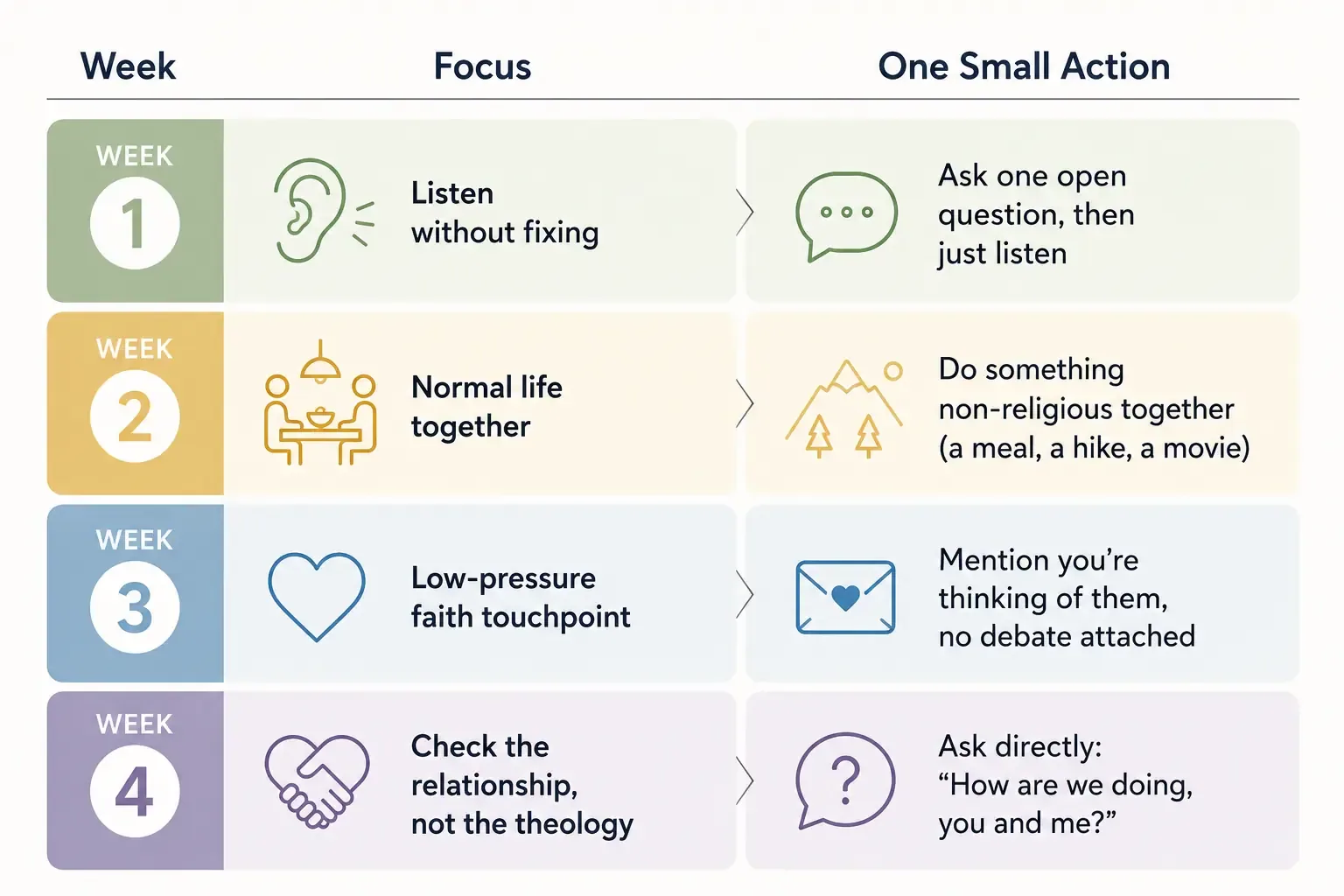
This plan works because it separates the relationship from the theology. You can keep one strong even while the other is genuinely uncertain.
When to Get Outside Help
Some situations are bigger than a family conversation can hold. Watch for these signs that it's time to bring in a counselor, pastor trained in this specific issue, or therapist:
- Talk of self-harm or hopelessness alongside the faith questions
- The relationship has gone completely silent for months
- Every conversation ends in shouting or shutdown
- You notice you're losing sleep, appetite, or functioning because of the stress
There's no shame in bringing in a third party. A good counselor isn't there to defend your theology or theirs. They're there to help two people who love each other keep talking.
FAQ: What People Actually Ask About This
Is it my fault my kid is deconstructing? Almost never entirely. Faith questions come from a mix of personal experience, exposure to new ideas, disappointment with church, and normal human development. Blaming yourself usually just adds guilt on top of an already hard situation, without changing the outcome.
Should I keep inviting them to church? Yes, but keep the invitation light and pressure-free. "You're always welcome, no expectations" works better than repeated asks that feel like scorekeeping.
What if they say something that sounds like they hate God? Anger is often a stage, not a destination. Resist correcting the theology in the moment. A simple "that sounds like a lot of pain" usually opens more doors than a rebuttal does.
Can a marriage survive one spouse deconstructing? Yes, and many do. The marriages that survive tend to have one thing in common: both people agree the marriage matters more than winning the argument, even while the faith conversation stays unresolved.
How long does deconstruction usually last? There's no fixed timeline. For some it's months, for others it's years, and for some it becomes a permanent shift in how they see faith. Patience matters more than a deadline.
Is it okay to set boundaries around what gets said at family events? Yes. A simple house rule like "we don't debate theology at the dinner table" protects everyone, including the person deconstructing, from feeling ambushed in front of relatives.

The One Thing to Remember
You cannot argue someone back into belief, and trying usually pushes them further away. What you can do is stay close enough, calm enough, and honest enough that the door stays open no matter where their questions lead. That's not giving up on your faith or theirs. It's choosing the relationship as the thing you refuse to lose, even when everything else feels uncertain.
If your own footing feels shaky while you walk through this with someone you love, the piece on trusting God through uncertainty is a good place to land before your next conversation with them.
Key Statistics
Americans who say they've deconstructed the faith of their youth
42%
Barna research found that nearly half of U.S. adults report having deconstructed the faith they were raised with.
Source: Barna Group – The Deconstruction of Christianity
Christians who say they've deconstructed
37%
Even among people who still identify as Christian, many report experiencing some level of faith deconstruction.
Source: Barna Group – The Deconstruction of Christianity
Credible Sources
Pew Research Center · January 1, 2014
Offers authoritative demographic data on religious affiliation, belief change, and religious switching in the United States.
Pew Research Center · Various publications
Helps explain why religious questioning and identity shifts commonly occur during adolescence and young adulthood.

About the Author
Editorial Team
Editorial Team
Daily Faith Path articles are prepared by the editorial team to help readers find scripture-centered guidance for healing, faith, prayer, and spiritual encouragement.
Expertise: Healing scriptures, Bible study resources, prayer guidance, devotional writing, Christian encouragement
Experience: The team researches scripture references, reviews surrounding biblical context, compares translation wording where useful, and updates articles to improve clarity, usefulness, and trust for readers.
Credentials: Editorial review, devotional writing, scripture study, content updating
This article is published by the Daily Faith Path editorial team to help readers use scripture carefully, prayerfully, and in ways that are practical for real-life seasons of illness, grief, waiting, and spiritual reflection.
Continue Reading
Related articles

October 7, 2026
12 Bible Verses About Hiding Money From Your Spouse
Explore 12 Bible verses about secret spending, hidden debt, financial honesty, confession, forgiveness, boundaries, and rebuilding trust in marriage.

October 6, 2026
15 Bible Verses for Couples Who Keep Fighting About Money
Money fights are rarely just about dollars. These 15 Bible verses help couples address spending, saving, debt, secrecy, unequal income, giving, and financial control with practical next steps and conversation questions.

October 5, 2026
Should You Tithe While in Debt? 11 Bible Passages to Study First
Should you tithe while in debt? Explore 11 Bible passages on tithing, debt, generosity, family responsibility, and giving according to your means—plus a practical plan for deciding what to do.