Why Gen Z Is Choosing Church Over Therapy
Gen Z is returning to church in surprising numbers—and many say mental health is a major reason why. Discover what's driving this shift, how church compares with therapy, where faith helps, where professional care is essential, and why the healthiest approach is often combining both.
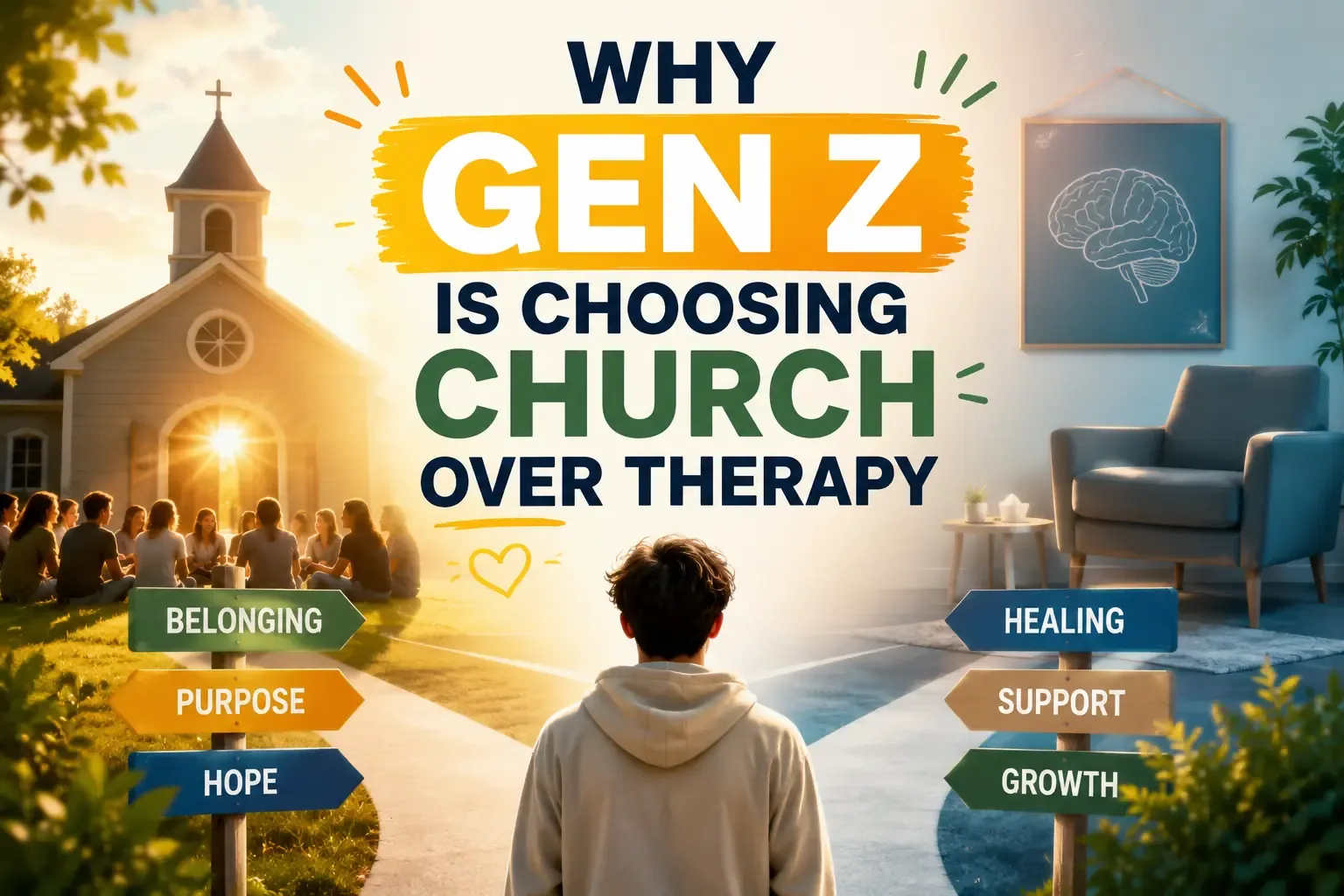
Gen Z now attends church more often than Baby Boomers — and almost half of them say mental health is a big reason why. That's not a hot take. That's what the newest attendance data shows.
Here's the twist nobody mentions: the same generation is also in therapy at record rates. So this isn't really "church vs. therapy." It's a generation quietly building its own mental health system — and picking pews as part of it.
This article breaks down what's actually happening, why it's happening, where it helps, where it can seriously backfire, and how to make a smart choice for yourself.

The Numbers: Yes, This Is Really Happening
For 20 years, every survey said the same thing. Young people were leaving religion. The "nones" — people with no religious affiliation — kept growing.
Then the trend broke.
Barna Group's latest tracking found that Gen Z churchgoers now attend about 1.9 weekends per month. That's more frequent than Millennials — and more than Boomers. During the pandemic, young adults averaged just over once a month. This is a real rebound.
The shift is even sharper overseas. Bible Society research found church attendance among 18–24-year-olds in the UK jumped from 4% in 2018 to 16% — a fourfold increase in about six years. Young men are driving much of it.
Meanwhile, Pew's Religious Landscape data shows the decades-long decline in Christian affiliation has basically stopped. Researchers are careful here: this is stabilization plus deeper engagement, not a full national revival. The people showing up are showing up more.
Now put that next to the mental health data:
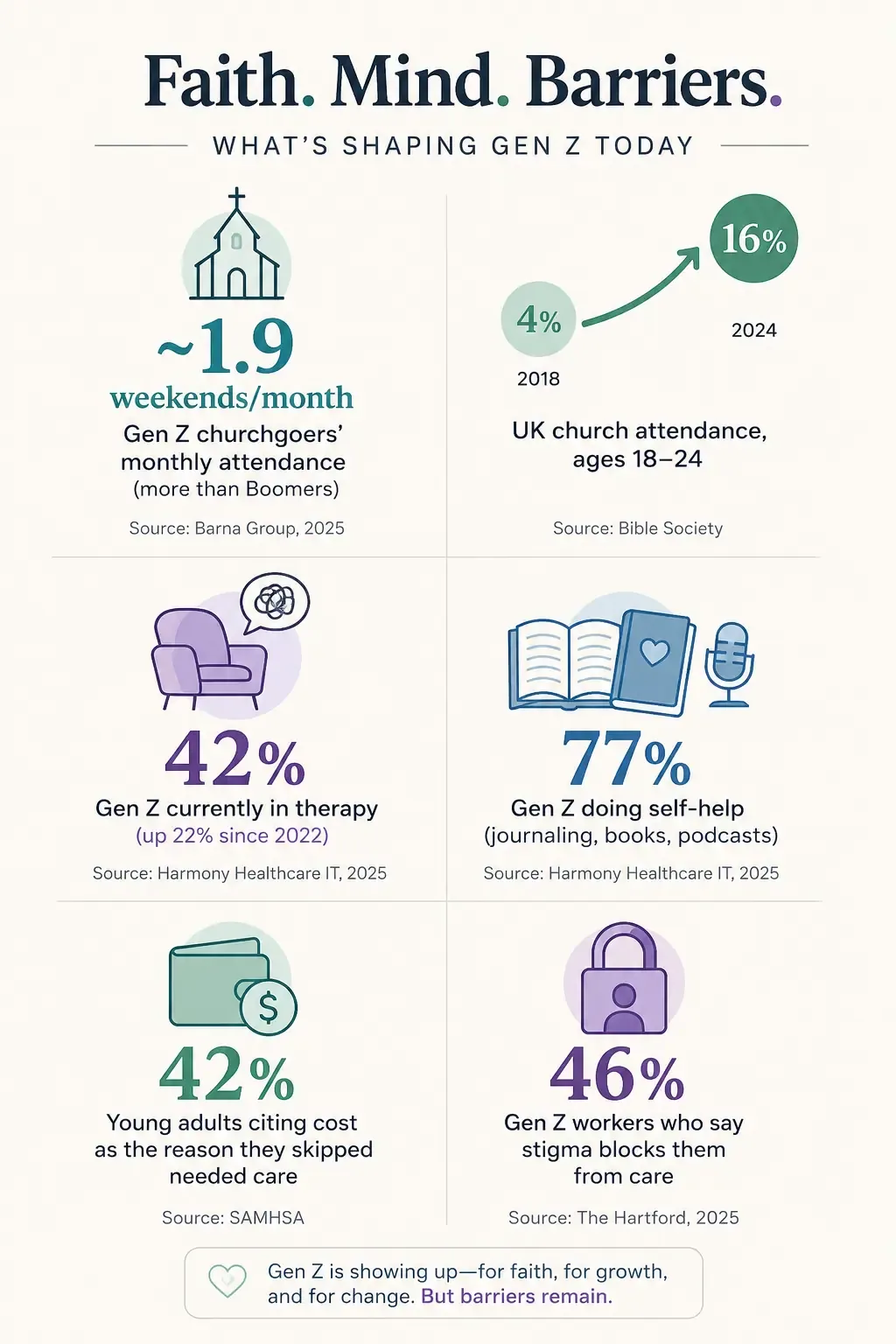
Read that table again. Therapy use is up. Church attendance is up. Both at the same time, in the same generation.
The "church over therapy" story is really a "church alongside — and sometimes instead of — therapy" story. And the "instead of" part usually comes down to three things: money, waitlists, and loneliness.
Why Church Is Winning for Some People
Reason 1: Therapy Costs $150. Church Costs $0.
Let's be blunt. A therapy session in the US often runs $100–$200 without insurance. Even with insurance, many people pay out of pocket, and a third of them cancel sessions because of cost.
SAMHSA found 42% of young adults who needed mental health care didn't get it — because they couldn't afford it. Nearly half of Gen Z and Millennials say they've struggled just to find a therapist, and the top complaint is price.
Church asks for nothing at the door. You get a place to go, people who know your name, someone to call in a crisis, free meals, and a weekly reset — for free.
For a 23-year-old with student loans and a $60 copay, that math is not complicated.
Reason 2: Loneliness Is the Real Diagnosis
Therapy treats symptoms one hour a week. But a huge share of what Gen Z reports isn't a disorder — it's isolation, purposelessness, and dread about the future. Around 60% of Gen Z worldwide say world events leave them overwhelmed about what's coming.
A therapist can help you cope with loneliness. A church small group ends the loneliness on Tuesday nights.
Consider a story like Jake's — a pattern youth pastors across the country describe constantly. He's 24, moved to a new city for work, spent eight months talking to almost no one outside Slack. He tried a therapy app, quit after three sessions. Then a coworker invited him to a young adults group. Within a month he had Sunday lunch plans, a pickup basketball group, and three people who texted when he went quiet.
Nothing about that is clinical treatment. All of it is protective for mental health. Decades of research back this up — regular religious attendance is linked to lower rates of depression and substance abuse, largely because of exactly these ingredients: community, routine, purpose, and accountability.
Reason 3: Therapy Language Stopped Working for Some of Them
Gen Z grew up marinated in therapy-speak. Boundaries, trauma, attachment styles, "protecting my peace." For many, it helped. For others, it started feeling like a vocabulary for avoiding people rather than connecting with them.
Church offers the opposite framing: you're not just a bundle of symptoms to manage. Your pain can mean something. You're part of a story bigger than your own head.
That's also why so many young people turn to scripture for mental health language first. Verses about fear, despair, and hope give words to feelings without requiring a diagnosis. If that's you, this collection of Bible verses for depression and anxiety is a good starting point — and notice it openly encourages getting professional support too, which is exactly the balance this article is arguing for.

Reason 4: Waitlists vs. Sunday Morning
Even when Gen Z wants therapy, they often can't get in. Therapist shortages mean weeks or months of waiting, especially outside big cities. Church happens every seven days, no intake form, no insurance card.
When you're struggling this week, "we have an opening in March" loses to "doors open at 10 a.m."
What Church Actually Delivers (And What Therapy Can't)
Let's give church its full credit. Here's what a healthy congregation provides that no clinician can:
Built-in community. Not scheduled, billed connection — actual ongoing relationships. People who notice when you're gone.
Weekly rhythm. Depression and anxiety hate structure. A fixed Sunday anchor plus midweek groups creates routine for free.
Meaning. Viktor Frankl, a psychiatrist who survived the Holocaust, argued that meaning — not comfort — is what keeps people going. Church hands you a framework for suffering, purpose, and forgiveness on day one.
Intergenerational contact. Where else does a 22-year-old regularly talk with 70-year-olds who've survived divorce, layoffs, and grief? That's free wisdom no app can replicate.
Practical help. Meals when you're sick. Help moving. Someone watching your kid. Churches run informal mutual aid networks that function like a safety net.
Embodied practices. Singing together, kneeling, communion, silence. These calm the nervous system in ways that overlap heavily with what therapists call grounding and co-regulation. In fact, many classic Christian habits — real rest, prayer, community, sabbath — map closely onto what clinicians would call good behavioral health. These Christian self-care practices show how much overlap there really is.
One more point people miss: the Bible itself doesn't treat physical and mental needs as unspiritual. When the prophet Elijah collapsed in despair and wanted to die, God's first response wasn't a sermon — it was sleep and food, twice, before anything else. That pattern, sometimes called the Elijah Protocol, is strong evidence that faith done well takes bodies and brains seriously.
The Part Nobody Wants to Say Out Loud: The Risks
Here's where most hot takes stop. We won't.
Church is powerful for general mental wellbeing. It is not a treatment for clinical conditions. And confusing the two hurts people.
Risk 1: "Pray Harder" Theology
Some churches teach that anxiety or depression means weak faith. That's not just wrong — it's dangerous. It adds shame on top of illness and delays real treatment.
A story pastors and counselors both know well: a young woman — call her Maya, 23 — struggling with panic attacks. Her small group told her to pray more and memorize verses. She did, for a year. The panic got worse, and now she also felt like a spiritual failure. When she finally saw a doctor, she learned she had a treatable panic disorder. Twelve weeks of therapy plus her faith community did what either alone couldn't.
The lesson isn't "church failed her." The lesson is: her church tried to be a clinic, and it isn't one.
Risk 2: Missing Real Illness
Community can lift low mood. It cannot treat major depression, PTSD, OCD, bipolar disorder, eating disorders, or suicidal thinking. These are medical conditions. Would you treat diabetes with potlucks?
Even within faith circles, it matters to know the difference between spiritual tiredness and clinical illness. Burnout, for example, gets confused with depression constantly — and they need different responses. This breakdown of how Christian burnout differs from clinical depression is worth reading before you self-diagnose in either direction. Same with recognizing signs of spiritual exhaustion versus something deeper.
Risk 3: Unqualified Counsel
Your pastor may be wonderful. He is (usually) not trained in trauma, medication, or crisis care. Well-meaning advice from an untrained leader on serious issues — abuse, self-harm, addiction — can do real damage.
Risk 4: High-Control Environments
A minority of churches use community as leverage: obey, conform, don't ask questions, or lose everyone you know. For a lonely 22-year-old, that's a trap dressed as belonging. We'll cover the red flags below.
Church vs. Therapy: What Each One Is Actually For
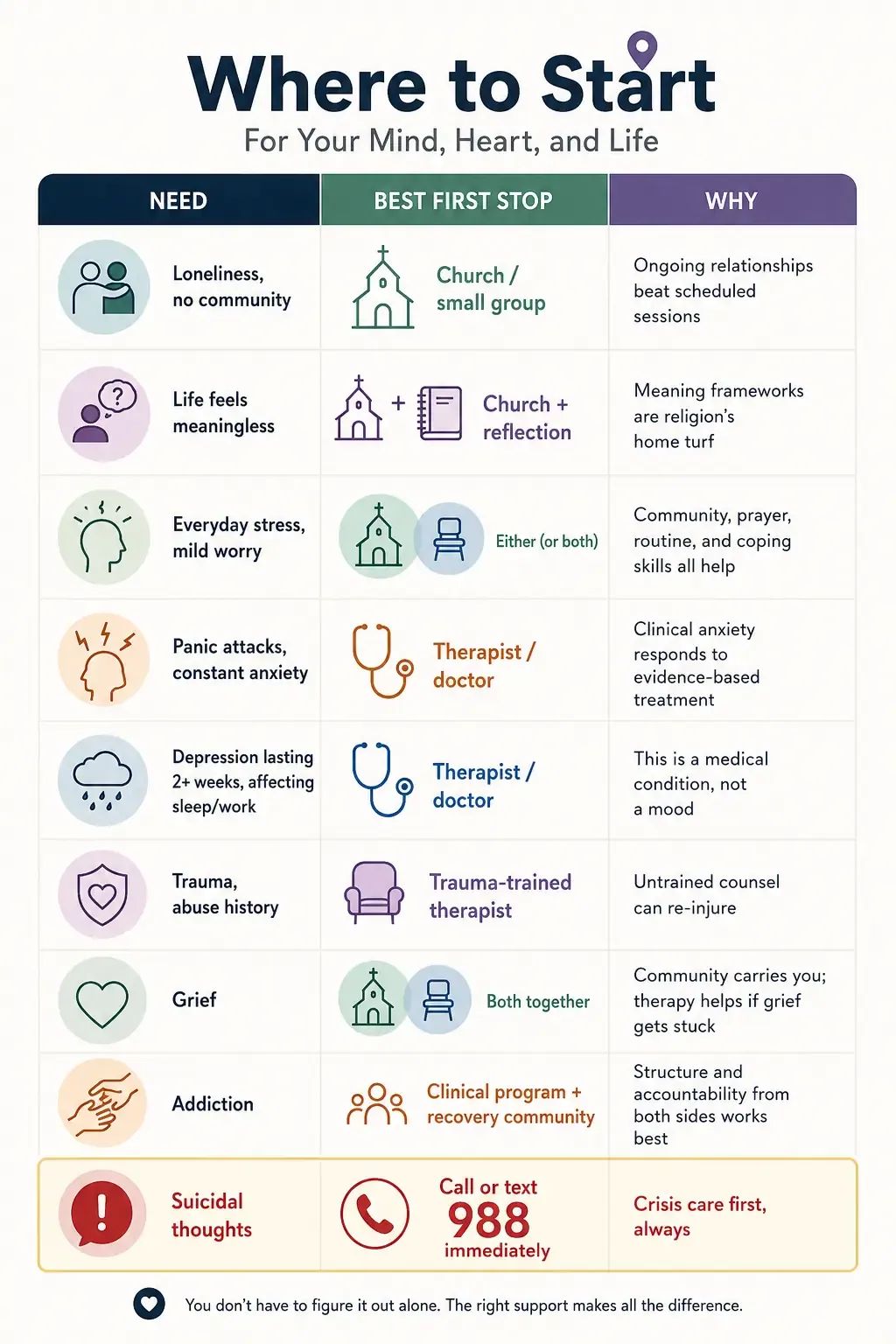
Print that table. Screenshot it. It answers 90% of the debate.
The Smart Playbook: How to Use Both Without Getting Burned
If You're Leaning Toward Church
Tip 1: Vet the church like you'd vet a therapist. Ask directly: "What does this church believe about mental illness and medication?" A healthy answer sounds like: "God works through doctors and counselors too." A red flag sounds like: "You just need more faith."
Tip 2: Look for churches with referral lists. The best congregations keep a list of licensed Christian counselors and refer people out. That one habit tells you they know their limits.
Tip 3: Join a small group, not just Sunday service. The mental health benefits live in the relationships, not the sermon. Sitting anonymously in row 14 gives you maybe 20% of the value.
Tip 4: Watch for control red flags. Leaders who discourage outside friendships, punish questions, demand to know your finances or dating life in detail, or shame people who leave — walk away. Belonging should never cost your autonomy.
Tip 5: Use spiritual practices as practices. Prayer, scripture meditation, and gratitude have real calming effects. Build them into daily rhythm — many people start with structured prayers for emotional healing in the morning or scripture before bed to quiet anxiety at night instead of doomscrolling. Nighttime phone anxiety is one of Gen Z's biggest sleep killers, and a scripture-based wind-down routine is a genuinely practical swap.
If Cost Is Why You're Skipping Therapy
Don't quietly give up. Try these in order:
Sliding scale therapists. Many charge based on income — sometimes $20–$40 per session. Search Open Path Collective (sessions $30–$80).
Community mental health centers. Federally funded, income-based pricing, in most counties.
University training clinics. Grad students supervised by licensed pros, often $10–$25 per session.
Your church itself. Growing numbers of churches subsidize counseling for members or host licensed counselors on site. Just ask.
Insurance check. Telehealth coverage expanded massively — 60% of Gen Z actually prefers virtual sessions, and it's usually cheaper.
If You Want the Best of Both (Recommended)
A realistic combo that works for a lot of people:
- Weekly: Church service + one small group night (community, meaning, rhythm)
- Biweekly or monthly: Therapy session (skills, processing, medical oversight if needed)
- Daily: 10 minutes of prayer/scripture + basic body care — sleep, food, movement
- Quarterly: Honest check-in — is this actually working? Ask someone who'll tell you the truth.
Notice therapy drops to biweekly in this model. That's the real financial win of church community: it doesn't replace therapy, it lets therapy do less heavy lifting, which means fewer sessions and lower cost.

What This Trend Says About Us
Here's the deeper read.
Gen Z isn't rejecting mental health care. They're rejecting the idea that mental health is a solo project — one person, one paid professional, one hour a week, forever.
They tried the individualized model. 42% are literally in therapy right now. And many discovered that what hurt most wasn't chemical — it was disconnection. No community, no meaning, no elders, no place to belong.
Church happens to be the oldest, cheapest, most widely available institution that supplies all four. So they're walking back in — often skeptical, often picky, but showing up.
The generations before them split the world in two: faith over here, science over there, never talking. Gen Z is quietly stitching them back together. A therapist and a small group. Medication and prayer. A diagnosis and a purpose.
Honestly? That might be the healthiest thing this "anxious generation" has done yet.
FAQ: Gen Z, Church, and Therapy
Is church actually good for mental health?
Yes — for general wellbeing. Long-running research links regular religious attendance to lower depression rates, less substance abuse, and longer life. The main drivers are community, routine, purpose, and support. But it's protective, not curative. It's a gym membership for your mind, not surgery.
Can church replace therapy?
For loneliness, mild stress, and lack of meaning — it often does the job. For clinical conditions like major depression, panic disorder, PTSD, OCD, or bipolar disorder — no. Those need trained professionals, the same way a broken leg needs a doctor. The wisest churches say this themselves.
Why is Gen Z going back to church now?
Four big drivers: cost of therapy (sessions often run $100–$200), an epidemic of loneliness, hunger for meaning beyond self-improvement, and burnout on internet life. Young men are the fastest-growing group, drawn partly by structure and challenge.
Is this a real revival or just hype?
Somewhere in between. Overall religious affiliation has stabilized, not surged. But among engaged young people, attendance frequency has genuinely jumped — Gen Z churchgoers now attend more often than Boomers. Researchers call it deepening, not mass conversion.
What if my church says medication is a lack of faith?
That teaching is both theologically shaky and medically harmful. Even in scripture, God met Elijah's despair with food and rest before anything spiritual. If your church shames treatment, get care anyway — and seriously consider finding a healthier congregation.
Does the Bible say anything about anxiety and depression?
Constantly. David wrote openly about despair. Elijah wanted to die. Jesus sweat blood from distress. Scripture never treats these feelings as shameful — it gives them language. Many people use those passages alongside professional care, not instead of it.
I can't afford therapy. What should I actually do this week?
Three moves: (1) Search Open Path Collective or a local community mental health center for low-cost sessions. (2) Visit one church young adults group — just once, as an experiment. (3) If you're in crisis, call or text 988 right now. It's free and open 24/7.
How do I know if I need a professional, not just community?
Rule of thumb: if symptoms last more than two weeks, disrupt sleep, work, or eating, or include any thoughts of self-harm — that's professional territory. Community helps you live; clinicians help you heal. You'll likely need both at different times.
Key Statistics
Gen Z Church Attendance
~1.9 weekends/month
Average monthly church attendance among Gen Z churchgoers, exceeding Baby Boomers.
Source: Barna Group (2025)
UK Young Adult Church Attendance
4% (2018) → 16% (2024)
Monthly church attendance among UK adults aged 18–24. Note: this finding has since been disputed due to survey quality concerns.
Source: Bible Society – The Quiet Revival (2025)
Credible Sources
Barna Group · September 2, 2025
Primary source for the article's central statistic showing Gen Z churchgoers attend more frequently than older generations.
Pew Research Center · February 26, 2025
Provides nationally representative research showing religious decline has slowed while offering important context about younger Americans' religious engagement.

About the Author
Editorial Team
Editorial Team
Daily Faith Path articles are prepared by the editorial team to help readers find scripture-centered guidance for healing, faith, prayer, and spiritual encouragement.
Expertise: Healing scriptures, Bible study resources, prayer guidance, devotional writing, Christian encouragement
Experience: The team researches scripture references, reviews surrounding biblical context, compares translation wording where useful, and updates articles to improve clarity, usefulness, and trust for readers.
Credentials: Editorial review, devotional writing, scripture study, content updating
This article is published by the Daily Faith Path editorial team to help readers use scripture carefully, prayerfully, and in ways that are practical for real-life seasons of illness, grief, waiting, and spiritual reflection.
Continue Reading
Related articles

October 7, 2026
12 Bible Verses About Hiding Money From Your Spouse
Explore 12 Bible verses about secret spending, hidden debt, financial honesty, confession, forgiveness, boundaries, and rebuilding trust in marriage.

October 6, 2026
15 Bible Verses for Couples Who Keep Fighting About Money
Money fights are rarely just about dollars. These 15 Bible verses help couples address spending, saving, debt, secrecy, unequal income, giving, and financial control with practical next steps and conversation questions.

October 5, 2026
Should You Tithe While in Debt? 11 Bible Passages to Study First
Should you tithe while in debt? Explore 11 Bible passages on tithing, debt, generosity, family responsibility, and giving according to your means—plus a practical plan for deciding what to do.