Why Young Women Are Leaving Church Faster Than Anyone Else
For the first time in modern religious research, Gen Z women are leaving church at higher rates than young men. This article explores the surprising data behind the trend, why young women are disengaging while young men are returning, and what these shifts could mean for churches, families, and the future of faith.
For the first time since anyone started counting, more young women are walking away from church than young men. Not slightly more — 54% of Gen Z adults who left the religion they were raised in are women, compared to 46% who are men. That's a complete flip from your grandmother's generation, and almost nobody outside religion research circles has caught up to what it means.

The Numbers Nobody Saw Coming
Here's the quiet earthquake. For every generation researchers have measured — Baby Boomers, Gen X, Millennials — men left church at higher rates than women. Women were the ones who stayed, who dragged the kids to Sunday school, who kept the lights on. That pattern held for decades.
Then Gen Z showed up and broke it.
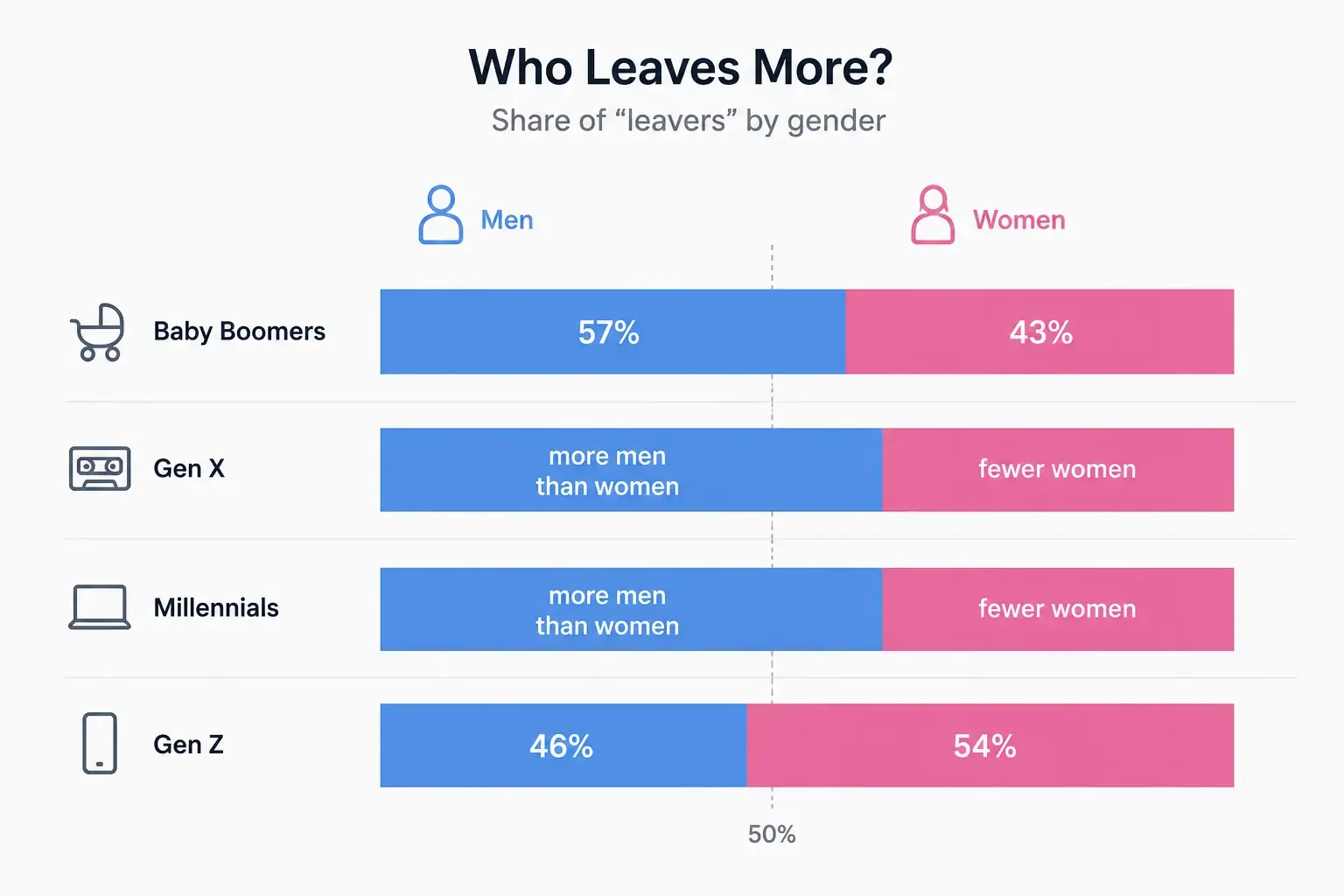
That data comes from the Survey Center on American Life, run through the American Enterprise Institute, based on a survey of over 5,000 adults. The researchers didn't expect it either. One of them wrote that women have "traditionally been more religious than men," which made this reversal genuinely surprising even to people who study this for a living.
A few more numbers that matter:
- 39% of Gen Z women are religiously unaffiliated, compared to 34% of Millennial women, 23% of Gen X women, and just 14% of Baby Boomer women.
- 65% of Gen Z women say churches don't treat men and women equally. Even 54% of Gen Z men agree with them.
- Nearly 3 in 10 women under 30 identify as something other than straight, which matters a lot in churches that still teach a traditional sexual ethic.
- 54% of young women say abortion should be available without restriction, based on 2022 General Social Survey data.
None of these numbers explain everything on their own. Together, they paint a picture of a generation of women who grew up being told they could do anything — then walked into a sanctuary and heard they couldn't teach, couldn't lead, and in some cases couldn't even speak from the pulpit.
Why This Reversal Actually Makes Sense (Once You See the Other Half)
Here's the part almost nobody has connected. While young women are leaving, young men are doing the opposite.
Barna Group's 2025 State of the Church data found that 43% of men now attend church weekly compared to 36% of women — the largest gender gap Barna has recorded in 25 years of tracking. Gen Z men specifically are attending more often than Millennial men did at the same age. That's never happened before either.
So you've got two currents running in opposite directions at the exact same moment, in the exact same generation. Young women are leaving. Young men are arriving. Nobody is writing about both trends side by side, and that's the real story here: men and women in their twenties are now moving through the church's front doors in opposite directions.

What's Pulling Men In
Researchers point to a few overlapping reasons:
- The isolation of the pandemic hit young men hard, and church offered structure and community when a lot of other institutions felt shaky.
- Public figures like Jordan Peterson reframed the Bible as a psychological and philosophical text, which gave skeptical men a way in that didn't require an altar call first.
- Politically, religion has become coded as more traditional and more aligned with where young men are already drifting.
- One researcher put it plainly: for some young men, church is "one institution that isn't initially and formally skeptical of them as a class."
What's Pushing Women Out
The reasons on the women's side are almost a mirror image:
- Two-thirds of Gen Z women don't think their church treats men and women as equals.
- Many conservative denominations, including the Southern Baptist Convention (the largest Protestant body in the U.S.), formally teach that women submit to male leadership and can't hold ordained positions.
- Church has become one of the few remaining institutions that hasn't shifted with them on gender roles, LGBTQ inclusion, and reproductive rights — so for a generation raised to expect equality everywhere else, church starts to feel like the exception, not the refuge.
- Abuse and the handling of abuse. Researchers studying "exvangelicals" note that a lot of women in deconstruction spaces cite churches responding poorly, or not at all, when women reported harm.
Put those two lists side by side and the picture gets uncomfortable fast: the very things drawing men toward church — tradition, clear roles, a pushback against a culture that feels skeptical of masculinity — are close to the same things pushing women away.
Real Stories Behind the Statistics
Numbers only tell you so much. Here's what this actually looks like in people's lives, based on patterns researchers and pastors describe again and again.
The youth group graduate. A woman in her mid-20s grows up the "good girl" of her church — worship team, mission trips, Bible quiz champion. She goes to a state college, majors in something practical, and starts dating. Nobody in her home church ever talked honestly about sex, mental health, or doubt, so when real life throws all three at her at once, she has no framework for it except guilt. She doesn't storm out. She just stops going one Sunday, then another, and eventually stops explaining why.
The one who asked too many questions. A woman serves for years as a small group leader, unpaid, faithful, reliable. She asks her elder board why women can't be elders. She's told it's "not up for debate." She keeps serving for another year out of loyalty, then leaves quietly, not because she stopped believing in God, but because she stopped believing the institution had room for her.
The friend who stayed close. A woman doesn't leave over doctrine at all — she leaves because her best friend came out as gay in college and her church's response was to quietly stop inviting her friend to things. She didn't want to be part of a community that treated someone she loved as a problem to manage.
These stories rarely make headlines because nobody dramatically renounces faith on a stage. Most people just fade. One missed Sunday becomes a missed month becomes a new normal, and by the time anyone notices, she's already gone.
The Ripple Effects Nobody's Talking About
This isn't just a church attendance story. It's changing dating, marriage, and family life in ways that are just starting to show up.
Dating pools are shrinking and skewing. If young women are leaving faith communities and young men are entering them, church singles groups start to look lopsided — more men than women, or the reverse in the wider dating pool outside church. Researcher Ryan Burge has flagged this directly: "People like to marry people like them, and women are increasingly liberal and increasingly non-religious, while men are the opposite of them." That's a recipe for more mismatched couples, more friction over faith after the wedding, or fewer people from this generation getting married in a faith community at all.
Family dinners get harder. A mom who left church five years ago now sits across from a 22-year-old son who just started going every Sunday. Neither one planned to be the "religious opposite" of their kid or parent. That's a genuinely new kind of family tension, and there's no script for it yet.
Churches lose a generation of future leaders quietly. Women have historically run the nursery, led the women's ministry, organized the potlucks, and taught Sunday school. If that pipeline of women dries up over the next 20 years, plenty of mid-size churches are going to feel a leadership gap they didn't see coming.
Practical Advice: If You're the Woman Thinking About Leaving
If you recognize yourself in any of this, here's what actually helps, based on what pastoral counselors and people who've walked this path say works.
Name the specific thing, not just the feeling. "I don't feel connected anymore" is vague and hard to act on. "I stopped believing women should be silent in leadership" is specific and lets you actually decide what to do about it. Write down the actual reasons, not just the mood.
Separate God from the institution before you decide anything. A lot of women conflate "I'm angry at my church" with "I don't believe in God anymore." Those are two different questions. Give yourself permission to answer them separately, on your own timeline.
Try one honest conversation before you try the exit. Talk to one trusted leader, not the whole board, and say the real thing out loud. Sometimes nothing changes. Sometimes you learn there were other women feeling exactly the same way, quietly, for years.
If you're in a spiritually dry season and don't know if it's doubt or just exhaustion, read something built for exactly that. This piece on what to do when God feels silent walks through the difference between spiritual dryness and genuinely losing your faith, which is worth sorting out before you make a permanent decision.
If you decide to stay and rebuild trust instead of leaving, go in with a plan, not just hope. This step-by-step guide for trusting God when life is falling apart is written for exactly that kind of rebuilding, one honest step at a time.
Practical Advice: If You're a Church Leader Trying to Keep Women From Leaving
Ask before you lose them. Most women don't announce they're leaving. Build in real exit interviews, or better, regular check-ins with the women already serving, before they hit the point of no return.
Give a real answer on leadership roles, not a deflection. "It's not up for debate" is the fastest way to lose a woman who was already on the fence. Even if your theology doesn't change, an honest, respectful explanation goes further than silence.
Watch for burnout in your most faithful volunteers. The women doing the most unpaid labor in your church are often the first to quietly disappear. If you want a related read for your own team, 10 signs of spiritual exhaustion and 7 Christian burnout symptoms you should never ignore are both useful checklists to run your volunteer teams against once a year.
Take abuse reports seriously the first time, publicly and consistently. Nothing pushes women out faster than watching a church protect a man's reputation over a woman's safety.

What This Means For the Next Ten Years
If both trends keep going the way they're going, churches in 2035 could look genuinely different than they do today — younger, more male in the pews than they've ever been, and increasingly reliant on men for roles women used to fill by default.
That's not a doom prediction. Some pastors already see it as an opportunity: a chance to build churches that don't assume free female labor, and don't assume men are the hard-to-reach demographic anymore. But it only works if churches actually look at why women are leaving instead of only celebrating that men are showing up.
Frequently Asked Questions
Is it really true that more young women are leaving church than young men? Yes, based on Survey Center on American Life data from 2024: 54% of Gen Z adults who left their childhood religion are women, versus 46% men. That's the reverse of every older generation measured.
Why are young women leaving church faster than young men? The most cited reasons are perceived gender inequality in church leadership (65% of Gen Z women say churches don't treat men and women equally), more liberal political and social views among young women, disagreement over LGBTQ inclusion, and, in some cases, churches mishandling reports of abuse.
Are young men really returning to church, or is that overstated? It's real but researchers urge caution. Barna Group's 2025 data shows men now out-attending women weekly for the first time in 25 years of tracking. Pew's 2025 Religious Landscape Study is more cautious, saying the gender gap is narrowing but "there are still no birth cohorts in which men are significantly more religious than women." Both things are true at once — a real shift, and not yet a full reversal.
Does leaving church mean a woman has stopped believing in God? Not usually. Most disaffiliation research separates "belief in God" from "institutional religious affiliation." Plenty of women who leave church still pray, still believe in God, and still consider themselves spiritual — they've just stopped trusting the institution to represent that faith well.
What can a church actually do to keep young women engaged? Give honest, respectful answers on leadership questions instead of shutting down debate, take abuse reports seriously and visibly, watch for burnout in the women doing the most unpaid ministry work, and build real space for doubt instead of only for certainty.
Is this trend the same in every denomination? No. Churches with more women in visible leadership and more openness to LGBTQ inclusion tend to retain younger women at higher rates. Denominations with strict complementarian teaching — like the Southern Baptist Convention — are seeing the sharpest generational gap.
If you're in a season where church feels more complicated than it used to, you're not the only one. The trusting God hub has a range of reflections for exactly this kind of uncertainty, and if church hurt is part of what you're carrying, this collection on forgiveness is worth sitting with too. Wherever you land on this, your questions are worth taking seriously — including by the people leading your church.
Key Statistics
Gen Z religious leavers who are women
54%
Among Gen Z adults who left the religion they were raised in, women now make up the majority for the first time.
Source: Survey Center on American Life (2024)
Gen Z religious leavers who are men
46%
Men now represent the minority of Gen Z religious disaffiliates, reversing decades of historical trends.
Source: Survey Center on American Life (2024)
Credible Sources
Pew Research Center · January 1, 2025
Offers comprehensive national data on religious affiliation, attendance, and long-term demographic trends for contextual comparison.
NORC at the University of Chicago · January 1, 2022
Supplies nationally representative data on abortion attitudes and broader social values referenced in the article.

About the Author
Editorial Team
Editorial Team
Daily Faith Path articles are prepared by the editorial team to help readers find scripture-centered guidance for healing, faith, prayer, and spiritual encouragement.
Expertise: Healing scriptures, Bible study resources, prayer guidance, devotional writing, Christian encouragement
Experience: The team researches scripture references, reviews surrounding biblical context, compares translation wording where useful, and updates articles to improve clarity, usefulness, and trust for readers.
Credentials: Editorial review, devotional writing, scripture study, content updating
This article is published by the Daily Faith Path editorial team to help readers use scripture carefully, prayerfully, and in ways that are practical for real-life seasons of illness, grief, waiting, and spiritual reflection.
Continue Reading
Related articles

October 7, 2026
12 Bible Verses About Hiding Money From Your Spouse
Explore 12 Bible verses about secret spending, hidden debt, financial honesty, confession, forgiveness, boundaries, and rebuilding trust in marriage.

October 6, 2026
15 Bible Verses for Couples Who Keep Fighting About Money
Money fights are rarely just about dollars. These 15 Bible verses help couples address spending, saving, debt, secrecy, unequal income, giving, and financial control with practical next steps and conversation questions.

October 5, 2026
Should You Tithe While in Debt? 11 Bible Passages to Study First
Should you tithe while in debt? Explore 11 Bible passages on tithing, debt, generosity, family responsibility, and giving according to your means—plus a practical plan for deciding what to do.