Isaiah 60:22: Why Is God Taking So Long to Answer?
You've prayed for years, but nothing has changed. Discover what Isaiah 60:22 really means, why some prayers remain unanswered, and how to trust God's timing while taking practical steps forward.
You have prayed for years, but nothing has changed. Isaiah 60:22 says God will act at the right time, so why is He taking so long—and how do you know whether to keep waiting or move forward?
The answer starts with a truth that often gets missed: God's timing is not a guarantee that every prayer will be answered exactly as we expect. Isaiah 60:22 gives us a reason to trust God, but understanding what He actually promised can change how we handle years of waiting.
This guide explores what Isaiah 60:22 means, why some prayers remain unanswered, and what to do when you have waited five or ten years. It also offers practical steps for marriage, healing, finances, family struggles, and other situations where waiting has become exhausting.
What Does Isaiah 60:22 Actually Mean?
Isaiah 60:22 says:
"The least of you will become a thousand, the smallest a mighty nation. I am the LORD; in its time I will do this swiftly." — Isaiah 60:22, NIV.
The verse contains two ideas: something small will become great, and God will bring it about at the appointed time.
But who is God talking to? And what exactly will He make happen?
The Context Most People Miss
Isaiah 60 speaks about Zion, or Jerusalem. It describes God's future restoration of His people, with nations coming toward His light.
The chapter speaks of rebuilding, peace, justice, and the end of grief. Verse 22 closes that vision with a promise that the smallest will become a mighty nation.
That matters because Isaiah was not speaking directly to someone waiting for a promotion, marriage, pregnancy, or business breakthrough.
Christians can draw hope from God's character and faithfulness in this passage. But applying its original promise to every personal desire goes beyond what the verse says.
What Does "In Its Time I Will Do This Swiftly" Mean?
It means that when God's appointed time arrives, He is able to accomplish what He has promised.
It does not mean that every long wait must end with a sudden miracle.
Think about the difference between these two statements:
-
"God will fulfill what He has promised."
-
"God will give me the exact thing I want because I have waited long enough."
The first expresses trust in God's faithfulness. The second assumes something about the future that Scripture may not have promised.
You can trust God's timing without claiming to know His timetable.

Why Is God Taking So Long? 5 Things to Consider
When prayer goes unanswered, it is tempting to search for one hidden explanation.
Maybe God is preparing you. Maybe you are being tested. Maybe a breakthrough is about to happen.
But Scripture does not give us enough information to assign one of those explanations to every person's situation.
1. God's Promise May Be Different From Your Expectation
You may believe God promised you a particular marriage, job, or financial outcome.
But where did that belief come from?
Was it a direct biblical promise? Something a trusted person said? A strong feeling during prayer? A prediction you made after reading a verse?
Those are not the same thing.
Consider someone who reads Isaiah 60:22 after applying for a new job. They feel encouraged and conclude that God has promised them the position.
Six months later, someone else gets hired.
The rejection is painful. But it does not mean Isaiah 60:22 failed.
The expectation of receiving that particular job was never part of the verse.
This is also why understanding what Romans 8:28 actually promises matters. God's good purpose is larger than the specific outcome we hope to receive.
2. Some Prayers Are Answered Differently
In 2 Corinthians 12:7–10, Paul describes a painful struggle he calls a thorn in his flesh.
He asks God three times to remove it.
Yet the passage does not report the removal he requested. Instead, Paul receives assurance that God's grace is sufficient for him.
Paul did not stop believing in God because the struggle remained.
Nor did he pretend that the struggle was gone.
His experience shows that faithful prayer and an unchanged situation can exist together.
If you have prayed for healing and your symptoms remain, Paul's story does not explain your particular illness. It does, however, challenge the idea that an unchanged situation always means weak faith.
3. Waiting May Involve Other People's Choices
Suppose you have prayed for a spouse to return for seven years.
That person has repeatedly said they do not want to reconcile.
You might ask, "Why is God delaying our restoration?"
But reconciliation involves two people. It cannot be built on one person's desire alone.
You can pray for healing, pursue wise counsel, acknowledge your own mistakes, and remain open to healthy reconciliation.
You cannot make another adult choose the relationship.
The same applies to adult children, former friends, and business partners.
Sometimes what feels like a divine delay also involves another person's decisions.
4. You May Have a Next Step You Have Not Taken
Prayer and action are not opposites.
If you have prayed for financial stability, a budget may be one practical next step.
If you have prayed for work, you may need to update your résumé or consider a different field.
If you have prayed for physical healing, seeking appropriate medical care is important.
None of those actions guarantees a particular result.
They simply recognize that trusting God does not require you to stop using the opportunities and resources available to you.
5. Some Questions Remain Unanswered
Job suffered deeply without knowing the full reason behind his suffering.
Psalm 13 begins with a question many Christians recognize: how long will God seem distant?
The Bible makes room for questions that do not receive quick explanations.
You may never know why a particular prayer remained unanswered.
Not knowing the reason is different from knowing that God has rejected you.
If that uncertainty has made prayer difficult, explore what to do when God feels silent .
What Long Waiting Looks Like in Real Life
Waiting is not just a spiritual idea. It affects how people manage money, relationships, health, and everyday choices.
Pew Research Center's 2023–2024 Religious Landscape Study surveyed 36,908 U.S. adults. It found that 44% of Americans and 60% of Christians reported praying daily.
Those figures show how common prayer is, but they do not measure unanswered prayers or prove how often a breakthrough occurs.
The following examples show why different problems need different responses.
Story 1: Hannah Waited for a Child
In 1 Samuel 1, Hannah experiences deep distress because she has no children.
She prays, weeps, and speaks honestly about her pain.
Her story eventually includes the birth of Samuel. But notice something important: Hannah does not know that ending when she first prays.
For someone facing infertility today, Hannah's story can provide comfort without becoming a prediction.
A couple can pray for a child while exploring medical options, discussing treatment limits, and seeking emotional support.
They can also talk about adoption or a meaningful life without children, without treating either path as a required substitute.
Hannah's eventual pregnancy does not mean every couple will conceive after praying long enough.
Story 2: A Job Search That Lasts Two Years
Consider Daniel, a fictional example based on common job-search struggles.
Daniel loses his job at 43. For two years, he prays for a similar position with the same salary.
At first, he applies only to jobs that match his previous title. Meanwhile, his savings shrink.
Eventually, he meets with a career adviser, revises his résumé, and starts applying to related roles.
He accepts a position with lower pay but steadier hours.
His original expectation never happens.
But his new job gives him financial stability and a chance to rebuild.
The practical lesson is not that God secretly planned the layoff. It is that Daniel could pursue a responsible next step without waiting for his old career to return.
Story 3: A Real Example of Faith Without the Expected Relief
Mother Teresa spent decades serving people in poverty while experiencing long periods of spiritual darkness.
Her private correspondence, published after her death, revealed that she often struggled with a sense of God's absence.
She continued her work, even when she did not experience the spiritual comfort she wanted.
Her experience does not explain why anyone else feels spiritually dry. It does show that a person's relationship with God cannot be measured only by how strongly they feel His presence.

The Promise, Expectation, and Action Framework
Here is a practical way to examine a prayer you have carried for years.
Separate it into three parts: what God has promised, what you hope will happen, and what you can responsibly do now.
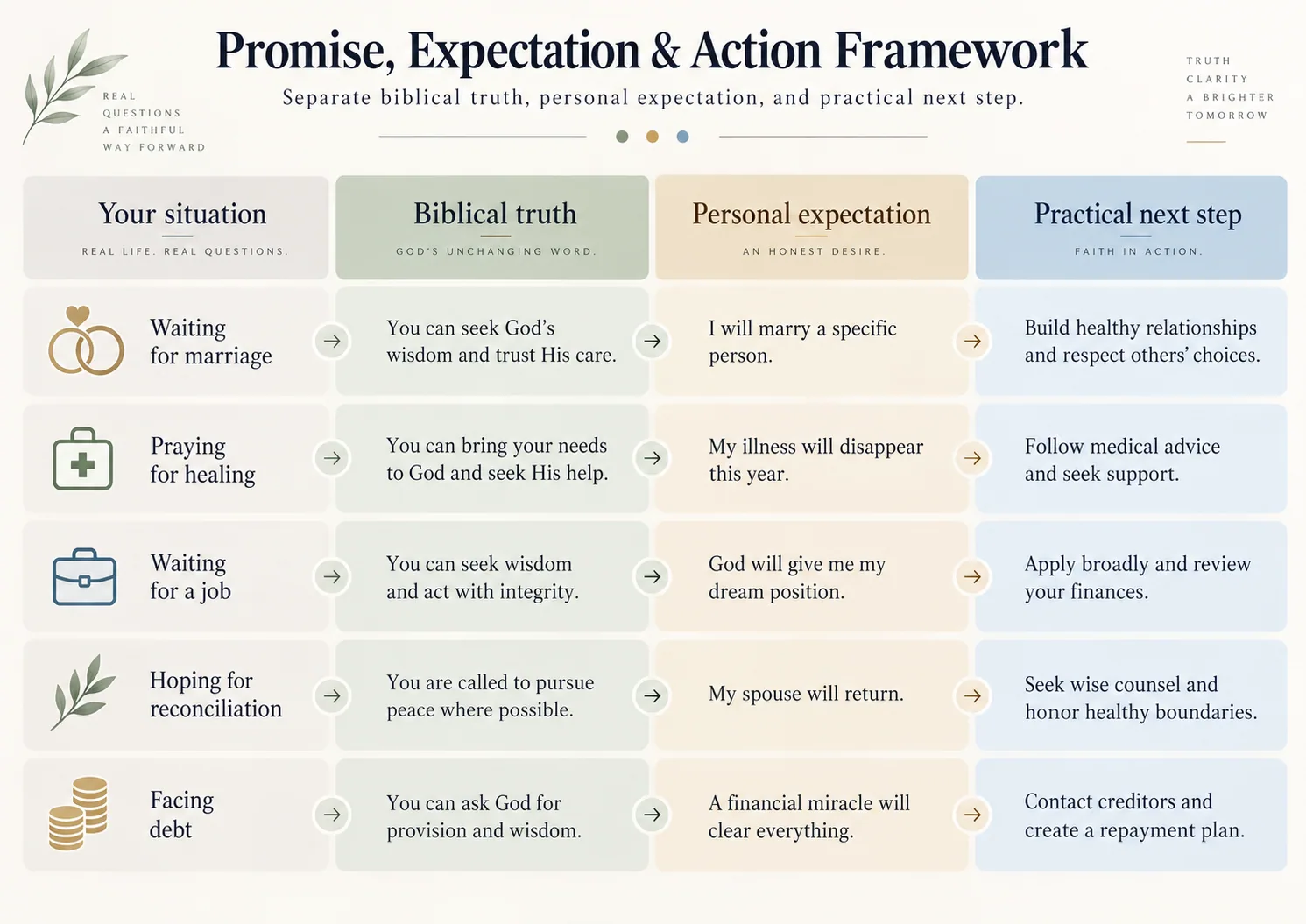
This framework helps you hold on to faith without making promises God has not made.
It also gives you permission to change your plans.
Changing a plan is not the same as giving up on God.
What to Do When You Have Waited Five or Ten Years
A ten-year wait is different from a ten-day wait.
Over a decade, your health, family, career, finances, and responsibilities may change. A decision that made sense years ago might no longer be wise.
Use this five-step review to examine your situation.
Step 1: Name Exactly What You Are Waiting For
Write one clear sentence.
For example: "I am waiting for my former spouse to return."
Avoid vague descriptions such as "I am waiting for my season."
A clear sentence makes it easier to understand the real problem and what action is possible.
Step 2: Identify What Has Actually Been Promised
Ask yourself:
-
Is my expected outcome stated in Scripture?
-
Am I applying a general biblical principle to a specific personal result?
-
Did someone predict this outcome for me?
-
Have I treated a strong feeling as a guarantee?
-
Could I still trust God if this outcome never happens?
These questions are not meant to discourage prayer.
They help you distinguish confidence in God from confidence in your own prediction.
The same issue appears in Jeremiah 29:11 and waiting for God's promises . God's message to the exiles included hope, but it did not promise immediate relief.
Step 3: Check What Waiting Is Costing You
Long waiting can have a real price.
Perhaps you have delayed important medical care, turned down reasonable work, or kept returning to an unhealthy relationship.
Ask what the current approach is costing you emotionally, physically, financially, and spiritually.
Do not measure your faith by how much preventable harm you can endure.
If your situation involves abuse, immediate safety matters more than waiting for someone to change. Seek appropriate local support.
Step 4: Choose One Action Within Your Control
Focus on something you can do during the next seven days.
Book the appointment. Contact the adviser. Apply for the job. Ask a trusted person for help.
If no major action is possible, choose a small one.
A meal, a walk, a conversation, or a night of rest can still be a responsible step.
Step 5: Set a Review Date, Not a Deadline for God
Choose a date to review your plan.
For example: "In 90 days, I will review my finances and decide whether to change careers."
That is different from declaring, "God must answer within 90 days."
You are setting a deadline for your own decisions, not predicting God's behavior.

Should You Keep Waiting or Move Forward?
You do not always have to choose between trusting God and moving forward.
Sometimes you can continue praying for an outcome while changing the way you live.
Use these questions to consider your next step.
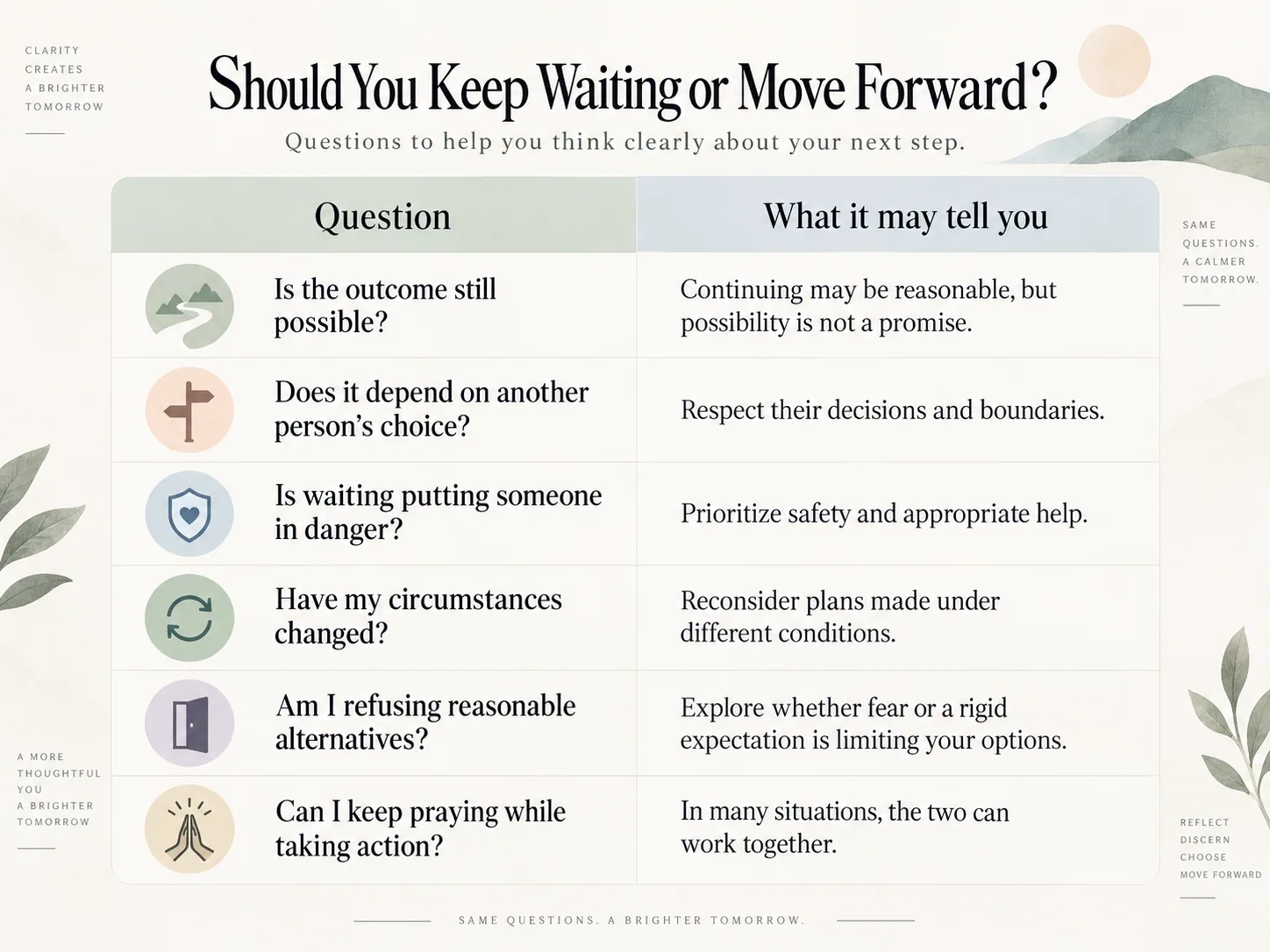
Consider someone who has prayed for a particular career for eight years.
They can continue asking God for that opportunity while accepting another job that supports their family.
They have not stopped believing in prayer.
They have simply stopped making their whole life depend on one outcome.
How to Pray When You Are Tired of Waiting
You do not need to repeat the same long prayer every morning.
Jesus warned against treating repeated words as a way to make prayer effective (Matthew 6:7–8).
Try a shorter prayer:
"God, You know what I have asked for. I still want this, and I am tired of waiting. Please help me see what I can do today. Give me wisdom to know what to hold on to and what to release. Help me trust You without pretending I know the future. Amen."
Some days, even that may feel like too much.
You can simply say, "Lord, help me."
If you cannot find the words, this guide on how to pray when you don't know what to say offers simple ways to begin.
Try a Seven-Day Prayer Reset
Instead of measuring each day by whether your breakthrough has arrived, give yourself a different focus.
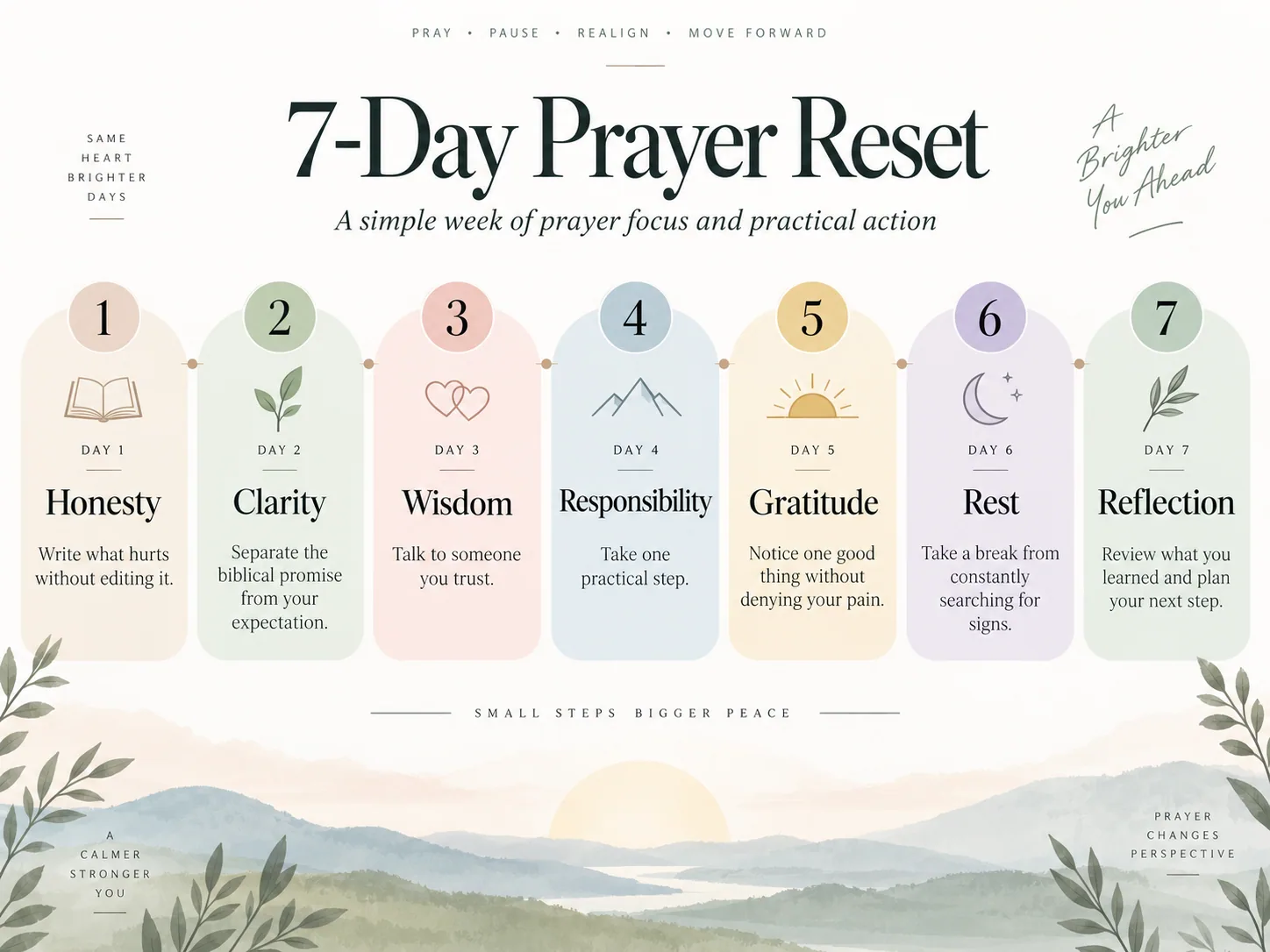
The goal is not to produce a miracle in seven days.
It is to develop a healthier way of living with uncertainty.

When Waiting Becomes Spiritually or Emotionally Exhausting
There is a difference between waiting with hope and feeling trapped by an expectation.
You might spend hours looking for signs. You may feel guilty whenever you consider another option.
You might also avoid friends because their lives seem to be moving forward while yours feels stuck.
If this describes you, consider speaking with a trusted pastor, mature Christian friend, or qualified counselor.
A good source of support should help you think clearly. They should not pressure you to believe that a particular outcome is guaranteed.
You can also seek professional mental health care when prolonged distress affects your sleep, relationships, work, or ability to function.
Receiving help is not evidence that your faith has failed.
Frequently Asked Questions About Isaiah 60:22 and God's Timing
Does Isaiah 60:22 mean God will answer my prayer soon?
No specific personal deadline is given in Isaiah 60:22.
The verse describes God's promised restoration of Zion. It teaches confidence in God's ability to fulfill His purposes, not certainty that your prayer will be answered within a particular number of days or years.
Why is God taking so long to answer my prayer?
Scripture does not provide a single explanation for every unanswered prayer.
Sometimes circumstances involve other people's decisions. Sometimes our expectations go beyond what God has promised. In other situations, we simply do not know the reason.
You can examine your expectations and next steps without claiming to know God's hidden intentions.
What does "when the time is right, I, the Lord, will make it happen" mean?
This is a popular paraphrase of the final part of Isaiah 60:22.
In context, God promises to bring about the restoration described in Isaiah 60 at the appointed time.
It is not a universal guarantee that every personal desire will eventually happen.
Does God make you wait because He is preparing you?
Spiritual growth can happen during waiting, but we cannot assume that preparation explains every delay.
The Bible also describes suffering, unanswered prayer, human choices, and circumstances believers cannot understand.
It is better to ask what you can learn and do today than to declare that God is preparing a specific surprise for tomorrow.
How do I know whether God is saying no or wait?
You may not receive a clear answer.
Consider what Scripture teaches, whether the outcome remains possible, what wise people observe, and what responsibilities need your attention.
Avoid interpreting every coincidence, delay, dream, or feeling as a direct message from God.
What if I have been praying for the same thing for ten years?
You can keep praying. But you can also review whether your expectations and current approach remain healthy.
Identify what you can control, seek wise counsel, and take practical steps.
Ten years of prayer does not create a guarantee that the desired outcome must happen.
Is it wrong to stop praying for something?
Not necessarily.
You may decide to change the way you pray or release a specific expectation.
For example, instead of praying only for an old relationship to return, you might pray for healing, wisdom, peace, and healthy relationships.
You can surrender an outcome without abandoning your relationship with God.
Can I be disappointed or angry with God?
Yes. The Psalms contain honest expressions of grief, frustration, and questions.
Psalm 13 is one example of a believer asking God how long suffering will continue.
You do not need to hide your feelings in order to pray.
Does unanswered prayer mean I lack faith?
No.
Paul prayed for relief and did not receive the outcome he requested in 2 Corinthians 12:7–10.
An unanswered prayer is not enough to judge the quality of someone's faith.
What should I do while waiting for a breakthrough?
Continue praying, but also care for your health, relationships, responsibilities, and finances.
Seek advice, take reasonable action, and stay open to outcomes that differ from your original plan.
You do not have to put your whole life on hold while waiting.
The Bottom Line: God's Timing Is Not a Promise to Follow Your Timeline
Isaiah 60:22 gives Christians a reason to trust God's faithfulness. It does not give us a way to predict when a job, marriage, healing, or financial breakthrough will arrive.
You can keep asking God for what matters to you. You can also grieve when years pass without the answer you hoped for.
And you can change your plans without treating that change as a failure of faith.
The question is not only, "How much longer must I wait?" It is also, "What can I faithfully do with the life I have today?"
Your unanswered prayer matters. So does the rest of your life.
Key Statistics
Christians who pray daily
60%
Percentage of U.S. Christian adults who reported praying every day in the 2023–2024 study.
Source: Pew Research Center, 2025
Americans who pray daily
44%
Percentage of U.S. adults reporting prayer at least once a day in the 2023–2024 Religious Landscape Study.
Source: Pew Research Center, 2025
Credible Sources
Bible Gateway / Biblica · Undated
Provides the full chapter context for Isaiah 60:22, including the restoration of Zion and God's promise concerning its future.

About the Author
Editorial Team
Editorial Team
Daily Faith Path articles are prepared by the editorial team to help readers find scripture-centered guidance for healing, faith, prayer, and spiritual encouragement.
Expertise: Healing scriptures, Bible study resources, prayer guidance, devotional writing, Christian encouragement
Experience: The team researches scripture references, reviews surrounding biblical context, compares translation wording where useful, and updates articles to improve clarity, usefulness, and trust for readers.
Credentials: Editorial review, devotional writing, scripture study, content updating
This article is published by the Daily Faith Path editorial team to help readers use scripture carefully, prayerfully, and in ways that are practical for real-life seasons of illness, grief, waiting, and spiritual reflection.
Continue Reading
Related articles

October 7, 2026
12 Bible Verses About Hiding Money From Your Spouse
Explore 12 Bible verses about secret spending, hidden debt, financial honesty, confession, forgiveness, boundaries, and rebuilding trust in marriage.

October 6, 2026
15 Bible Verses for Couples Who Keep Fighting About Money
Money fights are rarely just about dollars. These 15 Bible verses help couples address spending, saving, debt, secrecy, unequal income, giving, and financial control with practical next steps and conversation questions.

October 5, 2026
Should You Tithe While in Debt? 11 Bible Passages to Study First
Should you tithe while in debt? Explore 11 Bible passages on tithing, debt, generosity, family responsibility, and giving according to your means—plus a practical plan for deciding what to do.